Newfoundland Visitors From Nova Scotia
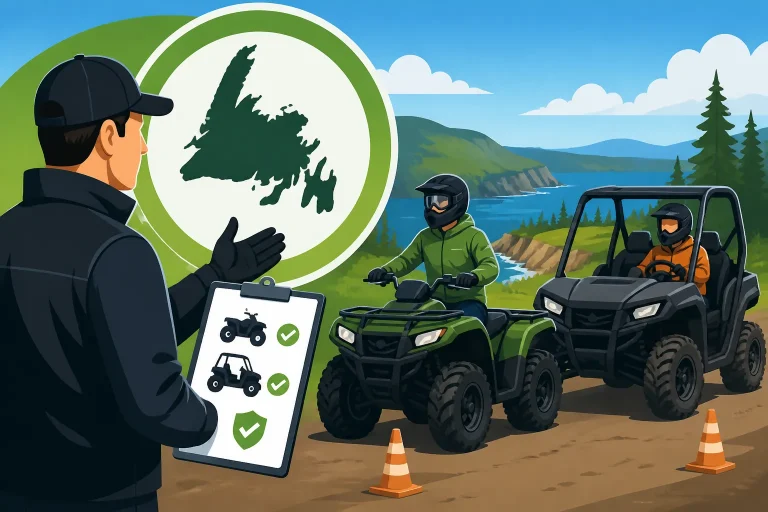
A Nova Scotia registration does not automatically make every ride in Newfoundland legal. Visitors need to know how long their home registration can stand in for local registration, what documents to carry, and which Newfoundland requirements still apply. The practical rule is to prepare for both provinces: keep your machine’s paperwork and insurance in order, then check the trail and local access rules before unloading.
What Nova Scotia registration lets you do
If you bring an ATV or UTV registered in Nova Scotia for a visit, Newfoundland and Labrador generally allows a visitor to use that valid out-of-province registration for a limited period. The visitor exemption is commonly described as lasting up to 30 days. It is a temporary allowance, not a transfer of your Nova Scotia registration or a general exemption from Newfoundland’s laws.
The exemption depends on the circumstances. It is intended for a visitor bringing a machine that is properly registered elsewhere, not for someone who has moved to Newfoundland or is keeping a machine there indefinitely. Keep your registration current and make sure the details identify the machine you are actually riding. A plate, permit, or registration document from another province may not be enough if it has expired, belongs to another machine, or cannot be produced when requested.
For a stay approaching the limit, do not assume that time spent away from the machine pauses the clock. Confirm how the exemption applies to your particular visit with the provincial registry before you travel or before the permitted period runs out. If you have moved to Newfoundland, the visitor rule is not a substitute for registering as a new resident; see Newfoundland’s 30-Day Visitor Exemption and Newfoundland’s 90-Day New Resident Rule for the distinction between a temporary visit and a move.
Reciprocity also does not mean that every Nova Scotia operating rule follows you across the water. Once riding in Newfoundland, you must follow the rules that apply there, including requirements for equipment, passengers, helmets, road crossings, and access. A machine that is legal to operate at home may still need adjustments or different paperwork to be used lawfully on a Newfoundland trail or road.
That applies to both ATVs and UTVs, including side-by-sides. The vehicle’s class can affect the requirements that apply, so do not assume that a rule for a quad covers every UTV. Newfoundland’s vehicle categories include side-by-sides; see Newfoundland Side-by-Sides Added in 2022 if you need to check how the machine is treated under local rules.
Documents and requirements to check before riding
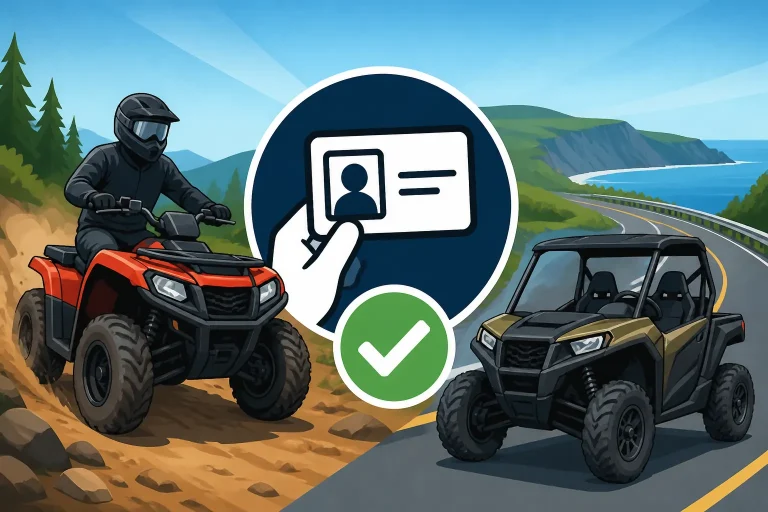
A smooth border crossing is only the start. Carry enough documentation to show that the machine is registered, that you are entitled to use it, and that insurance is in place. Keep paper copies or accessible digital copies as backups, but do not rely on a phone alone if service may be unavailable or the battery may run low.
| Item | What to check before leaving Nova Scotia | Why it matters in Newfoundland |
|---|---|---|
| Registration | Confirm it is current and matches the machine’s identifying details | It supports use under the visitor exemption |
| Ownership or permission | Carry proof of ownership, or clear permission if the machine belongs to someone else | A registration document may not show that you have authority to ride it |
| Insurance | Confirm the policy covers the machine and riding in Newfoundland | The visitor exemption does not remove insurance obligations |
| Identification | Bring the identification you normally use for travel and registration matters | It can help resolve questions about the rider or registered owner |
| Safety training records | Check whether the rider’s training proof is accepted for the activity and age group | Home training does not automatically settle every Newfoundland requirement |
| Trail sticker or permit | Ask the trail operator what is required for the route you plan to use | A registration plate is not necessarily the same as trail access permission |
Registration and insurance are separate. A valid Nova Scotia permit does not prove that your insurance policy provides the coverage required for riding in Newfoundland. Contact your insurer before departure, describe where and how you intend to ride, and ask what evidence to carry. Do not rely on a general policy summary if the insurer can confirm coverage for your machine and trip. The rules for visitors are covered further in Newfoundland Visitors Still Need Insurance.
Bring the registration document, not just a photograph of the plate. Check that the machine identification number and owner information are legible and consistent across your papers. If the ATV or UTV is borrowed, make sure you can show the owner’s permission and know how to reach them. For a privately purchased machine that has not yet been properly registered, a bill of sale alone may not give you the same standing as a current registration. The document rules can be more involved than expected; Newfoundland Proof of Ownership on the Trail explains why it helps to sort them out before riding.
Training is another item to verify, especially if a young rider will operate the machine. Do not assume that a Nova Scotia card or course certificate will automatically satisfy every Newfoundland training requirement. Ask the relevant provincial office whether the specific credential is accepted, and check what proof must be carried. For a minor, confirm the age-related rules and supervision requirements before the trip, rather than trying to resolve them at a trailhead.
Finally, ask about the trail sticker or other access requirements for the exact route. Registration allows the machine to be identified; it does not necessarily grant access to every managed trail. Requirements may depend on the trail operator, the land, and the type of riding. Newfoundland Visitors From Away and How to Get a Newfoundland Trail Sticker provide useful context, but the operator remains the best place to confirm current access instructions for a specific trail.
Local riding rules still apply
The most important part of reciprocity is knowing its limits. A visitor’s Nova Scotia registration may be recognized temporarily, but the ride itself is governed by Newfoundland’s requirements. That means checking more than the machine’s paperwork: know where you may ride, what equipment is required, and whether a road or trail has conditions that differ from those at home.
Before setting out, check the route’s status and access rules. A trail shown on a map is not automatically open to every machine, and permission to use one section does not necessarily extend to nearby private land, a restricted area, or a community road. Managed trails may require a separate sticker or operator permission. National and provincial parks can have their own restrictions, so confirm directly with the responsible land manager rather than relying on a general trail map.
Road use is especially easy to misunderstand. Do not treat an ATV or UTV as road-legal simply because it is registered in Nova Scotia. Newfoundland has specific rules for limited road-related situations, such as crossing a highway or using a shoulder to reach a trail. Those permissions come with conditions and do not amount to unrestricted highway travel. Read Can You Ride an ATV on the Road in Newfoundland? and Newfoundland ORV Road Rules Explained before planning a route that involves public roads.
Equipment requirements can also differ. Review the rules for helmets, eye protection, lights, tires, mufflers, seat belts, and passengers for your type of machine. A UTV’s enclosed cab, factory-installed belts, or passenger seating may affect which requirements apply, but do not assume that one feature removes all other obligations. Check the equipment rules before departure and inspect the machine after it is unloaded. Newfoundland Equipment Requirements is a useful checklist.
If you are travelling with children, confirm both rider eligibility and passenger requirements. A child’s ability to ride at home does not establish that they can operate or ride as a passenger in every Newfoundland situation. Age, machine size, seating, supervision, and training can all matter. For a passenger in a side-by-side, check that the seat and restraint are suitable and that the child meets the applicable requirements.
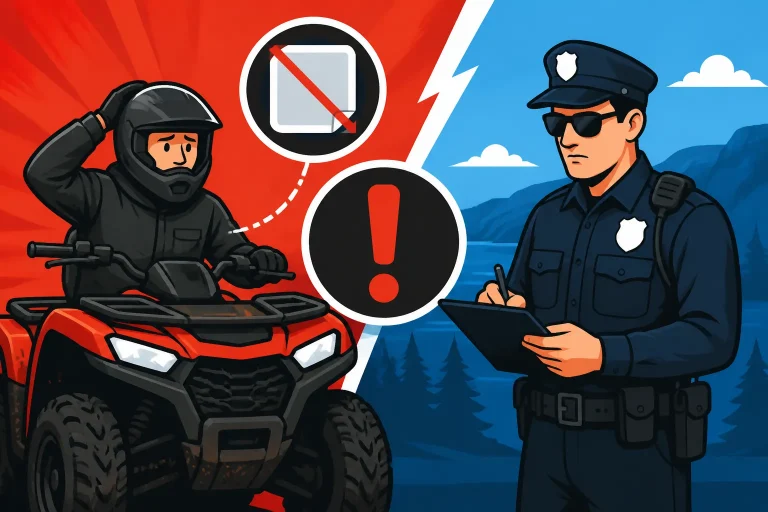
Plan for enforcement as well as convenience. An officer may ask for registration or insurance information, and a trail operator may check access documents. Keep the paperwork somewhere dry and easy to reach, not buried under luggage or locked in a vehicle far from the machine. If you cannot produce a document immediately because your phone has no signal, an offline copy or printed backup can help. For details on what may be requested, see What an Officer Can Ask You to Produce.
If your visit lasts longer than the exemption
A short holiday and a longer stay call for different planning. If you expect to keep riding in Newfoundland beyond the visitor exemption, contact the Motor Registration Division before the exemption expires and ask what is required to register the machine locally. Do not wait until a trip is nearly over to find out that the machine needs additional paperwork, an appointment, or a document you left at home.
The steps may depend on whether you are still a visitor, have become a resident, own the machine, or are borrowing it. A move to Newfoundland is not simply an extended visit. New residents should check the applicable registration timeline and requirements; Newfoundland Registration for a New Resident explains the issue in more detail. If you are bringing a machine that is registered in another province, Bringing a Machine Registered in Another Province can help you identify the questions to resolve.
Before calling or visiting the registry, gather the machine’s registration papers, identification details, proof of ownership, and any supporting sale or transfer documents. Ask whether the original Nova Scotia paperwork is enough for your case and whether any other forms are needed. If the machine has changed hands or the owner’s name does not match the paperwork, explain that clearly. A mismatch can turn a routine registration into a request for more evidence. Newfoundland Registration Paperwork Explained and What to Bring to Your Registration Appointment can help you prepare.
A practical plan for a Nova Scotia visitor is:
- Confirm the machine’s Nova Scotia registration is valid and that its identifying information matches the machine.
- Ask your insurer to confirm coverage for the trip and find out what proof to carry.
- Check the visitor exemption’s time limit against your travel dates, and confirm how it applies if your stay is unusual or extended.
- Verify whether the riders’ training documents meet Newfoundland requirements, especially for minors.
- Contact the trail operator or land manager about stickers, permits, closures, and machine access.
- Review Newfoundland rules for the type of machine, road crossings, passengers, and required equipment.
- Carry registration, insurance, ownership or permission documents, and any required training or trail proof while riding.
- If the visit may exceed the exemption, contact the registry early rather than assuming the Nova Scotia registration will remain sufficient.
The safest approach is to treat home registration as one part of the plan, not a universal pass. Valid papers and insurance help establish that the machine can be used temporarily, while local operating rules and trail access decide where and how you can ride. Confirm the details before travel, then recheck them if the route, length of stay, or riders change.
Disclaimer
This article is for general informational purposes only and does not constitute professional advice. Laws, prices and regulations vary by location and change over time. Consult a qualified professional for guidance on your specific situation.