Newfoundland Registration for a New Resident
Moving to a new place can feel like you’re trying to solve a complicated puzzle, and when you bring your beloved ATV or side-by-side with you, adding off-road vehicle registration to the mix can certainly amplify that stress. Many folks arrive in our beautiful province of Newfoundland and Labrador, machine in tow, only to be confused by the specific local requirements for making their ORV legal here. This guide is designed to clarify the process for new residents, walking you through every step of registering your ATV or UTV so you can hit our incredible trails with confidence and peace of mind, making your transition as smooth as a fresh snowfall on a well-groomed railbed.
Understanding Newfoundland's 90-Day New Resident Rule for ORVs
One of the first things you need to wrap your head around when you bring your off-road vehicle to Newfoundland as a new resident is the 90-day rule. It’s a crucial timeframe that dictates when you absolutely must get your machine registered locally. Missing this window can lead to some headaches you definitely don't need after the big move.
What the 90-Day Window Means for You
When you first move to Newfoundland and Labrador, the province gives you a bit of a grace period, recognizing that settling into a new home is a massive undertaking. This means you have a full 90 days from the date you establish residency to officially register your off-road vehicle with Motor Registration. During this initial 90-day period, if your machine is properly registered and insured in your previous jurisdiction, you are generally permitted to operate it here. However, this isn't a free pass for indefinite riding. It's truly a temporary measure designed to give you ample time to get your affairs in order. Think of it as a brief honeymoon period where the province understands you're still unpacking boxes and finding your way around. After those 90 days, your out-of-province registration is no longer recognized, and operating your ORV without Newfoundland registration will put you offside with the law. It’s a firm deadline, and it's best to start gathering your documents well before it looms. To delve deeper into this, you can check out [Newfoundland's 90-Day New Resident Rule].
Proof of Residency and When It Matters
Establishing your residency isn't just about moving your furniture; it's about officially informing the government that you now call Newfoundland and Labrador home. For ORV registration, proving your residency is absolutely critical because it directly impacts your eligibility to register your machine under provincial rules. What counts as proof? Typically, this would be a Newfoundland and Labrador driver's licence, which is often the first thing people update. If you haven't managed that yet, other documents like utility bills (electricity, internet, or phone bills showing your new local address), a signed lease agreement for your home, or property deeds if you’ve purchased a house, can all serve as valid evidence. The clock on your 90 days effectively starts ticking from the moment you truly establish residency, so make sure your proof of address is clear and unambiguous. This step ensures that you’re recognized as a legitimate resident, qualifying you for the provincial registration process and all the benefits (like the one-time fee!) that come with it. Having this documentation ready is paramount when you visit Motor Registration. For more information on what types of documentation are accepted, read [Newfoundland Registration and Proof of Address].
Essential Paperwork for a New Resident's ORV Registration
Registering an off-road vehicle in a new province, even one you’ve owned for years, involves a specific set of documents. You might think your old registration is enough, but Newfoundland and Labrador has its own requirements, especially for verifying ownership and your new status as a resident.
Documentation from Your Previous Province or State
When you arrive at Motor Registration to get your quad or side-by-side registered, the folks behind the counter will want to see its full history. This means bringing along the original ownership documents from your previous province or state. We're talking about the title, the most recent registration certificate, or any other official papers that clearly prove you are the legal owner of the machine. If you've recently purchased the ORV, you'll also need the bill of sale. This documentation is crucial because it establishes a clear "chain of ownership," showing how the machine legally came into your possession. Without this, it’s like trying to trace a family tree with missing generations – it simply won’t make sense to the registrar. The clearer and more complete your ownership history is, the smoother your registration process will be. If, for some reason, your paperwork isn't perfect – maybe you've lost an old title, or an older machine has a less formal history – don't panic, but be prepared for extra steps. There are provisions for such situations, but they often involve additional declarations or affidavits. You can learn more about these scenarios by looking at [Newfoundland Registration Without a Bill of Sale].
Proof of Newfoundland Residency and Identity
Beyond proving ownership of your machine, you'll also need to prove who you are and that you genuinely live in Newfoundland and Labrador now. The most straightforward way to do this is with a Newfoundland and Labrador driver's licence. It serves as both your personal identification and definitive proof of your new residency. However, if you haven’t had a chance to switch over your driver’s licence yet, other forms of government-issued photo ID combined with secondary proof of address will usually suffice. This could include recent utility bills (like your power bill or internet bill), a formal lease agreement for your home, or property tax assessments if you've bought a house here. The key is that these documents must clearly show your name and your new physical address within the province. This step is vital because it confirms to Motor Registration that you meet the residency requirements for provincial ORV registration. They need to be sure you're truly planting roots here before they issue a Newfoundland plate and registration permit. It ties into the overall verification process and ensures that only legitimate residents are registering machines under our provincial rules.
The Application Form and Required Affidavits
Once you've got your ownership and residency proofs sorted, the next piece of the puzzle is the actual application form. You'll need to complete a specific ORV registration application form provided by the Motor Registration Division. These are usually available at their offices or sometimes downloadable online. Take your time filling it out, ensuring all details about yourself and your machine are accurate and complete. What if your ownership documents from your previous home aren’t crystal clear, or maybe you inherited an older machine with less formal paperwork? This is where affidavits come into play. A sworn affidavit is a written statement confirmed by oath or affirmation, and it can be a lifesaver when you need to formally declare facts about your machine's history or ownership that aren't perfectly documented. Sometimes, an indemnity form might also be required, which essentially releases the Registrar from liability if there are any future disputes about ownership. Tools like LawDepot can be incredibly useful for finding general templates for statutory declarations or affidavits, which you can then adapt and have notarized if needed. While LawDepot offers templates, always confirm with Motor Registration precisely what type of affidavit or declaration they require for your specific situation. Having these legal documents correctly prepared can save you a world of hassle. More details on these can be found under [Newfoundland Sworn Affidavits and Indemnity Forms].
The Step-by-Step Registration Process for Newcomers
Navigating any government process can feel a bit daunting, but with a clear understanding of the steps involved, registering your ORV as a new resident can be quite straightforward. It’s all about preparation and knowing what to expect.
Preparing for Your Motor Registration Appointment
The absolute best way to ensure a smooth registration day is to prepare thoroughly beforehand. First things first, you'll want to book an appointment with Motor Registration. In many offices, walk-ins are a thing of the past, and showing up without a pre-scheduled slot can mean a long wait or being turned away. Once your appointment is set, gather all your documents in one place: your original ownership papers from your previous jurisdiction, your bill of sale (if applicable), proof of your new Newfoundland residency, your personal ID, and any affidavits or indemnity forms you've prepared. It’s also wise to take a moment to inspect your machine. Ensure the Vehicle Identification Number (VIN) is easily accessible, clean, and legible. The registrar will need to verify this number, and you don’t want any delays because of mud or grime. The more organized you are, the less likely you'll be sent home to collect missing paperwork, which is a common frustration for many people. Having everything neatly arranged means you’re more likely to walk out with your new registration in hand the very first time. For help with scheduling, see [Newfoundland Registration by Appointment].
At the Counter: What to Expect
When your appointment time arrives, you'll present your carefully gathered stack of documents to the Motor Registration clerk. They will review everything, often starting with your proof of ownership and then moving on to verify your identity and residency. A crucial part of this step is the VIN verification. The clerk (or sometimes another staff member) will need to physically check the VIN on your off-road vehicle against the documents you’ve provided. Make sure your machine is accessible for this inspection, whether it's on a trailer or parked nearby. Once all the documentation is approved and the VIN verified, you'll be required to pay the applicable registration fee. For example, [Newfoundland Charges $95 for an ATV], though other types of ORVs might have different costs. It’s a one-time fee here in Newfoundland, which is a fantastic benefit compared to provinces with annual renewals. You can read more about what to expect regarding fees under [Newfoundland Registration Cost]. After payment, you'll be issued your new Newfoundland and Labrador registration permit and an identification plate or decal for your machine. This permit is your official proof of registration and confirms that your ORV is now legally recognized in the province. Remember, this registration is valid for as long as you own the machine, as [Newfoundland Registration Valid While You Own It]. This means no yearly renewals, which is a huge convenience!
Post-Registration Responsibilities
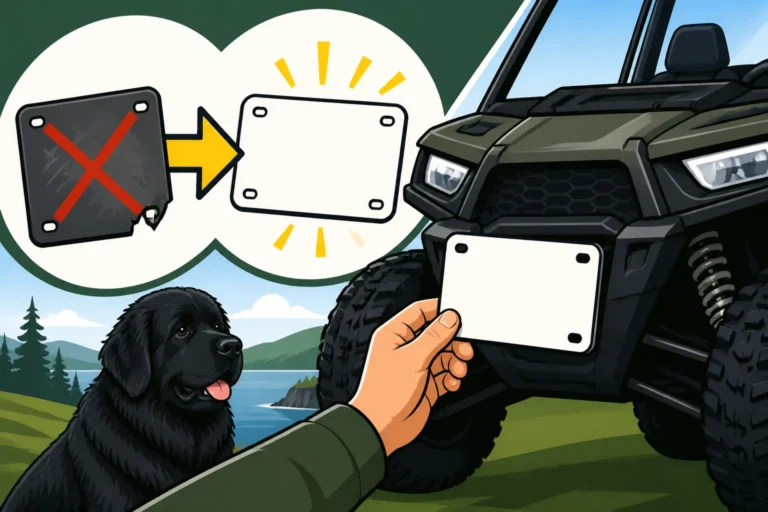
Getting your registration permit and plate is a big step, but your responsibilities don't end there. The plate or decal you receive isn't just a souvenir; it needs to be properly affixed to your machine. For ATVs, this usually means attaching the plate to the rear, ensuring it's clearly visible and not obstructed by cargo or mud. Check out [Newfoundland Plate Placement on a Quad] for specific guidance. Beyond the plate, you also need to ensure your machine is insured. Newfoundland and Labrador requires minimum liability insurance for ORVs, even if you’re only riding on trails. This protects you and others in case of an accident. Familiarize yourself with these requirements by reading [Newfoundland Insurance Requirements for Riders]. Finally, as a new resident, it's absolutely vital to acquaint yourself with the local rules and regulations governing off-road vehicle operation. This includes everything from where you can and cannot ride, helmet laws, and speed limits on shared trails or when crossing roads. A good starting point is [Newfoundland ORV Road Rules Explained]. Understanding these rules will not only keep you safe but also help you avoid fines and ensure you can enjoy our beautiful trails without incident. Should you ever lose your permit or plate, it’s good to know that getting a [Newfoundland Duplicate Registrations at $25] or [Newfoundland Replacement Plates at $30] is a straightforward process at Motor Registration.
Common Hiccups and Practical Advice for Newcomers
Moving and getting settled is a journey, not a sprint. Even with the best intentions, you might hit a few bumps on the road to getting your ORV fully legal in Newfoundland. Knowing what these might be and how to navigate them can save you a lot of grief.
Dealing with Missing or Incomplete Paperwork
It's not uncommon for an older ATV or UTV, especially one that has changed hands a few times, to have less-than-perfect paperwork. Maybe you bought it from a friend years ago and the original title got lost, or perhaps an old bill of sale is faded and barely legible. This can definitely throw a wrench into the registration process. However, it’s not necessarily a dead end. One of the primary strategies for machines with incomplete documentation is the use of a statutory declaration or an indemnity form. These are legal documents where you solemnly declare facts about the machine's ownership history or affirm that you are indeed the rightful owner. You might need to visit a commissioner of oaths or a notary public to have these forms properly witnessed and stamped. Sometimes, Motor Registration will provide specific forms, but for general templates or guidance, resources like LawDepot can be a helpful starting point, though always double-check with the registry for their exact requirements. It’s important to understand that these situations require patience. The registry staff want to ensure legal ownership, and if the paper trail isn't clear, they need to follow due diligence. Be prepared for a bit more back-and-forth, but with persistence, a solution can usually be found.
Understanding Fees and Taxes
When you register your off-road vehicle as a new resident, you'll encounter a few financial considerations. The primary one is the initial registration fee itself. As mentioned, for many common ORVs like ATVs, this is a fixed fee, for instance, [Newfoundland Charges $95 for an ATV]. This is a one-time payment for as long as you own the machine, which is a fantastic benefit that many provinces don't offer. You won't be hit with annual renewal fees, which is a common source of surprise for new residents, but a welcome one! This is because [Why a Newfoundland ATV Registration Never Needs Renewing]. In terms of taxes, if you are bringing a machine you already owned and used in another jurisdiction, you generally won't pay provincial sales tax (HST) on its value when you register it here, as it's not a new purchase. However, if you purchased the machine very recently and are moving it to Newfoundland, or if you purchase an ORV from a dealer here, you will be subject to [Newfoundland HST on an ATV Purchase]. Always clarify these specifics with Motor Registration or a reputable dealer to avoid any surprises.
Getting Acquainted with Local Regulations
Beyond the initial registration, one of the most important aspects of being a responsible ORV owner in Newfoundland and Labrador is understanding and adhering to local regulations. Our provincial rules can differ significantly from where you previously rode, so simply assuming things are the same could lead to fines or even more serious consequences. It's not just about provincial statutes; many municipalities also have their own bylaws regarding ORV use within their boundaries. For example, [Newfoundland Municipal Road Bylaws] can dictate where, when, and if you can operate your machine on municipal roads.
A great way to integrate into the local riding community and learn the ropes is by connecting with local ATV or snowmobile clubs. These groups often have intimate knowledge of local trails, rules, and even safety courses. Speaking of safety, Newfoundland and Labrador has mandatory safety training requirements. If you haven't already completed an approved course, you'll likely need to do so, especially if you're a first-time registrant or under a certain age. This is addressed in [Newfoundland Safety Training Is Mandatory]. Taking the time to understand these nuances will make your riding experience much more enjoyable and keep you on the right side of the law. Don't be afraid to ask questions at Motor Registration or from experienced local riders – we're a friendly bunch and happy to help new folks get out on the trails safely.
| Document Type | Purpose | Source/Where to Get It | Key Consideration for New Residents |
|---|---|---|---|
| Proof of Previous Ownership | Confirms legal ownership of your ORV. | Your original title, registration, or bill of sale from previous province/state. | Must be original and clearly state your name as owner. |
| Proof of Newfoundland Residency | Establishes you as a provincial resident. | Newfoundland & Labrador driver's licence, utility bills, lease agreement. | Must show your current physical address in NL. |
| Personal Identification | Verifies your identity. | Valid government-issued photo ID (preferably NL driver's licence). | Ensure ID is current and matches your name on ownership docs. |
| ORV Registration Application Form | Official request for NL registration. | Motor Registration Division office or online download. | Fill out completely and accurately before your appointment. |
| Sworn Affidavit / Indemnity Form | Declares ownership or absolves liability in lieu of perfect paperwork. | Notary public, commissioner of oaths, general templates (e.g., LawDepot), or specific Motor Reg forms. | Only required if ownership history is unclear; confirm exact requirements. |
| Bill of Sale (if recently purchased) | Confirms details of recent purchase. | Seller of the ORV. | Essential for machines acquired shortly before moving. |
Disclaimer
This article is for general informational purposes only and does not constitute professional advice. Laws, prices and regulations vary by location and change over time. Consult a qualified professional for guidance on your specific situation.