Replacing a Lost Identification Plate for $30
Losing your ATV or UTV's identification plate in Newfoundland is more than just a minor inconvenience; it can bring your riding plans to a screeching halt and leave you wondering how to navigate the official channels. No rider wants to be caught out on the trails without proper identification for their machine, facing potential fines or frustrating delays. This guide is here to walk you through the straightforward process of replacing that lost plate for $30, ensuring you're back on the trails legally and without unnecessary stress.
Why Your ORV Identification Plate is So Important
It’s easy to think of an identification plate as just another piece of metal, but for your off-road vehicle (ORV) in Newfoundland, it’s its legal identity. Without it, your machine is essentially invisible to the provincial registry, and that can lead to a heap of trouble out on the barrens or cabin roads. We’ve all been there, pushing through brush or bouncing over rough terrain, and sometimes those plates can come loose. But knowing why it matters helps you understand the importance of getting it replaced quickly.
The Legal Mandate of Displaying Your Plate
First and foremost, the display of your identification plate is a requirement under [Newfoundland's Off-Road Vehicles Act]. This isn't just a suggestion; it's a provincial law that all ATV and UTV operators must adhere to. The plate, issued by Motor Registration, serves as unique identification for your specific machine, linking it directly to your registration details. It’s how enforcement officers quickly verify that your off-road vehicle is properly registered and therefore legal to operate on approved trails and lands.
Imagine you're out enjoying a beautiful sunny day near Salmonier Line, cruising along a designated trail. A peace officer pulls up, just doing their routine checks. They ask for your registration papers and want to see your plate. If that plate isn't securely attached and clearly visible, you could be facing a fine right there on the spot for [Newfoundland Fines for a Machine With No Plate]. It’s a completely avoidable situation, and certainly not the kind of memory you want to make on a perfect riding day. Having your plate visible isn't just about avoiding a ticket; it's about accountability and ensuring everyone on the trails is following the rules.
How a Lost Plate Can Disrupt Your Riding
Beyond the immediate legal ramifications, a missing identification plate can throw a wrench into your entire riding schedule. If your plate goes missing, you legally cannot operate your ATV or UTV on any public land, managed trail, or Crown Land where registration is required. This means no more weekend trips to the cabin, no more hunting excursions, and no more exploring new sections of the T'Railway until you get a replacement. It effectively grounds your machine, which is incredibly frustrating when all you want to do is get out and ride.
Consider a scenario where you've decided it's time to upgrade and sell your current machine. A buyer from Gander shows keen interest, but when they come to inspect the ATV, they notice the identification plate is gone. This immediately raises red flags for them. A potential buyer will be wary of a machine that doesn't have its proper identification, as it complicates the transfer of ownership process. While you can still sell it, it makes the transaction much smoother if all documentation, including the plate, is in order. You want to make it as easy as possible for the buyer, not add extra hoops to jump through.
Furthermore, a lost plate could complicate matters if your machine is ever stolen or involved in an accident. While your registration documents are the primary proof of ownership, a visible plate helps authorities identify your machine quickly if it's recovered. Without it, proving that a recovered machine is yours can become a more drawn-out process, adding stress to an already difficult situation. It’s another layer of protection that, while seemingly small, can make a big difference when things go wrong.
The Step-by-Step Process to Replace Your Plate
When you realize your identification plate is gone, it’s natural to feel a bit overwhelmed. But don't worry, the process in Newfoundland is quite straightforward, designed to get you back on track with minimal hassle. It involves a bit of paperwork and a visit to Motor Registration, but with the right preparation, it’s a smooth sailing experience.
Gathering Your Documentation
The first crucial step is to gather the necessary documents to prove ownership and facilitate the replacement. You'll primarily need your existing off-road vehicle registration permit. This document contains all the vital information about your machine – the VIN, make, model, and, most importantly, proof that you are the registered owner. It’s your machine’s official birth certificate, so to speak. Always keep this permit somewhere safe, not necessarily on the machine itself where it could get damaged or lost.
You will also need valid photo identification, such as your driver's license. This is to confirm your identity as the registered owner of the ATV or UTV. If, by chance, you’ve also lost your registration permit, don't panic! You can apply for a duplicate permit, which is a separate process but can often be handled at the same time. The fee for this is typically around [Getting a Duplicate Registration Document for $25]. Ensure you have both your personal ID and the machine's registration permit (or a valid request for a duplicate) ready for your appointment. If you're dealing with complex ownership situations or missing crucial documents for other reasons, you might find resources like LawDepot helpful for drafting sworn affidavits to attest to ownership or circumstances, although for a simple lost plate with a valid permit, it's usually not necessary.
Visiting Motor Registration and Paying the Fee
Once your documents are in order, the next step is to visit a Motor Registration office. It’s highly recommended to [Newfoundland Registration by Appointment] to avoid long wait times. You can usually book an appointment online or by phone, specifying that you need to replace an identification plate. This helps the staff prepare and ensures you're seen promptly. Bring all your gathered documents to your scheduled appointment.
At the counter, you'll explain that you need a replacement identification plate. The staff will verify your ownership using your registration permit and photo ID. You'll then be required to pay the standard fee for a replacement plate, which is set at $30. This fee covers the administrative cost and the production of a new plate for your machine. Payment methods typically include debit, credit card, or cash. Once the transaction is complete, you'll be issued a brand-new identification plate for your ATV or UTV. It’s as simple as that! You'll leave with your new plate, ready to be attached to your machine, ensuring you’re compliant with the [Newfoundland Plates Unobstructed by Cargo] rules and ready to ride legally.
Practical Tips for Securing Your New Plate
Getting a brand-new identification plate feels great, but the last thing you want is to lose it again! A little bit of proactive effort in how you attach and maintain your plate can save you another trip to Motor Registration and another $30 down the road. After all, these machines are built for tough terrain, and everything on them takes a beating.
Best Practices for Plate Attachment
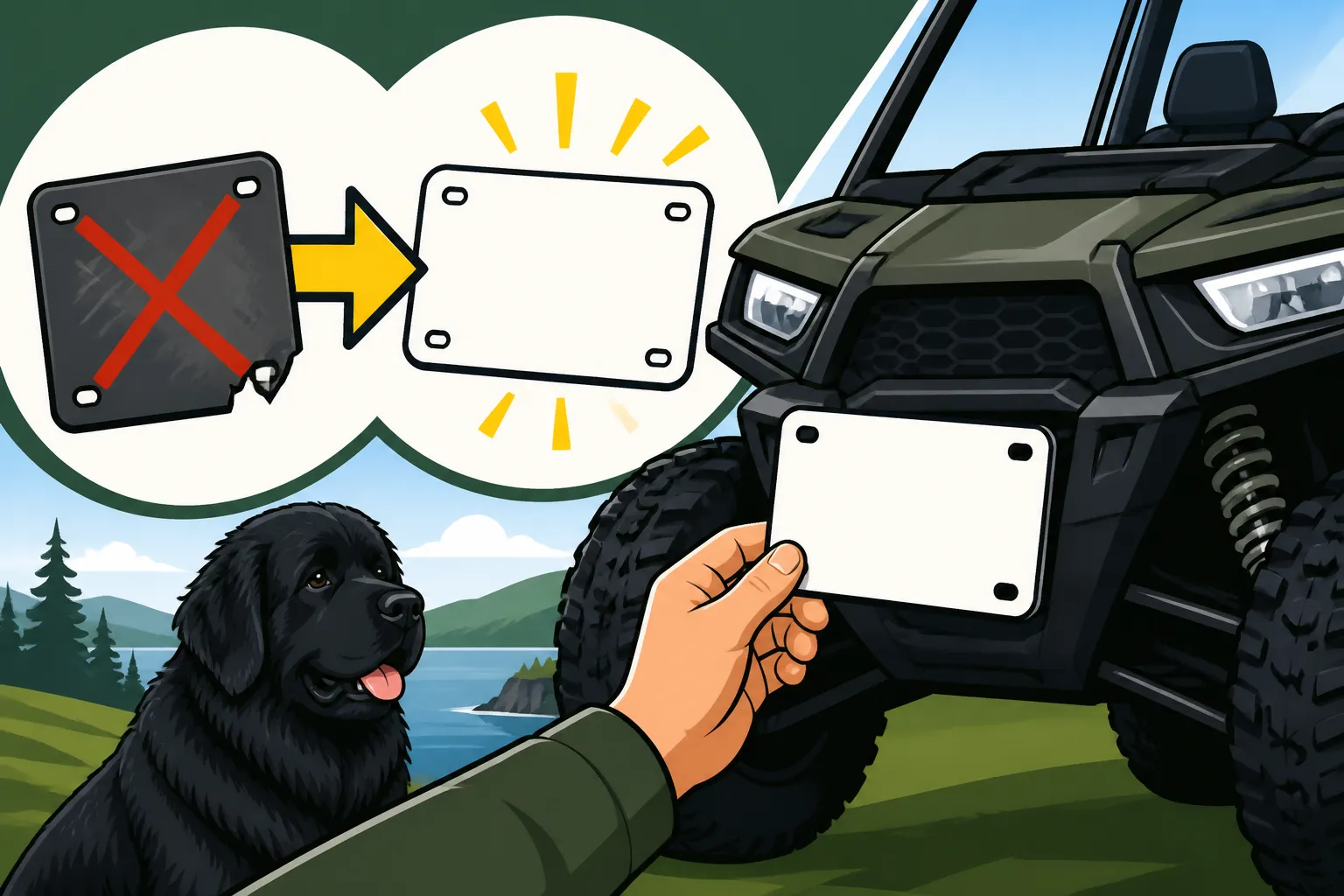
When attaching your new plate, don't just use any old screws. Invest in some quality hardware. Stainless steel bolts with Nylock (nylon insert) nuts or lock washers are your best friends here. The nylon in Nylock nuts provides resistance against loosening due to vibration, which is rampant on an ATV or UTV. Rubber washers placed on both sides of the plate (between the plate and the machine, and between the bolt head/nut and the plate) can also help absorb vibrations and prevent the metal from fatiguing and eventually tearing around the bolt holes.
Think about the placement as well. The [Newfoundland Plate Placement on a Quad] rules require it to be clearly visible from the rear. Avoid mounting it in areas where it might be easily snagged by branches, or where it’s directly in the line of fire for mud and debris kicked up by your tires. Sometimes, even though the manufacturer provides a spot, reinforcing it with a small custom bracket can add extra security, especially if you find your specific model has a history of losing plates. A little bit of preventative maintenance now saves a lot of headaches later.
Keeping Your Plate Visible and Legible
Beyond securing it firmly, maintaining the plate's visibility and legibility is also part of your responsibility as a rider. The [Newfoundland Plates Kept Free of Mud] rule is there for a reason. After a particularly muddy ride, take a few moments to wipe down your plate. Accumulated mud, dirt, or snow can obscure the numbers and letters, making it unreadable. If an enforcement officer can't read your plate, it's as good as not having one, and you could still face a fine.
Similarly, be mindful of what you're carrying on your machine. Sometimes, a poorly secured cooler, a hunting bag, or even a heavy jacket draped over the back can inadvertently obstruct your plate. Before heading out on any ride, especially one where you’re carrying extra gear, do a quick walk-around of your machine. Check that your identification plate is clean, securely attached, and completely visible. This quick check takes mere seconds but can save you a lot of trouble on the trail.
Common Scenarios and What to Do
Life throws curveballs, and sometimes a lost plate isn’t just a case of it vibrating loose. There are other scenarios that might lead to you needing a replacement, and knowing how to navigate them can save you time and stress.
Reporting a Stolen Plate
It's a rare but unfortunate occurrence: your identification plate isn't just lost; it's been stolen. Perhaps your machine was parked at a trailhead, or even at home, and someone deliberately removed it. If you suspect your plate has been stolen, your first step should be to contact your local RCMP detachment or municipal police force to file a police report. This is important for a couple of reasons. Firstly, it creates an official record of the theft, which can be useful if the plate is ever found in connection with another incident. Secondly, having a police report can sometimes streamline the replacement process at Motor Registration, as it provides official documentation of the circumstances of the loss.
While having a police report doesn't change the $30 replacement fee for a new plate, it does provide peace of mind and an official record. Make sure to get a report number from the police, as Motor Registration might ask for it, though it’s not always a strict requirement for replacement. This situation is different from when your entire machine is stolen, but dealing with any kind of theft early is always best. For more general information on reporting incidents, you can refer to resources like [Newfoundland Accident Reporting Rules], even though a stolen plate isn't an "accident."
What If You Find Your Old Plate After Getting a New One?
You’ve gone through the process, paid your $30, and now you have a shiny new identification plate. Then, a week later, while cleaning out the back of your pickup or rummaging through a gear bag, you find the "lost" plate! It happens more often than you might think. So, what do you do with the old one? The rule of thumb here is simple: your off-road vehicle is only allowed to have one valid identification plate at any given time. The new plate you received is now the official one associated with your registration.
You cannot legally use the old plate, even if it was technically the original. It’s best to dispose of the old plate responsibly. Many people opt to cut it in half or otherwise deface it to ensure it cannot be used by anyone else, then take it to a metal recycling facility. Alternatively, you could return it to a Motor Registration office, though this isn't strictly necessary. The key is to avoid any confusion or potential misuse of the old, now-invalid plate. Stick with your new, officially issued one, ensuring your machine is always compliant.
Addressing Damaged or Unreadable Plates
Sometimes, a plate isn't lost but is so severely damaged or corroded that it becomes unreadable. Perhaps you had a minor fender bender with a tree, or years of exposure to the harsh Newfoundland elements have taken their toll. If the numbers or letters on your plate are no longer clearly legible from a reasonable distance, for all practical purposes, it’s considered the same as a lost plate. An enforcement officer cannot verify your machine’s identity if they can’t read the plate, and this could lead to the same fines as having no plate at all.
Don't wait until you get a ticket to address a damaged plate. If you notice that your plate is bent beyond recognition, rusted to the point of illegibility, or has significant portions missing, it’s time to head back to Motor Registration. The process for replacing a damaged or unreadable plate is exactly the same as replacing a lost one: gather your documents, book an appointment, and pay the $30 fee. It’s a small investment to maintain your legal riding status and avoid potential penalties. Taking care of these details ensures your riding experience remains enjoyable and hassle-free, allowing you to focus on the beautiful Newfoundland scenery.
| Item | Requirement | Notes | Fee (Estimated) |
|---|---|---|---|
| Identification Plate Replacement | Submit an application at Motor Registration. | Your primary proof of ownership for the ORV. This is essential to confirm the machine is yours and to issue a new plate. If lost, apply for a duplicate first. | $30 |
| Valid Photo ID | Present a government-issued photo identification. | Your driver's license or another form of government ID to verify your identity as the registered owner. | N/A |
| ORV Registration Permit | Present the original or a duplicate copy. | Your primary proof of ownership for the ORV. This is essential to confirm the machine is yours and to issue a new plate. If lost, apply for a duplicate first. | N/A (Duplicate is $25) |
| Payment for Fee | Accepted methods usually include debit, credit, or cash. | Ensure you have the means to pay the replacement fee at the time of your appointment. | N/A |
Disclaimer
This article is for general informational purposes only and does not constitute professional advice. Laws, prices and regulations vary by location and change over time. Consult a qualified professional for guidance on your specific situation.