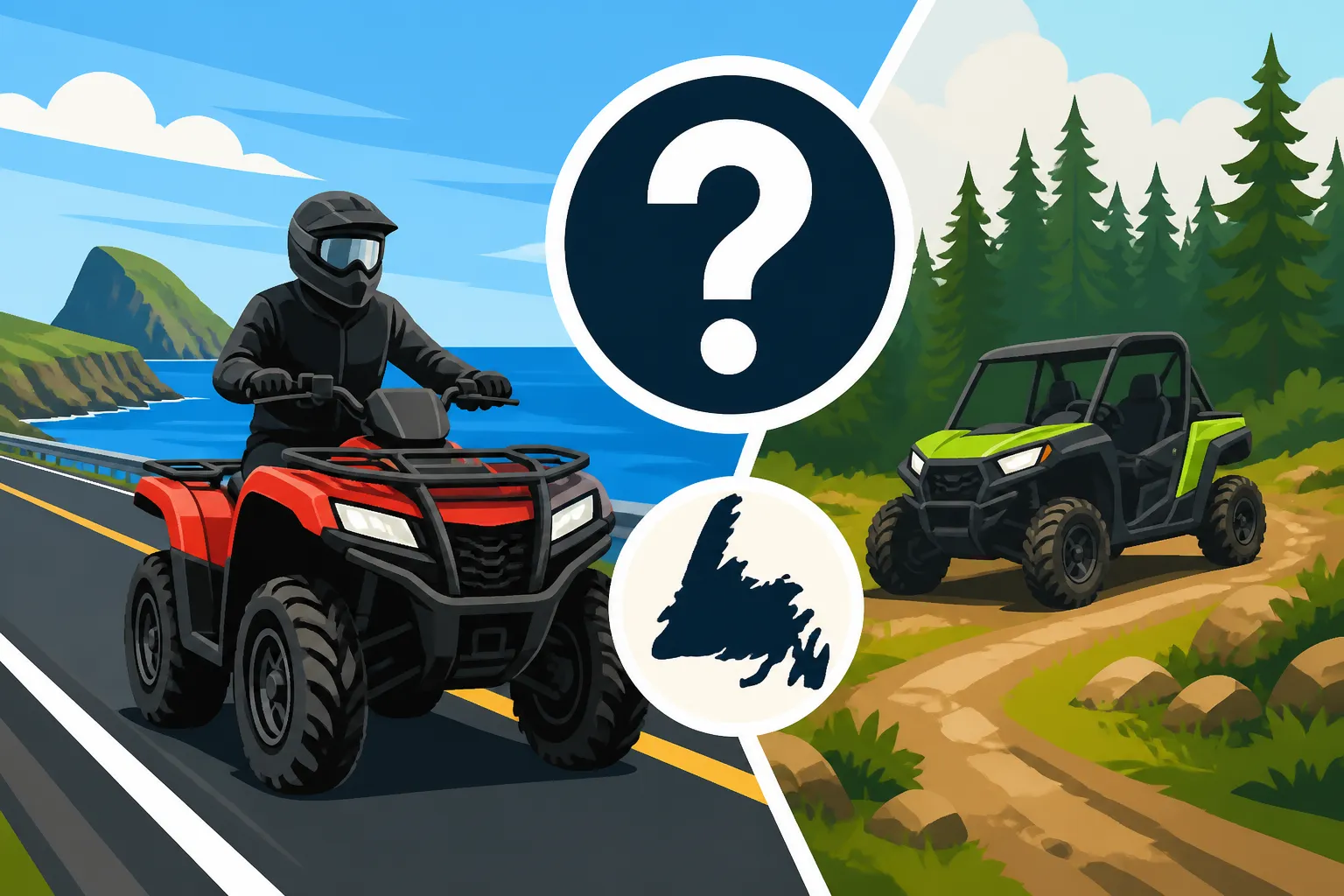
Can You Ride an ATV on the Road in Newfoundland?
It's a common dilemma for ATV and UTV owners in Newfoundland: you've got your machine, you're ready to explore, but getting from your driveway to the nearest trail often means traversing a section of paved road. The question of whether you can legally ride your off-road vehicle on public roads and highways is fraught with confusion, and many riders find themselves caught between wanting to follow the rules and needing a practical way to reach the backcountry. This guide will cut through the uncertainty, explaining Newfoundland's specific regulations for operating ATVs and UTVs on provincial roads, shoulders, and highways, helping you ride safely and legally.
Understanding Newfoundland's Off-Road Vehicle Act
Riding an ATV or UTV in Newfoundland and Labrador comes with its own set of rules, and the provincial government has been pretty clear about where these machines belong. The core legislation governing off-road vehicles (ORVs) is designed to keep everyone safe, whether they're on a quad, a side-by-side, or just driving a car down the road. It’s easy to assume that because you see someone riding on a gravel road somewhere, it must be universally allowed, but that's often not the case. The rules are quite specific, aiming to minimize conflicts between ORVs and regular highway traffic. Ignoring these details can lead to fines, or worse, serious accidents.
The Big Picture: Where You Can and Can't Ride
Let's start with the fundamental principle: generally, ATVs and UTVs are not permitted on Newfoundland's public highways. This isn't just about the Trans-Canada Highway; it applies to most paved roads and public thoroughfares managed by the province. These machines are, by their very design, built for off-road conditions – the barrens, the woods, the dedicated trails, and private lands. The provincial government's stance is that mixing these vehicles with high-speed, heavy road traffic creates unacceptable risks. This means that casually cruising down the main road in your town or village on your ATV, even if it feels safe, is generally not allowed unless very specific conditions are met, or a local bylaw specifically permits it. Always remember, the default assumption is that public roads are off-limits for ORVs.
However, the "Off-Road Vehicles Act" does carve out a few very specific exceptions. These exceptions are critical for riders who need to access trails or get to their cabins, and understanding them is key to staying on the right side of the law. These aren't loopholes; they are carefully defined circumstances where the province has acknowledged a legitimate need for ORV access on or across roadways. Misinterpreting these exceptions is a common reason why riders find themselves pulled over by enforcement officers. For example, simply needing to get to the grocery store doesn't qualify as an exception to ride on the main road.
Highway Crossings: The Specifics
There are times when your off-road adventure might involve crossing a provincial highway to get from one section of a trail to another, or perhaps to access a different parcel of Crown land. This isn't a free-for-all, however. Newfoundland has very strict rules about how you can cross a highway. You can't just dart across wherever it's convenient. The law states that you must cross the highway at as close to a 90-degree angle as possible, and only after coming to a complete stop and yielding to all highway traffic. Think of it like a pedestrian crossing a busy street; you wouldn't just walk out without looking. The same caution, if not more, applies here.
But there's an even more critical component: visibility. The law explicitly states that you must have a clear, unobstructed view of at least 150 metres in both directions along the highway before you initiate your crossing. This [Newfoundland's 150-Metre Crossing Visibility Rule] is not just a suggestion; it's a legal requirement designed to prevent collisions. If you're coming out of a dense stand of trees or over a rise where you can't see far enough, you simply cannot cross at that spot. You'll need to find an alternative crossing point that meets the visibility criteria, even if it means riding a little further on a shoulder or an approved access road. It's about ensuring both you and highway drivers have ample time to react.
Riding the Shoulder: A Limited Privilege
Another common scenario is needing to ride along the shoulder of a public road or highway to connect to a trail or access point. Again, this is not a general permission to travel on the shoulder for extended periods. The "Off-Road Vehicles Act" permits riding on the shoulder only for the purpose of getting to a trail or a designated riding area, and there are very strict limitations on this. You are allowed to ride on the shoulder for a maximum distance of one kilometre. This [Newfoundland's 1-Kilometre Shoulder Rule] is crucial – it's not "until you feel like getting off," it's a hard limit. If your trail access is further than a kilometre down the road, you'll need to find an alternative route that avoids the shoulder, perhaps by using side roads or designated ORV corridors if they exist.
When you are permitted to ride on the shoulder, there are also speed restrictions. You must travel at a maximum speed of 20 kilometres per hour. This [Newfoundland's 20 km/h Shoulder Limit] is designed to keep your speed compatible with other shoulder users (like cyclists or pedestrians, although ORVs typically shouldn't be where pedestrians are) and to allow you to react quickly to any hazards. Remember, you must always yield to highway traffic, and safety is paramount. The shoulder privilege is just that – a privilege, not a right to commute or travel long distances. It's a short bridge between your road-legal access point and the true off-road experience.
Equipment, Licensing, and Safety Gear on Roads
So, if you find yourself in one of those specific situations where riding on or crossing a road is permitted, it's not enough to simply know the rules of engagement. Your machine itself, and you as the operator, need to meet certain standards. Many off-road vehicles are purchased with the sole intent of tearing through the woods, and they might not come equipped with the necessary features for even brief encounters with public roadways. This is where many riders get caught out, assuming their brand-new quad is road-ready simply because it has lights.
What Your Machine Needs to Be Road-Ready Legally
For an ATV or UTV to be legally operated on any portion of a public roadway (even for a crossing or short shoulder ride), it must meet specific equipment requirements that mirror some of the standards for regular motor vehicles. First and foremost, your machine needs proper lighting. This means at least one headlamp that casts a white or amber light forward, and at least one tail lamp that casts a red light to the rear. Both must be clearly visible and functional from sunset to sunrise, and whenever visibility is low. Don't forget reflectors either; amber reflectors should be visible from the front and sides, and red reflectors from the rear. These reflective elements are especially important for low-light conditions, helping other drivers spot your machine.
Beyond lights, your machine also needs to be in good operating condition. This includes effective brakes, a functional muffler system that keeps noise within acceptable limits (no excessively loud aftermarket exhausts unless they meet legal decibel limits), and tires that are appropriate for the surface. While some modifications like lifts or wider tires for off-road performance are common, make sure they don't compromise your vehicle's stability or safety on pavement. If you're considering adding accessories to make your machine more visible or signal-ready, like turn signals or mirrors, companies like SuperATV offer a range of products that could enhance safety, but always ensure any additions comply with local regulations and don't interfere with the vehicle's intended operation.
Driver Requirements and Young Riders
Just like driving a car, operating an ATV or UTV on or across a highway in Newfoundland means you, the operator, have to meet certain licensing requirements. If you're operating the machine on any portion of a public highway, you must hold a valid driver's licence. This isn't just for paved sections; it applies even to the shoulder. So, if you've only ever ridden off-road and don't have a car licence, you are not permitted to operate your machine on public roads or shoulders. This rule is straightforward: [Which Driver's Licence You Need on a Highway].
For younger riders, the rules are even stricter. While Newfoundland does have provisions for young riders to operate ATVs off-road under supervision and after completing a safety course, these allowances typically do not extend to public highways. Generally, any minor operating an ORV on a highway will be in violation of the "Off-Road Vehicles Act," as they likely won't meet the driver's licence requirement. Parents or guardians who allow a minor to operate an ORV on a public road or shoulder could face significant penalties. It's crucial to understand [Newfoundland ATV Age Requirements] and ensure that any rider on a public road segment is legally qualified to do so.
Essential Safety Equipment for Road Sections
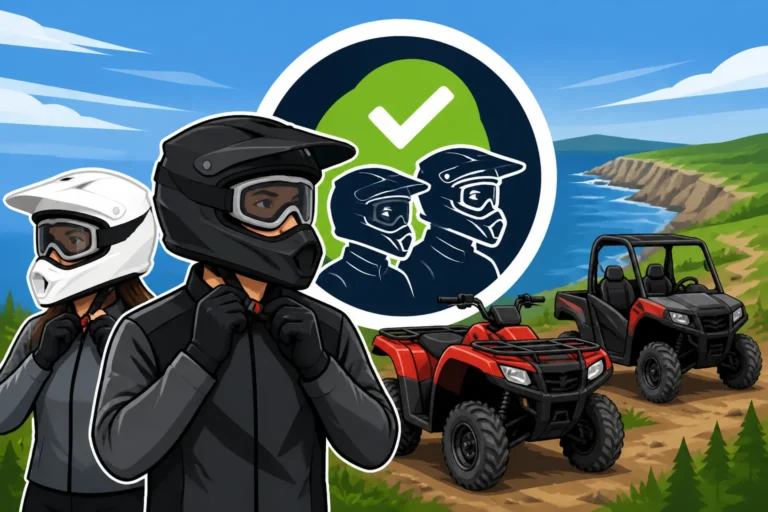
Beyond the machine's equipment, the operator and any passengers also have mandatory safety gear they must wear, especially when traversing public roads or shoulders. The most critical piece of equipment is a helmet. Newfoundland's [Newfoundland Helmet Law for Every Rider] is clear: every operator and passenger on an ORV must wear an approved helmet, securely fastened, at all times while the machine is in operation. This isn't optional; it's a non-negotiable safety requirement that applies whether you're on a trail or making a permitted road crossing. Approved helmets typically carry a Canadian Standards Association (CSA) marking, a U.S. DOT standard, or a European ECE standard.
Eye protection is also mandatory. This could be goggles or a face shield integrated into your helmet. If your side-by-side has an enclosed cab with a windshield, that usually counts as sufficient eye protection, but for open-air ATVs and UTVs, goggles are essential. Additionally, if your machine is equipped with seat belts from the factory, they must be worn. This is particularly relevant for side-by-sides, where seat belts are standard. While not legally required by the ORV Act for road sections, dressing appropriately with long sleeves, pants, and sturdy footwear is always a good idea for any ride, adding an extra layer of protection in case of an unforeseen incident. Even for short road stretches, don't skimp on the gear; safety is paramount.
Local Bylaws and Potential Pitfalls
While the provincial "Off-Road Vehicles Act" sets the baseline, it's not the only layer of regulation you need to be aware of. Municipalities in Newfoundland and Labrador have the power to enact their own bylaws regarding the operation of ATVs and UTVs within their town or city limits. This can create a patchwork of rules, where what's allowed in one community might be strictly forbidden just a few kilometres down the road. This local variability is a significant source of confusion for riders and can easily lead to unintentional infractions.
Municipal Bylaws: The Wild Card
Many towns and cities across Newfoundland and Labrador have taken steps to regulate ORV use on municipal roads. Some municipalities might create specific "approved areas" or designated routes where ORVs are allowed to travel on certain streets to access trails, while others might impose a blanket ban on all ORV operation on any municipal road. It's not uncommon for a town council to feel the need to balance the recreational desires of residents with concerns about noise, safety, and property damage. The problem is, these bylaws aren't always widely publicized or easy to find. Before you ride your ATV on any road within a town's limits, it is absolutely vital to check with the local municipal office.
A municipality's bylaw will override the provincial act's general prohibition on public roads if it specifically allows ORVs on certain roads. However, the provincial rules for highway crossings and shoulder riding still apply to those specific instances on provincial highways, even if you are within town limits. This means you could be on a municipal road where ORVs are allowed, but if you need to cross a provincial highway that runs through that town, you still have to adhere to the 150-metre visibility rule and 90-degree crossing. Always confirm [Newfoundland Municipal Road Bylaws] before you venture onto any roads in an unfamiliar area.
Common Mistakes That Lead to Fines
Riding an ATV or UTV on a public road or highway without fully understanding the rules is a surefire way to encounter law enforcement and receive a ticket. One of the most common mistakes is simply riding on a main road because "everyone else does it." This is anecdotal evidence, not legal advice, and it won't hold up in court. Another frequent error is misinterpreting the 1-kilometre shoulder rule, assuming it means you can ride a longer distance if you "really need to." The limit is exact. Many riders also forget about the 20 km/h speed limit when on the shoulder, thinking they can go faster if conditions seem clear.
Then there's the equipment issue. Operating a machine on a road section without proper working lights, especially at dusk or night, is a serious offence. And failing to wear an approved helmet, or having an unfastened chin strap, is an easy ticket to get. Finally, many people overlook the driver's licence requirement, particularly younger adults who might have completed an ATV safety course but don't yet hold a full provincial driver's licence. Each of these oversights can lead to a fine, and if an accident occurs, it can complicate insurance claims and legal liabilities significantly.
What Happens If You Break the Rules
Breaking the "Off-Road Vehicles Act" rules regarding road usage can result in a range of penalties, from monetary fines to more serious consequences. For minor infractions, like not having proper lights or riding on a prohibited section of road, you could face fines that vary depending on the specific offence. These fines can quickly add up, especially if you're cited for multiple violations at once. An enforcement officer has the authority to stop you and issue a ticket, and they often conduct roadside checks in areas known for ORV activity.
More serious offences, such as impaired operation on a road or a repeat violation, can lead to much heavier penalties, including significant fines, court appearances, and even the seizure of your machine. [Newfoundland Machine Seizure Rules] are in place, allowing officers to impound your vehicle for specific violations, which incurs towing and storage fees on top of any fines. A conviction could also have implications for your driver's licence if you have one. It's simply not worth the risk. Understanding [Newfoundland Fine Ranges by Offence] is important, but more so is making the conscious choice to always ride legally and safely.
To summarize the key points on road access for ATVs and UTVs in Newfoundland:
| Condition / Requirement | Applies To | Specifics |
|---|---|---|
| General Road Use | All provincial highways and public roads | Generally not permitted, unless specific exceptions or local bylaws apply. |
| Highway Crossing | Any provincial highway | 90-degree angle, complete stop, yield to traffic, 150m clear visibility in both directions. |
| Shoulder Riding | Shoulders of provincial highways | Max 1 km distance, only to access a trail/riding area, 20 km/h speed limit, yield to traffic. |
| Municipal Roads | Roads within town/city limits | Check local bylaws; some may permit limited use on specific streets. Provincial rules apply to highway sections. |
| Operator Licence | Any road/shoulder operation | Must hold a valid driver's licence (e.g., Class 5). |
| Helmet | All operators and passengers | Approved helmet, securely fastened. |
| Eye Protection | All operators and open-cab passengers | Goggles or face shield (unless enclosed cab with windshield). |
| Vehicle Lights | Road/shoulder operation, sunset to sunrise | Functional headlamp (white/amber) and tail lamp (red), plus reflectors. |
| Vehicle Condition | All road/shoulder operation | Good brakes, quiet muffler, appropriate tires. |
In the end, while the allure of taking a shortcut down the main road or just cruising through town on your ATV might be strong, the legal framework in Newfoundland and Labrador is designed to keep off-road vehicles off public roads for everyone's safety. Adhering to the specific crossing and shoulder rules, ensuring your machine is properly equipped, and that you meet the operator requirements will help you avoid unnecessary stress, fines, and potential accidents. Ride smart, stay informed, and enjoy the incredible trails Newfoundland has to offer without putting yourself or others at risk on the pavement.
Disclaimer
This article is for general informational purposes only and does not constitute professional advice. Laws, prices and regulations vary by location and change over time. Consult a qualified professional for guidance on your specific situation.