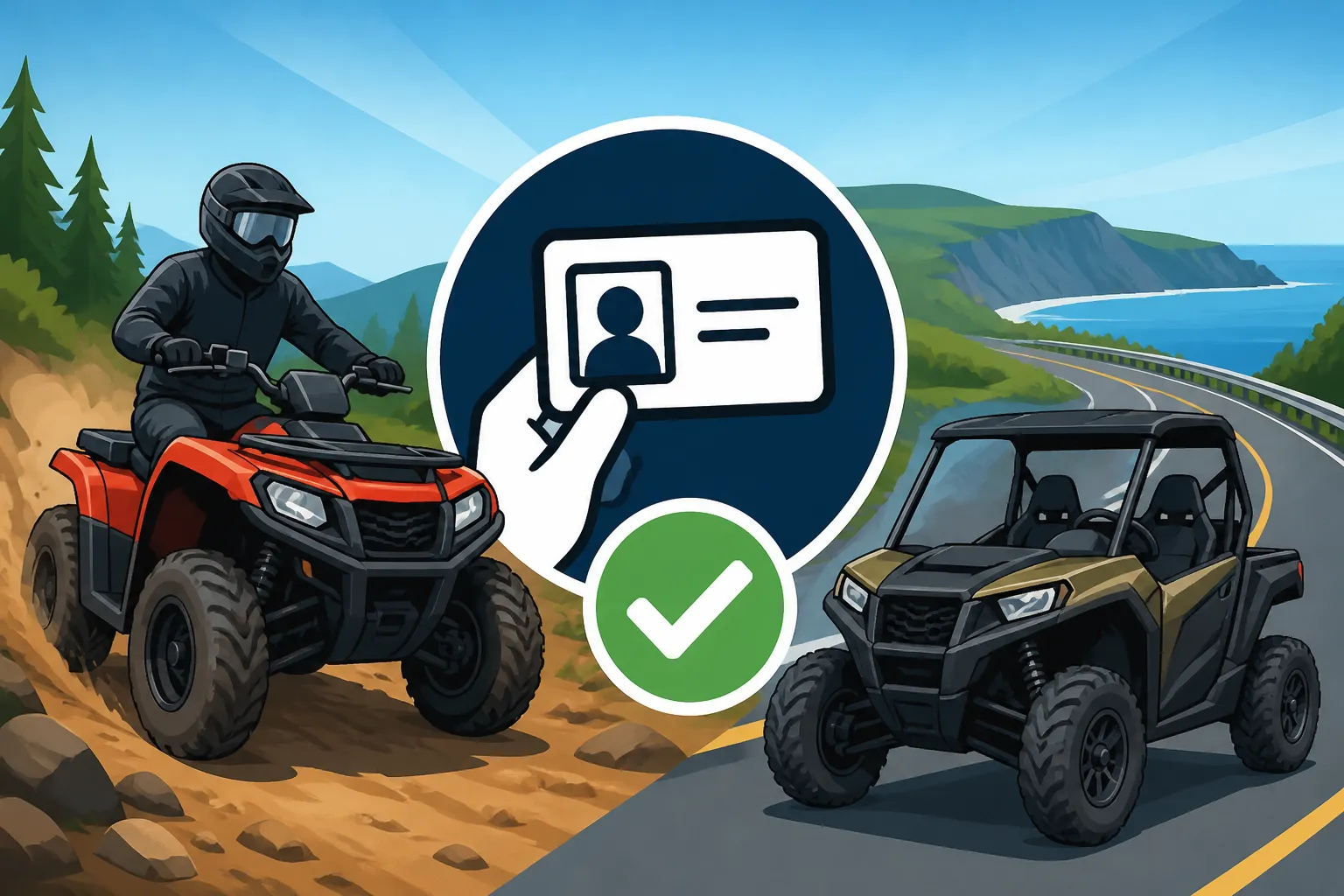
Visitors Still Need a Driver’s Licence on Highways
Bringing an ATV or side-by-side to Newfoundland does not automatically let you ride it wherever you can drive it at home. Visitors may qualify for a temporary registration exemption, but that exemption is not a substitute for a driver’s licence when operating on a highway. Here’s how to separate the highway-licence rule from trail, registration and training requirements.
What the Highway Licence Rule Means for Visitors
A visitor operating an off-road vehicle on a highway in Newfoundland needs a valid driver’s licence. The rule matters even if your machine is registered in another province or territory and you are only visiting temporarily.
That does not mean an ATV or UTV can be driven freely along public roads. Highway operation is restricted, and the circumstances in which you may use a highway are limited. The licence requirement applies when you are legally operating on a highway; having a licence does not create permission to ride on a road where off-road vehicles are prohibited.
A highway trip might involve a permitted crossing or a short, lawful stretch of shoulder used to reach a trail. Check the specific rules before setting out: Newfoundland Rules for Crossing a Highway and Newfoundland Rules for Riding a Shoulder. For example, crossing and shoulder travel have different conditions. A rider should not treat either as a general route between trails or communities.
A temporary registration exemption is a different matter
Visitors whose machines are registered elsewhere may qualify for a temporary exemption from Newfoundland registration requirements. That exemption is about the machine’s registration status; it does not cancel other provincial rules for riding, including the highway driver’s-licence requirement.
The time limit and conditions matter. Read Newfoundland’s 30-Day Visitor Exemption and Newfoundland Rules for an Out-of-Province Machine before travelling. If your visit will extend beyond the exemption period, check what registration steps apply rather than assuming your home-province documents will remain enough.
| Situation | What the visitor should understand |
|---|---|
| Riding a trail | Follow Newfoundland’s riding, equipment, insurance and access rules. A highway driver’s licence does not replace any trail-specific requirement. |
| Crossing a highway | Use only a lawful crossing and follow the applicable crossing rules. Carry a valid driver’s licence if the law requires one for the highway operation. |
| Riding a highway shoulder | Shoulder use is restricted. A driver’s licence does not make shoulder travel legal where the route or conditions do not allow it. |
| Riding with an out-of-province registration | A visitor exemption may cover registration for a limited period, but it does not exempt the rider from highway or safety rules. |
| Riding on private land | Highway requirements may not apply in the same way, but landowner permission and other applicable rules still matter. |
The practical takeaway is to plan for the strictest part of your route. A ride that is almost entirely on a trail may still include a highway crossing or short shoulder section. Do not leave the driver’s licence behind because most of the day will be off-road.
What counts as highway riding?
The exact legal meaning of “highway” depends on the relevant legislation and the place where you are riding. Riders should not assume that a road is private, or that a road is an off-road trail, just because it is gravel, remote or used mainly by local traffic.
If your route touches a public road, a highway shoulder or a marked crossing, check the applicable rules and signs. When the status of a road is unclear, ask the relevant local authority or land manager before riding it. A route shown on a map is not, by itself, proof that ATV travel is permitted there.
The distinction is important because highway rules and trail rules can overlap. A machine can be properly registered, insured and equipped and still be on a route where it is not permitted. Conversely, a lawful highway crossing does not remove requirements that apply to the machine or rider elsewhere.
Which Licence to Carry and What to Check
Visitors should carry a valid driver’s licence issued by their home jurisdiction and make sure it is valid for them to drive. If your licence is a learner, graduated or restricted licence, do not assume its conditions are irrelevant when you operate an ATV or UTV on a highway. Check whether those conditions affect your planned use in Newfoundland.
The precise licence class or restrictions that apply can depend on the rider’s circumstances and the rules in force. If you are unsure whether your licence qualifies, confirm with the appropriate Newfoundland authority before riding rather than relying on a general assumption that any licence card is enough. Which Driver’s Licence You Need on a Highway is a useful starting point for understanding the issue.
A driver’s licence is not the same as an ATV safety certificate, machine registration or proof of insurance. Each document serves a different purpose, and one does not stand in for another.
| Document or requirement | What it is for |
|---|---|
| Driver’s licence | Required for the applicable highway operation; the rider should confirm their licence is valid and suitable for their circumstances. |
| Registration or visitor exemption | Shows that the machine meets the applicable registration rules or qualifies for a temporary exemption. |
| Proof of insurance | Shows that the machine has the required insurance coverage. Visitors should check the rules and their policy before riding. |
| Safety training proof | May be required based on the rider’s age or circumstances. It does not replace a driver’s licence. |
| Trail sticker or permit | May be needed for access to certain managed trails. It does not authorize highway use. |
Before you travel, check both your home-jurisdiction licence conditions and Newfoundland’s requirements. A foreign or out-of-province licence may involve additional considerations, especially if it is temporary, restricted or not readily understood by an officer. If the licence is not in English, ask whether you need supporting identification or documentation.
Keep the licence accessible while riding, not packed at the bottom of luggage at your accommodation. Carry registration information and insurance proof as well. Check the requirements for presenting those documents, and make sure the information matches the machine you are operating.
Safety training is separate from licensing
Some riders also need to meet Newfoundland’s ATV safety-training requirements. Those requirements are not the same as having a driver’s licence, and completing training does not grant permission to operate on a highway. The rider’s age and circumstances can affect which requirements apply, so review the rules before the trip.
A visitor should check Newfoundland Visitors Still Need Insurance as well as the training and riding requirements that apply to their machine. Do not assume that a home-province safety course automatically satisfies every Newfoundland requirement; confirm whether it is accepted for the situation.
Insurance and machine paperwork still matter
A valid driver’s licence does not prove that the machine is insured or properly registered. Before departure, verify that your policy covers the machine and the type of riding you plan to do in Newfoundland. Ask your insurer about coverage on trails, crossings and any permitted highway operation, and carry acceptable proof.
Also confirm that the registration documents belong to the machine you are bringing. A visitor exemption, where available, is not permission to ignore document requirements or use a machine that is not properly registered in its home jurisdiction. For additional context, see Newfoundland Insurance Rules for Visitors.
Plan the Route Around the Rule
The safest planning approach is to identify every place your route could touch a highway before unloading the machine. Use current maps and trail information, then verify access and road status with the trail operator or the relevant local authority. A line that appears to connect two trail sections may lead onto a public road where riding is restricted.
If the route requires a highway crossing, learn the crossing rules and choose a location with good visibility. Newfoundland’s visibility requirements are explained in Newfoundland’s 150-Metre Crossing Visibility Rule. Do not cross at a location simply because it is convenient or because another rider has done so.
Shoulder travel has its own limits and should be treated as a narrow exception for reaching a trail where permitted, not as a road-riding alternative. Review Newfoundland’s 1-Kilometre Shoulder Rule and 20 km/h on a Shoulder before relying on a shoulder to connect your route. If the route does not fit the legal conditions, choose another route or trailer the machine to a suitable access point.
A simple pre-ride check can prevent confusion:
- Confirm your licence. Make sure it is valid, carry it and check any learner or other restrictions that apply to you.
- Confirm the machine’s status. Verify its home registration and whether the visitor exemption applies to your stay.
- Check insurance. Confirm coverage for Newfoundland and carry proof in the required form.
- Review the route. Identify highway crossings and any proposed shoulder sections, then verify they are lawful.
- Check rider-specific rules. Confirm any applicable training, age, helmet and equipment requirements.
- Ask when uncertain. Contact the appropriate authority or trail operator if a road’s status, access or paperwork requirement is unclear.
Avoid making last-minute decisions at a trail junction. If a sign, gate or local instruction conflicts with your planned route, stop and resolve the issue before continuing. Remote areas can have limited service, so it is sensible to save maps and contact details ahead of time.
Common Visitor Mistakes to Avoid
The most common misunderstanding is treating the visitor registration exemption as a general exemption from Newfoundland law. It is not. It may address whether the visiting machine must be registered locally for a limited period, but it does not remove the highway licence requirement, grant trail access or cancel insurance and safety obligations.
Another mistake is assuming that a driver’s licence allows the holder to ride an ATV anywhere a car can go. The licence requirement and the permission to operate on a particular road are separate questions. Check both. A route can be off limits even when the operator has the right licence and the ATV is fully documented.
Visitors can also confuse an ATV safety certificate with a driver’s licence. If a rule calls for one, having the other is not enough. Check which requirements apply to each rider, particularly when children or young people are in the group. For age-related guidance, see Newfoundland ATV Age Requirements.
Finally, do not rely on verbal assumptions from a seller, a fellow rider or an old trip plan. Rules, local access and road conditions can change. Verify current requirements close to departure, and follow posted signs and directions while riding.
A practical way to think about the rule is this: if your ATV or UTV will be operated on a highway, carry a valid driver’s licence and confirm that the specific highway use is allowed. If you cannot confirm both, keep the machine off that route and find another way to reach the trail.
Disclaimer
This article is for general informational purposes only and does not constitute professional advice. Laws, prices and regulations vary by location and change over time. Consult a qualified professional for guidance on your specific situation.