Newfoundland’s 1-Kilometre Shoulder Rule
It's a common frustration for ATV and UTV riders in Newfoundland: you're out on a fantastic trail, the wind is in your hair, and then suddenly, the trail ends. There's a highway, a paved road, or a community separating you from the next section of glorious wilderness. Many riders wish they could simply ride their machine on the road, but that's just not how it works. This guide is going to meticulously break down Newfoundland's specific "1-kilometre shoulder rule," explaining exactly what it means, when you can use it, and how to stay compliant and safe.
Understanding the Shoulder Rule's Purpose
Riding an off-road vehicle (ORV) in Newfoundland and Labrador offers an unparalleled sense of freedom and access to some of the most stunning landscapes imaginable. But as any seasoned rider will tell you, the trail system isn't always a perfectly contiguous network. There are inevitable breaks, often caused by public roads, private land, or community boundaries. That's where the shoulder rule comes into play, offering a limited but crucial solution to an age-old problem for riders.
Bridging the Gaps in Newfoundland's Trail Network
Imagine you’re out on a ride, enjoying the rugged beauty of the Avalon Peninsula or the sprawling barrens of Central Newfoundland. You’ve been on the trail for hours, and the next segment of your route is just across a main highway. Before the specific rules for shoulder use were formalized, your only real option was to load your machine onto a trailer, drive it across the highway, and then unload to continue. This was, and still is, a significant hassle, disrupting the flow of your ride and adding considerable time and effort.
The provincial government recognized this practical dilemma for the riding community. The intent behind the 1-kilometre shoulder rule isn't to make ORVs street-legal, but rather to provide a pragmatic and safe way for riders to connect these isolated trail segments. It’s about ensuring that riders can get from point A to point B on a trail when a short stretch of highway shoulder is the only viable link, or perhaps to reach essential services like a gas station or a small community store that’s just off the main trail. It’s a solution to the "need" to bridge gaps, rather than a "want" to cruise down main street.
This rule addresses a specific frustration: the feeling of being "stuck" when a trail suddenly gives way to a paved road. It acknowledges that sometimes, for the sake of accessibility and the continuation of a ride, a short, controlled interaction with public road infrastructure is necessary. It’s a thoughtful concession that balances the desire for uninterrupted riding with the absolute necessity of public safety on shared roadways.
Safety First: Why the Rule Has Limitations
While the shoulder rule offers this valuable bridge, it's absolutely paramount to understand that it comes with very strict limitations, all designed with safety as the top priority. The fundamental truth remains that ORVs are not designed for highway speeds or for mixing with conventional road traffic. Their handling characteristics, braking distances, and visibility are all optimized for off-road environments. Allowing them onto highway shoulders, even for short distances, introduces inherent risks that must be carefully managed.
This is precisely why the rule is so prescriptive about conditions like the [Newfoundland's 20 km/h Shoulder Limit] and the need for extreme caution. The shoulder is a high-risk environment for an ORV, even at low speeds. Highway vehicles travel at much greater speeds, and drivers may not anticipate an ORV moving slowly on the shoulder. This dynamic creates a significant hazard that cannot be overstated, and the regulations are designed to minimize this danger as much as possible.
The shoulder rule should never be mistaken for an endorsement of ORVs as street-legal vehicles. It's an exception, not a norm. The entire framework of the Off-Road Vehicles Act is built around regulating machines off public roads, with very few, highly controlled exceptions. Therefore, viewing the 1-kilometre rule as anything other than a tightly regulated concession for specific, necessary circumstances would be a dangerous misinterpretation, potentially leading to serious accidents or legal trouble. It's about getting from one trail to another, safely and briefly, under explicit conditions.
The Specifics of the 1-Kilometre Shoulder Rule
Navigating the nuances of Newfoundland's ORV regulations can sometimes feel like trying to untangle a particularly stubborn fishing line. The 1-kilometre shoulder rule is one of those critical pieces of legislation that riders absolutely must understand in detail. It's not just a suggestion; it's a legal framework that dictates how and when you can operate your off-road machine on the fringes of provincial roads.
Defining "Shoulder" and "Highway" Under the Act
Before you even think about putting tires on a paved surface, it's crucial to understand what the law means by a "shoulder" and a "highway." In simple terms, a "highway" refers to any public road, including provincial highways, main roads, and even smaller community roads, where other vehicles typically travel. It's the designated thoroughfare for cars, trucks, and other registered vehicles. Your local paved road or the Trans-Canada Highway both fall under this definition.
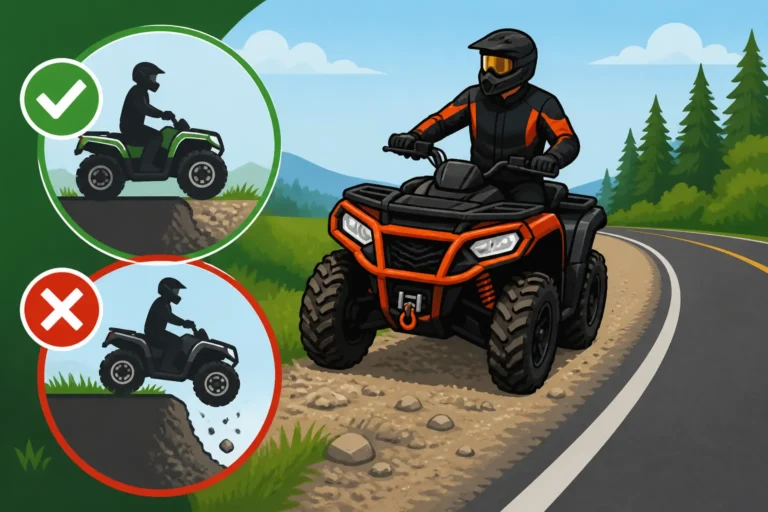
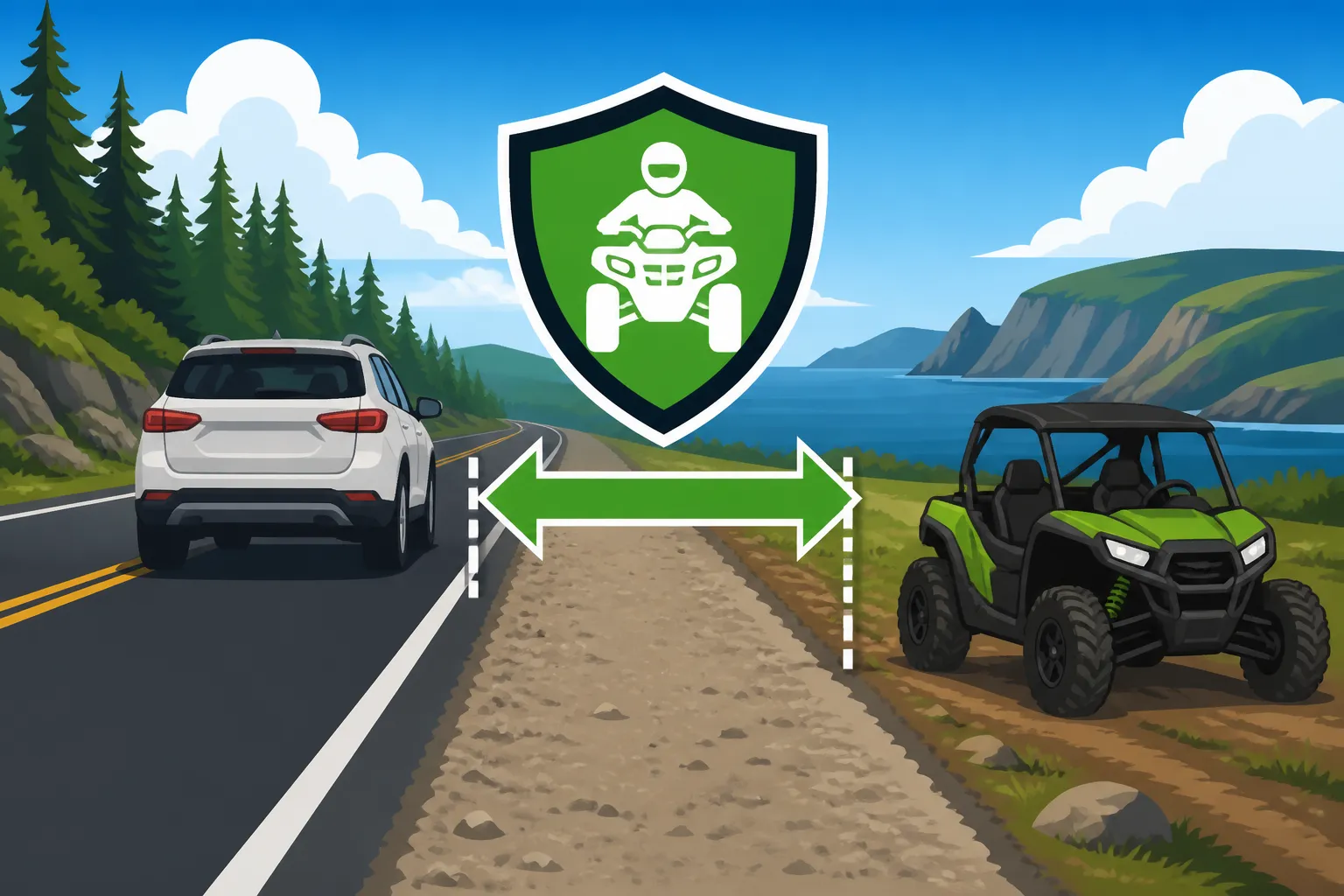
The "shoulder" is generally understood as the portion of the highway immediately adjacent to the travel lane, typically paved or graveled, that is not intended for through traffic. It's the strip of land to the side where you might pull over in an emergency or where pedestrians and cyclists might travel. The Act specifically permits ORV use on the shoulder, not in the active travel lanes. This distinction is critical; straying into the main traffic flow, even accidentally, is a serious offence and highly dangerous. Understanding this demarcation is the first step in compliant and safe riding when the trail temporarily disappears.
It's also important to differentiate between a highway shoulder and, say, a cabin road or a woods road. While many cabin roads might have a gravel edge, they typically aren't designated highways under the Act and may have different rules for ORV use, or might even be private property requiring permission. The 1-kilometre rule strictly applies to the shoulders of public highways, where standard road traffic laws, alongside ORV regulations, are in effect. Misinterpreting these definitions can lead to fines, machine seizure, or worse.
The Hard Limit: What 1 Kilometre Really Means
When the law states "1 kilometre," it means exactly that: one thousand metres, not "around a kilometre" or "just a bit further." This is not a guideline; it's a strict, measurable limit. Many riders, in their eagerness to connect trails or reach a quick stop, might be tempted to stretch this limit, thinking a little extra won't matter. This kind of thinking is a direct route to trouble. Peace officers are fully aware of this rule and are equipped to measure distances, and they don't take kindly to deliberate violations.
The consequences of exceeding this 1-kilometre limit can be severe. It immediately moves your operation outside the legal exception, treating it as if you were riding an unregistered or uninsured ORV directly on a highway. This can result in significant fines, as outlined in [Newfoundland Fine Ranges by Offence], and potentially even the seizure of your machine. It’s not worth the risk for a few extra hundred metres. Riders must plan their routes meticulously, using GPS or mapping apps to confirm distances between trailheads or access points.
Planning your ride to stay within this boundary is essential. If a trail segment is more than a kilometre away, or if the services you need are further down the highway, the legal and safest option is to trailer your machine. There's no grey area here; the law is black and white. Being prepared with accurate distance measurements and sticking rigidly to the limit is key to using this rule effectively and avoiding legal repercussions. You can't just estimate – you need to know, for sure, that your route segment on the shoulder is within that hard 1,000-metre maximum.
The 20 km/h Speed Limit and Other Key Conditions
Beyond the 1-kilometre distance, the most crucial condition for shoulder riding is the speed limit: a strict 20 kilometres per hour. This isn't a suggestion for a comfortable pace; it's a maximum legal speed. Operating your ORV at anything above 20 km/h on a highway shoulder, even for a short burst, is a violation of the rule and introduces significant danger. At this reduced speed, ORVs are more manageable, and there's a greater chance for highway drivers to react to their presence.
This 20 km/h limit is intentionally slow, reflecting the inherent risks of mixing ORVs with faster highway traffic. It gives both the ORV operator and other drivers more time to see and react to each other, especially when considering the differing profiles and expected speeds of these vehicles. It's a key part of the safety protocol, demanding extreme caution and defensive driving from the ORV operator. It also requires you to constantly be aware of your surroundings, ensuring you yield to all highway traffic and pedestrians, as outlined in [Newfoundland Riders Yield to Highway Traffic].
Furthermore, all other relevant ORV regulations remain in effect. Your machine must be properly registered as per [Newfoundland Registration Valid While You Own It], you must have the minimum required insurance, and your identification plate must be clearly visible, as covered in [Newfoundland Plates Unobstructed by Cargo]. Proper lighting, including functional head and tail lamps, is also non-negotiable, especially from sunset to sunrise. This isn't just about being seen; it's a legal requirement. These conditions, along with others like the [Newfoundland's 150-Metre Crossing Visibility Rule] when crossing an actual highway, form a comprehensive safety net designed to protect everyone on and near the road.
| Condition | Requirement | Purpose |
|---|---|---|
| Distance Limit | Maximum 1 kilometre on the shoulder | Minimize ORV exposure to highway traffic |
| Speed Limit | Maximum 20 km/h | Enhance safety, reaction time, and control |
| Location | Strictly on the shoulder, not travel lanes | Separate ORV from high-speed vehicles |
| Visibility | Functional head/tail lamps, reflectors | Ensure ORV is seen by other road users |
| Yielding | Must yield to all highway traffic | Prioritize safety of conventional vehicles |
| Identification | Valid registration, visible plate | Legal compliance and accountability |
| Insurance | Minimum liability coverage | Financial protection in case of incident |
| Safety Gear | Helmet and eye protection (for operator) | Rider protection |
Practical Application: When and How to Use the Rule
The 1-kilometre shoulder rule isn't just a dry piece of legislation; it's a practical tool that, when used correctly, can significantly enhance your riding experience in Newfoundland. Understanding when and how to apply this rule can be the difference between a seamless journey and a frustrating detour. It’s designed to solve specific logistical challenges that riders frequently encounter across the diverse landscapes of the province.
Connecting Disconnected Trail Segments
One of the most common and valuable uses of the 1-kilometre shoulder rule is bridging those frustrating gaps where a designated trail suddenly ends at a highway and picks up again a short distance away. Picture this: you're exploring the wilderness near Gander, enjoying a challenging section of trail, only to find yourself at the edge of the Trans-Canada Highway. The next section of the trail, which you've been looking forward to, is clearly visible just 500 metres down the shoulder on the other side.
In such a scenario, rather than searching for a suitable place to load your machine onto a trailer, driving to the next trailhead, and then unloading, the shoulder rule allows you to legally and safely traverse that short distance. This makes multi-day rides or long-distance expeditions much more feasible and enjoyable, reducing the need for constant trailering. It preserves the adventurous spirit of off-roading, allowing for a more continuous experience that would otherwise be broken by logistical headaches. It also helps riders explore areas where dedicated trail bridges or underpasses aren't economically viable, making vast stretches of Newfoundland accessible.
However, this doesn't mean every road-adjacent trail connection is fair game. You must confirm the exact distance and ensure there isn't a more suitable, off-highway alternative. Always double-check your maps and be aware of any signs indicating specific restrictions. The convenience of using the shoulder rule should never overshadow the paramount importance of safety and compliance with the 20 km/h speed limit and the [Newfoundland's 150-Metre Crossing Visibility Rule] if you're actually crossing the highway itself.
Accessing Fuel, Food, or Services
Another incredibly practical application of the 1-kilometre shoulder rule is for accessing essential services that are just a stone's throw off an approved trail. Imagine you're deep in the interior, far from the main towns, and your fuel gauge is dipping dangerously low. A small gas station is marked on your map, just 700 metres down the highway shoulder from where the trail meets the road. This rule provides a lifeline in such situations, preventing you from being stranded or having to arrange complex fuel drops.
This flexibility extends to grabbing a quick bite at a roadside diner, picking up supplies at a convenience store, or even accessing a repair shop if you encounter a minor issue on the trail. For riders embarking on longer journeys, like those traversing sections of the [Riding the T'Railway From St John's to Port aux Basques], knowing you can legally access these amenities for a brief, controlled distance can be a trip-saver. It removes the anxiety of being entirely self-sufficient for every conceivable need while far from home.
It is absolutely crucial to reiterate, however, that this access is for essential services and within the 1-kilometre limit. It does not grant you permission to ride your ORV into the heart of a town for general errands or recreational cruising. The spirit of the law is to facilitate necessary practicalities, not to extend the use of your ORV beyond its intended off-road purpose. Any deviation from this intent could lead to fines and a negative perception of ORV riders within communities.
Riding to a Trailhead from Private Property
For many Newfoundlanders, their ORV isn't just a recreational machine; it's an integral part of cabin life, hunting, or simply getting around their own land. If your cabin, home, or private property is located just off a public highway, and the nearest trail access point is within that crucial 1-kilometre distance along the shoulder, this rule becomes incredibly useful. It allows you to legally get from your property to the trail without the need to trailer your machine for what might be a very short hop.
This is particularly relevant in rural areas where properties often border provincial roads, and the nearest official trailhead might be a quick, controlled ride away. It simplifies the process of starting and ending your rides, integrating the ORV more smoothly into daily life. It also means less time spent loading and unloading, giving you more time to enjoy the trails themselves. However, it's vital to remember that while the provincial shoulder rule allows this, you must also be mindful of any [Newfoundland Municipal Road Bylaws] that might impose additional restrictions or require permits for specific local roads or access points within municipal boundaries.
Always ensure that you have explicit permission to cross or access any private land if your route involves it, even if it's just to get to the shoulder. While the shoulder itself is public access under these conditions, the land leading to it might not be. This proactive approach ensures a respectful relationship with landowners and avoids any potential trespass issues that could jeopardize future access for all riders. The rule is a convenience, but it does not supersede other property or local regulations.
Equipment and Compliance for Shoulder Riding
Operating your ATV or UTV on a highway shoulder, even for a limited distance, demands a heightened level of preparation and strict adherence to equipment and compliance standards. This isn't just about avoiding a ticket; it's fundamentally about ensuring your safety and the safety of others when momentarily sharing space with faster-moving highway traffic. Every detail matters when you're making this brief transition.
Essential Lighting and Reflectors for Road Sections
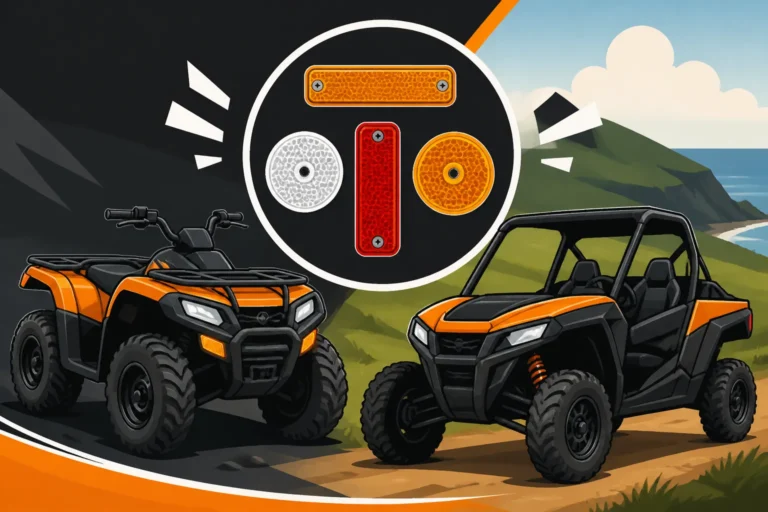
When you're riding on the shoulder, especially during low light conditions like dusk, dawn, or simply an overcast, foggy Newfoundland day, visibility is your absolute best friend. Highway vehicles are travelling at much higher speeds, and an ATV or UTV can be surprisingly difficult to spot quickly if not adequately illuminated. This is why the law is so strict on lighting requirements. Your machine must be equipped with a functional headlamp that emits a white or amber light to the front and a tail lamp that emits a red light to the rear, both clearly visible.
Beyond the basic requirements, consider enhancing your visibility with additional reflectors. While the minimum factory-installed reflectors are a start, adding extra reflective tape to the front, rear, and sides of your machine can make a significant difference. Products like reflective kits from companies such as SuperATV can provide an extra layer of conspicuity, helping your machine stand out against the background, particularly important when navigating busy highway shoulders. Remember, your goal is to be seen as early and clearly as possible by other drivers.
It's not just about having the lights; they must be clean and functional. Mud-splattered lamps or burnt-out bulbs are not only non-compliant but dangerously reduce your visibility. Before any ride that might involve shoulder use, perform a quick check of all your lighting elements. Ensure they're bright, clear, and working perfectly. The [Newfoundland Lighting Requirements on a Machine] explicitly state these needs for a reason: to minimize the chance of a collision by maximizing how well other road users can detect your presence.
Insurance, Registration, and Identification Plates
Just because you're only on the shoulder for a kilometre doesn't mean you can slack on your basic legal requirements for ORV ownership. Every time your machine touches a public highway shoulder, it must be fully compliant with all provincial registration and insurance laws. This means your ATV or UTV needs to be properly registered with Motor Registration Division, and you must carry proof of that registration. [Newfoundland Registration Valid While You Own It] confirms that once registered, it stays that way, but you need to prove it.
Furthermore, possessing valid insurance is non-negotiable. The province mandates a minimum liability coverage, as specified in [Newfoundland's Minimum Insurance Requirement]. This insurance protects you and others in the event of an accident. Operating an uninsured ORV on a highway shoulder, even briefly, is a serious offense that can lead to substantial fines, impoundment of your machine, and personal financial ruin if you're involved in an incident. Always carry your proof of insurance with you, perhaps in a waterproof bag on your machine.
Finally, your identification plate is your machine's unique identifier and must be clearly displayed. It needs to be attached to the rear of your ATV or UTV, visible at all times, and kept free of mud, snow, or any obstruction. As stated in [Newfoundland Plates Unobstructed by Cargo], cargo, saddlebags, or even excessive mud built up from the trail cannot obscure your plate. An obstructed plate is a fineable offense, and it prevents law enforcement from easily identifying your machine should the need arise, undermining the very purpose of its display.
Helmets and Safety Gear: Non-Negotiable
When you're operating an ORV on a highway shoulder, you are entering a higher-risk environment than a typical trail. The proximity to high-speed traffic demands that you maximize your personal safety. This starts, unequivocally, with your helmet. [Newfoundland Helmet Law for Every Rider] is not something to be debated; it is a strict requirement for all operators and passengers on an ORV, regardless of where you are riding.
Your helmet must be a proper, DOT-approved (or equivalent standard like ECE or CSA) off-road helmet, fitted correctly, and with the chin strap securely fastened. It's not enough to simply have a helmet on your head; it needs to be worn as intended to offer full protection. Alongside your helmet, appropriate eye protection is also mandatory unless your machine has an enclosed cab with a windshield. Goggles or a full-face helmet visor protect your eyes from debris, wind, and the elements, which can be particularly disorienting when sharing space with highway vehicles.
For side-by-side (SxS) operators and passengers, factory-installed seat belts must be worn at all times. These are not optional accessories; they are critical safety features designed to keep you contained within the vehicle during sudden stops or impacts. Combining a proper helmet, eye protection, and seat belts creates the safest possible environment for those brief, but potentially hazardous, stretches of shoulder riding. Cutting corners on safety gear, especially when on a highway shoulder, is simply not worth the gamble with your well-being.
Common Mistakes and Misconceptions About the Rule
Even with clear regulations in place, the 1-kilometre shoulder rule is often misunderstood or misused. These misconceptions can lead to dangerous situations, hefty fines, and damage the overall reputation of the ATV and UTV riding community. It's vital to address these common errors head-on to ensure everyone rides responsibly and legally.
The "Street Legal" Fallacy
Perhaps the most pervasive and dangerous misconception about the 1-kilometre shoulder rule is the belief that it somehow makes your ATV or UTV "street legal" for general road use. Let's be absolutely clear: it does not. An ORV, even one equipped with all the bells and whistles for visibility, remains an off-road vehicle in the eyes of Newfoundland law. The shoulder rule is a very specific, limited exception, not a blanket permission.
This means you cannot ride your ATV to the grocery store across town, commute to work on it, or use it for casual cruising on paved roads. Its purpose is explicitly for transitioning between off-road segments or accessing immediate services, and only for that limited 1-kilometre distance at a maximum speed of 20 km/h. Any attempt to use the shoulder rule as an excuse for general road use will be met with enforcement, fines, and potentially even machine impoundment. The desire for a fully street-legal ORV is understandable for many riders, but the current regulations in Newfoundland do not facilitate it beyond these very narrow exceptions.
It's crucial for riders to internalize this distinction. Your ORV is designed for trails, barrens, and woods roads, not highways. While manufacturers like SuperATV offer accessories that can enhance safety and compliance for certain road-legal requirements in other jurisdictions, those modifications alone do not confer street-legal status in Newfoundland. Always refer to the provincial Off-Road Vehicles Act and avoid interpreting the 1-kilometre rule as anything other than a tightly controlled privilege.
Exceeding the Distance or Speed Limits
Another common mistake, often born of impatience or misjudgment, is exceeding either the 1-kilometre distance limit or the 20 km/h speed limit. Riders might think, "It's just a little bit further," or "I'll just speed up for a second to get past this section." These seemingly minor deviations carry significant risks and legal consequences. The limits are set for a reason: to minimize the exposure time and speed differential between ORVs and highway traffic.
Going over the 1-kilometre limit transforms your ride from a legal transition into an illegal operation of an off-road vehicle on a public highway. This can lead to charges for operating an unregistered or uninsured vehicle on a highway, which are far more serious than a simple ORV violation. Similarly, exceeding 20 km/h significantly increases the danger, reducing reaction time for both the ORV operator and other drivers, and increasing the severity of any potential collision. These limits are not arbitrary; they are based on safety assessments.
The penalties for such infractions can include substantial fines, impoundment of your machine, and even points on your driver's license, affecting your ability to drive conventional vehicles. It's a clear illustration that the authorities take these specific rules very seriously. Planning your route, using a GPS or odometer to track your distance, and constantly monitoring your speed are non-negotiable practices when engaging in shoulder riding. Don't let a moment of impatience cost you your machine or your riding privileges.
Ignoring Other Road Rules and Yielding
Even when you are legally operating on a highway shoulder, you are still interacting with the broader road network. A critical mistake many ORV riders make is forgetting this and failing to observe other basic road rules and, most importantly, the principle of yielding. The 1-kilometre rule allows ORVs on the shoulder, but it does not grant them any special right-of-way. In fact, it's quite the opposite: ORVs must yield to all highway traffic, including vehicles, cyclists, and pedestrians.
This means being acutely aware of your surroundings, checking mirrors frequently (if equipped), and making eye contact with drivers if possible. When entering or exiting the shoulder, or if you need to perform a highway crossing (which has its own [Newfoundland's 150-Metre Crossing Visibility Rule]), you must ensure the way is completely clear. Expect that highway traffic may not always see you, so ride defensively and be prepared to stop or pull further off the shoulder if necessary.
Ignoring these fundamental rules not only makes you liable for traffic violations but also contributes to a negative perception of ORV riders among the general public and conventional drivers. Every time an ORV rider acts irresponsibly on a highway shoulder, it reinforces the stereotype that off-roaders are reckless and disregard public safety. Maintaining a high standard of conduct, yielding every single time, and showing respect for other road users is essential for the continued acceptance and availability of rules like the 1-kilometre shoulder exception.
Navigating Local Bylaws and Potential Conflicts
While the provincial Off-Road Vehicles Act provides the overarching framework for ORV use in Newfoundland and Labrador, it's not the only authority at play. Municipalities, through their own bylaws, have the power to further regulate or even restrict ORV access within their boundaries. This creates a complex patchwork of rules that riders must navigate, especially when considering shoulder riding near populated areas.
How Municipalities Can Override Provincial Rules
One of the most important things for an ORV rider to understand in Newfoundland is that a provincial rule is not always the final word. Local municipalities, be they towns, cities, or even some rural service districts, have the authority to enact their own bylaws governing ORV use within their specific jurisdictional limits. This means that while the province might allow the 1-kilometre shoulder rule, a town council could choose to prohibit ORVs entirely on any of its municipal roads or shoulders, or impose even stricter conditions.
This hierarchical structure can be incredibly frustrating for riders who assume provincial law applies everywhere. For example, a town might have a bylaw that forbids ORVs from operating on any road within its municipal boundaries, regardless of whether it's a provincial highway running through it. This effectively nullifies the 1-kilometre shoulder rule for that specific stretch of road within that town. You can’t assume; you absolutely must verify. The [Newfoundland Municipal Road Bylaws] are not always easily accessible, and sometimes require a call or visit to the local town office.
Before planning any ride that involves shoulder use near or through a community, it is paramount to check for local bylaws. Riding within a municipality that has a restrictive bylaw can lead to fines, public complaints, and potentially the loss of riding privileges, even if you are technically adhering to the provincial Act's general conditions. Being informed about local rules demonstrates responsible riding and helps maintain positive relationships between the ORV community and local residents.
Shared Use Areas: T'Railway and Crown Land
It's also important to distinguish between designated highway shoulders and other shared-use areas like the T'Railway or vast expanses of Crown Land. The 1-kilometre shoulder rule specifically applies to the shoulders of public highways, not necessarily to every unpaved path or shared corridor. The T'Railway Provincial Park, for instance, is a unique, multi-use trail corridor that operates under its own specific set of regulations.
While ORVs are generally permitted on much of the T'Railway, the rules there are different from those governing highway shoulders. You won't be observing the 20 km/h shoulder limit or the 1-kilometre rule because you're not on a highway shoulder; you're on a dedicated trail system. Similarly, [Newfoundland Crown Land Riding Rules] dictate where and how ORVs can be used on vast tracts of public land. These rules usually pertain to environmental protection, seasonal closures, or designated approved areas, and again, are distinct from highway shoulder regulations.
Confusing these different regulatory environments can lead to violations. For example, applying the relaxed rules of a remote Crown Land trail to a busy highway shoulder would be incredibly dangerous and illegal. Conversely, expecting the shoulder rule to apply to a section of the T'Railway where other restrictions might be in place is also incorrect. Always be aware of the specific type of land or corridor you are on and which set of regulations applies to that particular environment.
Enforcement and Consequences for Violations
Ignoring the rules, whether provincial or municipal, has real and often severe consequences. The enforcement of ORV regulations, including the 1-kilometre shoulder rule, falls to various agencies across Newfoundland and Labrador. This can include the Royal Newfoundland Constabulary (RNC) in urban areas, the Royal Canadian Mounted Police (RCMP) in rural regions, and even Fish and Wildlife Enforcement officers, particularly if violations occur on or near Crown Land or protected areas.
These officers are empowered to stop ORV operators, request documentation (registration, insurance, driver's license for highway crossings), and issue citations for non-compliance. Violations can range from fines for improper equipment or exceeding the speed limit to more serious charges like operating an unregistered or uninsured vehicle, or impaired driving, which carries the heaviest penalties under the Act. [Newfoundland Machine Seizure Rules] are also in effect, meaning your valuable machine could be impounded if you're found in serious violation.
A major consequence to understand is that some ORV offences can affect your provincial driver's license. While you don't typically need a driver's license to operate an ORV on a trail, certain violations, especially those occurring on or near a highway (like shoulder riding violations), can result in points against your driver's license or even a license suspension. This means a lapse in judgment on your quad could impact your ability to drive your car. The repercussions are far-reaching, reinforcing the message that safe and legal operation is not just a suggestion, but a fundamental responsibility.
Planning Your Route to Incorporate Shoulder Riding Safely
Successful and safe ORV riding, especially when it involves navigating highway shoulders, is rarely spontaneous. It requires careful planning, research, and a commitment to defensive riding. Just as you wouldn't head out on a long trail without mapping your fuel stops, you shouldn't approach shoulder riding without meticulous preparation.
Pre-Ride Mapping and Research
Before you even turn the key, detailed pre-ride mapping is absolutely essential. This means using reliable maps, GPS devices, or mapping applications to identify your entire route, including every segment that requires shoulder riding. Accurately measure these segments to ensure they fall within the 1-kilometre limit. Don't eyeball it; be precise. You need to know exactly where the trail begins and ends, and where the legal shoulder access points are.
Beyond just distances, research local bylaws for any municipalities you might skirt or pass through. A quick call to a town office or checking their website can save you a lot of grief. Additionally, consult local ATV clubs, such as those listed by [Newfoundland ATV Clubs Worth Joining], as they often have the most up-to-date information on trail connections, local restrictions, and designated safe crossings. Their members are often a wealth of practical knowledge and can offer insights that maps alone might not.
This research should also include checking for any temporary trail closures, construction on highways that might affect shoulder access, or special events that could increase traffic in certain areas. The more information you have about your planned route and its surroundings, the better equipped you'll be to make safe decisions on the fly and avoid unpleasant surprises that could compromise your ride or put you at risk.
Group Riding Considerations on Shoulders
Riding with a group is a fantastic way to enjoy the trails, but it introduces additional complexities when it comes to navigating highway shoulders. The general rule for group riding on shoulders is single file, with adequate spacing between machines. This is not only a safety measure but also helps to minimize the visual impact on highway drivers, who might be overwhelmed by a cluster of ORVs.
Communication within the group is paramount. Before approaching a shoulder segment, ensure everyone understands the plan: where you'll enter, where you'll exit, the strict 20 km/h speed limit, and the need to yield. The lead rider should be highly experienced and aware, acting as a scout for highway traffic, while the tail rider should ensure no one gets left behind or strays. Using hand signals or two-way radios can greatly enhance coordination and safety.
Remember, a group of ORVs on a highway shoulder is even more conspicuous, and potentially more intimidating, to highway traffic. This means the group has an even greater responsibility to ride defensively, predictably, and with impeccable adherence to all regulations. A single rider's mistake can reflect poorly on the entire group and the broader riding community. Ensure everyone in your group is aligned on safety protocols before you begin any shoulder riding segment.
Situational Awareness and Defensive Riding
When you're operating an ORV on a highway shoulder, your situational awareness needs to be at its absolute peak. You are in a vulnerable position, sharing space with vehicles that are larger, faster, and often less aware of your presence. This calls for a purely defensive riding strategy. Assume highway drivers don't see you, and be prepared to take evasive action if necessary.
Constantly scan your surroundings: check your mirrors (if you have them), look over your shoulder, and be aware of traffic approaching from both the front and the rear. Pay particular attention to blind spots of larger vehicles like trucks or buses. Predict driver behavior; if a car is indicating a turn or seems to be slowing down unexpectedly, anticipate their next move. Make yourself as visible as possible by wearing bright clothing and utilizing all your machine's lighting and reflective gear.
The goal is to minimize your time on the shoulder and to do so as safely and predictably as possible. This means avoiding sudden movements, maintaining a consistent (and slow) speed, and being extra cautious when entering or exiting the shoulder. Your complete focus must be on the road and the traffic around you, not on your conversation or the scenery. Defensive riding is not about giving up your rights; it's about proactively protecting yourself and ensuring a safe return to the trails.
Disclaimer
This article is for general informational purposes only and does not constitute professional advice. Laws, prices and regulations vary by location and change over time. Consult a qualified professional for guidance on your specific situation.