How to Get a Newfoundland Trail Sticker
A Newfoundland trail sticker is easy to confuse with an ATV registration plate or safety certificate, but each serves a different purpose. If you plan to ride a managed trail, you need to know who issues the sticker, what to bring, and whether an exemption applies. This article explains how to get one and how to avoid arriving at a trail gate without the required proof.
What a Newfoundland trail sticker is for
A trail sticker is the proof required to use a managed trail where the operator requires one. It is separate from provincial vehicle registration: having a valid plate or registration permit does not automatically give you access to a managed trail. The sticker is also not a replacement for required rider training, insurance, or other riding documents.
The key is to treat these as separate checks. Before setting out, confirm that your machine is registered as required, that you have any required training proof and insurance, and that you have the trail sticker if your route uses a managed trail.
| Requirement | What it generally shows | Where to confirm it |
|---|---|---|
| Registration | The machine is registered with the province when registration is required | Motor Registration or the relevant registry office |
| Trail sticker | The required access authorization for a managed trail | The operator of that trail |
| Safety training proof | The rider has met applicable training requirements | The provincial rules and your training certificate |
| Insurance proof | The machine has the required coverage | Your insurer and provincial requirements |
A sticker is not a general permit to ride anywhere in Newfoundland and Labrador. It does not grant permission to cross private land, enter a restricted area, or ride in a park where machines are not allowed. It also does not override local bylaws or temporary trail closures. Check the rules for the specific route, rather than assuming that one sticker makes every trail available.
If you are still sorting out the other requirements, The Trail Sticker and Training Proof Newfoundland Requires explains how those obligations differ. For registration basics, see Do You Need to Register an ATV in Newfoundland?.
How to get a trail sticker
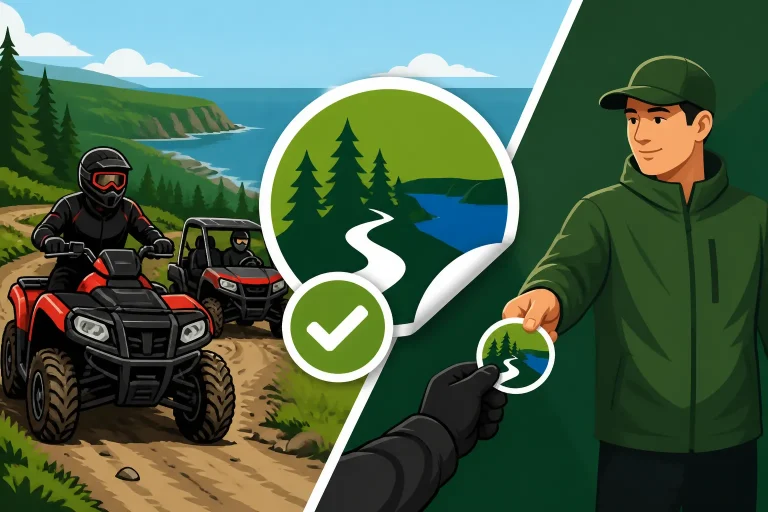
The sticker comes from the operator responsible for the managed trail, not from the office that registers your ATV. Start by identifying the trail or trail system you intend to use, then contact its operator to ask whether a sticker is required and how to obtain it. Access arrangements may differ by trail, so do not assume that a sticker issued for one managed trail automatically applies to another.
Use this process before your ride:
- Identify the trail and its operator. Check the trail information, signs, or local riding contacts. If it is not clear who manages the route, ask before travelling.
- Ask whether a sticker is required. Confirm that the trail is managed and whether there are additional access conditions, closures, or route restrictions.
- Ask how the operator issues stickers. Find out where to obtain one, what information is needed, how payment works, and whether you must arrange it before arriving. Fees and pickup arrangements can change, so confirm current details directly with the operator.
- Check any conditions attached to access. Ask whether the operator needs to see registration, insurance, training proof, or other information. A sticker does not replace those documents.
- Follow the operator’s instructions for carrying or displaying it. Some rules may allow a trail sticker to be attached to the machine or carried while riding. Confirm which option applies and make sure it is accessible if you are asked to show it.
- Keep your other documents ready. Carry required proof of registration, insurance, and training, as applicable. Keep the sticker separate from those documents so you can produce the right item when asked.
It is worth sorting this out before you load the ATV onto a trailer. A trail operator may not be able to issue a sticker at every access point, and a machine that is otherwise properly registered can still be turned away from a managed trail if the required access proof is missing.
The provincial sticker rules and a trail operator’s access arrangements are related but not identical. The operator can tell you how to obtain its sticker and what it requires at that trail; provincial sources can clarify the wider rules. For questions specific to the sticker itself, see How to Get a Newfoundland Trail Sticker. For operator responsibilities and access, Which Operators Can Issue a Trail Sticker is also useful.
What to check before you ride
Getting the sticker is only one part of preparing for a ride. Before leaving, confirm that your machine and your route meet the applicable requirements.
Registration and identification
Check that the machine is registered if registration is required for it and that its plate is fitted and visible as required. A trail sticker is not a plate, and a plate does not substitute for a trail sticker. If your machine is visiting from another province, check both the visitor rules and the managed trail requirements. A visitor’s registration status does not, by itself, answer whether the visitor needs a trail sticker.
Newfoundland Visitor Rules and the 30-Day Limit covers the visitor registration question. For the distinction between a machine’s plate and other identifiers, see Do You Get a Plate or a Decal?.
Training and insurance
Confirm whether the rider must have safety training and carry proof of it. Requirements can depend on the rider and circumstances, so do not treat the sticker as proof of training. Check that the machine also has the required insurance and that you can produce proof when needed. The operator may have its own check-in process, but that does not replace the province’s rules.
Newfoundland Training Required Under 16 explains one important training requirement. For insurance, see Newfoundland ATV Insurance Requirements.
Route access and land permission
Check that the trail is open and that your planned route is authorized for your machine. A sticker does not give permission to use every woods road, private road, or Crown land route. Restrictions may apply to specific areas, and signs or temporary notices can change where riding is permitted.
If you plan to connect a managed trail to another route, confirm that the connection is legal too. Ask the operator or relevant land manager about unclear sections rather than relying on a map line alone. [Newfoundland Crown Land Access Rules] offers more detail on riding in those areas.
Sticker placement or carriage
Follow the operator’s directions and the applicable rule on whether to attach the sticker or carry it. If it is attached, place it where it can be seen and is unlikely to be covered by mud, cargo, or equipment. If you are carrying it, keep it somewhere secure and easy to produce during a check. A sticker that is left at home, lost, or hidden in a packed trailer may not help when you reach the trail.
For more on the permitted options, see Newfoundland Stickers Attached or Carried. If you are checking the exact requirement, Attach the Sticker or Carry It in Your Pocket addresses this practical question.
Exemptions and common mistakes
Some riders may qualify for an exemption in specific circumstances, including certain riding on land owned by the rider or immediate family. There are also distinct provisions for particular communities and businesses. These are limited exemptions, not a general pass for riding without a sticker wherever you choose.
Do not assume that owning land near a managed trail makes the trail exempt, or that permission to ride on family land carries over to a managed route. The exact land, rider, machine, and type of use matter. If you believe an exemption applies, confirm it with the relevant authority or trail operator before riding. You can read more about Newfoundland Stickers From a Trail Operator and Land You or Your Family Own.
Visitors should be especially careful not to mix up a registration exemption with a sticker exemption. A visiting machine may be allowed to use its out-of-province registration for a limited period, but that does not necessarily remove managed-trail access requirements. Ask the operator about its rules for visitors and check the provincial visitor requirements separately.
Common mistakes include:
- Treating the sticker as a registration plate or registration permit.
- Assuming a registration plate is enough to ride a managed trail.
- Buying or collecting a sticker without checking whether it covers the intended trail.
- Assuming that a visitor exemption applies to trail access.
- Relying on a family-land exemption while riding beyond that land.
- Leaving the sticker or supporting documents at home.
- Turning up at a trailhead without checking where the operator issues stickers.
- Assuming a sticker means the trail is open or that every connecting route is permitted.
A short call or message to the operator can prevent a wasted trip. Ask what the sticker covers, where to get it, what proof to carry, and whether the route is open to your machine. If the operator’s instructions and what you find at the trailhead seem inconsistent, pause and clarify before riding.
Disclaimer
This article is for general informational purposes only and does not constitute professional advice. Laws, prices and regulations vary by location and change over time. Consult a qualified professional for guidance on your specific situation.