Newfoundland Visitor Rules and the 30-Day Limit
A Newfoundland riding trip can be straightforward until someone asks how long your out-of-province ATV or side-by-side can stay before local registration is required. The 30-day visitor exemption is useful, but it is only one part of the rules. Here’s how to plan around the limit, what paperwork to carry, and which other requirements still matter.
What Newfoundland’s 30-day visitor exemption means
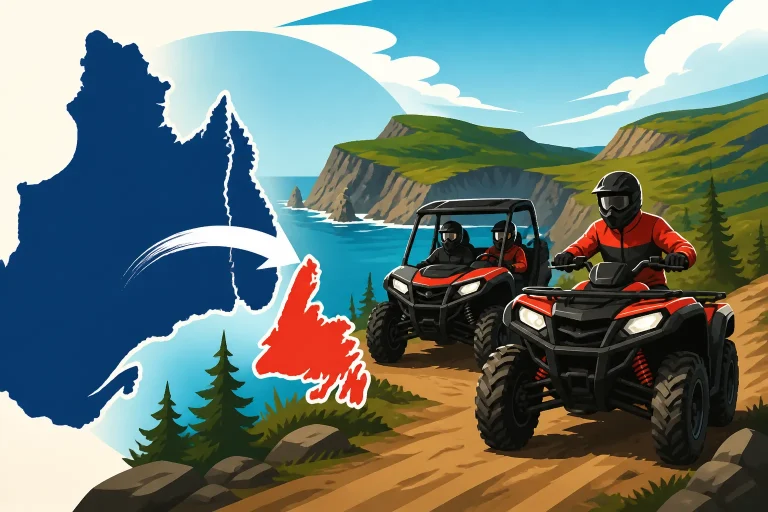
If your ATV or other off-road vehicle is registered in another province or territory, Newfoundland and Labrador generally allows you to operate it in the province temporarily without registering it there. The visitor exemption is limited to 30 days. If your stay or use goes beyond that period, you may need to register the machine in Newfoundland and Labrador.
This is a registration exemption, not a blanket pass from every local requirement. It does not automatically give you permission to ride on every road, trail, private parcel, or Crown land area. It also does not replace the need to carry valid documents or meet applicable insurance, equipment, training, and trail-access rules.
The key distinction is between where the machine is registered and where you are riding it. A machine with current registration from home may qualify for temporary use in Newfoundland and Labrador, but its owner still needs to follow the rules that apply where the machine is being operated.
For a plain-language look at the exemption itself, start with Newfoundland’s 30-Day Visitor Exemption. If you are bringing an ATV or side-by-side on a ferry, or driving in from Labrador, Bringing a Machine Registered in Another Province is also a useful companion topic.
| Your situation | What to check |
|---|---|
| You are visiting with a machine registered outside Newfoundland and Labrador | Keep the home registration current and confirm the visitor exemption applies to your machine and circumstances |
| You plan to ride for a short visit | Track how long the machine is in the province; do not assume the limit means 30 riding days |
| You are staying longer than the exemption allows | Contact the registry before the limit is reached and ask what is needed to register the machine locally |
| You recently moved to Newfoundland and Labrador | Treat this as a move, not simply a holiday; review the resident registration rules |
| You are riding on a managed trail | Check separately whether a trail sticker, training proof, or other trail-specific requirement applies |
| You plan to use a highway or shoulder | Check the highway rules, licence requirements, insurance, equipment, and permitted route |
The 30-day rule is most useful when you plan for it before travelling. It is easy to lose track of the machine’s time in the province when you are splitting a trip between a campground, a cabin, and several trail areas. Keep a simple record of when the machine arrived and when it leaves. If your plans change, ask the registry how the limit applies before you ride beyond it.
Who should look closely at the exemption
The visitor rule is most relevant to someone who brings a machine that is already registered elsewhere and intends to use it temporarily in Newfoundland and Labrador. That could include a rider from another province, a seasonal visitor bringing a quad to a cabin, or someone passing through with a machine on a trailer.
It is not safe to assume that every machine from outside the province qualifies automatically. The machine should be properly registered in its home jurisdiction, and the registration should be current. If it has no plate, has an unclear ownership history, is newly purchased, or is registered under someone else’s name, check the details before travelling.
If the machine is registered in another province, that does not necessarily settle questions about ownership or permission to use it. Carry paperwork that connects you to the machine, especially if the registration shows another person or a business as the owner. The general rules for an out-of-province machine are covered in Newfoundland Rules for an Out-of-Province Machine.
A visitor exemption is not a new registration
The exemption lets a qualifying visitor use a machine temporarily without completing Newfoundland registration. It does not mean that the machine has been registered locally, and it does not give it a Newfoundland plate or permit.
That distinction matters if you are stopped, asked for documents, or applying to use a trail with separate access requirements. A home registration document and a Newfoundland registration permit are not interchangeable. Carry the document that actually applies to your machine and be prepared to explain that it is registered in another jurisdiction.
If you are unsure what proof is useful to carry, see Newfoundland Proof of Ownership on the Trail. For a broader look at what a Newfoundland registration document says, What the Registrar’s Permit Says About Your Machine explains the local document rather than the visitor exemption.
How to count the 30 days and plan your stay
The safest approach is to treat the limit as a period of time in the province, not as an allowance for a certain number of rides. Do not assume that you can ride for 30 separate days spread across a much longer stay, or that the clock pauses whenever the machine is parked.
Likewise, do not assume that a short trip out of the province restarts the clock. The precise application of the rule can depend on your circumstances, and a border crossing or brief absence may not have the effect you expect. If your itinerary includes travel in and out of Newfoundland and Labrador, ask the registry how it counts the time before relying on a reset.
The visitor limit is easy to underestimate when the machine arrives before you do, stays at a cabin after you return home, or remains in the province between separate visits. The important question is not only how many days you personally rode. You should establish how the rule applies to the machine’s presence and use, then keep records that support your understanding.
Use a calendar, not your memory
Before you travel, write down the date the machine enters the province and the date you expect it to leave. If a ferry, road trip, or shipment changes your arrival plan, update the record. Keep receipts, ferry confirmations, or other travel records if they help establish the machine’s movements.
A simple note on your phone is often enough for personal tracking. For a business fleet or a machine used by several family members, keep a shared log. Record who brought it in, where it is stored, and when it leaves. This helps avoid a common problem: the person riding the machine does not know when it arrived.
Do not count only days when the machine is being operated. If it stays at a cabin while you take a week away, or is stored while the weather is poor, that does not necessarily mean the time should be ignored. Ask the registry rather than inventing a calculation that suits your itinerary.
Ask before you reach the limit
If you expect to stay beyond 30 days, contact the registry early enough to act on its answer. Waiting until the last day leaves little room to resolve missing paperwork, ownership questions, appointments, or payment arrangements. It is particularly risky if the machine has been bought recently or has passed through several owners.
For current steps and timing, see What a Visitor Does After Thirty Days and Newfoundland Registration Processing Time. Processing time can depend on the paperwork and the type of application, so do not plan around an assumed same-day result.
If you are moving to the province rather than visiting, look at Ninety Days in Newfoundland Before You Must Register and Newfoundland Registration for a New Resident. The new-resident rules are a separate situation. A person who has moved may have obligations that do not match the temporary visitor exemption, even if the machine arrived with a current registration from elsewhere.
Keep the machine’s status clear
A visitor should be able to answer three practical questions:
- Where is the machine registered?
- Is that registration current?
- When did the machine enter Newfoundland and Labrador?
If you cannot answer those questions, sort them out before riding. A clear document folder and a travel-date note can prevent an avoidable roadside conversation or a last-minute scramble at the registry.
What documents to carry while visiting
Carry the home registration document for the machine, proof of ownership or permission to use it, and any insurance documents that apply. Keep them somewhere protected from rain and mud, but accessible enough to produce when asked. If your documents are digital, confirm you can open them without cellular service and consider carrying a paper backup where practical.
The registration should identify the machine clearly. Check that the vehicle identification number, or VIN, on the document matches the VIN on the machine. Make sure the plate is mounted as required where you are riding and is not obscured by mud, cargo, or accessories. A plate hidden by a fuel can or a load of camping gear is still a problem even if the paperwork is correct.
If someone else owns the machine, carry written permission to use it and a way to contact the owner. If you are travelling with a borrowed ATV, a vague explanation may not be enough to resolve questions about authority or ownership. If the machine belongs to a company, have the relevant business documentation available and confirm who is authorized to ride it.
Check the registration before departure
Before loading the machine, inspect the registration document for:
- The owner’s name and address
- The machine’s make, model, and identifying number
- The registration or permit status
- Any restrictions or conditions shown on the document
- A clear match between the paperwork and the machine
If the details are wrong, contact the home registry or issuing authority before leaving. A mismatch can be difficult to fix from a remote trailhead, especially if the error involves an ownership change or an incorrect VIN.
For machines with a recent sale, bring the bill of sale and any transfer papers as well as the registration. If you bought the machine privately, do not rely on the seller’s old document as proof that the registration has already been transferred to you. Ownership and registration are connected, but they are not the same thing.
Make a plan for weak cell service
Some riding areas have limited or unreliable mobile coverage. Download or save digital copies of important documents before leaving town, and carry paper copies if that is practical. Store originals securely rather than leaving them loose in a wet glove compartment or cargo box.
A photograph of a registration document can be a useful backup, but it is not always a substitute for the document itself. Ask the relevant authority what forms of proof it accepts. Do not assume that a screenshot, a photo of a plate, or an online account will be enough in every situation.
You can use a small waterproof document pouch for paperwork, a map, and emergency contacts. If you are shopping for basic supplies, Amazon may offer document pouches and compact first-aid kits, but check the item’s dimensions, closure, and water resistance rather than relying on a product title alone. The same goes for trail accessories: a low-cost pouch that leaks is not much help in a wet storage box.
The other rules visitors still need to follow
The 30-day exemption addresses local registration. It does not cancel other rules that apply to visitors. A machine can be properly registered at home and still be operated unlawfully if the rider lacks required insurance, rides in a restricted area, ignores a local bylaw, or uses a road where ATV travel is not allowed.
Think of the trip as having several separate checks:
- Registration: Is the machine properly registered where required, and does the visitor exemption apply?
- Insurance: Does the coverage apply to the machine, rider, location, and intended use?
- Access: Is the route or land open to the machine?
- Trail requirements: Does a managed trail operator require a sticker, training proof, or other condition?
- Rider requirements: Does the operator meet the applicable age, licence, training, helmet, and supervision rules?
- Equipment: Is the machine equipped and maintained to meet the rules where it is being used?
Passing one check does not automatically pass the others.
Insurance is a separate question
Do not assume that registration from home proves that you have the coverage required for riding in Newfoundland and Labrador. Read the policy, ask your insurer about the planned use, and make sure the coverage is valid in the province and on the types of routes you intend to use.
Some policies may distinguish between private land, trails, roads, commercial use, or a machine operated by someone other than the named owner. Confirm those details before travelling, especially if you are lending the machine to a relative or joining an organized ride.
A visitor should also know how to show proof of insurance if asked. Keep a copy that can be accessed offline and verify that the policy information is current. For more detail, see Insurance a Visitor Still Carries in Newfoundland. If you plan to ride on a highway or shoulder, insurance is only one part of the check; route rules and licence requirements matter too.
Road and highway use is not the same as trail use
A road may look like a convenient connection between two trails, but that does not make it legal for an ATV or side-by-side. Rules can vary by road type and location, and municipal bylaws may impose restrictions beyond provincial requirements. Check the exact route rather than relying on a map line or an assumption that local riders use it.
Where highway operation is allowed, the rider may need the appropriate driver’s licence and must follow the relevant equipment and operating rules. Visitors Still Need a Driver’s Licence on Highways is a useful starting point. For the broader road question, see Can You Ride an ATV on the Road in Newfoundland?.
A visitor’s out-of-province registration does not grant permission to ride on a highway. Nor does it authorize riding on a road that is closed to ORVs, a private woods road without permission, or a trail that is restricted to another type of machine.
Managed trails may have their own requirements
A provincial visitor exemption does not automatically settle whether a managed trail operator requires a sticker or other proof. Trail access requirements can be different from vehicle registration rules. Before setting out, identify who manages the trail and check that operator’s current requirements.
This is particularly important for a visitor who expects to ride a popular corridor or a managed trail network. Confirm whether the machine must display a sticker, whether the operator accepts a visitor’s registration document, and whether training proof is required for the rider. If you are riding several areas, do not assume that one operator’s sticker or permission covers all of them.
The operator is often the best place to ask about trail-specific access. For an overview of how local stickers fit into riding requirements, see Managed Trails Require a Sticker on Your Machine and Newfoundland Visitors Registered Elsewhere.
Training, helmets, and passengers still matter
Visitors should check the age, training, supervision, helmet, and passenger rules before riding. Do not rely on the rules from home being identical. A young rider who is allowed to operate a machine in another province may face different conditions in Newfoundland and Labrador, and a parent riding nearby does not automatically satisfy every supervision requirement.
The same caution applies to passengers. A machine needs to be designed and equipped for the number of people aboard. Do not carry a passenger on a rack or improvised seat. Check the machine’s manual and the applicable rules, particularly if children are riding as passengers.
For the current requirements, consult Newfoundland Safety Training Is Mandatory, Newfoundland Helmet Law for Every Rider, and Newfoundland Passenger Seat Requirements. A visitor should verify which requirements apply to their particular situation rather than treating a home-province certificate or habit as automatic proof of compliance.
Trail access, land permission, and local restrictions
A valid registration is not a trail permit. It does not give you permission to cross private land, ride a restricted Crown land route, enter a park where machines are prohibited, or use a community road that has a local restriction.
This is a frequent source of confusion because a machine can be legal to own and still be in a place where riding it is not allowed. Before you leave the trailer, confirm that your planned route is open to your type of machine and that you have permission where it is needed.
Check the route, not just the destination
A map may show a trail or old road without showing its current status. It may cross private land, a wetland, a restricted area, or a community that has its own rules. Check current maps, posted signs, trail operator notices, and local bylaws. If you cannot verify a segment, choose a route you can confirm rather than assuming access.
For Crown land, distinguish between an approved area, a restricted area, and a marked trail through a restricted area. A machine being permitted somewhere nearby does not mean it can travel anywhere in the surrounding landscape. Review Finding Approved Areas on the Provincial Map and [Newfoundland Restricted Area Permissions] before planning a ride.
If your route crosses private land, get permission from the landowner. A public-looking woods road may still be private, and an open gate is not a reliable sign that motorized access is welcome. Written permission is sensible when the access is important to your trip. See Permission From a Landowner Before Crossing Private Ground for the related access issue.
Parks and community rules can change your route
Do not assume that a trail network continues through a provincial or national park. Parks may have their own rules and may prohibit machines away from designated roads or areas. Confirm directly with the park or official land manager before including a park in your route.
Municipal rules matter too. A road that is open to an ATV in one community may be closed in the next. If your route includes a town or settlement, ask whether the specific street or road is open to ORVs. Newfoundland Municipalities With ORV Bylaws and How a Town Council Writes Its Own ORV Bylaw can help explain why local checks matter.
Trail conditions are a safety and access issue
Newfoundland weather can change quickly, and wet ground can turn a passable trail into a damaging bog. Riding around a closure or widening a track can harm the land and may create more restrictions for future riders. Respect signs, barriers, and seasonal notices even if the route appears usable.
Plan a route that fits your machine, experience, and weather conditions. Tell someone where you are going, carry a map that works without signal, and have a turnaround plan. If you are travelling with a group, agree on what to do if the group gets separated or a machine breaks down.
A visitor may be tempted to rely on a phone map alone. Download a map before leaving service, keep the route details available offline, and consider a paper backup for remote areas. Amazon can be one place to look for waterproof map cases or compact power banks, but check that any electronics can tolerate cold, moisture, and vibration. A battery pack does not replace a route plan or a way to navigate if the phone fails.
If you are staying longer than 30 days
If your plans extend beyond the visitor exemption, do not wait until the limit has passed to ask about local registration. Contact the registry, explain where the machine is registered and how long it will remain in the province, and ask what process applies. The answer can depend on whether you are still a visitor, have become a resident, bought the machine locally, or are using it for a business.
The registry may need ownership and vehicle information before it can advise you on the next step. Gather the current registration document, proof of ownership, the VIN, and any bills of sale or transfer paperwork. If the machine has multiple owners or a complicated history, say so at the outset rather than submitting an incomplete application.
For a complete explanation of local registration steps, read How to Register an ATV in Newfoundland. If you have moved, compare the process with Newfoundland’s 90-Day New Resident Rule. That title refers to the new-resident situation; it should not be treated as an extension of the visitor exemption.
Expect paperwork questions
A straightforward case is easier to resolve when the registration and ownership documents agree. A less straightforward case may involve a bill of sale, a transfer not completed in the home province, a missing permit, or a chain of previous owners.
If you bought the ATV shortly before bringing it into the province, bring the sale documents and ask how the transaction affects registration. If the seller did not provide a proper bill of sale, deal with that before travelling where possible. The registry may require additional proof or forms when ownership is unclear. Helpful background includes Newfoundland Registration Paperwork Explained and Newfoundland Transfer of Ownership Explained.
Do not alter a VIN, make a guessed correction, or rely on a seller’s verbal assurance if an identifying number is damaged or unreadable. Ask the appropriate authority how to resolve the issue before trying to register or ride the machine.
Budget and timing need a check
Local registration may involve an application process, paperwork, and fees. Those can vary by machine type and situation, and current amounts or payment methods should be confirmed with the registry. Do not assume the fee structure is the same as your home province, or that a local fee is recurring. Newfoundland registration rules include details that differ from many riders’ expectations; see Newfoundland ORV Registration Cost and Newfoundland ORV Registration You Pay Once for background.
Check whether you need an appointment, what original documents are required, and how long processing might take. If registration is required, do not continue riding on the assumption that an application in progress is equivalent to approval. Ask the registry what you may lawfully do while the application is being handled.
A move is different from a long visit
A rider who has moved to Newfoundland and Labrador should not rely on the visitor rule simply because the machine is still registered elsewhere. Residency can affect the deadline and the steps required. If you recently moved, explain that to the registry and ask which rule applies to you.
The same caution applies to a seasonal property owner who spends part of the year in the province. Owning a cabin does not necessarily make someone a visitor for every legal purpose, and the length or pattern of visits may matter. Describe the real arrangement rather than trying to fit it into a convenient label.
For additional context, see Moving to Newfoundland With a Machine You Already Own and Newfoundland Registration Questions After a Move. If the machine is used only at a cabin, Does a Cabin-Only Machine Still Need Registering? addresses a related but separate question.
A practical checklist before you ride
Use this checklist before bringing an out-of-province machine into Newfoundland and Labrador. It will not replace official advice, but it can help reveal gaps while you still have time to fix them.
- Confirm the machine’s home registration. Check that it is current and that the details match the machine.
- Confirm who owns it. Bring a bill of sale, business paperwork, or written permission if the rider is not the registered owner.
- Record arrival and departure dates. Track the machine’s time in the province rather than counting only the days you ride.
- Ask about the exemption if your trip is close to the limit. Do not guess how a stopover or short trip outside the province affects the calculation.
- Check insurance. Ask your insurer whether the policy covers the machine, rider, location, and planned use.
- Check the route. Verify that trails, roads, private land, and Crown land areas are open to your type of machine.
- Ask the trail operator about separate requirements. Confirm whether a sticker, training proof, or other condition applies.
- Review rider and passenger rules. Check age, supervision, licence, helmet, and passenger-seat requirements.
- Prepare documents for poor cell service. Save copies offline and carry paper copies where practical.
- Contact the registry early if the trip may run long. Ask what applies before you exceed the visitor period.
A visitor who works through this list is less likely to confuse a registration exemption with permission to ride anywhere. The details are separate, but they fit together: the machine needs a valid status, the rider needs to meet the applicable rules, and the route must be open.
If you are close to the 30-day point, or your situation does not fit a simple holiday visit, make the registry call before the trip rather than during it. Give them the machine’s registration jurisdiction, the dates it will be in the province, whether you are visiting or moving, and whether anyone else owns or operates it. Clear facts usually make it easier to get a useful answer.
Disclaimer
This article is for general informational purposes only and does not constitute professional advice. Laws, prices and regulations vary by location and change over time. Consult a qualified professional for guidance on your specific situation.