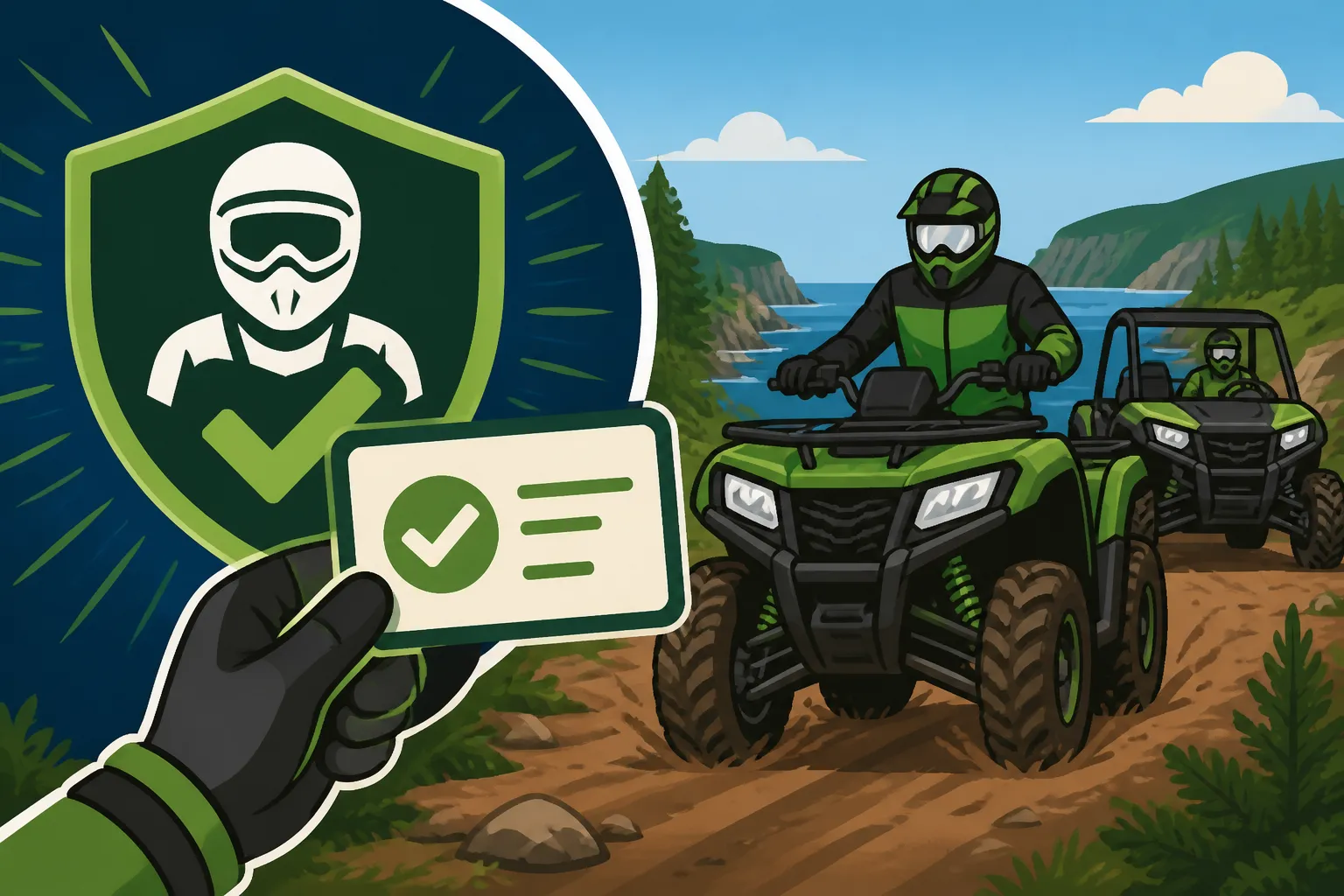
Carrying Your Safety Certificate on Every Ride
If you completed off-road vehicle safety training, it can be easy to leave the certificate at home or mix it up with your registration papers. Here’s who needs training in Newfoundland and Labrador, what proof to carry, and what the rules say if an officer asks to see it.
Who needs an off-road vehicle safety certificate
Safety training is required for some operators, not automatically for everyone. According to the Government of Newfoundland and Labrador, the requirement applies to anyone under 16, anyone registering an off-road vehicle for the first time, and anyone directed by the Registrar of Motor Vehicles to complete training after an offence that led to a suspension or cancellation of registration.
These are separate situations. An adult who has ridden before may still need training when registering a vehicle for the first time. A young operator may need training regardless of whether the vehicle has been registered for years. If the Registrar requires training after an offence, the operator should follow the specific direction they receive.
| Situation | What it means for training proof |
|---|---|
| You are under 16 | Complete the required training and have proof available when riding. |
| You are registering an off-road vehicle for the first time | Complete training as required and keep the certificate accessible. |
| The Registrar directs you to complete training after an offence | Follow the direction and retain proof of completion. |
| You are not in one of these categories | Training may not be mandatory for you under these requirements, but check whether another rule or circumstance applies. |
The certificate is proof that the required training was completed. It is not the vehicle’s registration document, and it does not replace a plate, insurance proof when required, or a trail permit. Keeping these papers separate in your mind helps avoid a common mix-up: one document shows that a vehicle is registered, while the training certificate shows that an operator completed the required safety program.
For details about the groups covered by the training rule, see Newfoundland Training Required Under 16 and Newfoundland Training for First-Time Registrants. If you are still figuring out whether training applies to your situation, Newfoundland Training for an Adult covers the adult-operator question.
What carrying the certificate means in practice
Digital Government and Service NL says that after completing the safety training, users can print a certificate to carry while using an off-road vehicle. That makes carrying a paper copy a practical way to have proof close at hand on a ride. You can print the certificate at home after finishing the program, and you should check that the printout is readable before putting it away.
There is also a specific response period if proof is requested. According to Government Services, an operator who is required to complete mandatory training must provide proof of completion within 2 business days if a peace officer requests it. This is not the same as saying you can ignore a request: take it seriously, ask what proof is needed if that is unclear, and arrange to provide it within the stated period.
The safest approach is to carry the certificate rather than rely on finding it later. A ride can take you away from home, and you may not have reliable phone service or easy access to a printer. Having a paper copy with you makes it easier to demonstrate that you completed the training and avoids a scramble after a request.
If your certificate is available electronically, you may also keep a digital copy as a backup. But do not make a phone the only way to access it. A dead battery, a damaged device, or poor reception can make a saved file inconvenient to retrieve. A printed copy remains useful even when your phone is unavailable.
You can find more about the certificate itself in A Newfoundland Certificate You Print at Home. For a broader overview of what riders may need to show, see What an Officer Can Ask You to Produce. The important point is to keep training proof distinct from registration paperwork: carrying one does not mean you have the other.
How to get and protect your proof
Digital Government and Service NL offers a free off-road vehicle safety training program through MyGovNL. Users are advised to review the Off-Road Vehicles Handbook before completing the program. Other courses approved by the Registrar of Motor Vehicles, including in-person training, are also accepted. The online training may also be completed by visiting a local Employment Support Centre or public library.
According to Government Services, passing the safety training test requires a minimum score of 80 percent. Once you complete the training, print the certificate and check that your name and the completion information are legible. If a name or other detail appears incorrect, sort that out through the relevant training or government contact rather than assuming the certificate will be accepted as it is.
A simple storage routine can make the certificate easier to find when you need it:
- Put the printed certificate in a waterproof document sleeve or small pouch.
- Store it with your vehicle papers, but keep it separate from the registration document so you can identify each quickly.
- Choose a place on the vehicle that stays dry and is easy to reach without unloading cargo.
- Keep a backup copy at home or on your phone, while treating the paper copy as the one you plan to carry.
- Replace a torn, faded, or water-damaged copy with a fresh printout if you can access the certificate again.
A slim waterproof sleeve from an outdoor retailer or Amazon can help protect a paper copy from rain, mud, and condensation. Keep it somewhere secure; loose paperwork can be lost when you open a storage compartment or shift gear.
If you ride with family members, make sure each person who is required to complete training has their own proof available. One rider’s certificate does not demonstrate that another rider completed the program. This matters particularly when an adult is supervising a young operator: the supervisor should make sure the young person has completed the required training, rather than relying only on the adult’s papers.
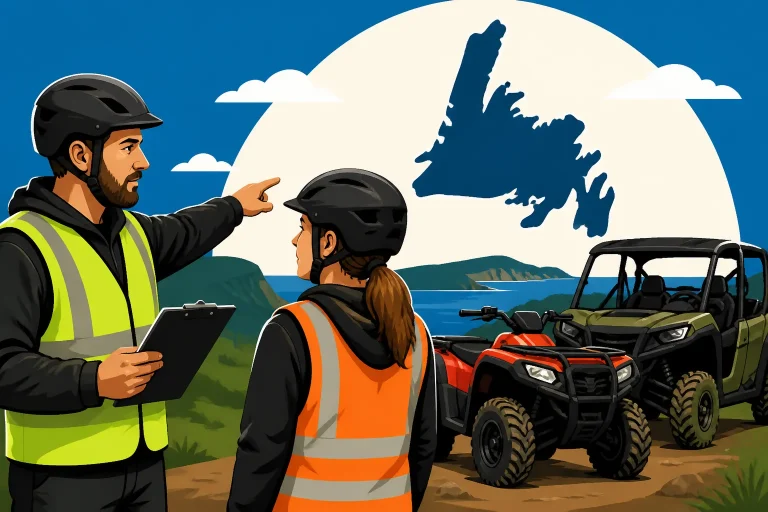
Training is only one part of being ready to ride. According to the Government of Newfoundland and Labrador, anyone under 16 must be supervised by a licensed driver who is at least 18 years old. The supervisor must be able to see the young operator, provide direction, and ensure the operator can see them. Check the details of Newfoundland Supervisors and Training Duties if you are arranging a ride with a young person.
Also keep the certificate separate from the safety gear you need on the vehicle. Digital Government and Service NL says helmets are required for off-road vehicle riders, with a limited hunting and trapping exception involving frequent stops and speeds under 20 km/h. According to the Government of Newfoundland and Labrador, riders and passengers must also wear safety glasses, goggles, or a face shield if the vehicle lacks a windshield of sufficient height, and seatbelts must be worn when installed. The certificate does not replace any of those requirements. See Newfoundland Helmet Law for Every Rider for more on helmet rules.
A practical pre-ride check
Before heading out, take a moment to check that the right documents and equipment are with the right people. This is especially useful when a machine is shared, a young operator is riding, or the group is travelling farther from home.
- Confirm whether each operator needs training. Check whether the under-16, first-time registration, or Registrar-directed requirement applies.
- Make sure required training is complete. Do not treat registration or supervision as a substitute for the course.
- Pack the certificate. Carry the printed proof where it will stay dry and can be reached without unpacking the vehicle.
- Keep vehicle documents separate. Registration papers, insurance proof when required, trail permits, and training certificates serve different purposes. Newfoundland Registration Paperwork Explained can help clarify the registration side.
- Check the vehicle and required safety gear. A certificate does not authorize riding an unregistered vehicle or remove other equipment and operating rules.
- For a young operator, confirm supervision. Make sure the supervisor meets the requirements and can maintain the required visibility and direction.
- Be ready to respond to a request. If a peace officer asks an operator who is subject to mandatory training for proof, Government Services says it must be provided within 2 business days.
The certificate is a small item, but leaving it behind can create an avoidable problem. Treat it like the other ride essentials: protect it from the weather, keep it with the operator who needs it, and check for it before leaving. For more on what riders may need to carry beyond training proof, see Newfoundland Insurance Proof on the Trail and Newfoundland Proof Carried While Riding.
Sources
- Government Services — Off-Road Vehicles Safety – Government Services (checked November 3, 2026)
- Government of Newfoundland and Labrador — Off-Road-Vehicle-Training-Manual-24173.pdf (checked November 3, 2026)
- Digital Government and Service NL — Public Advisory: Off-Road Vehicle Training Now Available on MyGovNL – News Releases (checked November 3, 2026)
- Digital Government and Service NL — Public Advisory: Helmets and Seatbelts Mandatory for Off-Road Vehicles as of May 19 – News Releases (checked November 3, 2026)
- Digital Government and Service NL — Public Advisory: Residents Reminded to Practice Off-road Vehicle Safety – News Releases (checked November 3, 2026)
- Digital Government and Service NL — New Legislation Increases Safety for Off-Road Vehicle Users – News Releases (checked November 3, 2026)
- Government of Newfoundland and Labrador — Offroadsafety-summer.pdf (checked November 3, 2026)
- Government of Newfoundland and Labrador — Offroadsafety-winter.pdf (checked November 3, 2026)
Disclaimer
This article is for general informational purposes only and does not constitute professional advice. Laws, prices and regulations vary by location and change over time. Consult a qualified professional for guidance on your specific situation.