What Gets Checked at a Managed Trail Gate
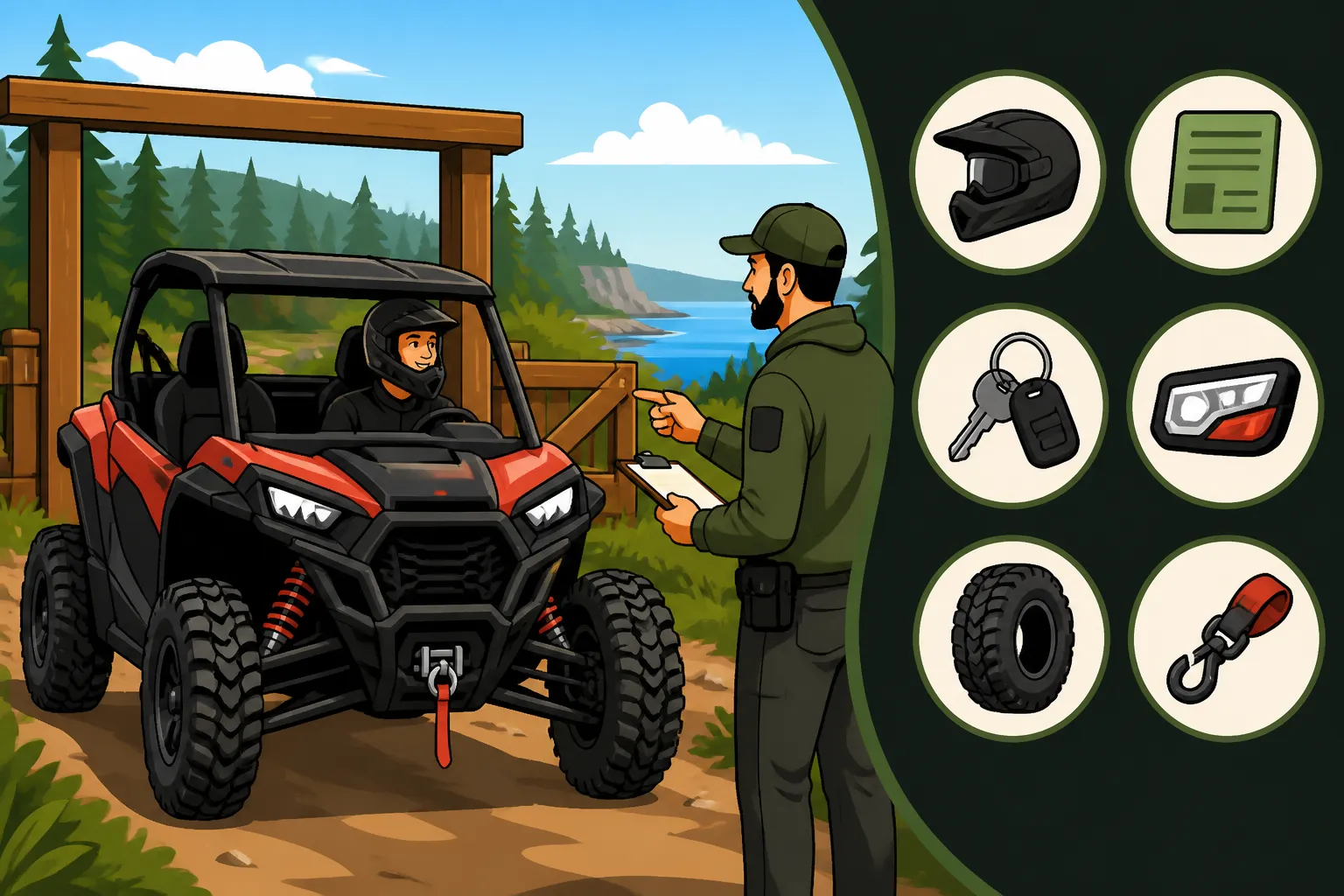
A managed trail gate is not just a place to show a sticker. Riders may be asked to confirm that their machine and trip meet the trail operator’s access rules, and to produce required documents. Knowing what to carry helps prevent delays, especially if you are visiting Newfoundland with an out-of-province ATV or side-by-side.
What a managed trail gate may check
There is no single checklist that every gate follows. Some trails have a staffed access point, while others rely on signs, remote checks or patrols. An operator may check access requirements at the gate; a peace officer may separately enforce provincial laws. A check at one gate is not a guarantee that every other requirement has been met.
The most useful approach is to arrive ready to show the items that apply to your ride:
| Item | Why it may be checked | What to have ready |
|---|---|---|
| Managed trail sticker or other access authorization | Confirms that you have met the operator’s access requirement | Attach the sticker as directed or carry it if that is permitted |
| Safety training proof | Shows that you have the required certificate if the training rule applies to you | Keep the certificate available while riding |
| Registration permit and plate | Helps identify the machine and confirm its registration status | Carry the registration document and keep the plate visible |
| Insurance proof | Shows that the machine has applicable coverage | Keep proof accessible, including for an out-of-province machine |
| Rider’s licence or age-related information | May help confirm that a rider is permitted to operate the machine | Carry the required licence and follow supervision rules |
| Event or group permission | May apply to organized rides or special access arrangements | Follow the event organizer’s and trail operator’s instructions |
A gate attendant may not ask for every item on the table. They may focus on the trail sticker, group booking, machine type or another condition specific to that access point. But you should not assume that an item will never be requested just because it was not checked on a previous ride.
A managed trail sticker is different from vehicle registration. Registration identifies the machine under provincial rules; the sticker or other authorization concerns access to a managed trail. One does not automatically replace the other. Read Managed Trails Require a Sticker on Your Machine and Which Operators Can Issue a Trail Sticker before setting out, especially if you are unsure whether your planned route is managed.
If you are using a rental machine, ask the operator which documents and trail permissions are already supplied and which obligations remain yours. A rental shop’s answer should be specific to the route and the machine, not just a general statement that the vehicle is ready to ride.
Stickers, training proof and registration
Trail access authorization
Managed trails have their own access requirements. The sticker generally needs to come from an operator authorized to issue it. Do not assume that a sticker from another province, a club membership card or a registration plate is accepted in its place.
Check the operator’s current instructions before riding. They should tell you whether the sticker must be attached to the machine, whether carrying it is acceptable, and what to do if it is damaged or missing. Requirements can differ by operator and access arrangement, so follow the instructions for the trail you intend to use. See How to Get a Newfoundland Trail Sticker and Newfoundland Managed Trail Rules.
Some riders may qualify for an exemption, such as a rider using land they or an eligible family member own. Exemptions are limited: they should not be treated as permission to use any managed trail without checking its rules. If you believe an exemption applies, confirm it with the relevant operator before travelling. The details in Land You or Your Family Own and Labrador Inuit Settlement Area and the Sticker Exemption can help identify questions to ask.
At a gate, have the sticker or other authorization ready rather than searching for it while holding up the line. If a sticker is on the machine, keep it visible and in good condition. If the operator allows it to be carried instead, store it somewhere dry and easy to reach.
Training certificate
Safety training is a separate requirement from trail access. If the training requirement applies to you, carry proof while riding and be prepared to produce it when asked. Passing a test or course but leaving the certificate at home can create a practical problem when proof is requested. The process and accepted proof are covered in Newfoundland Safety Training Is Mandatory and Carrying Your Safety Certificate on Every Ride.
Do not rely on a gate attendant to decide whether you personally qualify for an exemption. Training rules can depend on the rider and circumstances. If you are uncertain, check the current provincial instructions before your trip, and carry the certificate if you have one. For a minor, make sure the supervision and training arrangements are clear before leaving home; Newfoundland Supervisors and Training Duties explains the role of the supervising adult.
Registration and plate
A registration plate and permit are not trail stickers. A gate operator may check whether the machine is identified or belongs to the person using it, but the registration obligation exists independently of the trail operator’s process. Keep your plate visible and unobstructed, and have the permit available in case it is requested. Newfoundland Permits, Plates and Decals explains how those items differ.
This is especially important when a machine has recently changed hands, has paperwork gaps or is registered to someone who is not on the ride. Resolve those issues before reaching the trailhead rather than expecting a gate attendant to sort them out. See Newfoundland Registration Paperwork Explained for the documents that may matter.
What visitors and out-of-province riders should prepare
An out-of-province registration does not automatically remove Newfoundland’s trail-access requirements. A visitor may be allowed to use a machine registered elsewhere for a limited period without registering it in Newfoundland, but that is a registration rule, not a general waiver from trail stickers, insurance or other riding requirements. Check Newfoundland’s 30-Day Visitor Exemption and Bringing a Machine Registered in Another Province for the distinction.
Before the trip, confirm three separate things:
- Registration status: Check whether your machine can remain registered in its home province during your stay or whether you need to register it in Newfoundland.
- Trail permission: Ask the operator whether the specific route requires a managed trail sticker or another form of authorization.
- Insurance and riding documents: Carry applicable insurance proof and any training certificate or licence required for your circumstances.
Visitors should not assume that a gate attendant will accept a home-province document as proof of every Newfoundland requirement. A plate from another province can identify the machine, but it does not necessarily show that you have trail access permission or satisfy a separate provincial obligation. The same distinction matters for insurance: a visitor still needs suitable coverage, even if the machine is not required to be re-registered during a short stay. See Newfoundland Visitors Still Need Insurance and Newfoundland Insurance Proof at a Trailhead.
If you are travelling with several machines, check each one. A sticker or permit associated with one machine should not be assumed to cover the whole group. Likewise, make sure the documents match the machine’s plate and identification details. A mismatch can turn a quick check into a longer conversation.
For a group ride, assign one person to confirm the operator’s rules before departure and make sure every rider knows what to carry. The organizer should not assume that a single group booking or one person’s paperwork covers all participants. For an organized event, additional permission or insurance conditions may apply; see Getting a Permit for an Organized Trail Event.
How to make the gate check quick and avoid trouble
A little preparation makes the interaction easier for you, the operator and the riders behind you.
- Check the route and operator before travelling. Confirm that the trail is open to your type of machine and that you understand its access rules. A route described informally as a trail may have restrictions or closures.
- Ask what the gate checks. Contact the trail operator about the sticker, proof of training, group access and any current conditions. Do not rely on an old post or a friend’s recollection.
- Match documents to each machine. Check that the registration information and plate correspond, and keep insurance details accessible. If the machine is borrowed or rented, ask who is responsible for each document.
- Make papers easy to retrieve. A waterproof document pouch can keep a registration permit, certificate and insurance card together. A small pouch from a general retailer such as Amazon may be convenient, but any durable, water-resistant holder that stays secure on the ride can do the job.
- Keep the plate and sticker visible. Mud, cargo or accessories can obstruct identifying information. Clean or reposition items before reaching the gate.
- Follow instructions calmly. If a staff member says a document or permission is missing, ask what specific requirement applies and what the operator recommends. Do not ride onto a restricted trail while trying to resolve the issue later.
A gate check can also reveal an access problem that is not simply a missing sticker. The trail may be closed, unsuitable for your machine, restricted to a marked route or subject to a special condition. If you are told the route is not open to your machine, stop and verify the rule with the operator rather than taking another route around the barrier.
Keep provincial road rules in mind too. A managed trail sticker is not permission to ride on every road, woods road or private property along the way. Access permission, vehicle registration and lawful route use are separate questions. For route planning, Newfoundland Crown Land Access Rules and Permission From a Landowner Before Crossing Private Ground help explain why a mapped or familiar track is not necessarily open to all riders.
If a gate is unstaffed, the lack of an attendant does not mean the requirements have disappeared. Follow posted signs and carry the same documents you would bring to a staffed access point. If a sign is unclear, contact the operator before riding rather than treating uncertainty as permission.
The simplest way to avoid a return trip is to treat the gate as a final check, not the first place to find out what the rules are. Confirm the operator’s current access conditions, carry your relevant documents, and keep the machine’s plate and sticker visible. That preparation does not replace compliance with provincial rules, but it makes it easier to show that you have done your part.
Disclaimer
This article is for general informational purposes only and does not constitute professional advice. Laws, prices and regulations vary by location and change over time. Consult a qualified professional for guidance on your specific situation.