Why Newfoundland Has No Spark Arrester Rule
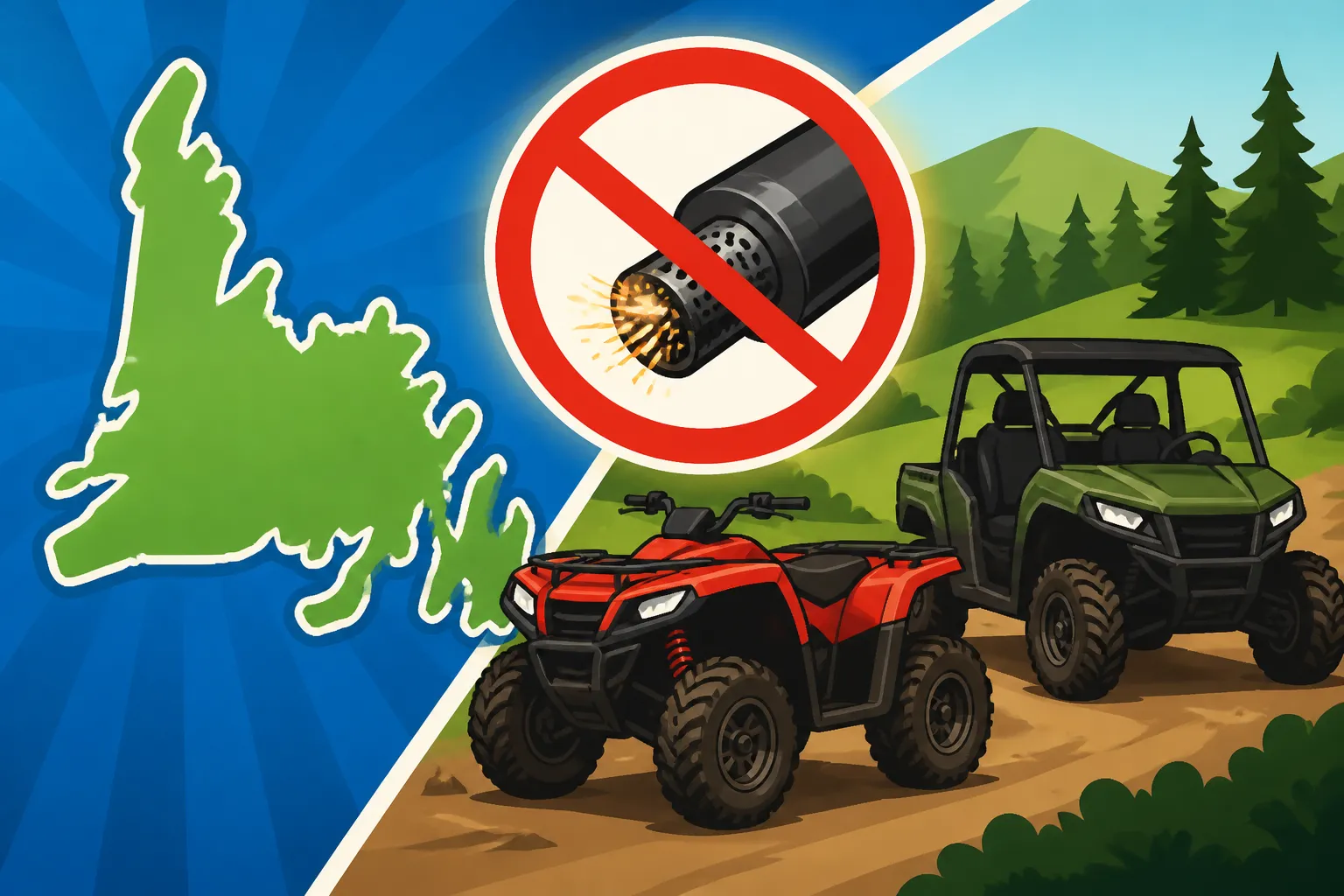
Newfoundland ATV riders often hear that a spark arrester is not required and assume that means any exhaust setup is acceptable. It does not. The provincial rules distinguish between a standalone spark-arrestor requirement and other equipment and riding restrictions. Knowing that difference helps you check your machine and avoid treating one missing rule as permission to ignore the rest.
What the rule does and does not require
Newfoundland’s off-road vehicle rules do not set a general requirement for every ATV or side-by-side to have a separate spark arrester. That does not mean the rules have no exhaust requirements, or that riders can remove or alter parts without consequence.
A spark arrester is designed to help stop hot particles from leaving an engine’s exhaust. A muffler, by contrast, reduces exhaust noise and is subject to its own equipment requirements. Some machines may have an exhaust system that includes a spark-arresting screen as part of the original design, but that does not make a standalone arrester a universal provincial requirement.
The practical distinction is important: no standalone spark-arrester rule is not the same as no exhaust rule. A machine still has to meet applicable equipment standards, including the requirements for its exhaust and muffler. For a broader overview of those requirements, see Newfoundland Equipment Requirements and Newfoundland Muffler and Noise Rules.
| Question | Practical answer |
|---|---|
| Is a separate spark arrester required on every ATV or UTV? | Newfoundland does not have a general standalone requirement of that kind. |
| Does that mean an open or modified exhaust is automatically allowed? | No. Exhaust and muffler requirements still apply. |
| Does the absence of a rule mean there is no fire risk? | No. Fire risk and seasonal restrictions are separate concerns. |
| Can a trail operator or land manager set additional conditions? | Access rules may vary by location, so check before riding. |
| Should you check your machine’s manual? | Yes. The manufacturer can identify the exhaust equipment fitted to your model. |
The statute and regulations set out legal requirements, but they do not necessarily explain why every possible item was included or omitted. So the clearest answer to “why does Newfoundland have no spark-arrester rule?” is that the province’s current equipment framework addresses other exhaust standards without imposing a general, separate arrester requirement. It would be guesswork to claim a more specific legislative reason unless it is documented.
That distinction also helps when you compare rules from another province or a private trail system. A device required elsewhere may not be required by Newfoundland’s provincial ORV equipment rules. But a trail operator, landowner, event organizer, or other authority may impose conditions for a particular route or activity. Check the rules that apply to the place you plan to ride, not only the province-wide equipment list.
Why the muffler requirement still matters
A muffler is not a substitute for a spark arrester in technical terms. The parts serve different purposes. But Newfoundland’s rules do address exhaust through requirements that focus on the way exhaust gases are cooled and expelled and on quiet operation. That is why removing a screen or other exhaust component should not be treated as harmless simply because no standalone arrester rule exists.
A machine that is excessively loud, has a damaged exhaust, or has been modified in a way that no longer meets applicable requirements can create legal and practical problems. Noise affects nearby residents, wildlife, other trail users, and the communities that support riding access. It can also bring attention to a machine whose exhaust may need inspection. For more detail on exhaust standards, see Gases Cooled and Expelled Quietly.
Check the machine before changing parts
Before replacing or modifying an exhaust component, identify what is currently installed and what the manufacturer specifies for your make and model. Check the owner’s manual, parts information, and any markings on the original equipment. A repair shop or dealer can help identify whether a screen is part of the exhaust assembly and whether a replacement part is suitable.
Aftermarket parts are not automatically compliant simply because they fit the machine or are listed for sale. If you shop through a marketplace such as Amazon, confirm compatibility with the exact model and year, and do not rely on a product listing alone as proof that a part meets Newfoundland requirements. When the legal status of a modification is uncertain, ask an appropriate registry or enforcement contact before riding with it.
Also pay attention to the condition of the full system. Loose joints, damaged mufflers, missing fasteners, and improvised repairs can affect how the machine operates and whether it meets equipment rules. Keep the original parts when practical, especially if you may need to restore the machine to its original configuration.
Noise and fire prevention are separate issues
A quiet exhaust does not guarantee that a machine cannot start a fire. Nor does a spark-arresting screen eliminate every fire hazard. Hot exhaust parts, dry vegetation, careless parking, and other conditions can matter even when the machine is mechanically sound.
This is why it helps to treat three questions separately:
- Does the machine meet exhaust and equipment requirements?
- Are there current fire-season restrictions or other safety notices?
- Is riding permitted on the land or trail you intend to use?
A “yes” to the first question does not answer the other two. A machine can have a compliant exhaust but still be prohibited from a particular area or activity. Likewise, being allowed to ride an area does not excuse an equipment violation.
Fire restrictions and land access still apply
The absence of a province-wide spark-arrester requirement does not cancel fire-season rules. Newfoundland and Labrador have seasonal fire restrictions that riders should check before heading out. The timing and applicable directions can differ by region, and restrictions may change with conditions. Confirm current notices with the relevant official source before a ride, rather than assuming that a past season’s dates or restrictions still apply.
The province’s fire-season information includes different start timing for Newfoundland and Labrador, with the listed season generally ending on September 30. For the regional distinction, see Newfoundland’s Fire Season Starts the First of May and Labrador’s Fire Season Starts Two Weeks Later. Treat those dates as a prompt to check current restrictions, not as a substitute for checking whether an order or local closure is in effect.
Fire restrictions can affect more than the machine itself. Rules may cover campfires, equipment use, access to certain areas, or activities that could create a fire hazard. Follow signs and posted notices, and do not assume that a lack of a spark-arrester requirement makes riding acceptable during a fire restriction. For a focused overview, see Newfoundland Fire Season Riding Restrictions.
Land access is another separate layer. A route may cross Crown land, private property, a managed trail, or a restricted area, and each can have its own access conditions. Even if the ATV meets provincial equipment rules, you still need to be on a route where riding is allowed. Check Newfoundland Crown Land Access Rules before relying on a general assumption that a visible trail or woods road is open to machines.
Riders should also avoid damaging sensitive ground. A machine can leave ruts or disturb wet areas even when it is operated carefully, and environmental protection rules may limit where it can travel. Review Newfoundland Wetland Protection Rules if your route crosses bog, wetland, or other vulnerable terrain.
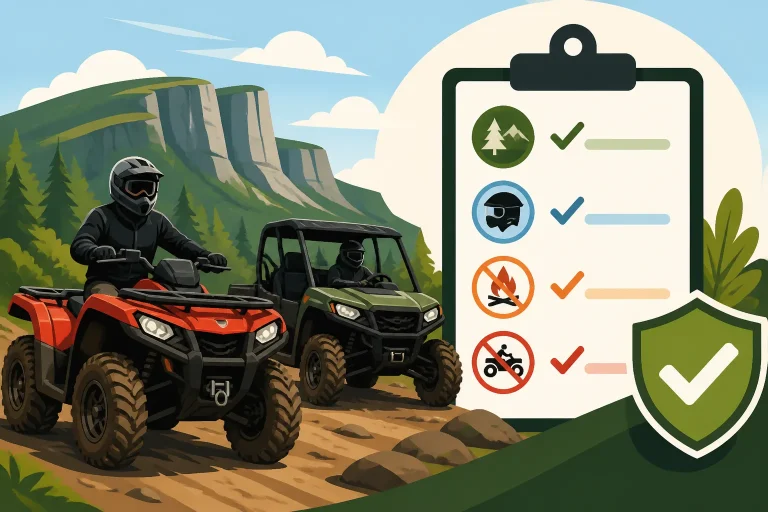
A practical pre-ride check
Because the spark-arrester question is only one part of compliance, use a short check before a ride, particularly if the machine has a modified exhaust or you are visiting an unfamiliar trail.
- Identify the exhaust setup. Check the owner’s manual and inspect the system for damage, missing parts, or recent modifications. If you are unsure whether a component is required for the machine, ask a qualified service provider.
- Confirm the muffler and exhaust are in proper condition. Do not assume that a missing spark-arrestor requirement permits a damaged, excessively loud, or improvised exhaust system.
- Check current fire notices. Look for regional restrictions, closures, and posted instructions before leaving. Recheck if conditions change during a trip.
- Verify trail access. Confirm that the route allows the type of machine you are riding and that no landowner, operator, or local restriction applies.
- Follow signs and operator directions. A managed trail or organized event may have conditions that are more specific than the general provincial equipment rule.
- Avoid preventable fire hazards. Park away from dry vegetation where practical, do not leave a hot machine idling over combustible material, and follow all instructions about fires and equipment use.
These steps are useful whether the machine is a quad, side-by-side, or another covered off-road vehicle. They are especially important when you are travelling to ride, because a route that looks open may have restrictions that are not obvious from the trailhead.
If you are buying a used machine, ask whether the exhaust has been altered and whether the original parts are available. A seller’s statement that an arrester is unnecessary does not confirm that the complete exhaust is in good condition or meets the rules that do apply. Inspect the machine, compare it with its manufacturer information, and clarify any questionable modification before purchase.
The main takeaway is straightforward: Newfoundland does not impose a general standalone spark-arrester requirement on every ATV or UTV, but that is a narrow point about one piece of equipment. Muffler and exhaust requirements, fire restrictions, trail conditions, and land-access rules remain relevant. Check each of those separately instead of treating the absence of an arrester rule as a blanket exemption.
Disclaimer
This article is for general informational purposes only and does not constitute professional advice. Laws, prices and regulations vary by location and change over time. Consult a qualified professional for guidance on your specific situation.