Newfoundland Wetland Protection Rules
A Newfoundland wetland can look like an open stretch of bog, but riding across it may damage fragile ground, create deep ruts, or take you into an area where machines are restricted. This guide explains how to check access, recognize sensitive terrain, plan a lower-impact route, and respond when a trail becomes wet or uncertain.
What wetland protection means for ATV and UTV riders
Wetlands are more than ponds and marshes
A wetland is not always an obvious pool of water with reeds around the edge. In Newfoundland, wet ground may appear as a peat bog, a marshy hollow, a saturated forest floor, or a stretch of soft terrain that seems dry at first glance. Low vegetation, dark spongy soil, standing water, and ground that gives way under your boots can all be signs that you are approaching a sensitive area.
That matters because an ATV or side-by-side puts concentrated weight on a relatively small area. A route that looks passable from the seat can become a series of deep tire grooves once a few machines cross it, especially when the soil is saturated. Peat and wetland vegetation recover slowly, so damage can remain visible long after the ride.
The practical rule is not to treat every wet-looking area as an open route. Check whether the trail is authorized, whether the land manager has posted restrictions, and whether the ground is suitable for travel. For the broader picture of where riding is allowed, review [Newfoundland Crown Land Access Rules] and [Newfoundland Restricted Area Permissions].
There is no single wetland rule that makes every route legal or illegal
Whether you may ride through a particular wet area depends on where it is, who manages the land, what restrictions apply, and whether there is an authorized trail through it. A wetland on private property, Crown land, a managed trail, or a protected area may be subject to different access conditions. A visible track or old tire rut does not prove that motorized access is permitted.
This is why “I’ve seen other machines go through here” is not a reliable test. A trail may have changed status, a closure may apply to a specific section, or riders may have created an informal route that should not be followed. If a sign, gate, map, or trail operator’s instruction conflicts with what looks like a rideable path, stop and clarify access before continuing.
The wetland question is also part of a wider land-access check. Before heading out, learn how to [Finding Approved Areas on the Provincial Map], and review [Newfoundland Wetland Protection Rules] alongside the rules for the specific place you intend to ride. When access is unclear, ask the appropriate land manager, trail operator, or local authority instead of guessing.
How to check whether a wet trail is open to machines
Start with land status and official restrictions
Before loading your ATV or UTV, identify the route and the land it crosses. Look for official maps, posted notices, trail information from the operator, and any specific rules for the area. A route on a general-purpose map may show a road, path, or track without confirming that motorized riding is allowed there.
Be especially careful around parks, conservation areas, wetlands, and other places with special restrictions. Some areas may allow machines only on designated routes, while others may prohibit them altogether. A map line can help you orient yourself, but it cannot always tell you whether a trail is currently open, whether seasonal restrictions apply, or whether a route crosses private land.
Digital mapping tools, including onX Offroad, can help with route planning and understanding where a track appears to run. Treat them as planning aids rather than proof of permission. Compare what you see on a digital map with authoritative provincial information and posted signs, and contact the relevant operator or land manager when the status of a wet section is uncertain.
Read the trail on the ground before entering
Once you reach the area, pause before riding into a wet stretch. Look for signs, barriers, flagged closures, washouts, deep standing water, and fresh ruts. Pay attention to whether the established trail continues clearly through the area or whether the track appears to split into several muddy lines. Multiple parallel ruts can be a sign that riders have been trying to avoid a difficult section by widening the damage.
Do not assume that a dry-looking edge is a safe detour. Cutting around a muddy patch can push machines onto fragile vegetation or into a previously untouched part of the wetland. If the marked route is flooded, blocked, or visibly deteriorated, the responsible choice may be to turn around and use another authorized route rather than inventing a bypass.
When the trail condition and access rules are unclear, take a moment to check your route instead of letting group momentum make the decision for you. A phone map can help you orient yourself, but it is sensible to carry a backup map or saved route in case reception drops. [Carrying a Paper Map Where There Is No Signal] is useful preparation for remote riding, where a quick online check may not be possible.
Wetland riding risks and lower-impact choices
Why a small detour can cause lasting damage
Wetland soil often holds water close to the surface. When tires churn it, the tread can break vegetation and compress or displace soft ground. Once a rut forms, water may collect in it, and later riders may follow the same line or create a wider one to get around the mud. The result can be a scarred trail with several damaged edges instead of one narrow route.
The problem can be hard to judge from the machine. A rider may see only a shallow puddle, while the ground beneath it is deep, soft, or unstable. A heavier UTV, a loaded machine, or repeated passes can make the damage worse. Spinning tires may also dig down quickly, turning a short crossing into a recovery problem for the rider and a disturbance for the surrounding ground.
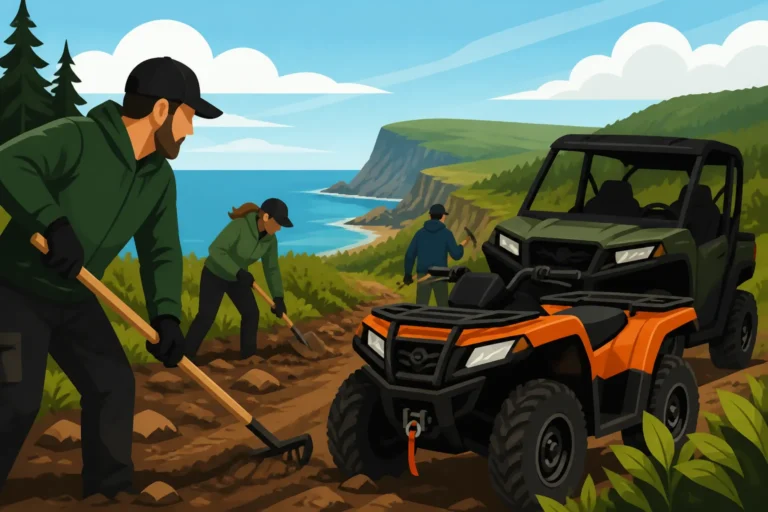
A bog recovery can be tempting to solve by driving around the stuck machine. Resist that impulse if it means leaving the established trail. If the route is too soft, stop before entering when possible. If a machine is already stuck, avoid repeated throttle bursts and uncontrolled winching that could widen the damaged area. Plan recovery carefully, use suitable equipment, and follow local guidance for the land.
Choose a route that suits the conditions
A route that is manageable after a dry spell may become unsuitable after heavy rain or spring thaw. Check the forecast and recent trail notices before leaving, and be ready to change plans. In remote areas, weather can shift quickly, so a route decision should account for the return trip as well as the first crossing.
If you reach water or soft ground, do not judge the crossing by the machine ahead of you alone. The first vehicle may have found a firm line, while the next rider’s tires can break through the surface. Keep to the marked route only when it is open and passable, and do not follow another machine into a section that looks unsafe or restricted.
The same caution applies when using route-planning apps. onX Offroad or another mapping tool may help you compare possible routes, but a displayed track does not establish that a wetland crossing is authorized or currently in good condition. Check the route against official access information, then make a conservative call on the ground. For broader trail planning, [Newfoundland Trail Conditions Before You Ride] and [Newfoundland Riding After Heavy Rain] offer useful preparation topics.
A practical checklist before you ride
Prepare before leaving home
A little planning can prevent the awkward moment when your group reaches a boggy section and no one knows whether the trail is open or where the route goes next. Before setting out, identify your intended route, note alternate authorized routes, and make sure everyone in the group understands that a closed or unsuitable section is not an invitation to cut a new path.
Use this checklist as a starting point:
| Before the ride | What to check | Why it matters |
|---|---|---|
| Route status | Confirm that motorized access is allowed on the planned trail | A visible track does not prove permission |
| Land management | Identify whether the route crosses Crown, private, managed, or protected land | Different land managers may set different conditions |
| Notices and signs | Look for closures, barriers, seasonal limits, and local instructions | Restrictions may apply to a specific section |
| Weather and ground conditions | Check recent rain, thaw, flooding, and trail updates | Soft ground can turn a passable trail into a damaging or unsafe route |
| Navigation | Save the route and carry a backup map | Reception may be unreliable in remote areas |
| Group plan | Agree to stop or turn back if a section is closed or unsafe | Prevents pressure to continue into an uncertain area |
| Recovery gear | Carry suitable recovery equipment and know how to use it | Reduces the chance of worsening a stuck-machine situation |
Tell someone who is not riding where you expect to go and when you plan to return, particularly if your route is remote. Bring enough supplies to manage a delay, and do not rely on a phone signal for navigation or emergency communication. For longer trips, see [What to Carry for First Aid on the Barrens] and [Packing for Weather That Changes Every Hour].
Make group decisions before the muddy section
Wetland problems often become group problems. One rider may want to try the crossing, another may be worried about the ground, and the rest may feel pressure to keep moving. Agree in advance that any rider can call for a stop when access or conditions are in doubt. A quick discussion at the edge of the trail is easier than dealing with a damaged machine or a newly widened rut.
Keep the group together and avoid sending someone ahead to “see if it gets better” when the route is uncertain. If the lead rider reaches standing water, a closure sign, or a badly rutted patch, have the group stop in a safe place and review the route. If turning around is the right choice, do it without blaming the person who raised the concern.
On a shared trail, ride in a way that limits disturbance and leaves room for other users. Follow operator instructions, respect barriers, and do not park in a way that blocks the route. [Newfoundland Trail Etiquette Locals Expect] and [Sharing the Railbed With Walkers and Cyclists] are useful reminders that responsible riding includes more than keeping your own machine moving.
What to do when you encounter a wetland restriction
Stop, verify, and avoid creating a new route
If you see a closure sign, barrier, or clear indication that the trail is restricted, do not ride past it to see whether the path opens farther ahead. Stop somewhere that does not block the trail, read the notice, and confirm what route remains available. If you are unsure whether the restriction applies to your machine or to the whole area, contact the trail operator or land manager.
If the trail is simply very wet rather than formally closed, make a separate safety and impact decision. A trail can be open but still unsuitable for your machine or group that day. Deep water, unstable edges, active rutting, or a route that disappears into soft ground are good reasons to turn back. An open route is not a guarantee that every condition is safe or that every crossing should be attempted.
Do not bypass a restriction by riding through nearby brush, a field, or an unmarked wet area. That can create additional damage and may take you onto land where you do not have permission to ride. When in doubt, keep your group on the established route until you can turn around safely, then choose a route whose access status you can confirm.
Report damage or confusing access information
If you find a badly damaged trail, a washed-out crossing, or a sign that is missing or difficult to understand, report it to the trail operator or relevant land manager. A clear description helps: note the trail name or nearest landmark, the direction you were travelling, and what you observed. If it is safe and appropriate, a photo can help explain the condition without requiring you to ride farther into the area.
Avoid posting a precise route around a closure or describing an unofficial bypass as a recommended alternative. That can encourage others to repeat the same damaging choice. Share helpful information about closures and conditions through responsible channels, and make clear when access needs confirmation.
If your group disagrees about what the rules allow, do not settle the argument by testing the boundary with a machine. Check the relevant official information or ask the authority responsible for the land. Wetlands can be difficult to assess from a seat, and the consequences of a wrong turn can last far longer than the ride.
Disclaimer
This article is for general informational purposes only and does not constitute professional advice. Laws, prices and regulations vary by location and change over time. Consult a qualified professional for guidance on your specific situation.