Newfoundland Poker Runs and Club Rides
A Newfoundland poker run can sound like an easy day out: follow a route, visit checkpoints, and meet other riders. In practice, changing trail conditions, unclear access, group delays, and event requirements can turn planning into a headache. This guide explains how poker runs and club rides typically work, what to ask before signing up, and how to prepare for a safer, smoother ride.
How Newfoundland poker runs and club rides work
What makes a poker run different from a regular ride
A poker run is a group event built around a route and a series of stops. Riders may collect a card or other marker at each checkpoint, with the finished hand determining a prize or simply adding a bit of fun to the day. The cards are not the main reason most people go: the appeal is riding a planned route with other people and sharing the day at a manageable pace.
A club ride is usually less focused on checkpoints. It may be a scheduled outing for members, a social ride open to guests, or a trip to a particular community, cabin area, or trail section. Some rides are relaxed and beginner-friendly; others cover longer distances or rougher terrain. Ask the organizer what the ride is actually like rather than assuming that “club ride” means easy.
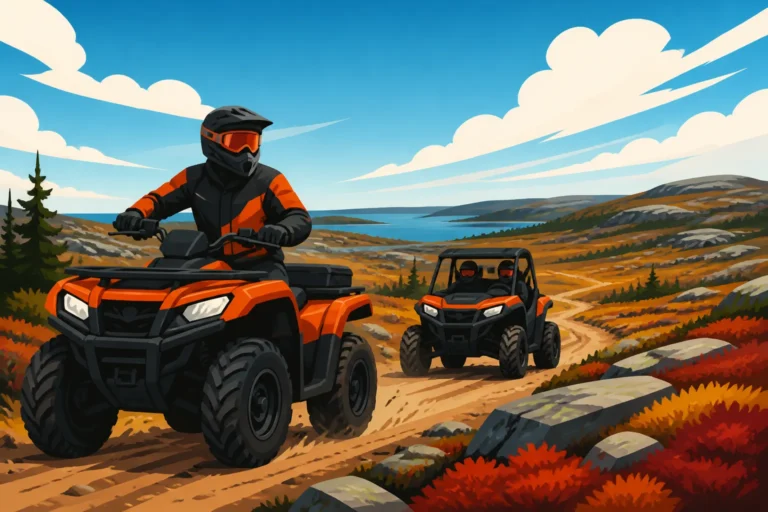
In Newfoundland, the route matters as much as the event format. A ride near Gander, Corner Brook, or the Avalon can involve different terrain and access considerations, and conditions may change along the way. A posted event location does not necessarily tell you the full route, the difficulty, or whether every machine type is suitable. Get those details before you tow your ATV to the starting point.
What to expect at an organized ride
An event may begin with registration, a safety briefing, and instructions about the route, checkpoints, regrouping, and emergency contacts. Organizers may also explain what to do if your machine breaks down or you decide to turn back. Listen carefully, even if you have attended similar events elsewhere: local access arrangements and trail conditions can differ from one ride to another.
The route may be marked, shared digitally, or explained at the start. Don’t assume you can leave the group and rejoin whenever you like. If you need to stop, let the ride leader or a designated sweep rider know. That small courtesy helps prevent the rest of the group from worrying that someone is missing.
Some events include a meal, a fundraising element, prizes, or a gathering after the ride. Confirm what is included and what you need to bring. For a sense of the questions to ask an event organizer, see [Questions Worth Asking a Trail Operator]. For route-focused preparation with friends or a club, [Newfoundland Group Ride Planning] is also worth reading.
Choosing a ride that fits your experience
Match the route to your machine and comfort level
A ride’s advertised distance is only part of the picture. A shorter route across soft or uneven ground can feel harder than a longer trip on a firm trail. Ask about the expected terrain, pace, elevation changes, water crossings, narrow sections, and planned breaks. If the organizer cannot describe the route clearly, treat that as a reason to ask more questions before committing.
Be honest about your experience, too. If you are new to ATV riding, a large group moving at a brisk pace can make it difficult to ask questions or take your time. Look for a beginner ride, a shorter loop, or an event that explicitly welcomes newer riders. If you are unsure whether your machine is suitable, describe its type and setup to the organizer instead of relying on a photo or model name.
A side-by-side can handle a ride differently from a quad, particularly on a narrow trail or in a tight staging area. Check whether the route accommodates your machine and whether passengers are welcome. Don’t make assumptions based on what you have seen at another event; the event’s route and rules are what matter. For general trail manners that help keep shared routes pleasant, review [Newfoundland Trail Etiquette Locals Expect].
Find a club and ask the right questions
A local ATV club can be a useful place to learn about group rides, trail etiquette, and the communities around a riding area. Clubs may share event notices through their own channels, but not every ride is open to non-members. Ask whether guests can join, whether advance registration is needed, and whom to contact if you arrive late or have a question on the day.
Before you sign up, ask about the ride’s pace, distance, machine requirements, passenger arrangements, and plan for breakdowns. Find out whether there is a sweep rider at the back, how the group handles stops, and whether the route includes fuel or food options. If you have mobility, medical, or experience-related concerns, raise them privately with the organizer rather than waiting until the group is underway.
It can help to compare more than one group before choosing where to ride. A club that suits your neighbour may not be the right fit for your experience or schedule. Start with [Newfoundland ATV Clubs Worth Joining], then check the club’s own event information for current participation requirements.
| Question to ask | Why it matters |
|---|---|
| Is the ride open to guests? | Some events may be limited to members or require advance registration. |
| What machines can use the route? | A narrow or difficult section may not suit every ATV or UTV. |
| What is the expected pace and distance? | Helps you judge whether the outing fits your experience and stamina. |
| How are stops and breakdowns handled? | Clarifies how the group stays together and responds to delays. |
| What do I need to bring? | Organizers may have specific requirements for safety gear, proof, or supplies. |
| Is there a weather or cancellation plan? | Conditions can affect whether a ride proceeds or changes route. |
Prepare before you join the group
Confirm access, event details, and requirements
A club invitation does not automatically mean every part of a route is open to every rider. Confirm where the ride goes and whether the organizer has arranged any permissions or event approvals that may apply. For organized events, review [Newfoundland Event Permits for a Ride] and [Insurance an Event Organizer Has to Carry]. The organizer should be able to explain what applies to that particular outing and what participants must arrange for themselves.
Ask whether any trail sticker, safety training proof, insurance evidence, or registration documents need to be ready. Requirements can depend on where and how you ride, and a poker run should not be treated as an exemption from ordinary rules. If the route uses a managed trail, check the event instructions and [What Gets Checked at a Managed Trail Gate] before setting out.
You should also verify that the trail is open and appropriate for the planned ride. Recent rain, storm damage, seasonal restrictions, or local closures can change what is practical. Ask the organizer for a final update shortly before departure and consult [Newfoundland Trail Conditions Before You Ride]. A route on an older event flyer may not reflect current access or ground conditions.
Plan navigation and personal supplies
Save the route details before you leave home, especially if you expect to travel beyond reliable cell service. Carry the organizer’s contact information and agree on a simple regrouping plan in case riders become separated. A map app such as onX Offroad may help you review and save route information, but treat it as a planning aid rather than proof that a trail is open or that you have permission to ride there. Confirm access with the organizer or relevant land manager.
If the event shares a digital route, download it in advance and learn how to use it before you are on the trail. onX Offroad can be useful for organizing route information, but a device can lose power, break, or fail to show the latest local conditions. Bring a backup navigation option appropriate to the area, and make sure at least one person in your group knows the route and meeting points.
Pack for the day rather than for the forecast at the starting point. Newfoundland weather can feel different across exposed barrens, wooded sections, and coastal areas. Bring suitable riding gear, water, food, basic first-aid supplies, and any machine-specific essentials recommended by the manufacturer or ride leader. A spare belt or tow strap may be sensible on some outings, but ask what the route demands rather than carrying gear blindly. Check [Newfoundland Trail Conditions Before You Ride] again if the weather or trail picture changes.
Ride considerately and handle problems well
Follow the ride plan and protect shared trails
At the start, identify the leader and sweep rider, learn the agreed signals, and understand how the group will regroup. Ride at a pace that leaves room to react, and don’t pressure someone ahead of you to go faster. On a shared route, pedestrians, cyclists, other riders, and local traffic may appear unexpectedly. Keep a safe distance and follow the event instructions about passing and stopping.
Poker-run checkpoints can tempt riders to hurry, especially when there is a prize or a time element. Resist that urge. The event is not worth taking blind corners too quickly, tailgating, or making risky passes. If you miss a checkpoint or fall behind, contact the organizer rather than cutting across unfamiliar ground to catch up.
Stay on the route and leave gates, signs, and property as you found them. Avoid widening a trail around mud or water; repeated detours can damage vegetation and turn a difficult spot into a larger problem for everyone. If a section appears unsafe or badly damaged, tell the ride leader and follow their direction. Responsible conduct helps preserve access for future events.
What to do if you fall behind or your machine stops
If you become separated, stop somewhere safe and use the agreed contact method. Don’t assume the rest of the group knows you have taken a different turn. If the route is unclear, avoid improvising a shortcut: the safer choice is generally to remain on a known route and contact the leader or sweep rider. This is one reason organizers should share phone numbers, meeting points, and a clear plan before departure.
For a mechanical problem, tell the group as soon as you can and move out of the way if it is safe to do so. The ride leader can decide whether the group waits, sends help, or continues under a prearranged plan. If you are riding with friends, agree in advance that nobody gets left alone with a disabled machine unless the group has an explicit and safe reason to split.
A good event is not just a route and a set of checkpoints. It is a group that knows what to expect, respects local access, and looks after riders who need help. Before leaving, make sure you know how to reach the organizer, where the group plans to regroup, and what to do if weather or trail conditions make continuing unwise. Planning with onX Offroad can help you keep route information organized, while the event organizer remains your best source for ride-specific instructions. And if you are comparing routes or scouting a new area, use onX Offroad alongside local information rather than treating any app as the final word on access.
Disclaimer
This article is for general informational purposes only and does not constitute professional advice. Laws, prices and regulations vary by location and change over time. Consult a qualified professional for guidance on your specific situation.