Newfoundland Lodging That Welcomes Trailers
Finding a place to stay is harder when you’re towing an ATV or side-by-side: a standard parking stall may not fit your truck, trailer, and machine, and “parking available” doesn’t always mean there’s room to turn around. This guide explains how to find trailer-friendly lodging in Newfoundland, what to ask before booking, and how to plan an overnight stop around your riding route.
What trailer-friendly lodging means for an ATV trip
A hotel or cabin can welcome guests with trailers without having a designated ATV parking area. The important question is whether the property can safely accommodate your whole setup—not just your vehicle. A truck and trailer may need extra length, room to manoeuvre, and a place to leave the trailer while you ride.
“Trailer-friendly” can also mean different things to different properties. One inn might allow you to park in an oversized lot but have no secure storage. A cabin may have a wide gravel driveway but a tight entrance or soft ground. Confirm the practical details instead of relying on a listing description.
Choose a property for the whole rig
Before you book, estimate the combined length and width of your towing vehicle and trailer. Include the hitch, spare tire, ramps, and any gear that sticks out. If you’re travelling with a side-by-side, remember that the trailer may be wider than the machine itself.
Ask whether you can park the truck and trailer together, or whether the property expects you to unhitch and park separately. That detail matters if the lot is narrow, sloped, or busy. It’s also worth asking whether you’ll have enough room to back in or turn around. A long rig can be difficult to reposition in a small lot, particularly after dark or in wet weather.
For a longer stay, ask where the trailer can remain while you’re out riding. Some properties may permit it in a designated area; others may require it to stay attached to your vehicle. Don’t assume an empty corner of the lot is available. The property may need to keep access clear for other guests, deliveries, snow clearing, or emergency vehicles.
Look beyond hotels and roadside motels
Hotels and motels can be convenient for a quick overnight stop, especially in larger service centres. But they aren’t the only options. Cabins, campgrounds, inns, and other rural stays may offer more outdoor space, although the access road and ground conditions can vary.
A campground can be a sensible choice if you’re travelling with camping gear as well as an ATV. Check whether the site itself can accommodate your vehicle and trailer, whether you can leave the trailer there during a ride, and whether the access road is suitable for your setup. A cabin or cottage may offer a private driveway, but ask about turning space and whether the driveway is gravel, paved, or soft.
When searching, use “trailer parking” or “oversized vehicle parking” as a starting point, not as proof that your ATV trailer will fit. A property may be thinking of a small utility trailer rather than a truck towing a machine trailer. The quickest way to avoid a frustrating arrival is to describe your exact setup before you reserve.
Where to plan an overnight stop in Newfoundland
Newfoundland is large enough that a convenient overnight stop can make a riding trip much more comfortable. Rather than choosing a place based only on its distance from a trail, think about your route, fuel and food access, the type of riding you plan to do, and where you can legally ride.
Some travellers use larger communities as practical bases for supplies and road access, then drive to their chosen riding area. Depending on your itinerary, you might consider service centres such as Port aux Basques, Corner Brook, Deer Lake, Grand Falls-Windsor, Gander, or Clarenville. These are examples of places to investigate, not guarantees of a particular type of lodging or trail access. Always check the property’s current parking arrangements and your route to the riding area.
Match lodging to the route, not just the map distance
A property can look close to a trail on a map and still be inconvenient once you account for road conditions, trail access rules, and where you can unload. In Newfoundland, a planned ride may involve a mix of paved roads, gravel, and trail surfaces. Don’t assume that a visible line on a map is an open, approved route for your machine.
If you’re planning to ride the T’Railway, choose lodging based on the section you intend to reach and the road route to a suitable trail access point. The long corridor passes through many communities, but that doesn’t mean every lodging property is beside a permitted access point or has space for a trailer. Read [Riding the T'Railway From St John's to Port aux Basques] when building a longer route, and check local access details before unloading.
A route-planning app such as onX Offroad can help you organize ride ideas and keep track of route information, but use it as one planning tool rather than as permission to ride. Confirm access, restrictions, closures, and local rules with the relevant operator or authority. This is especially important if your lodging host suggests a nearby road or informal trail that you haven’t independently checked.
Consider whether you need one base or several stops
A single base can work well if you’re riding a relatively compact area and don’t mind trailering to your starting point each day. It means fewer check-ins and less time packing. The trade-off is that you may spend more time driving the truck and trailer between the lodging and ride location.
A multi-stop itinerary can make sense for a longer trip across the island. It may reduce daily towing, but you’ll need to confirm trailer parking at every overnight stop and allow time to load, secure, and unload the machine. If weather changes your plan, a flexible itinerary is easier to adjust than one built around a single tightly timed trail day.
| Lodging option | Why it may suit a towing trip | What to confirm before booking |
|---|---|---|
| Hotel or motel | Convenient for a quick overnight and access to community services | Total parking space, turning room, overnight trailer parking, and whether you can leave the trailer during a ride |
| Cabin or cottage | May offer a private driveway or more outdoor space | Driveway width and surface, slope, turning area, and permission to keep the trailer on site |
| Campground | Can suit travellers combining riding with camping | Site dimensions, access-road conditions, trailer storage, and rules for leaving equipment unattended |
| Inn or rural stay | May provide a quieter stop near a planned route | Whether the property can accommodate a full truck-and-trailer setup and where it can be parked |
What to ask before booking
A short conversation with the property can prevent a lot of unnecessary stress. Be specific: say what you’re towing, how long the setup is, how many nights you’ll stay, and whether you need to leave the trailer while riding. “Do you have parking?” is often too broad to get a useful answer.
Confirm dimensions, access, and parking rules
Ask the host whether the lot or driveway can fit your combined vehicle and trailer, and explain if you’ll need to back in. If you’re unsure of the available space, ask whether they can describe the parking area or suggest where guests with trailers normally park. A photo can help you judge the layout, but confirm that the space will actually be available for your booking.
Check the surface and slope, too. A narrow gravel entrance, soft shoulder, steep driveway, or tight turn can make arrival difficult. If you’ll be arriving late, ask about lighting and where to park when you get there. If you’re travelling during colder weather, ask whether snow clearing or winter access could affect the parking area.
Also clarify whether the trailer can stay on the property during the day. Some hosts may allow it only if it remains attached to the truck, while others may have a separate area. Ask whether there are restrictions on parking near entrances, cabins, or other guests’ vehicles. Don’t leave the trailer in an unapproved spot and assume it will be fine until morning.
Ask about security without assuming secure storage
A parking space is not the same as secure storage. If you want to leave an ATV or UTV on the trailer while you’re away, ask what the property can and cannot offer. Find out whether the parking area is visible from the accommodation, whether access is controlled, and whether there’s a place to store valuable riding gear indoors.
Regardless of the answer, use sensible precautions. Lock the trailer and machine, keep keys with you, and avoid leaving loose equipment in view. A cover can protect the machine from weather and make it less conspicuous, but it shouldn’t replace proper locks or a careful parking choice. If your machine is financed, insured, or covered by a travel policy, review any relevant requirements for securing it overnight.
For a multi-day itinerary, write down the host’s parking instructions and arrival details. This is especially helpful when you’re tired after a long drive or arriving with more than one vehicle. One person can check in while another handles the trailer, reducing the chance of blocking the entrance or taking a space meant for other guests.
Plan the ride and the overnight stay together
Trailer-friendly lodging is only one part of a smooth ATV or UTV trip. You’ll also want to make sure the ride itself is suitable, permitted, and realistic for your group. A beautiful route is not automatically a legal route, and a lodging host’s local tip is not a substitute for checking applicable rules.
Verify riding access before unloading
Before you arrive, confirm where you can unload and whether the route you plan to ride is open to your machine. Newfoundland has rules about approved areas, restricted areas, managed trails, and other access conditions. Check [Newfoundland Approved and Restricted Areas] and [Newfoundland Managed Trail Rules] as part of your preparation.
If a managed trail requires a sticker or other proof, arrange that before you set out. Read [How to Get a Newfoundland Trail Sticker] and check directly with the relevant trail operator about its requirements. Don’t assume that registration alone gives you access to every trail, or that a machine can be ridden from your lodging to a trailhead along any convenient road.
Use onX Offroad to keep route notes organized alongside official information, especially if you’re comparing possible ride areas or planning a day with multiple stops. Before riding, confirm the current route status and access conditions through the appropriate local channels. If a route crosses private land, restricted land, or an area with a temporary closure, change the plan rather than treating a map line as authorization.
Build a practical day-by-day plan
For each riding day, note your lodging, unloading point, intended route, fuel options, and a backup plan. Share the plan with someone who isn’t riding with you, especially if you’ll be travelling in an area with limited cell service. If the ride takes longer than expected, having a clear check-in plan can provide peace of mind.
Leave enough time to return before dark and to secure the machine before the property gets busy. If you’ll be staying somewhere with shared parking, tell the host when you expect to return with the trailer. Some lots have limited space, and a quick update can help avoid blocking another guest or making a difficult late-night manoeuvre.
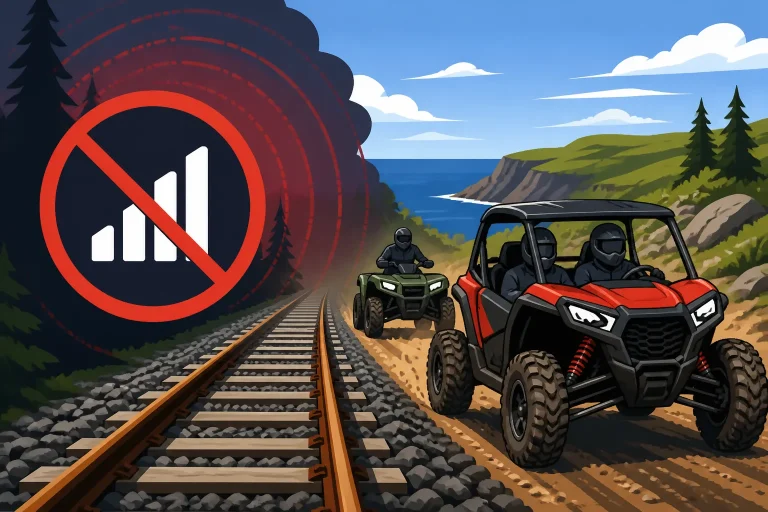
For a longer trip, use onX Offroad as one place to keep your planned route details, but save key information in a form you can access offline. Cell coverage can be unreliable in some rural or exposed areas. A paper map, written directions, and a charged phone are useful backups; don’t rely on a single device for every navigation and communication need.
Use this booking checklist
Before confirming a reservation, ask:
- Can my truck and trailer fit on the property at the same time?
- Is there enough room to turn around or back in safely?
- Can the trailer stay on site while I’m out riding?
- Is parking on a firm, level surface, and is access suitable for my vehicle?
- Are there parking restrictions, quiet hours, or arrival instructions I should know?
- Is there a place to secure the ATV or UTV and store riding gear?
- How far is the property from a legal unloading point or the riding area I plan to use?
- Are there local access restrictions, trail closures, or managed-trail requirements I should check?
Keep the answers with your booking details. If the property’s instructions are unclear, ask for clarification before you leave home. That is much easier than trying to sort out trailer parking after a long drive.
A little extra planning makes it easier to choose lodging that genuinely works for a Newfoundland ATV or UTV trip. Confirm the space for your entire rig, verify where the trailer can remain, and plan the ride using current access information. Those steps help turn an uncertain arrival into a more relaxed start to the trip.
Disclaimer
This article is for general informational purposes only and does not constitute professional advice. Laws, prices and regulations vary by location and change over time. Consult a qualified professional for guidance on your specific situation.