Newfoundland Bog and Machines
A Newfoundland bog can look like a firm trail until a tire breaks through the surface, and then a quick ride can turn into a long, tiring recovery. This guide explains how bog terrain affects ATVs and side-by-sides, how to reduce the chance of getting stuck, and what to do if your machine starts sinking.
Why Newfoundland bog terrain is hard on ATVs and UTVs
The surface can hide what is underneath
A bog is not simply a muddy patch. Its surface may be covered with moss, grasses, low shrubs, or a thin crust that looks solid but rests on saturated ground. One spot might support a machine, while a few metres away the ground gives way. That unpredictability makes it risky to assume that a route is passable because it looks dry from the seat.
The challenge can be especially frustrating when a familiar track changes after rain, thaw, or repeated traffic. A machine that passed through earlier in the season may sink on a later trip. Tracks made by other riders are not proof that the ground is safe: they may have been left by a lighter machine, formed in different conditions, or cut through a surface that has since softened.
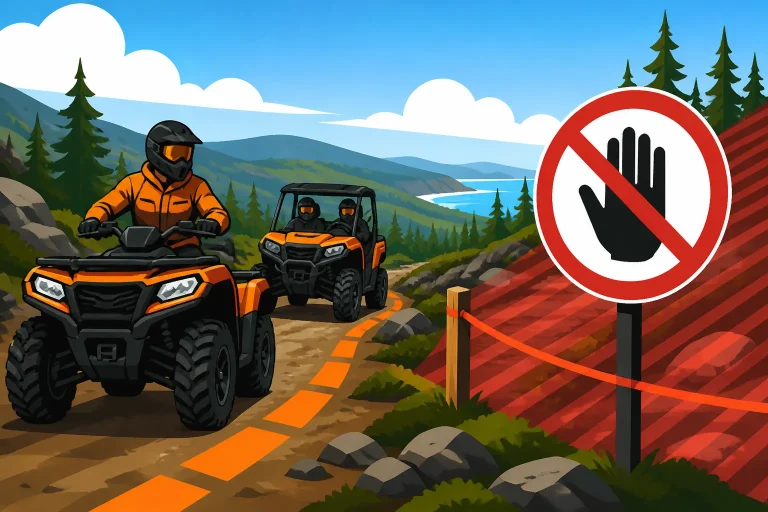
Treat boggy ground as a route decision, not just a traction problem. If the only way forward is through uncertain wetland, stopping and turning around may be the safest choice for you, your machine, and the terrain. For related context on access and environmental limits, read [Newfoundland Wetland Protection Rules] and [Newfoundland Crown Land Access Rules].
How bog conditions affect a machine
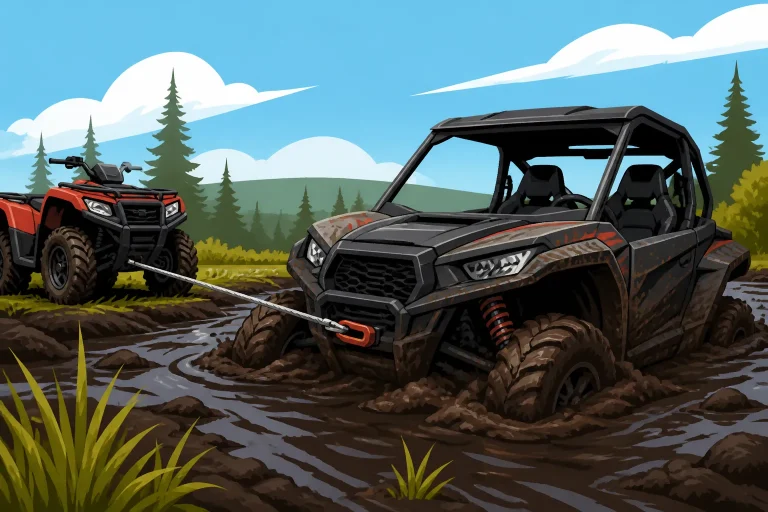
Once tires begin to sink, the machine’s weight can press it deeper into soft ground. Spinning the throttle often makes the situation worse: tires can dig down, churn the surface, and create ruts that are harder to cross on the next attempt. On a side-by-side, extra passengers or cargo add weight, so a route that looks manageable on an unloaded machine may not be suitable with a full load.
Bog mud and peat can also build up around moving or cooling parts. A machine that seems to be moving normally may still be collecting material in places that need to remain clear. After a boggy section, take a careful look over the machine rather than assuming it is ready for a long ride. [Radiator Screens for Peat] and [Washing Bog Mud Off a Machine] cover two useful parts of that post-ride check.
The condition of the route matters as much as the machine’s specifications. Tire design, ground clearance, load, speed, and the depth of the soft area all influence how a vehicle behaves, but none of them can turn unknown wetland into a dependable trail. For a closer look at tire considerations, see [Which Tires Float Best on Soft Bog].
How to reduce the chance of getting stuck
Check the route before you leave
Start with the route, not the throttle. Check reliable trail information and look for current access notices, closures, and restrictions. A route shown on a mapping app is not, by itself, confirmation that riding is permitted there. Before setting out, compare your planned route with information from the relevant land manager or trail operator.
Apps such as onX Offroad can help riders review route information and prepare navigation, particularly where mobile service may be unreliable. Download or save the information you expect to need before leaving a connected area, and carry a backup such as a paper map. Use the app as a planning aid, not as permission to ride: confirm that the route is open and legal through appropriate local sources. Conditions can change between a map update and your trip.
Also check the weather and recent trail reports. Rain, snowmelt, or a prolonged wet spell may make a familiar low-lying section much softer. [Newfoundland Trail Conditions Before You Ride] offers further preparation guidance. If you cannot tell whether a route crosses a sensitive or restricted area, choose a clearly approved route instead of relying on guesswork.
Choose a line carefully and ride within your limits
On a known, permitted trail, aim for a firm, established line rather than creating a new route across vegetation. Avoid accelerating hard through soft ground. Smooth, controlled movement is generally easier to manage than abrupt throttle inputs, but do not treat steady momentum as a reason to enter a section whose depth or exit you cannot assess.
Approach uncertain ground slowly enough to stop before committing. Look for signs of softening, standing water, deep ruts, or vegetation that conceals the surface. If you cannot see a safe exit, or if the ground is already deeply churned, turn back where you can do so safely. A detour along an approved trail is preferable to widening a damaged track.
| What you notice | Why it matters | A cautious response |
|---|---|---|
| Water or a shiny, saturated surface | The soil may be soft beneath the visible layer | Stop before entering and assess whether a permitted, firmer route is available |
| Deep tire ruts | The ground may already be damaged and difficult to cross | Do not assume the ruts are a safe line; consider turning around |
| Thick vegetation hiding the ground | You may not be able to judge depth or firmness | Avoid riding into it without a clearly established, approved route |
| A machine begins to sink or lose progress | Continued wheel spin can deepen the rut | Ease off, stop, and reassess before attempting recovery |
| A route’s legal status is unclear | A visible track does not establish permission | Check with the land manager or trail operator, or choose a confirmed route |
No checklist can make an unknown bog safe. If you are riding with a group, agree in advance that anyone can call a stop when the ground looks questionable. That simple agreement can prevent pressure to follow the first machine into a section the rest of the group cannot safely cross.
What to do when a machine starts sinking
Stop before wheel spin makes it worse
If the machine loses forward movement, resist the urge to keep applying throttle. Spinning tires can dig a deeper hole, compact or tear up the surface, and make extraction harder. Stop as soon as it is safe, keep people clear of moving parts, and take a moment to understand where the machine is supported and where it is sinking.
Do not rush to have another machine pull from an improvised point. A poor attachment point, an unsuitable strap, or a sudden pull can injure people or damage equipment. Keep bystanders away from tensioned recovery gear, and follow the vehicle and recovery-equipment manufacturers’ instructions. If the machine is deeply bogged, unstable, or in a place where a recovery could put people at risk, seek qualified help rather than improvising.
A recovery should not become an excuse to push farther into wetland. Once the machine is free, return by a permitted route and avoid expanding the damaged area. For additional recovery considerations, see [Winching a Machine Out of Deep Bog]. The most useful recovery plan is still prevention: travel with suitable equipment, tell someone your route, and set a clear turnaround point before conditions become difficult.
Inspect the machine and the ground afterward
After a recovery, check the machine for packed mud, vegetation, or other debris around the tires and underbody. Pay attention to areas that could affect cooling or moving parts, and consult the owner’s manual if anything looks damaged or out of place. If the machine behaves differently, makes an unfamiliar noise, or shows a warning, stop riding and have the issue assessed rather than hoping it will clear itself.
Take a moment to consider the trail as well. A deep rut or torn surface can worsen with each machine that follows. Do not encourage the rest of the group to cross the same damaged line simply because the first machine made it through. Where appropriate, report significant trail damage or access concerns to the trail operator or responsible land manager.
Once back somewhere suitable for cleaning, remove bog mud carefully and follow the manufacturer’s guidance. A thorough check is especially worthwhile after a difficult extraction, because hidden debris can remain even when the machine looks clean from a distance. For more on minimizing damage while riding, see [Newfoundland Trail Damage and Bog Ruts].
Planning a bog-aware ride
Pack for delays and changing conditions
A short ride can take much longer when a route is soft, a machine needs attention, or the group has to turn back. Bring supplies suited to the expected ride, including drinking water, food, first-aid supplies, navigation, weather protection, and a way to contact help where service is available. Tell someone who is not riding where you plan to go and when you expect to check in.
Pack with Newfoundland’s changeable conditions in mind. A dry start does not guarantee a dry return, and exposed areas can feel very different from sheltered ground. Layered clothing and rain protection can make a delay less miserable. [Packing for Weather That Changes Every Hour] has more preparation ideas.
Consider the group’s experience and the least capable machine when choosing a route. A newer rider may not recognize a soft section early, while a heavily loaded side-by-side may behave differently from a lightly loaded ATV. Keep the ride within the ability of everyone present, and do not split the group in a way that leaves a stuck rider without support.
Make turning around part of the plan
Before leaving, decide what conditions will end a section of the ride: a closure, unclear access, deep standing water, repeated rutting, worsening weather, or a route that cannot be safely assessed. A planned turnaround is easier to follow than a decision made after someone is already stuck and tired.
Navigation tools can help you stay oriented, but map lines do not show every change in ground firmness. onX Offroad may be useful for reviewing a planned route and keeping track of your position, but pair it with local trail information and sound judgment. If the route on screen seems to lead toward a restricted area or an uncertain wetland crossing, stop and verify rather than following it automatically. Keep the app’s information available offline where possible, and carry a backup plan for when batteries, devices, or reception become a problem.
A good bog-aware ride is not measured by how far the group pushes into soft ground. It is measured by whether everyone gets home safely, the machines remain serviceable, and the route is left in good condition for the next person. When the ground looks uncertain, choosing the established route—or turning around—is a skill, not a failure.
Disclaimer
This article is for general informational purposes only and does not constitute professional advice. Laws, prices and regulations vary by location and change over time. Consult a qualified professional for guidance on your specific situation.