How to Reach Gros Morne Before You Tow
If you’re planning to tow an ATV or side-by-side to Gros Morne, the biggest mistake is assuming that reaching the national park means you can ride its trails. Gros Morne National Park is not an off-road riding destination. This guide explains how to get there, what to confirm before hauling your machine, and how to plan a ride outside the park’s boundaries instead.
Understand what reaching Gros Morne means for your machine
Treat the national park as a destination, not an ATV trail system
Gros Morne is a spectacular place to hike, sightsee and explore by road, but you should not plan on riding an ATV or UTV along its hiking trails or park paths. The park’s machine rules are restrictive; check [Newfoundland National Park Machine Rules] and Gros Morne Bans Machines in Newfoundland before making plans around a ride inside the boundary. The practical starting point is to assume there are no park trails open to recreational machines unless Parks Canada tells you otherwise.
That distinction matters when you’re booking a campsite, choosing a place to stay or deciding whether to bring your machine at all. You might tow a quad to the region for riding elsewhere, then spend a day visiting Gros Morne’s viewpoints, communities and walking trails without unloading it. Or you might leave the ATV at home and make this a hiking and sightseeing trip. Either plan can work; the frustrating version is discovering after a long tow that the park itself isn’t where you can ride.
The park’s main attractions also aren’t ordinary ATV trailheads. Places such as the Tablelands, Western Brook Pond and Gros Morne Mountain are visited on foot or by using designated visitor facilities and routes. A machine on a trailer doesn’t give you permission to use a hiking route, and an open-looking access road shouldn’t be treated as an invitation to ride. Check the park’s rules and local signs for the specific place you’re visiting.
Don’t confuse nearby riding with riding inside the park
There may be riding opportunities in the wider region, but “near Gros Morne” and “inside Gros Morne National Park” are not interchangeable. Boundaries can be easy to miss when you’re looking at a broad map, especially if you’re unfamiliar with the area or following a route that changes from paved highway to gravel. Before setting out, confirm that the trail or area is open to your type of machine and that the route to it is legal.
The provincial approved-area map and any local trail operator’s information are more useful for this decision than a general road map alone. Start with Newfoundland Approved and Restricted Areas, then check current trail conditions and any posted restrictions. A trail that appears close to a park entrance may still be inside the national park or on land where machine access is restricted.
Mapping apps can help you compare routes and understand the general layout. For example, onX Offroad may help you organize a route or save map information for planning. Treat it as a navigation aid, not proof that a trail is open or that you have permission to ride there. Confirm access with the relevant land manager or trail operator before unloading.
Ask about permits instead of assuming an exception applies
If you have a specific reason to bring a machine into the park, contact Parks Canada before your trip and ask whether a permit or other authorization applies to your situation. Don’t assume that a permit is available, that a visitor-facing road is open to recreational riding, or that permission for one activity covers another. The park’s answer should guide your plan, not a guess based on what you see on a map.
For more detail on that question, see Asking Gros Morne for a Trail Permit. When you contact the park, describe the machine, where you hope to go, what you intend to do and whether you’re asking about access for a particular purpose. If you receive specific instructions, keep them with your travel documents so you can refer to them later.
Plan the drive to Gros Morne before you load up
Choose your arrival route and identify the main junctions
For many visitors arriving by ferry at Port aux Basques, the general drive is west along the Trans-Canada Highway, Route 1, toward Deer Lake, then north on Route 430, commonly known as the Viking Trail. Route 430 takes you toward the western side of the Gros Morne region and its communities. Route 431 branches from the area around Wiltondale toward Woody Point and the southern side of the park.
If you’re arriving through Argentia, plan the drive west across the island to connect with the Trans-Canada Highway before continuing toward Deer Lake and Route 430. The exact route and timing depend on your sailing, stops and destination. Check the ferry itinerary and road conditions before departure, and leave room for meal, fuel and rest breaks rather than planning around a best-case driving time.
It helps to enter your lodging, campground or first planned stop as a destination before you set off—not just “Gros Morne” or the park name. The region covers multiple communities and access points. Rocky Harbour, Norris Point, Cow Head, Woody Point and Trout River are not interchangeable drop-off locations, and choosing the wrong one can add backtracking, particularly when you’re towing.
Check your route and towing setup as a separate task
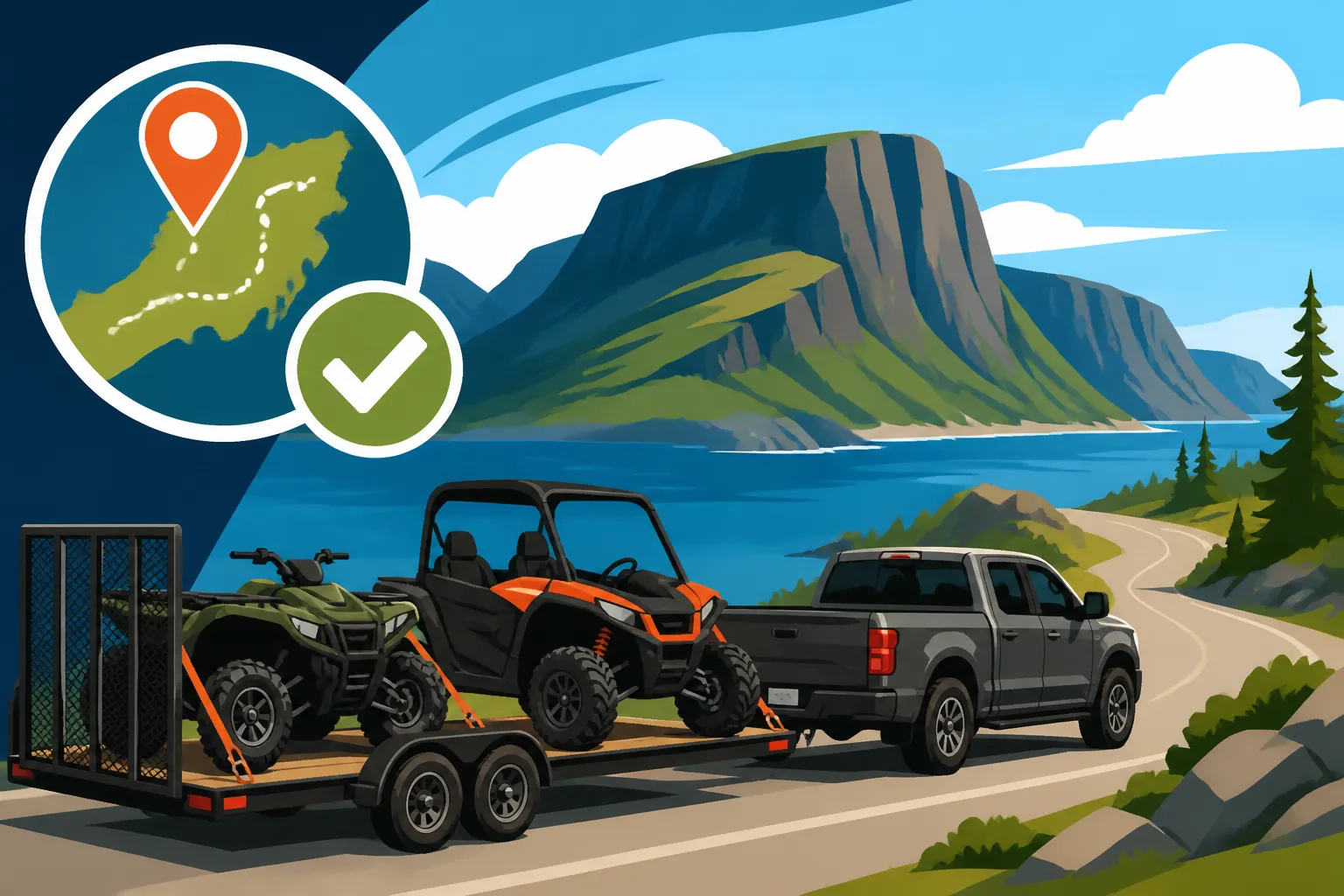
Towing adds a few practical decisions that are easy to overlook when you’re focused on the destination. Check the tow vehicle, trailer, tires, lights, hitch connection and load restraint before leaving. Make sure the machine is secured so it cannot shift under braking or on uneven pavement, and confirm that the trailer’s dimensions and load are suitable for your vehicle.
The route across Newfoundland includes long stretches where planning fuel and rest stops is sensible. Don’t count on finding a convenient place to stop simply because a map shows a road. If you need a large parking area to turn around or check a strap, identify possible stopping places in advance and follow posted parking and access rules. A tight roadside pull-off that works for a car may not be safe or practical with a trailer.
For a fuller towing checklist, see Trailering a Machine Along the Trans-Canada Highway. If you’re taking the ferry with your machine, review Bringing a Machine Over on the Ferry and confirm the operator’s current booking and loading requirements before travelling. Booking details and vehicle measurements matter; don’t leave them until the day you reach the terminal.
Allow time for changing conditions and a slower pace
The route may look straightforward on a screen, but the trip can take longer than expected once you account for a ferry crossing, stops, weather and the extra attention towing requires. Strong winds, rain, fog or road work can change how comfortable a towing day feels. If conditions are poor, take a break or adjust the plan rather than trying to make up time on the road.
If you’re navigating with a phone-based map, save essential route information before you leave reliable service. A mapping tool such as onX Offroad can be useful for organizing off-road planning, but keep your highway route and lodging details accessible separately as well. Offline maps, a charged phone and a simple written list of key turns can reduce stress if reception drops or your device runs low on power.
Decide where you will park and whether you will unload
Confirm trailer parking before choosing an attraction
A visitor parking lot may be designed for cars, buses or day-use traffic, not a truck and trailer. Don’t assume there will be room to turn around, leave a trailer for several hours or park overnight. Before towing into a busy site, ask the park, your accommodation or the relevant visitor facility what parking is permitted and whether a trailer can be accommodated.
This is especially important if you plan to visit a popular trailhead or attraction during a busy period. Arriving with a long trailer and no workable place to leave it can turn a relaxed stop into a frustrating search for somewhere to pull over. Never leave a trailer in a way that blocks access, narrows a road or ignores posted restrictions.
If you’re planning to ride outside the park, use a confirmed trailhead or staging area rather than assuming you can unload at the nearest roadside space. Look for a suitable place to park the tow vehicle and trailer, and check whether overnight parking is allowed. The guide to Newfoundland Trailheads With Trailer Parking can help you think through the questions to ask before you head out.
Keep the park visit and the ride plan separate
One simple way to avoid confusion is to plan the trip as two distinct activities: sightseeing in Gros Morne and riding in a verified legal area outside the park. Write down the address or directions for each, the parking plan, and the rules that apply. If your ride plan depends on a particular trail being open, confirm that directly before travelling there.
Do not assume that you can ride along the highway to connect the park with another trail. A road route that is legal for a truck and trailer does not automatically make it suitable or lawful for an ATV or UTV. Machine registration, insurance, equipment and road-use rules may apply. Review Inside a National Park, Only Highways Are Legal for the park-specific distinction, and verify any highway use against the rules for your machine and situation.
A mapping app can help you see how a potential staging area relates to your accommodation and planned route. onX Offroad may be useful for organizing candidate routes, but it cannot replace permission, signs or access information from the responsible authority. If the app’s map and a posted sign disagree, stop and verify before riding.
Use a map to plan, then confirm on the ground
A map is a planning tool, not a guarantee that a trail is passable, open or appropriate for your machine. Roads and trails can change after storms or maintenance, and closures may be temporary. Check Newfoundland Trail Conditions Before You Ride close to your departure, then look for signs and notices when you arrive.
It’s also worth knowing what kind of surface and terrain your group is prepared to handle. A short route on a screen may include rough ground, steep sections, boggy areas or crossings that are unsuitable for a novice rider or a particular machine. Ask a local trail operator or knowledgeable contact about current conditions rather than judging the route by distance alone.
For longer or more remote rides, make a backup plan and tell someone where you expect to be. Save the trailhead location, carry the essentials for the weather and bring a way to navigate if your phone loses service. onX Offroad can be one part of your route-planning setup, but don’t make a single app the only source of directions or access information.
Use this pre-trip checklist before towing
Match the plan to the purpose of your visit
If the main goal is seeing Gros Morne, decide whether towing an ATV is worth the extra ferry, vehicle and parking logistics. If the main goal is riding, identify an approved area outside the national park first, then decide where to stay and how to reach the trailhead. Being clear about the purpose of the trip makes it easier to choose the right route and avoid bringing a machine that will spend the whole visit on its trailer.
Use this table as a planning prompt, not as confirmation that any particular site is open or has parking available.
| Planning question | What to confirm before you tow |
|---|---|
| Where are you staying? | Exact community and address, plus whether your accommodation can store a trailer |
| Where do you plan to ride? | The area’s boundaries, current access status and rules for your machine |
| Are you visiting a park attraction? | Whether the site allows your vehicle and trailer to park, and for how long |
| How will you reach the region? | Ferry booking details, highway route, fuel stops and expected breaks |
| What if the trail is closed? | A legal alternate ride, a sightseeing day or a plan to leave the machine unloaded |
| What maps will you carry? | Saved route information, signs to follow and a backup navigation option |
If the plan includes both park sightseeing and a ride elsewhere, put those stops on separate days where possible. That avoids hauling a trailer into a crowded attraction parking area and lets you focus on the rules for each location.
Verify the details that can derail the trip
Before departure, confirm your accommodation’s trailer arrangements, the ferry’s current vehicle requirements, and the rules for the specific riding area you intend to use. Check that your machine paperwork and required riding equipment are in order. If you’re travelling with another rider, make sure they understand the plan too; a passenger who expects to ride in the park may have a very different idea of the trip than the driver who has checked the rules.
Keep your key information together: ferry confirmation, accommodation contact details, route notes, park information and trail access details. Save important phone numbers in case you need to ask about a closure or change of plan. If you rely on onX Offroad or another app, download or save the relevant information in advance and bring a charging option. A printed note with the planned route and a nearby alternative can be helpful if a device fails.
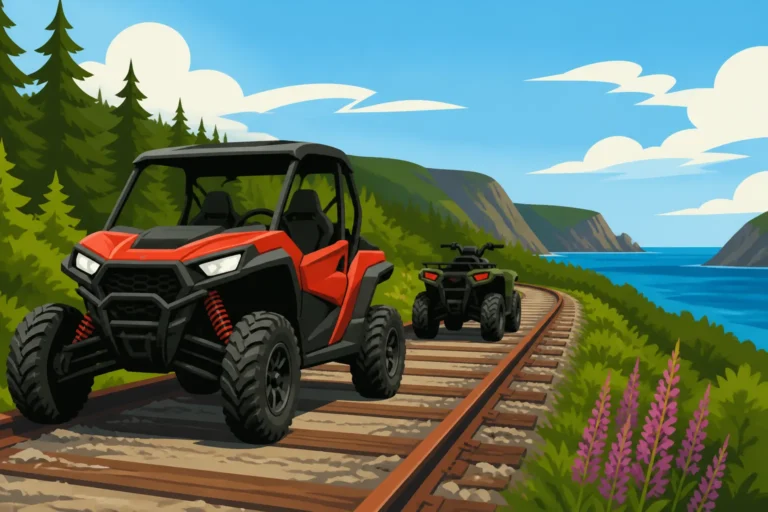
For an additional overview of riding options in the region, see Newfoundland ATV Trails: The T’Railway and Beyond. Don’t assume that a trail described elsewhere as part of a broader Newfoundland route is automatically open near Gros Morne. Confirm its location, access conditions and connection to the riding area you’ve selected.
Decide in advance when not to unload
It’s reasonable to change plans when you arrive. If signs restrict access, the trailhead is crowded, weather has worsened, or you can’t confirm that a route is permitted, leave the machine on the trailer and choose another activity. That may feel disappointing after the effort of hauling it across the island, but it’s much better than risking a ticket, damaging sensitive ground or getting stuck somewhere your group isn’t prepared to handle.
A good trip plan has a fallback that doesn’t depend on squeezing in a ride. You might take a hike, visit a community, enjoy a coastal viewpoint or spend more time at your accommodation. If the riding area is open and conditions suit your group, you can unload with confidence. If not, the trip can still be a worthwhile visit to one of Newfoundland’s most memorable regions.
Disclaimer
This article is for general informational purposes only and does not constitute professional advice. Laws, prices and regulations vary by location and change over time. Consult a qualified professional for guidance on your specific situation.