Newfoundland Trailheads With Trailer Parking
Finding a Newfoundland trailhead with room for an ATV trailer can take more planning than the ride itself. A spot that looks open on a map may have a narrow entrance, soft ground, no room to turn around, or no permission for trailer parking. This guide explains how to choose a practical launch point, confirm access, and avoid arriving with nowhere safe to unload.
How to find a suitable Newfoundland ATV trailhead
A useful trailhead is more than a place where a trail begins. If you’re towing a quad or side-by-side, you need a legal place to leave the truck and trailer, enough room to unload, and a safe way to join the route. Those details can matter as much as the trail’s scenery or distance.
Start with the route, then look for a parking area
Newfoundland’s T’Railway is a long corridor that passes through communities and rural areas, including Port aux Basques, Corner Brook, Gander, Clarenville and the St. John’s area. That doesn’t mean every point along it is a suitable place to launch a machine. Some access points may be better suited to walkers or cyclists, while others may have limited space or no designated parking for tow vehicles.
Begin with the section of trail you want to ride, then look for an established access point nearby. The [Newfoundland ATV Trail Map Downloads] can help you orient yourself, but a line or marker on a map doesn’t confirm that a parking area is open, spacious, or intended for trailers. Treat mapping as the first step in planning, not final permission.
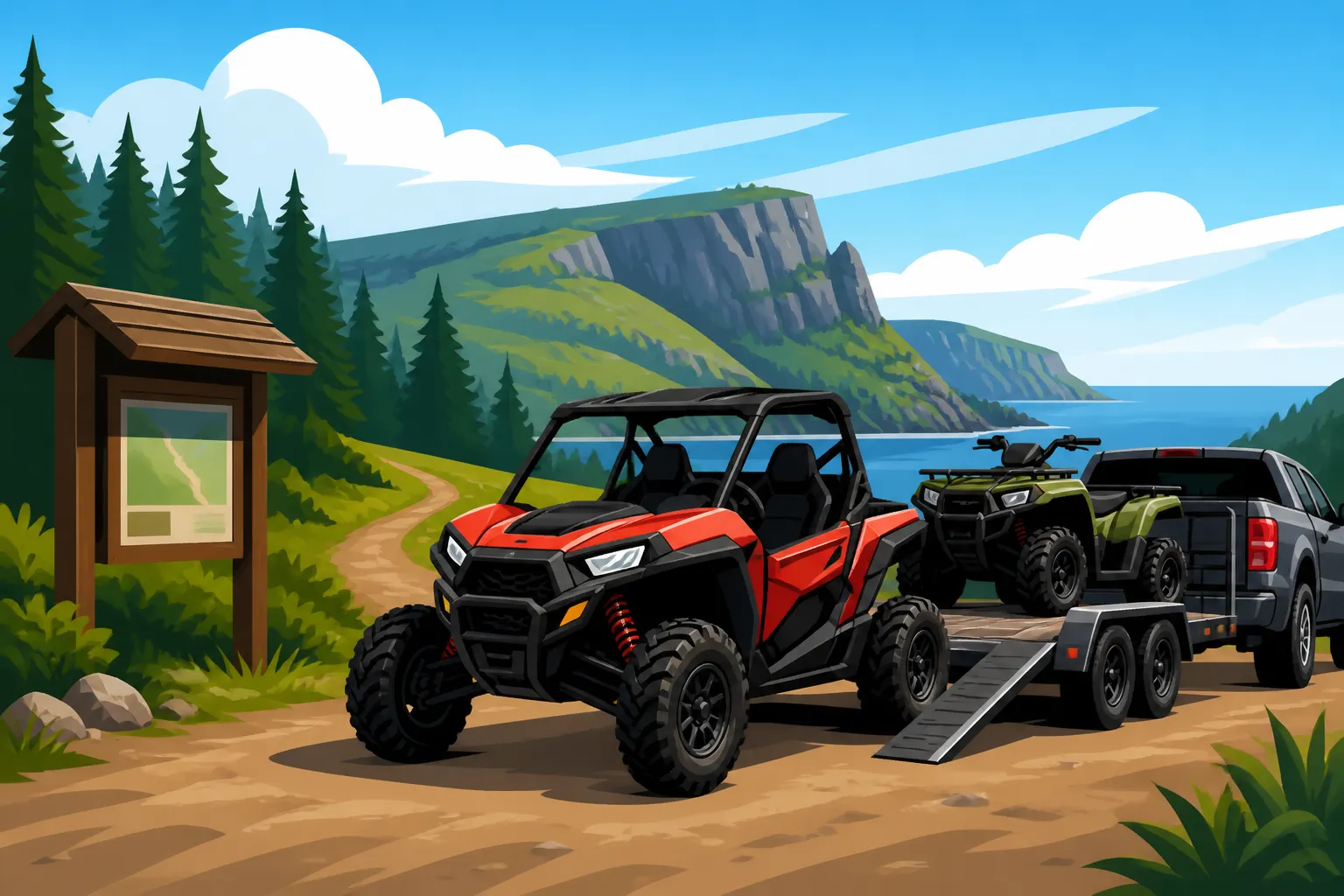
When you find a possible location, consider the whole arrival and departure process. Can the tow vehicle and trailer enter without blocking a road or gate? Is there room to unload without putting a machine in the path of other users? Can you turn around or exit without reversing a long distance? A spot that works for a car may be awkward or unsafe for a truck pulling a trailer.
The same caution applies when using apps such as onX Offroad. Mapping tools can help you compare routes and identify nearby access points, but check what the map actually shows and confirm parking and access details with the relevant local contact. Don’t assume that a mapped track is open to every vehicle or that nearby open ground is available for parking.
Check who manages the access point
Trail access can involve different landowners, community authorities, trail operators and public agencies. The organization responsible for maintaining a route may not control every nearby parking area. If you’re unsure who to ask, start with the local trail operator or community office and explain exactly what you’re planning: the trail section, vehicle type, trailer size and expected parking duration.
For a managed trail, contact the operator before you tow. Ask whether the access point is open to ORVs, whether trailer parking is allowed, and whether there are seasonal closures or local restrictions. The article [Emailing a Trail Operator Before You Ride] covers the kind of details worth confirming in advance. A quick check can prevent an unpleasant surprise after a long drive.
It’s especially important to confirm access if a launch point is near private land, a gate, a work area or a residential road. Don’t treat an unmarked pull-off as permission to park. If the person or organization you contact can’t confirm that trailers may be left there, choose a different spot rather than relying on guesswork.
What to confirm before towing to a trailhead
A trailhead that appears suitable online can feel very different once you arrive with a trailer. Confirm the practical details before departure, and make a backup plan in case the preferred access point is full, closed or unsuitable.
Ask specific questions about parking and unloading
“Is there parking?” is often too broad to get a useful answer. Be clear that you’re towing, and ask whether the space can accommodate your full setup. A truck and trailer need more room than a single vehicle, especially if you’ll need to unload machines and reposition the trailer before riding.
| What to confirm | Why it matters |
|---|---|
| Trailer parking is permitted | A nearby lot may be intended for other users or may prohibit long stays |
| Space for your full setup | A parking space for a car may not fit a truck and trailer |
| Room to unload safely | Machines shouldn’t be unloaded into traffic or across a busy entrance |
| A safe turning or exit route | Tight access can make departure difficult, especially with a long trailer |
| Gates and seasonal access | A route may be closed or restricted at certain times |
| Overnight parking rules | Permission to park during a ride doesn’t automatically allow overnight stays |
| Other users and local activity | Trailheads may be shared with residents, hikers, cyclists or work vehicles |
If you’re arranging a larger outing, ask about group size and how many vehicles can unload at once. The guidance in [Where a Ten-Machine Group Can Unload Safely] is a useful reminder that a space that works for one or two machines may not work for a convoy. For a group, stagger arrival times if appropriate and keep the access road clear.
Get a name, phone number or written confirmation when possible. That way, if conditions change or you need to clarify where to park, you have a reliable contact. Keep the answer simple in your trip notes: where to enter, where to leave the truck and trailer, and whom to call if the lot is blocked.
Choose firm, safe ground instead of an improvised pull-off
Newfoundland weather can change the condition of an unpaved access area quickly. A gravel shoulder that was firm on a dry day may become soft after rain. A trailer can sink or slide on uneven ground, and a loaded tow vehicle may struggle to turn around on a narrow or steep surface.
Look for a level, stable area where the whole vehicle can be parked without blocking traffic, a gate, a driveway or the trail itself. Avoid parking on vegetation, wet ground, private property or any place where your trailer could obstruct emergency or maintenance access. If there isn’t a clear, suitable space, don’t force the issue by unloading on the road.
Before committing to a location, consider the exit as well as the entrance. A tight turn that seems manageable on arrival can become stressful later if other vehicles are parked nearby or the ground has softened. Leave room for other users, and park so that you can leave without making an unsafe manoeuvre.
Trail conditions deserve the same attention as parking. Check [Newfoundland Trail Conditions Before You Ride] before setting out, especially after heavy rain or a storm. Poor conditions can affect not only the ride but also the approach road, the parking surface and your ability to tow out safely.
Plan the drive, the unload and the return
Good trailhead planning reduces the rushed decisions that often lead to blocked access, unsafe unloading or a difficult trip home. Think through the entire outing, from the towing route to the moment you load the machines again.
Prepare for the tow and arrival
Before leaving, check your route for narrow roads, steep approaches, construction or other restrictions that might affect a tow vehicle. The article [Trailering a Machine Along the Trans-Canada Highway] offers relevant planning considerations for transporting a machine along major routes. Allow extra time rather than trying to make up time on unfamiliar roads.
Keep the trailhead’s location and directions available offline. Cell service can be unreliable in some rural areas and along portions of the railbed. Save essential route information before you leave, and carry a paper map or written directions if you’ll be travelling beyond reliable coverage. [Cell Dead Zones Along the Railbed] and [Carrying a Paper Map Where There Is No Signal] explain why it’s wise not to depend on a phone connection for every turn.
Mapping apps, including onX Offroad, can be useful for viewing a route and organizing a ride plan. Download or save what you need before travelling, and check that you understand the map’s limits. A mapped route doesn’t replace permission, signage or current information from the trail operator. Bring a second way to navigate so that a dead battery or lost signal doesn’t leave the group unsure where to go.
When you arrive, take a moment to assess the area before unloading. Check for traffic, pedestrians, other parked trailers, soft ground and any signs that access has changed. If the spot is congested or unsafe, use your backup plan rather than blocking the entrance while you try to make it work.
Keep the trailhead usable for everyone
Trailheads are shared spaces. Local residents may need to pass through, trail crews may need access, and other riders may be waiting to unload. Park neatly, keep machines and gear out of traffic, and don’t spread a group across the entrance while people prepare.
Respect signs and barriers even when the trail appears clear beyond them. Don’t move a barricade to make trailer access easier, and don’t park in front of a gate or on a route used by maintenance vehicles. If a location is full, move on instead of squeezing into a spot that blocks someone else.
Trail etiquette matters once you’re riding, too. On shared routes, slow down around hikers and cyclists, leave room for other users, and follow posted instructions. [Newfoundland Trail Etiquette Locals Expect] offers a useful overview of courteous riding habits. If you’re riding with a club or a large group, agree on where everyone will park and unload before the first truck arrives; [Newfoundland Group Ride Planning] can help with organizing the day.
A practical trailhead checklist
A short checklist is useful when you’re packing the truck, especially if you’re coordinating more than one machine or travelling to an unfamiliar part of the province.
Before you leave home
- Confirm the trail section you intend to ride and identify an access point.
- Ask the local operator or relevant office whether trailer parking and unloading are allowed.
- Confirm that the space can handle your full vehicle-and-trailer setup.
- Ask about closures, gates, seasonal limits and overnight parking.
- Save directions and maps for offline use, and carry a backup navigation option.
- Identify a second access point in case the first one is unavailable.
- Check the weather and trail conditions, including the approach to the parking area.
- Make sure the tow vehicle, trailer and machines are ready for the route.
When you arrive
- Check signs and barriers before entering or unloading.
- Make sure the ground is firm and there is room to turn or exit safely.
- Park without blocking a road, gate, driveway, trail or maintenance access.
- Keep gear and machines within the area you’re permitted to use.
- Reassess conditions before loading up to leave.
If you’re uncertain about a trailhead, a local ATV club can sometimes point you toward the right operator or community contact. [Newfoundland ATV Clubs Worth Joining] may help you find a useful starting point for local knowledge. The key is to ask about the specific access point and your trailer, rather than assuming that a recommendation for a riding area also covers parking.
A little confirmation before departure can spare you a frustrating drive with a loaded trailer and nowhere safe to unload. Choose an access point that has clear permission, suitable space and a practical exit, and keep a backup plan ready if the first option doesn’t work.
Disclaimer
This article is for general informational purposes only and does not constitute professional advice. Laws, prices and regulations vary by location and change over time. Consult a qualified professional for guidance on your specific situation.