Newfoundland ATV Clubs Worth Joining
Joining an ATV club in Newfoundland can make the difference between guessing where a trail goes and riding with people who know the terrain, local conditions, and community expectations. But clubs vary: some focus on organized rides, others on trail work or advocacy. This guide explains what to look for, how to find a group near your riding area, and what to ask before joining.
What a Newfoundland ATV club can offer
Local knowledge that maps cannot provide
A local club can help you understand the difference between a route that looks passable on a map and one that is actually a good choice for your machine and experience. In Newfoundland, that might mean knowing where a railbed is rough with loose ballast, which low-lying sections hold water after rain, or whether a trail has been affected by recent weather.
That kind of practical knowledge is especially useful if you are new to an area. A rider heading out from Gander may have very different questions from someone exploring near Corner Brook, Clarenville, or the Avalon. Local members can often point out suitable places to unload, nearby services, and the kinds of conditions to expect on a particular loop. They may also know who to contact about access questions rather than relying on a trail name passed along second-hand.
A club is not a substitute for checking access rules or posted signs. Nor should a local recommendation be treated as permission to cross private property or enter a restricted area. Use local advice as one part of your planning, alongside official information and on-the-ground signs. For background on shared routes and riding expectations, see [Newfoundland Trail Etiquette Locals Expect].
Organized rides and a steadier learning curve
Riding with a club can feel less intimidating than joining an informal group of strangers. A well-organized ride usually has a clear meeting point, a planned route or destination, and someone who knows how the group will handle stops and regrouping. That structure helps newer riders settle in without feeling pressured to keep pace with the fastest machine.
It can also make longer days more manageable. On an unfamiliar railbed or a remote stretch of trail, having other riders nearby can be reassuring if someone gets stuck, has a mechanical problem, or realizes they packed for a sunny afternoon rather than a cold, wet one. Before a first group ride, ask how the club handles different experience levels, whether riders are expected to bring recovery equipment, and whether the route is suitable for your ATV or side-by-side.
The social side matters, too. Clubs can connect people who want regular rides, family outings, volunteer days, or simply a few local contacts to ask before heading out. If you prefer a small group rather than a large event, say so when you inquire. A club’s public ride schedule may not reflect every casual outing its members organize.
Finding clubs and groups near your riding area
Start with the community, then confirm the details
Search for active ATV groups connected to the area where you expect to ride, rather than choosing a club based only on a name that sounds provincial. Ask at local businesses that serve riders, check community noticeboards and social groups, and look for announcements from organizations involved in trail access or maintenance. In places such as Stephenville, Gander, and communities along the T’Railway, local contacts may know which groups are currently organizing rides or volunteer work.
When you find a possible club, look for recent evidence that it is active: current event notices, recent trail updates, or replies to membership questions. An old page or an impressive-looking trail photo is not enough to establish that a group is still organizing rides. Ask who handles membership inquiries and whether the club welcomes new riders from outside the immediate community.
It helps to distinguish a riding club from a trail operator or provincial organization. A club may organize local rides and volunteer projects, while another organization may manage a particular trail or handle access-related information. These roles can overlap, but they are not interchangeable. For a broader look at how organized riding fits into the province’s trail network, see [Newfoundland ATV Clubs Worth Joining] and [Newfoundland Managed Trail Rules].
Use maps as a planning aid, not as proof of access
Digital maps can help you compare routes, estimate how a ride fits into your day, and identify places to discuss with local riders. Some riders use onX Offroad to review mapped routes and plan trips, but a digital line on a screen does not establish that a trail is open, legal to use, or suitable for every vehicle. Check current local guidance and signs before you ride.
That distinction matters in Newfoundland, where a route may cross different land types or connect to a multi-use corridor. A mapped route might also leave out a washed-out section, a seasonal restriction, or a difficult bog crossing. Treat map details as a starting point for questions: Is this route open to my type of machine? Is there a suitable place to unload? Does the route pass through an area with additional rules?
For broader trip planning, compare a club’s local advice with [Newfoundland ATV Trail Map Downloads] and [Newfoundland Approved and Restricted Areas]. If a route is unfamiliar, ask a club member or trail contact to explain any uncertain sections before setting out. Keep a backup navigation option, too; cell coverage can be unreliable in some riding areas, so a screen that depends on a signal should not be your only plan.
| Club or group type | Often a good fit if you want | Questions to ask before joining |
|---|---|---|
| Local community club | Nearby rides and area-specific advice | Where do members usually ride, and how often are rides organized? |
| Trail-focused volunteer group | Trail work, maintenance, and access stewardship | What volunteer work is planned, and how are trail updates shared? |
| Informal social group | Casual outings and a low-pressure way to meet riders | Are rides open to newcomers, and how are routes and pace agreed on? |
| Provincial or advocacy organization | Wider policy and riding-community updates | What does membership include, and how does the organization communicate with local riders? |
Choosing a club that fits your riding style
Compare the ride culture, not just the membership pitch
Two clubs can both welcome ATV riders and still feel very different. One may plan early starts and full-day distances; another may favour short local loops and long breaks. Some groups are geared toward experienced riders who already know how to manage rough ground. Others make an effort to accommodate beginners, families, or a mix of ATVs and side-by-sides.
Ask how rides are organized and what riders are expected to do. Do members use a lead and sweep rider? Are stops planned at regular intervals? Does the group wait if someone falls behind? Are riders expected to bring their own tools, tow strap, first-aid supplies, and food? There is no single right style, but knowing the expectations in advance helps avoid an uncomfortable first outing.
Pay attention to how people talk about safety and access. A responsible group should take questions about land permission, closures, equipment, and respectful riding seriously. If a club treats rules as an annoyance or encourages riders to ignore signs, that is a warning sign—not a sign of adventurous local knowledge. You can read more about group planning in [Newfoundland Group Ride Planning] and shared-route manners in [Riding Etiquette on a Shared Railbed].
Check what membership actually includes
Membership might include invitations to club rides, access to member communications, opportunities to volunteer, or participation in advocacy and community events. It may not include trail access, insurance for your machine, training, a managed-trail sticker, or permission to ride on land controlled by someone else. Ask for a clear explanation of what membership does—and does not—provide.
Also ask about the practical details: how to sign up, how renewals are handled, whether household or family memberships are available, and where notices are posted. If you are joining from outside the club’s home community, find out whether members are expected to attend regular meetings or volunteer locally. A club can be a great fit even if you cannot attend every event, but it is better to know the expectations before committing.
If you ride with children, ask whether club events are family-friendly and what supervision or equipment expectations apply. If you are new to riding, ask whether members are comfortable helping beginners choose an appropriate outing. For a wider overview of preparing for a trip, see [Newfoundland Safety Training Is Mandatory] and [Newfoundland Trail Conditions Before You Ride].
Making your first club ride a good one
Ask clear questions before the event
A short conversation before your first ride can prevent a lot of stress on the morning of the event. Confirm the meeting location, expected start time, approximate ride length, and whether the group plans to stop for fuel or food. Ask what kind of terrain to expect and whether your machine is appropriate for the route. A ride described as “easy” can mean something different to a new rider than it does to someone who has ridden the area for years.
Be straightforward about your experience. You do not need to apologize for being new, but the organizer does need enough information to help you choose a suitable ride. Mention if you are unfamiliar with bog, rocky ground, steep sections, or riding in a group. A considerate club will want the outing to be enjoyable for everyone, not a test of who can push through the most difficult conditions.
Before leaving home, check your machine, fuel, weather, and required documents. Bring water, food, suitable layers, and any recovery gear the organizer recommends. For remote routes, ask about the plan if someone loses cell service or has a breakdown. These conversations are part of good trip planning, not a sign that you expect something to go wrong.
Be a helpful guest and decide whether to stay
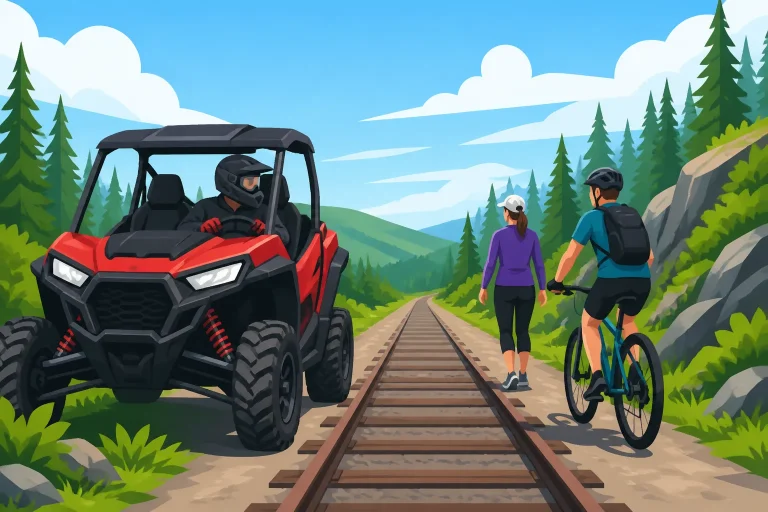
At the first ride, arrive on time, listen carefully to the safety briefing, and keep a pace that lets you ride comfortably. Leave enough space between machines, follow the group’s passing and stopping practices, and avoid taking a route shortcut unless the organizer agrees. On a shared corridor, be ready to encounter hikers and cyclists; a club ride should leave a good impression on everyone using the trail.
You can learn a lot by watching how members behave when plans change. Does the group adjust for weather or a slower rider? Do members take care around trail edges and other users? Are questions answered without mockery? A club’s culture is usually clearer on an ordinary ride than it is in a membership description.
Afterward, think about what suited you. Perhaps you enjoyed the route but wanted more frequent breaks, or you liked the group but would prefer a smaller outing. Tell the organizer what you thought and ask about other ride types. A good club connection should make you feel better prepared to ride Newfoundland—not obligated to take on trips that do not match your comfort level.
Disclaimer
This article is for general informational purposes only and does not constitute professional advice. Laws, prices and regulations vary by location and change over time. Consult a qualified professional for guidance on your specific situation.