Retaking the Safety Test After Scoring Under 12
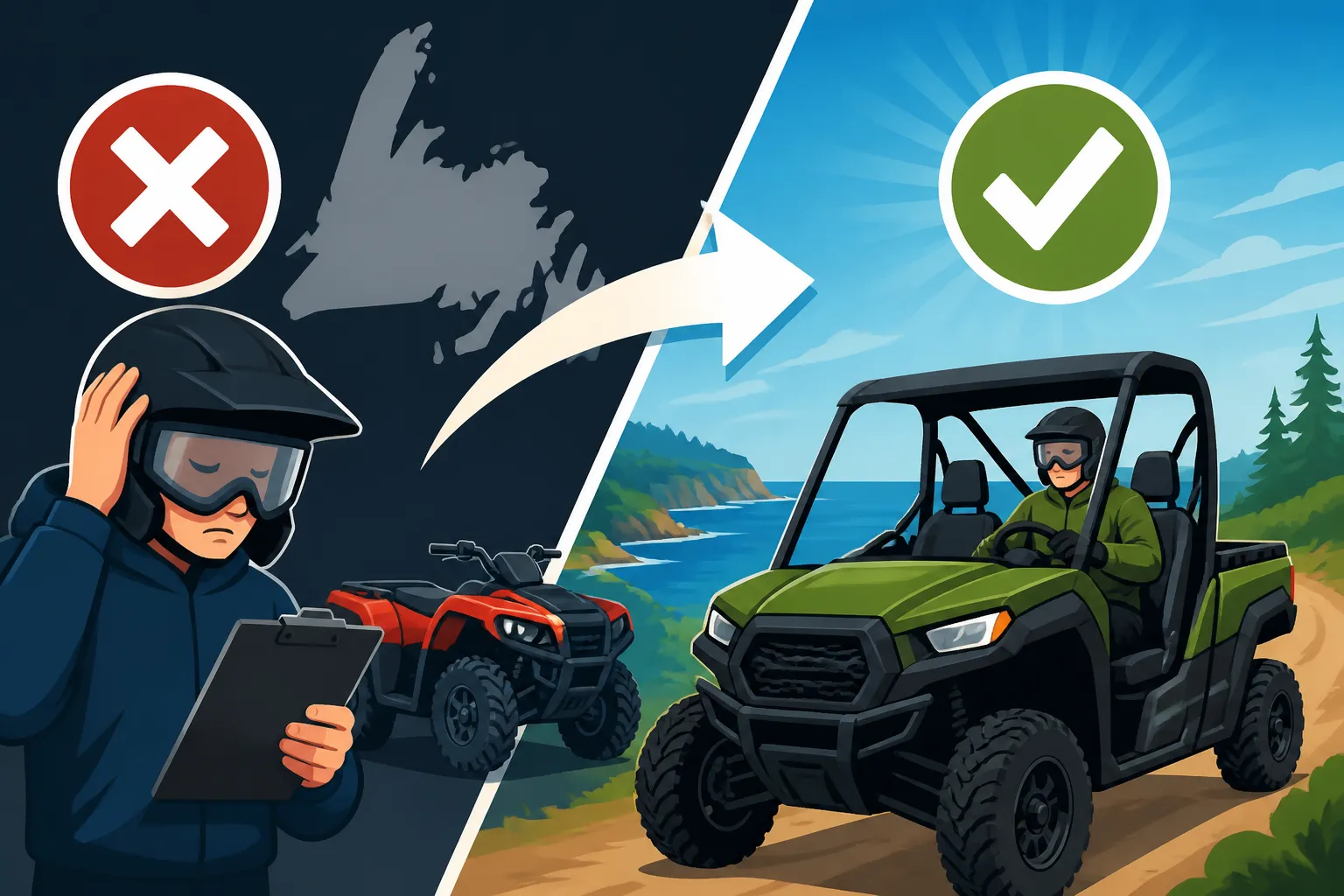
A score under 12 on Newfoundland’s ATV safety test means you have not reached the pass mark, but it does not have to end your training. The next steps are to check your result, review the material you missed, and find out how to retake the test. Here’s how to approach a retry and what to do once you pass.
What a score under 12 means
The Newfoundland safety test has 15 questions, and you need 12 correct answers to pass. A score below 12 means you do not yet have the certificate issued after passing. The threshold and format are covered in Twelve Right to Pass and Fifteen Questions Stand Between You and a Certificate.
Treat the result as a prompt to review, not as a reason to guess your way through another attempt. A safety test is intended to check whether you understand the rules and practical risks involved in riding. Knowing why an answer is right is more useful than remembering which option you selected last time.
Start by reviewing the test information and the safety material it draws on. What Is on the Newfoundland ATV Safety Test can help you identify the subject areas to revisit. If the test showed which questions you missed, use that feedback to focus your study. If it only displayed your score, review the full material rather than trying to reconstruct the questions from memory.
A failed score does not, by itself, tell you that you are barred from trying again. However, don’t assume there is no waiting period, limit on attempts, or change in the process. Follow the current instructions shown on the official test page, including any directions about when and how to retry.
| Your result or situation | What to do next |
|---|---|
| You scored under 12 | Review the safety material and follow the test page’s instructions for another attempt. |
| You scored 12 or more | Follow the instructions to access or print your certificate, then check when you need to carry proof. |
| You are unsure whether training applies to you | Check the requirements for your age and riding situation before operating a machine. |
| The test will not load or record a result | Check the official service instructions and troubleshoot your device before beginning again. |
| You passed but cannot find your certificate | Return to the test or account instructions and use the available certificate steps. |
The test and certificate are only one part of riding legally and safely. Registration, trail access, insurance, age-related restrictions, and rules for a particular machine may also matter. Passing the test does not automatically satisfy those separate requirements.
How to prepare before you retake it
The most effective preparation is a careful review of the rules, not a quick attempt to memorize answers. Give yourself enough time to read the material without distractions. If you are rushing, on a small screen, or trying to complete the test while doing something else, it is easier to misread a question or choose an answer that sounds plausible but does not match the rule.
Use a simple study process:
- Read the official safety information from beginning to end.
- Note any rule or term you do not understand.
- Look up those points in the relevant materials, rather than relying on a guess.
- Review the areas that are easiest to confuse, such as equipment requirements, rider responsibilities, and restrictions that depend on age or circumstances.
- Start the test when you can give it your full attention and have a reliable internet connection.
Pay particular attention to how a question is phrased. A question may ask what is required, what is permitted, or what a rider should do in a specific situation. Those are not interchangeable. Read each question and all its answer choices before deciding. If two choices seem close, ask which one follows the rule most precisely.
Don’t study only the questions you think you got wrong. The test may present questions differently on another attempt, and the same safety topic can be tested from another angle. Reviewing the complete material helps you handle a new wording or scenario.
It can also help to connect a rule to the situation it is meant to address. For instance, don’t treat equipment rules as a list of boxes to tick: think about what the equipment does and when it matters. Likewise, learn the difference between a rule that applies whenever you ride and one that applies only in a particular setting. That makes it easier to reason through a question you have not seen before.
If you are a parent or supervisor helping a young rider prepare, let the rider read and answer for themselves. You can explain terms and discuss real riding situations, but answering on their behalf defeats the purpose of the assessment. The operator is the person who needs to understand the responsibilities involved.
For an overview of the broader requirement, see Newfoundland Safety Training Is Mandatory. The rules can depend on the rider and circumstances, so a failed attempt is a good time to confirm whether the test is the appropriate training route for you. Riders and families can also review Newfoundland Training Required Under 16 and Newfoundland Training for First-Time Registrants where those situations apply.
How to retake the test through MyGovNL
The online test is available through MyGovNL. The basic retake process is to return to the official test service, read the current instructions, and follow the steps provided for taking the assessment again. The process may change, so rely on what the service displays rather than assuming that an old link, saved page, or set of instructions still works.
A practical approach is:
- Go to the official test service using the current MyGovNL instructions.
- Check that you are in the safety test for the correct type of machine or training requirement.
- Read any notice about eligibility, retries, or how results are saved.
- Make sure your connection is stable and your device is working properly.
- Complete the test yourself, reading every question carefully.
- Follow the final instructions to confirm your result and access your certificate if you pass.
If the service does not let you start again, do not keep submitting incomplete attempts or assume that a technical problem means your result has changed. Read the instructions and contact the appropriate service if they direct you to do so. A screenshot or note of the message you see can make it easier to explain the problem, but avoid sharing personal account details publicly.
If you lose your connection or the page freezes, first check whether the service recorded the attempt before starting over. A repeated submission could create confusion about which result is current. The official service’s own guidance should take priority if it provides specific troubleshooting steps.
The test is described in the related article Taking the Free Safety Test on MyGovNL. Check the live service for current instructions on retries and certificate access. Do not rely on a search result or an old saved page if it conflicts with what the official service says.
A passing result should lead you to the certificate instructions. If you pass but cannot access the certificate, follow the service’s steps for retrieving or printing it rather than retaking the test unnecessarily. The process for printing is explained in Printing Your Certificate the Moment You Pass.
After passing: certificate, riding rules, and common mistakes
A pass is a useful milestone, but it is not a substitute for checking the rules that apply to your ride. Once the certificate is available, save or print it as directed and keep proof accessible when required. Carrying Your Safety Certificate on Every Ride explains the practical point of having evidence with you.
Before your first ride after passing, check the other obligations that may apply. Depending on the rider and machine, you may need to consider registration, insurance, equipment, supervision, and where the machine is allowed to operate. A test certificate does not register the ATV or UTV, make a restricted trail legal to ride, or override age and supervision rules.
A few common mistakes are worth avoiding:
- Assuming a near-pass is a pass. The pass mark is 12 correct answers. If your score is below that, follow the retake instructions and do not treat the result as a certificate.
- Trying again without reviewing. Repeating the same approach may lead to the same result, especially if the questions are drawn from topics you have not understood.
- Relying on remembered answers. Questions may be worded differently on another attempt. Learn the underlying rule so you can apply it to a new scenario.
- Letting someone else take the test. The rider needs to understand the material personally. Help with studying is different from completing the assessment for them.
- Confusing a safety certificate with other documents. Registration papers and proof of insurance serve different purposes. Keep the documents you need for your own situation organized separately.
- Assuming a pass makes every ride legal. Local access rules, trail requirements, and machine-specific obligations still need attention.
If you are not sure whether you qualify to use the online test or need a different course, check the current official requirements or ask an approved provider. Newfoundland Approved Course Providers is a useful place to start when a course may be the right option. Confirm that the course is accepted for your situation before enrolling.
The safest next step after a failed score is straightforward: review the official material, use the current instructions to retake the test, and wait until you have passed and obtained the required proof before relying on the certificate. Then check the separate rules for the rider, machine, and route.
Disclaimer
This article is for general informational purposes only and does not constitute professional advice. Laws, prices and regulations vary by location and change over time. Consult a qualified professional for guidance on your specific situation.