Taking the Free Safety Test on MyGovNL
If you need off-road vehicle safety training in Newfoundland and Labrador, it can be hard to tell who must take it, where to start and what to do with the certificate afterward. The free program is available through MyGovNL, but passing the test is only one part of being ready to ride. Here’s how to approach it and what to sort out next.
Who needs to complete the safety training
The MyGovNL safety program is for off-road vehicle users who are required to complete training. That includes more than one group, so check which requirement applies to you before assuming the training is only for young riders.
According to the Government of Newfoundland and Labrador, safety training is required for anyone under the age of 16 and anyone registering an off-road vehicle for the first time. Training may also be required by the Registrar of Motor Vehicles after an offence that resulted in a registration suspension or cancellation. The Government’s Newfoundland Safety Training Is Mandatory covers the main situations in which the requirement applies.
That means an adult who has never registered an off-road vehicle may need to complete training even if they have ridden before. Familiarity with a machine does not necessarily remove a first-time registration requirement. If you are registering a vehicle for the first time, see Newfoundland Training for First-Time Registrants and confirm who must complete the training in your circumstances.
For young riders, training is only one part of the rules. According to the Government of Newfoundland and Labrador, a person under 16 must be supervised by a licensed driver who is at least 18 years old. The supervisor must be able to see the young operator, provide direction and ensure the operator can see them. The supervisor also has a duty to ensure the young person has completed the required training. For details on that responsibility, see Newfoundland Supervision Rules for Young Riders.
Training does not replace the other requirements that apply to the rider or vehicle. A completed certificate does not, by itself, register a machine, provide insurance, authorize highway use or give permission to ride a managed trail. It is useful to think of the certificate as proof of one safety requirement, not an all-purpose riding permit.
| Situation | What to check |
|---|---|
| You are under 16 | Complete the required training and confirm that the vehicle and supervision meet the rules for a young operator. |
| You are registering an off-road vehicle for the first time | Complete the required training before relying on the registration process being finished. |
| Your registration was suspended or cancelled after an offence | Check whether the Registrar requires training as a condition of reinstatement. |
| You have already completed an accepted course | Confirm that it is accepted by the Registrar and that you can provide proof. |
The program applies to off-road vehicles, including ATVs, UTVs and snowmobiles. The training requirement should not be confused with a test of one particular vehicle model or with an endorsement that replaces other legal requirements.
How to take the free test on MyGovNL
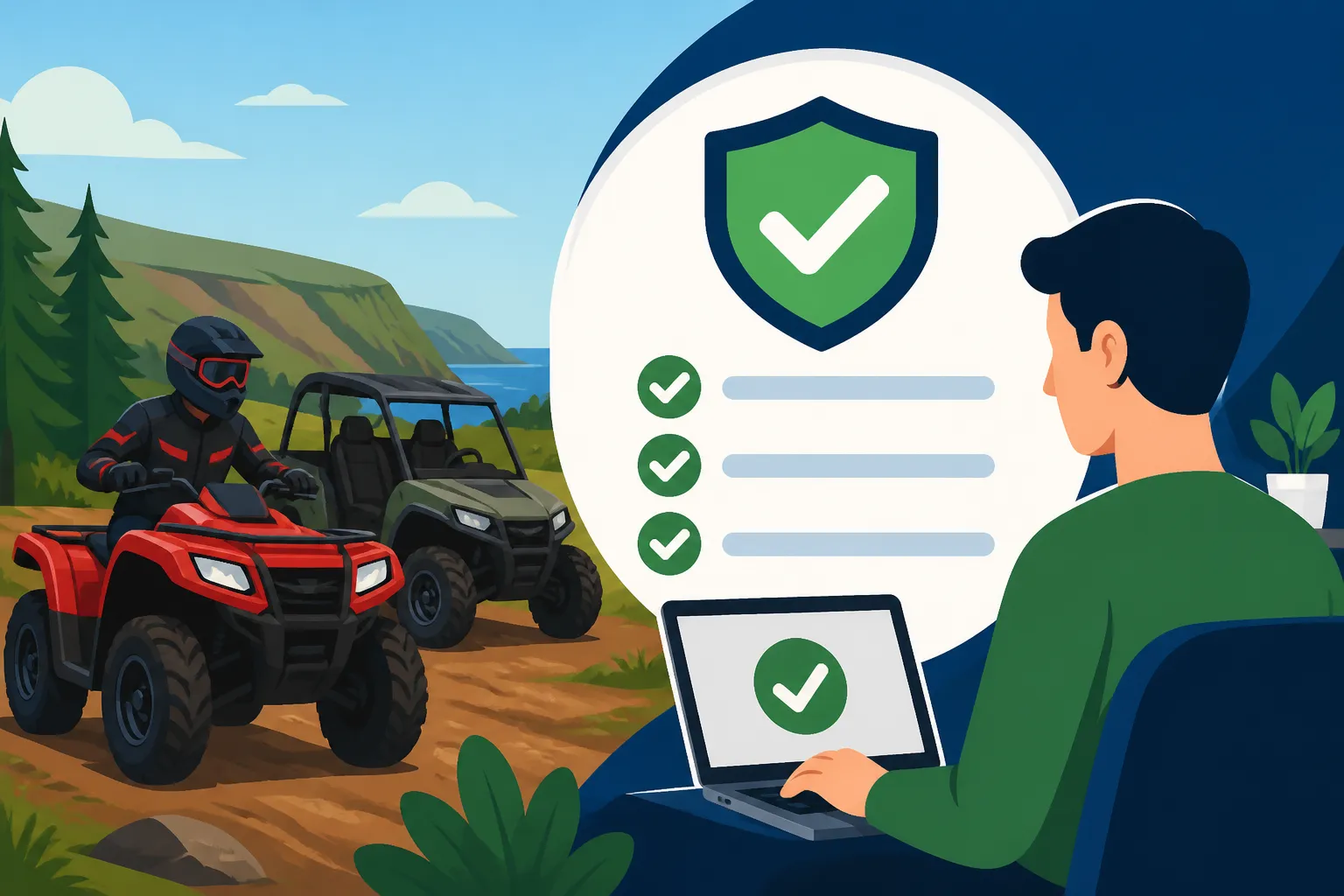
The free safety training program is available on MyGovNL, according to Digital Government and Service NL. The most useful preparation is to review the Off-Road Vehicles Handbook before starting the program. That gives you a chance to understand the rules and safety topics before you are asked to complete the training and test.
A straightforward way to work through it is:
- Check that the training applies to you. If you are under 16, registering an off-road vehicle for the first time, or completing a condition set after an offence, verify that the training requirement applies to your situation.
- Review the Off-Road Vehicles Handbook. Digital Government and Service NL advises users to review it before completing the MyGovNL training program. Pay attention to operating responsibilities and the rules that apply to your vehicle and riding situation.
- Open the safety training program on MyGovNL. Work through the program rather than treating the test as a stand-alone quiz. The training is intended to help you understand safe and lawful operation, not just achieve a passing result.
- Complete the test and check your result. According to Government Services, a passing score requires at least 80 percent.
- Save or print the certificate. Digital Government and Service NL says users can print a certificate after completing the training. Keep it somewhere you can access while riding.
The exact on-screen prompts may vary, so follow the directions presented in the program. If you need help accessing the training online, Digital Government and Service NL says it can also be completed by visiting a local Employment Support Centre or public library. That can be useful if you do not have reliable internet access or would rather work through the program in a community setting.
Other courses may count as well. Digital Government and Service NL says training courses approved by the Registrar of Motor Vehicles, including in-person training, are accepted. If you completed a course outside MyGovNL, do not assume that any general ATV course automatically qualifies. Confirm that the Registrar approves it and ask how to document completion. Newfoundland Approved Course Providers is relevant if you are considering an alternative course.
The training program is free, but that does not mean every part of preparing a machine or getting it registered is free. Registration and other riding-related costs are separate. For registration, owners must deal with Motor Registration Division, and registration requires an appointment. The paperwork depends on whether the vehicle is new or used; Newfoundland Registration Paperwork Explained covers the documents to prepare.
Passing, printing and carrying your certificate
Once you pass, make sure you can retrieve your certificate later. Digital Government and Service NL says you can print the certificate after completing the training, and recommends carrying it while using an off-road vehicle. If your printer is unavailable, arrange another way to print and keep the document accessible rather than assuming that a result visible on a screen will always be enough.
According to Government Services, an operator who is required to complete mandatory training must provide proof of completion within 2 business days if a peace officer requests it. Carrying the printed certificate makes it easier to respond to a request while riding. For more on keeping proof available, see Newfoundland Proof Carried While Riding and Newfoundland Printable Certificates.
Before you head out, check that the certificate belongs to the person who completed the training and is legible. Keep it with the other information you may need to produce, but protect it from water, mud and damage. A small document sleeve or a protected compartment in your riding gear can help keep a paper copy readable. If you rely on an electronic copy as a backup, do not let that replace the printed certificate if the program provides one.
If you do not pass on your first attempt, return to the learning material and review the topics you found difficult before trying again. The key standard is the passing score set by Government Services, not simply completing the online screens. Avoid relying on someone else’s answers or treating the test as a formality: understanding the material matters when riding conditions, other trail users or roadside situations require a quick decision.
The certificate also has a limited role. It proves completion of the training; it does not prove that your particular vehicle is registered or insured, nor does it establish that a route is open to off-road vehicles. If you are planning to use a managed trail, check its permit requirements separately. The rules for Newfoundland Managed Trail Rules are distinct from the MyGovNL training program.
What the certificate does not replace before a ride
A passed test does not complete the rest of your pre-ride checks. Owners must ensure that an off-road vehicle is registered with Motor Registration Division. Government Services says registering a new or used off-road vehicle requires an appointment, and a vehicle registration application must be brought to that appointment. New vehicles require a manufacturer-issued New Vehicle Information Statement; used vehicles require a bill of sale with the previous owner’s signature. You can use What to Bring to Your Registration Appointment to plan the paperwork.
Registration and safety training are separate requirements. A registration document is not a training certificate, and a training certificate is not a registration permit. Registration does not expire while you own the vehicle, but it still needs to be in place before use. If ownership changes, the sale or transfer must be reported within the required period; see Newfoundland Notification Within 10 Days for the related process.
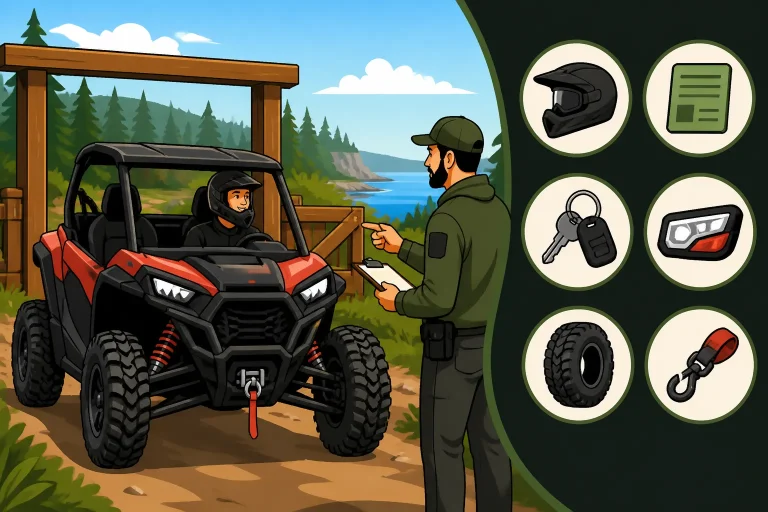
Also check the vehicle’s safety equipment and the rules for your intended route. Helmets are required for off-road vehicle operators and passengers, subject to the stated hunting and trapping exception. Seatbelts must be worn when the manufacturer has installed them. If the vehicle does not have a sufficiently high windshield, riders need eye protection such as safety glasses, goggles or a face shield. More detail is available in Newfoundland Helmet Law for Every Rider.
The MyGovNL program is one part of a broader safety system: it helps eligible riders demonstrate that they completed required training, while registration, equipment, supervision and access rules remain separate. Before setting out, confirm that the vehicle is registered, the right riders have completed training, the required certificate is available, and the route allows the type of vehicle you plan to use.
Sources
- Government Services — Off-Road Vehicles Safety – Government Services (checked November 3, 2026)
- Government of Newfoundland and Labrador — Off-Road-Vehicle-Training-Manual-24173.pdf (checked November 3, 2026)
- Digital Government and Service NL — Public Advisory: Off-Road Vehicle Training Now Available on MyGovNL – News Releases (checked November 3, 2026)
- Digital Government and Service NL — Public Advisory: Residents Reminded to Practice Off-road Vehicle Safety – News Releases (checked November 3, 2026)
- Digital Government and Service NL — New Legislation Increases Safety for Off-Road Vehicle Users – News Releases (checked November 3, 2026)
- Government of Newfoundland and Labrador — Offroadsafety-summer.pdf (checked November 3, 2026)
- Government of Newfoundland and Labrador — Offroadsafety-winter.pdf (checked November 3, 2026)
Disclaimer
This article is for general informational purposes only and does not constitute professional advice. Laws, prices and regulations vary by location and change over time. Consult a qualified professional for guidance on your specific situation.