Newfoundland Proof of Ownership on the Trail
If an officer asks who owns your ATV or side-by-side, a bill of sale in the truck may not be enough. The clearest trail document is usually the machine’s registration permit. Here’s what to carry in Newfoundland, what other papers can help, and how the answer changes for visitors and recently purchased machines.
What counts as proof of ownership on a Newfoundland trail
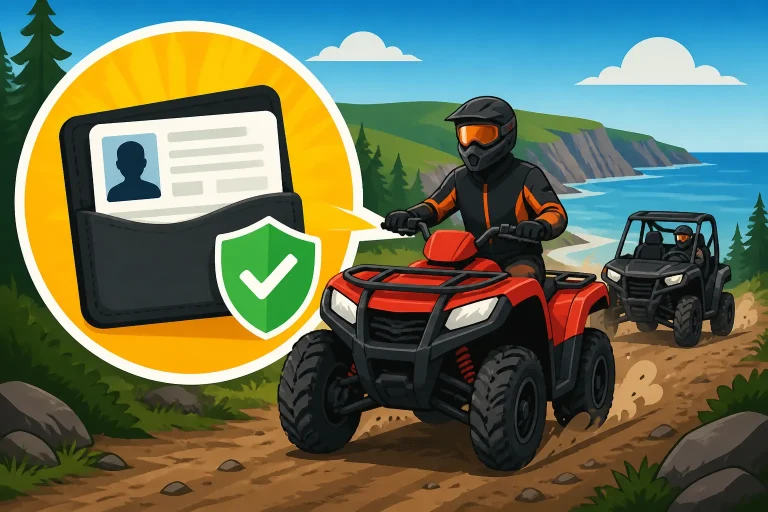
For a machine registered in Newfoundland and Labrador, keep its registration permit available when you ride. It identifies the machine and the person or people recorded as its registrant. That makes it the most useful document to show if an officer asks about the machine’s registration or who is responsible for it.
A registration permit is not the same thing as every possible proof of ownership. A bill of sale helps show how you acquired a machine, while the permit shows its registration record. If those records do not match—for example, because you bought the ATV recently—the bill of sale can help explain the difference, but it does not replace updating the registration.
| Document | What it helps establish | What it does not replace |
|---|---|---|
| Registration permit | The machine’s registration details and recorded registrant | A bill of sale showing a recent purchase |
| Bill of sale | The transaction and the parties involved | Registration in the new owner’s name |
| Prior ownership papers | How the seller obtained the machine | Missing steps in an unclear ownership chain |
| Out-of-province registration | That a visitor’s machine is registered elsewhere | Newfoundland requirements that still apply while riding |
| Trail sticker or marker | Permission or compliance for a managed trail, where required | Registration or proof of ownership |
| Insurance document | Insurance coverage details | Registration or ownership records |
Keep the permit for the machine you are actually riding. If you have several ATVs, do not assume one permit covers them all. Each machine has its own registration record. For the paperwork needed to register or transfer a machine, see Newfoundland Registration Paperwork Explained and Newfoundland Transfer of Ownership Steps.
A registration is generally tied to the machine and its recorded owner, not to a rider’s general permission to use any ATV. If you are borrowing a friend’s machine, the permit can still show your friend as registrant. That does not automatically prove you have permission to use it, so get the owner’s consent and know how to reach them.
If you and another person are both listed as owners, carry the permit showing the registration details. If the machine was inherited, recently bought, or registered under a business name, bring supporting papers that explain the situation. The more unusual the ownership record, the more useful it is to have a clear document trail. For shared ownership, see Registering a Machine in Two People’s Names.
What to carry, and how to keep it usable
A practical document set for a Newfoundland ride starts with the registration permit. Depending on the machine and your situation, it may also include proof of insurance, a bill of sale, and any documents needed to explain a recent transfer or out-of-province registration.
Do not mix up documents that serve different purposes. A registration permit relates to the machine’s registration. Insurance proof relates to coverage. A managed-trail sticker or marker relates to trail access requirements. Safety training proof relates to the rider. Having one does not necessarily satisfy the others.
Before heading out:
- Check that the registration permit matches the machine’s identification details and plate.
- Make sure the name on the permit makes sense for the person or business that owns the machine.
- Bring insurance information if the machine must be insured for the ride.
- If ownership recently changed, carry the bill of sale and any transfer paperwork.
- If you are visiting from elsewhere, carry the machine’s home-jurisdiction registration and documents that explain your stay or ownership.
- Keep documents where you can retrieve them without unloading cargo or leaving the machine unattended.
Protect paper from rain, mud, and fuel. A small waterproof document sleeve, including one sold through retailers such as Amazon, can keep papers together in a storage compartment. Avoid putting loose documents where they can blow out, soak through, or become unreadable. A clear sleeve is useful, but do not assume a photo or digital copy will be accepted in place of an original document. If you intend to rely on a copy, confirm what the relevant authority accepts before the ride.
You may prefer to keep the original permit safely with you rather than permanently on the machine. Either way, make sure it is accessible when requested. A document buried beneath tools, cargo, or recovery gear is technically with you but difficult to produce at a roadside stop. A second copy stored separately can help if the original is damaged, but it should be treated as backup rather than a substitute unless the authorities confirm that is acceptable.
The same basic habit matters on a cabin road or remote trail. Cell service may be unreliable, and an officer or trail operator may not be able to verify details by calling someone. Carrying papers on the ride is more dependable than expecting to retrieve a file from email or contact the owner later. For more on roadside checks, see What an Officer Can Ask You to Produce and Carrying Papers on a Cabin Road.
If you are visiting, buying, or borrowing a machine
Visitors riding a machine registered elsewhere
If you are visiting Newfoundland with an ATV registered in another province or territory, carry its registration document from home. Proof that the machine is registered elsewhere can help establish its status during the visitor period, but it does not waive every Newfoundland riding rule. Visitors still need to pay attention to local requirements for insurance, access, safety, and trail use.
The visitor exemption has a time limit. If your stay extends beyond the applicable period, the machine may need to be registered in Newfoundland and Labrador. Do not assume that a long visit, a seasonal stay, or keeping the machine at a cabin leaves the original registration sufficient indefinitely. Check the current rule before the deadline approaches. See Newfoundland’s 30-Day Visitor Exemption and Newfoundland Rules for an Out-of-Province Machine.
If you are moving to the province rather than visiting, the requirements are different from a short stay. Keep your existing registration and purchase records while you arrange the Newfoundland registration. Confirm the deadline and application steps with the provincial registry, especially if the machine has a lien or the ownership papers are incomplete. Newfoundland Registration for a New Resident explains that situation in more detail.
A machine bought shortly before the ride
After a private sale, the seller’s registration permit is not proof that the transfer to you has been completed. Keep the bill of sale and the seller’s registration information, but arrange the transfer promptly and follow the registry’s instructions about what you must submit. Until the paperwork is updated, be ready to explain why the name on the permit differs from the person carrying it.
A useful bill of sale should clearly identify the buyer and seller, describe the machine, and record the sale. Retain copies of communications and any supporting documents you receive. If the seller is not the person named on the existing permit, ask for documents showing how the seller acquired the machine. A gap in the ownership chain can create delays at registration and uncertainty during a roadside check.
Do not treat a handwritten note or payment record as a complete substitute for the required registration process. If the machine has passed through several owners, collect documentation from each prior owner where possible. When the chain is unclear, ask the registry what evidence it will accept before relying on the machine for a trip. See Newfoundland Registration Without a Bill of Sale and Collecting a Bill of Sale From Every Prior Owner.
A registration is generally valid while you own the machine rather than requiring routine renewal, but a sale changes who should be recorded as the registrant. A permit with the previous owner’s name does not automatically update itself when money changes hands. Review Newfoundland Registration Valid While You Own It for the difference between a registration’s validity and a transfer of ownership.
Borrowed, family-owned, or business machines
When you borrow an ATV, ask the owner for permission and confirm where the registration permit and insurance information are kept. A document showing the owner’s name may be entirely normal, but you should be able to explain your relationship to the machine. If a friend or family member is joining you, agree in advance on who carries the papers.
For a business-owned machine, keep the permit associated with the business and make sure the rider can identify the business as the owner. If a fleet has multiple machines, match each permit to the correct machine before leaving. Similar models or identical-looking plates can make mix-ups easy, especially when machines are loaded together.
If the machine is left at a cabin, do not assume its location changes what paperwork matters. Keep the registration documents accessible where the machine is stored, and confirm that the machine is properly registered and permitted for the intended ride. Cabin use does not automatically remove registration or trail-access obligations. See Does a Cabin-Only Machine Still Need Registering?.
A quick check before you ride
Use this short checklist whenever you take a machine onto a trail:
- Match the paperwork to the machine. Check the permit against the plate and identification details.
- Know whose name is recorded. Be ready to explain a recent purchase, shared ownership, or business registration.
- Carry sale documents when the transfer is new. A bill of sale can explain the history but does not complete the registration transfer by itself.
- Bring visitor documents if the machine is registered elsewhere. Check how long the visitor rules apply and what local requirements remain.
- Keep separate requirements separate. Registration, insurance, trail access, and rider training are different matters.
- Protect the papers from weather. Store them securely and make sure you can reach them during the ride.
- Check current requirements when your situation is unusual. This is especially important for incomplete paperwork, inherited machines, liens, or a move to Newfoundland.
A well-organized document pouch can prevent a simple question from becoming a long stop, but papers are only useful when they match the machine and tell a consistent story. If the permit lists someone else, the machine was recently purchased, or the ownership chain is incomplete, sort out the discrepancy before riding rather than hoping it will not come up.
Disclaimer
This article is for general informational purposes only and does not constitute professional advice. Laws, prices and regulations vary by location and change over time. Consult a qualified professional for guidance on your specific situation.