Newfoundland Registration Valid While You Own It
Oh, the never-ending parade of paperwork and fees! If you're anything like me, you've probably spent countless hours over the years grappling with vehicle registrations, dreading that annual envelope arriving in the mail, reminding you it's time to pay up again. It's a common frustration for anyone who owns a car, a truck, or even some trailers. But when it comes to your ATV or UTV here in Newfoundland and Labrador, you get to breathe a sigh of relief. This guide is all about one of the best perks of off-road vehicle ownership in our province: your registration is valid for as long as you own the machine, and we'll dig deep into what that really means for you as a rider and how to make the most of this unique system.
The Unique Advantage of Newfoundland's ORV Registration
Let's face it, nobody enjoys shelling out money every year just to keep their recreational vehicle legal. It feels like a perpetual tax on fun. Here in Newfoundland and Labrador, though, the folks behind the [Newfoundland's Off-Road Vehicles Act] understood that burden. They structured the ORV registration system in a way that truly simplifies ownership for residents. This isn't just a minor tweak; it's a fundamental difference from many other jurisdictions, making off-road vehicle ownership here refreshingly straightforward in one key area.
Understanding "Valid While You Own It"
When we say your Newfoundland ORV registration is "valid while you own it," we mean exactly that. Once you've gone through the initial registration process, paid your one-time fee – whether it's the [Newfoundland Charges $95 for an ATV] or the much smaller [Newfoundland Charges $5 for a Trail Bike] – and received your identification plate and registration permit, you're set. There are no annual renewal notices. You won't get a bill in the mail next year, or the year after that. There are no yearly stickers to fuss with or new expiry dates to track. This isn't just about saving a few dollars; it's about eliminating an entire administrative headache that plagues vehicle owners elsewhere. Your registration simply remains active and tied to you, the owner, for the entire duration of your ownership of that specific machine. This aspect is so significant that it's often highlighted as [Newfoundland Registrations Never Expire].
It's a stark contrast to, say, a passenger car registration, which typically needs to be renewed every one or two years with an associated fee. That annual cycle can catch you off guard, especially if you're not paying close attention to your mail or email. With an off-road vehicle in Newfoundland, once you're in the system, you're in for good, provided you don't sell the machine or move out of the province permanently. This long-term validity provides a remarkable sense of security and reduces the ongoing maintenance aspect of ownership to virtually nothing, at least concerning the registration itself.
How This System Benefits Riders
The immediate benefit of a "valid while you own it" registration system is, of course, the financial savings. While the initial registration fee might seem like any other cost, remember that it's a one-and-done payment for the life of your ownership. Over years, those annual renewal fees in other places can really add up, but here, that money stays in your pocket – perhaps to be spent on trail maintenance, new gear, or fuel for more adventures! It's essentially the [The Newfoundland Fee You Pay Once and Never Again].
Beyond the monetary aspect, there's the invaluable gift of time and peace of mind. No more remembering renewal dates, no more digging through paperwork to find your registration number, and no more last-minute dashes to Motor Registration just before your old sticker expires. This freedom allows you to focus on what really matters: enjoying the incredible trails and breathtaking barrens that Newfoundland and Labrador offer. Whether you're planning a trip to the [Newfoundland ATV Trails: The T'Railway and Beyond] or exploring your favourite [Newfoundland Cabin Road Riding], you can rest assured that your registration status is one less thing to worry about. It frees up your mental energy to concentrate on safety, trail conditions, and the pure joy of the ride.
Getting Your Off-Road Vehicle Registered
While the "valid while you own it" feature is fantastic, it doesn't mean you can skip the initial registration process. Getting your machine properly registered from the start is absolutely foundational. It's like building a house – you need a solid foundation before you can enjoy the comfort of your new home. This first step ensures your machine is legally recognized and that you, as the owner, are officially recorded in the provincial system.
The Initial Registration Process
Registering your ATV, UTV, or other off-road vehicle for the first time involves a visit to a Motor Registration office, usually by appointment. You'll need to gather specific documents to prove ownership and your identity. For a brand new machine, this will typically include the New Vehicle Information Statement (NVIS) provided by the dealer. For a used machine, you'll need a clear chain of ownership documents, primarily bills of sale from every prior owner. This can sometimes be a bit of a scramble if previous owners weren't meticulous with their paperwork, so it's always wise to ask for these documents when you're buying. Companies like LawDepot offer templates for bills of sale that can help ensure you have all the necessary information, making the process smoother for both buyer and seller. Proper documentation from the get-go prevents headaches down the line, especially when it comes to proving your ownership. You'll find more detailed guidance on what to bring in [Newfoundland Registration Paperwork Explained].
The fees you pay at this stage are crucial, as they are the one-time payment for your enduring registration. The specific fee depends on the class of off-road vehicle you are registering. For instance, the [Why an ATV Registration Costs $95 in Newfoundland] is a common point of discussion, but it covers you indefinitely. If you're registering a [Newfoundland Side-by-Sides Added in 2022], the process is similar to ATVs, recognizing their growing popularity and importance in the off-road community. Be prepared with all your documents and the applicable fee, and you'll walk out with your registration permit and plate, ready for years of worry-free ownership.
Understanding Your Identification Plate and Permit
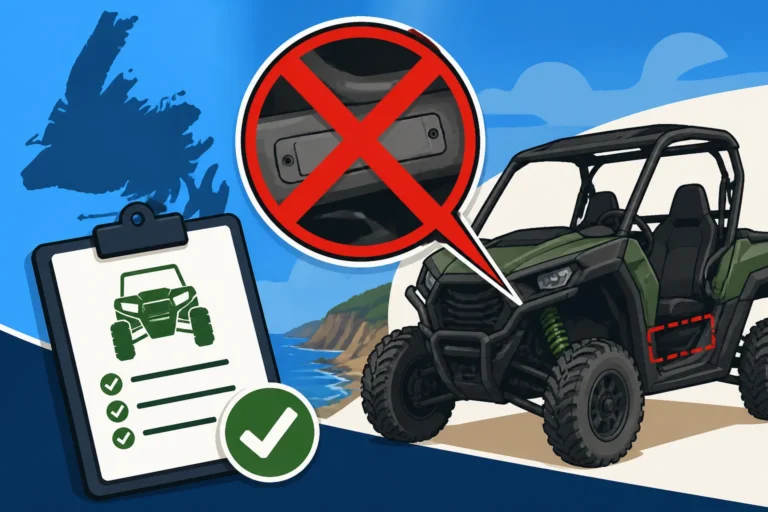
Once your registration is complete, you'll receive two key items: an identification plate and a registration permit. The identification plate, often called an "ORV plate," is a physical marker that must be affixed to your machine. The regulations are quite specific about its placement and visibility. It needs to be securely attached to the rear of your machine, clearly visible, and free from mud, snow, or any cargo that might obstruct it. An officer needs to be able to read it quickly and easily. You can dive deeper into these requirements with [Newfoundland Plate Placement on a Quad] and [Newfoundland Plates Kept Free of Mud].
The registration permit, on the other hand, is a paper document. This permit acts as your official proof of registration and ownership. It details your name, the machine's make, model, VIN, and other pertinent information. It's absolutely vital to carry this document with you whenever you're operating your off-road vehicle, or at least have it readily accessible. However, it’s generally recommended not to keep the original permit permanently on the machine itself, especially if it’s left unattended, to prevent loss or theft. A good practice is to carry a laminated copy or a clear photo on your phone, keeping the original in a safe place like your wallet or at home. This ensures you can always produce proof of registration if asked by a peace officer, which is a common requirement during roadside checks.
What Still Requires Your Attention: Beyond the Initial Registration
Even with the glorious "valid while you own it" registration, there are still a few scenarios where you'll need to interact with Motor Registration. This isn't about annual renewals, but rather about keeping your records accurate and ensuring the smooth transfer of ownership when the time comes. Think of it as maintaining your permanent record; while you don't need to update it annually, significant life changes still warrant a notification.
Changes to Your Personal Information
Life happens, and sometimes you move! If you change your residential address within Newfoundland and Labrador, it's your responsibility as the registered owner to notify Motor Registration of your new address. This isn't just a courtesy; it's a legal requirement. The registry needs to have your current contact information on file for any official correspondence, such as notifications about changes to the Off-Road Vehicles Act or, in less pleasant circumstances, if your machine is ever involved in an incident. This update doesn't cost anything, but it’s an important administrative step. You can find more details on this particular process in [Newfoundland Registration Address Change].
Similarly, if there's a legal name change (for instance, due to marriage or other reasons), you'll also need to update your registration details. While less common, ensuring your legal name on your registration permit matches your identification is vital. These updates preserve the integrity of the "valid while you own it" system by keeping your personal link to the machine accurate and current. Failing to update your address could lead to you missing important notifications, which could have unintended consequences down the road.
Transfer of Ownership: When "Valid While You Own It" Ends for You
This is perhaps the most critical distinction to grasp. The phrase "valid while you own it" is conditional on your ownership. The moment you sell or otherwise transfer ownership of your ATV or UTV to someone else, your registration for that specific machine becomes invalid. It does not transfer with the machine to the new owner. They will need to undertake a completely new registration process in their name. This ensures that the provincial registry always knows exactly who is responsible for each off-road vehicle.
This individual transfer process is a cornerstone of the Newfoundland ORV system. When you decide to sell your machine, it's not just a matter of handing over the keys. You are effectively ending your "lifetime" registration for that machine, and the new owner must begin their own. The intricacies of this process, including the necessary paperwork and steps, are fully laid out in articles like [Newfoundland Transfer of Ownership Explained] and [Newfoundland Transfer of Ownership Steps]. It's a crucial part of being a responsible seller and ensuring the new owner can legally enjoy their purchase. Companies like LawDepot can be invaluable resources for generating proper bills of sale, ensuring all parties have the documentation needed for a smooth transfer.
Navigating Sales and Purchases Under This System
The unique "valid while you own it" registration system means that selling or buying a used off-road vehicle in Newfoundland and Labrador has its own set of considerations. It's not complicated, but understanding the steps ensures a smooth transition for both the seller and the buyer, preventing any future headaches.
Selling Your Registered ATV or UTV
When you decide it's time to part ways with your beloved quad or side-by-side, your responsibility doesn't end the moment the buyer hands you the cash. Because your registration is tied directly to you, the seller, you have a legal obligation to inform Motor Registration that you are no longer the owner of that machine. The law states that you must notify the Registrar of Motor Vehicles within ten days of the sale. This critical step protects you from any liability associated with the machine once it's out of your hands. Imagine if the new owner, for whatever reason, decided not to register it and was involved in an incident. Without your notification, the machine would still be registered in your name, potentially creating a nightmare scenario. This notification requirement is detailed further in [Newfoundland Notification Within 10 Days].
To facilitate the new owner's registration, you'll need to provide them with the necessary documentation, primarily a clear bill of sale. This document should include all pertinent details: the sale date, the purchase price, the VIN of the machine, and the full names and addresses of both buyer and seller. Having a professionally drafted bill of sale, perhaps from a resource like LawDepot, can make this process straightforward and legally sound. Once you've completed these steps and notified the registry, your connection to that machine is officially severed, and your "valid while you own it" registration for that specific machine concludes. What happens to your registration when you sell is a common query, and the answer is clear: it essentially ceases to exist for you.
Buying a Used Machine in Newfoundland
For those looking to buy a used off-road vehicle in Newfoundland, understanding the registration process is equally important. Since the seller's registration becomes invalid upon sale, you, as the new owner, must complete a brand new registration in your name. This means gathering all the required paperwork and visiting Motor Registration to pay the one-time registration fee. This is not a "transfer" of an existing registration in the traditional sense; it's a completely fresh start for the machine under your ownership.
The most crucial document you'll need is a comprehensive bill of sale from the seller. It must clearly identify the machine and both parties involved in the transaction. If the machine has changed hands multiple times, you might need a clear chain of bills of sale from each previous owner to prove legitimate ownership. This can sometimes be a challenge, especially if the machine is older or has passed through several private sales. If you encounter issues with missing paperwork, guidance in [Newfoundland Registration Without a Bill of Sale] can be helpful, though it might involve additional steps like sworn affidavits. Before finalizing any purchase, it's also highly advisable to check for any existing liens on the machine, which can be done through a search. This ensures you're not inheriting someone else's debt, an important step elaborated in [Newfoundland Registration and Lien Records]. Taking these precautions during the purchase ensures that your journey to receiving your own "valid while you own it" registration is as smooth as possible.
Addressing Common Misconceptions and Special Cases
Even with a generally straightforward system like Newfoundland's ORV registration, questions and unique situations are bound to arise. Understanding how the system handles these can save you a good deal of confusion and potential frustration down the road.
Lost Permits or Plates
While your off-road vehicle registration doesn't expire, the physical documents and plates associated with it are, unfortunately, not indestructible. Things get lost, damaged, or even stolen. If you find yourself in the predicament of a missing registration permit, don't fret. You can obtain a duplicate. This involves visiting Motor Registration, providing proof of your identity and ownership, and paying a nominal fee. The process for getting a [Newfoundland Duplicate Registrations at $25] is relatively quick and painless, ensuring you always have official proof of your registration. Remember, while your registration is valid indefinitely, having the permit on hand is a legal requirement when riding.
Similarly, if your identification plate is lost, stolen, or damaged beyond recognition, you'll need to apply for a replacement. This is equally important, as operating your off-road vehicle without a visible, legible plate is a violation of the Off-Road Vehicles Act. The cost for a [Newfoundland Replacement Plates at $30] covers the production and issuance of a new plate, which will bear a different number than your original. Just like with a duplicate permit, you'll need to provide identification and proof of ownership to get a new plate. These processes ensure that despite unforeseen circumstances, you can always remain compliant with provincial regulations without having to re-register your entire machine.
What About Visitors or New Residents?
Newfoundland and Labrador is a popular destination for tourism, and many visitors want to bring their own off-road vehicles to explore our rugged landscapes. The "valid while you own it" rule primarily applies to residents, but there are specific provisions for out-of-province visitors. Generally, if you're visiting from another jurisdiction where your machine is registered, you're granted a [Newfoundland's 30-Day Visitor Exemption]. This means you can ride your out-of-province registered ORV here for up to 30 consecutive days without needing to register it in Newfoundland. However, you must still comply with all other provincial regulations, including carrying proof of your home province's registration and any required insurance.
For those making Newfoundland and Labrador their new home, there's also a specific rule. If you've just moved to the province and brought your off-road vehicle with you, you have a grace period of [Newfoundland's 90-Day New Resident Rule]. This allows you to continue operating your machine with your out-of-province registration for up to 90 days from the date you officially establish residency. After this period, you are required to register your off-road vehicle in Newfoundland and Labrador, entering into our "valid while you own it" system. This ensures that machines permanently residing in the province eventually fall under local regulations, contributing to consistent safety and enforcement across the board.
Here's a quick comparison of the Newfoundland and Labrador registration system versus common annual renewal systems:
| Aspect of Registration | Newfoundland & Labrador | Common Annual Renewal Systems |
|---|---|---|
| Registration Validity | While you, the owner, own the machine | Typically expires annually or biennially, requiring renewal |
| Renewal Notices | None; the initial registration is permanent | Usually mailed to remind you of upcoming expiry |
| Annual Fees | None after the initial registration fee | Required annually or biennially upon renewal |
| Transfer of Ownership | Seller's registration invalidates; new owner must initiate a new registration | Seller's registration invalidates; new owner registers (sometimes with a prorated fee for the remaining term) |
| Identification | Permanent identification plate and permit issued once | Permanent plate issued once, but annual sticker or validation may be required |
| Administrative Burden | Minimal after initial registration, only for changes or loss | Regular annual or biennial steps to ensure continued legality |
This article is for general informational purposes only and does not constitute professional advice. Laws, prices and regulations vary by location and change over time. Consult a qualified professional for guidance on your specific situation.