How Big a Group a Narrow Trail Can Take
A narrow trail can turn an ordinary ride into a long line of machines, blocked passing places and avoidable risk. In Newfoundland, the right group size depends on the route, its current condition, the machines involved and any rules set by the trail operator. Here’s how to plan a group that fits the trail, and what to confirm before setting out.
There is no one group size that fits every trail
A fixed number can be misleading. Ten machines may be manageable on a broad, open route with good sightlines and frequent places to pull over. The same ten machines could create a problem on a narrow, wet trail with blind corners, steep sections or nowhere safe to let other users pass.
The first question is not simply, “How many machines are allowed?” Ask whether there is a specific limit for the trail, managed area, event or access point you plan to use. An operator may set its own conditions, and those conditions can differ between sites. Don’t assume a group limit from one trail applies elsewhere.
For a trail without a stated maximum, choose a size based on what the route can safely handle. Consider:
- Width and passing space: Can riders pull completely off the travelled surface without damaging vegetation or soft ground?
- Sightlines: Can riders see far enough ahead to stop if someone is walking, cycling or coming toward them?
- Surface and weather: A trail that is passable when dry may be slow and difficult after rain, especially in boggy or rutted sections.
- Machine size: A group of large side-by-sides needs more room than the same number of compact ATVs.
- Other users: Shared trails can include hikers, cyclists, other riders and people working in the area.
- Recovery needs: If one machine gets stuck or breaks down, can the group deal with it without blocking the route?
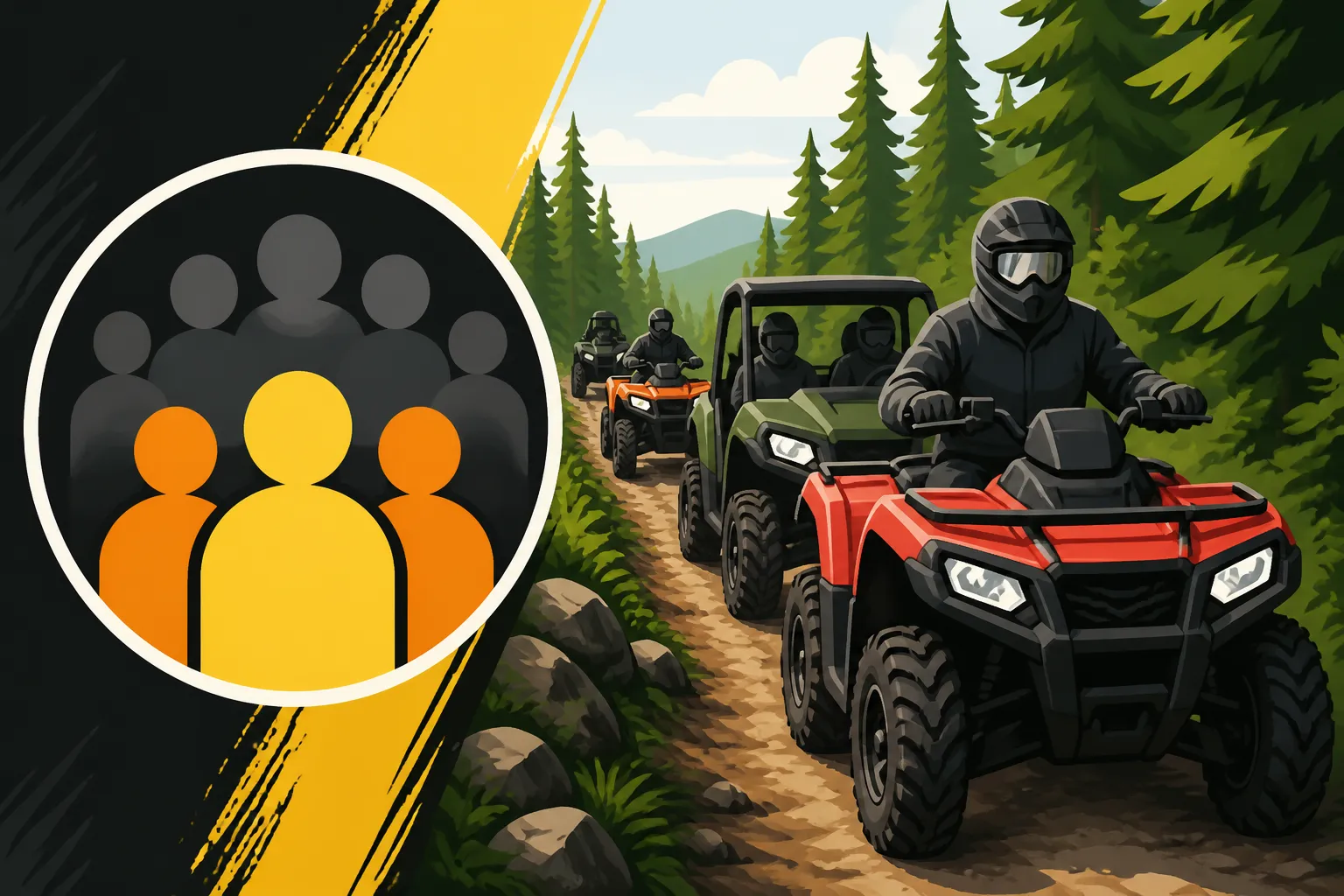
A group’s practical size is also affected by how it rides. A long, stretched-out line can be harder to manage than two smaller groups travelling with a clear plan. But splitting a group only helps if each section has its own capable lead and sweep rider, and if the groups can communicate or regroup safely.
Trail conditions and local requirements deserve particular attention. Check Newfoundland Managed Trail Rules before using a managed route, and ask the operator whether there are site-specific limits, closures or instructions for group rides. For a broad look at how groups should behave around other users, see Newfoundland Trail Etiquette Locals Expect.
Choose a size that riders can keep together safely
A group can be too large even when every machine fits on the trail. The practical test is whether riders can stay organized without crowding one another, losing contact or preventing other users from passing.
Before choosing a number, think about the slowest rider and the least experienced person in the group. Also account for passengers, children, unfamiliar machines and riders who may need more time on rough ground. A group that moves at the pace of its most cautious member is usually easier to supervise than one that repeatedly separates and catches up.
Use smaller riding units when the route is tight
On a narrow or technical section, dividing the ride into smaller units can make it easier to keep a safe distance and leave room for other users. Each unit should know who is leading, who is riding last, where the next regroup point is and what to do if someone stops.
Don’t split into smaller groups if it will leave a section without a responsible lead, make communication impossible, or cause riders to take different routes. If the trail has limited places to pull over, agree on regroup points in advance rather than stopping unexpectedly in a blind corner or on a steep approach.
A simple plan can cover:
- A lead rider who knows the route and sets a pace the group can follow.
- A sweep rider who stays behind the last machine and checks that nobody is left behind.
- A safe following distance that leaves room to brake and avoids dust or debris where possible.
- Planned stopping places wide enough for the group, away from corners, entrances and traffic.
- A response plan for a breakdown, injury, separation or trail closure.
For a new group, a route with wider surfaces and clear stopping areas may be a better choice than a narrow, difficult trail. Use Newfoundland Trail Difficulty Ratings to help assess whether a route suits the least experienced riders, and check Newfoundland Trail Closures After a Storm if recent weather may have changed conditions.
| Trail situation | Group-planning approach | What to confirm |
|---|---|---|
| Wide route with clear sightlines | A larger group may be easier to manage, but still needs a lead, sweep and planned stops | Operator rules, other users and suitable regroup areas |
| Narrow trail with occasional passing places | Consider smaller units and agree on where to pull over | Whether the passing places can hold the whole group safely |
| Wet, rutted or boggy section | Use a conservative pace and avoid bunching up | Current conditions, closures and whether the route is suitable for the machines |
| Blind corners or steep approaches | Keep space between machines and avoid stopping in the hazard area | Safe places to wait and how opposing traffic will be handled |
| Organized ride or event | Do not rely on ordinary trail access alone | Permit, operator approval, insurance and event conditions |
The table is a planning aid, not permission to use a route or a substitute for a posted restriction. If the operator sets a maximum, follow it. If the route looks unsafe for your group, reduce the number of riders, choose a different route or postpone the ride.
Check permissions before bringing a large group
A casual ride with friends and an organized event may be treated differently. If you are advertising a ride, inviting a broad group, collecting fees, arranging guides or using a managed trail as part of an event, contact the relevant trail operator and ask what approval is needed. Do not assume that a normal trail sticker or individual access permission covers a group event.
Start with the operator responsible for the route. Ask whether it has a maximum group size, whether it limits the number of machines arriving together, and whether you need to book a time or use a designated staging area. A group may be asked to split up, wait for a suitable interval or use a different access point to avoid congestion.
For a planned event, review Getting a Permit for an Organized Trail Event and Insurance an Event Organizer Has to Carry. Requirements can depend on the location and the nature of the ride. Get the relevant conditions directly from the operator or responsible authority rather than relying on another rider’s experience.
Useful questions to ask include:
- Is there a maximum number of machines or riders for this route?
- Does the limit apply to the whole ride, or to each group entering the trail at once?
- Are there restrictions on side-by-sides or trailers at the trailhead?
- Are there approved staging, parking or turnaround areas?
- Is the trail open to other users at the same time?
- Are there temporary closures, seasonal restrictions or sensitive areas?
- Does this ride count as an organized event, and what approval is required?
- Who should the group contact if conditions change or a machine becomes disabled?
You can also use Questions to Ask a Trail Operator to prepare a more complete call or message. Keep any written permission or event instructions with the ride organizer, and make sure every rider understands the conditions before departure.
A permit or operator’s approval does not mean every part of a route will be suitable on the day. Conditions can change quickly, and access can be affected by weather, maintenance or other users. If you arrive to find a narrow section badly damaged or blocked, don’t force a large group through it just because the ride was planned.
Make the ride manageable from the trailhead to the finish
Good group management starts before the machines enter the trail. Count the riders, confirm that each machine is ready and make sure everyone knows the route and the plan for stops. A short briefing can prevent confusion later, especially when riders have different experience levels or are visiting the area for the first time.
Set a pace that keeps the group together without encouraging unsafe following. Riders should leave enough space to react to a sudden stop, a rut or an obstacle. On a narrow trail, avoid passing unless there is room and it can be done safely. If someone needs to stop, they should move to a suitable place rather than bringing the line to a halt at a blind corner or in the only clear section.
The lead and sweep riders should be able to communicate with the group. Radios can help where mobile reception is unreliable, but the group should agree on simple signals and a plan for losing contact. A communication device is a backup, not a reason to ride beyond the group’s ability or ignore the route.
At the trailhead, avoid blocking access for other users, emergency vehicles or nearby traffic. If the parking area cannot hold all the machines and trailers, arrange staggered arrivals or meet at a larger approved location. Do not park on vegetation or create a new pull-off just to keep the group together.
Be ready to change the plan. Break the ride into smaller groups if a narrow section becomes congested, wait for other users to clear the route, or turn around if conditions are unsafe. If a trail is posted closed or the operator directs riders to stop, follow that instruction. A large group has more impact than one machine, so staying off a closed or unsuitable trail matters.
The best group size is therefore the one the route and its operator can accommodate while riders remain in control, other users can pass and the group can respond to problems. When you cannot confirm a limit, ask before you go. When the trail is tight, choose a smaller group or a less demanding route rather than trying to make the trail fit the convoy.
Disclaimer
This article is for general informational purposes only and does not constitute professional advice. Laws, prices and regulations vary by location and change over time. Consult a qualified professional for guidance on your specific situation.