Inuit Community Governments Are Exempt From the Sticker
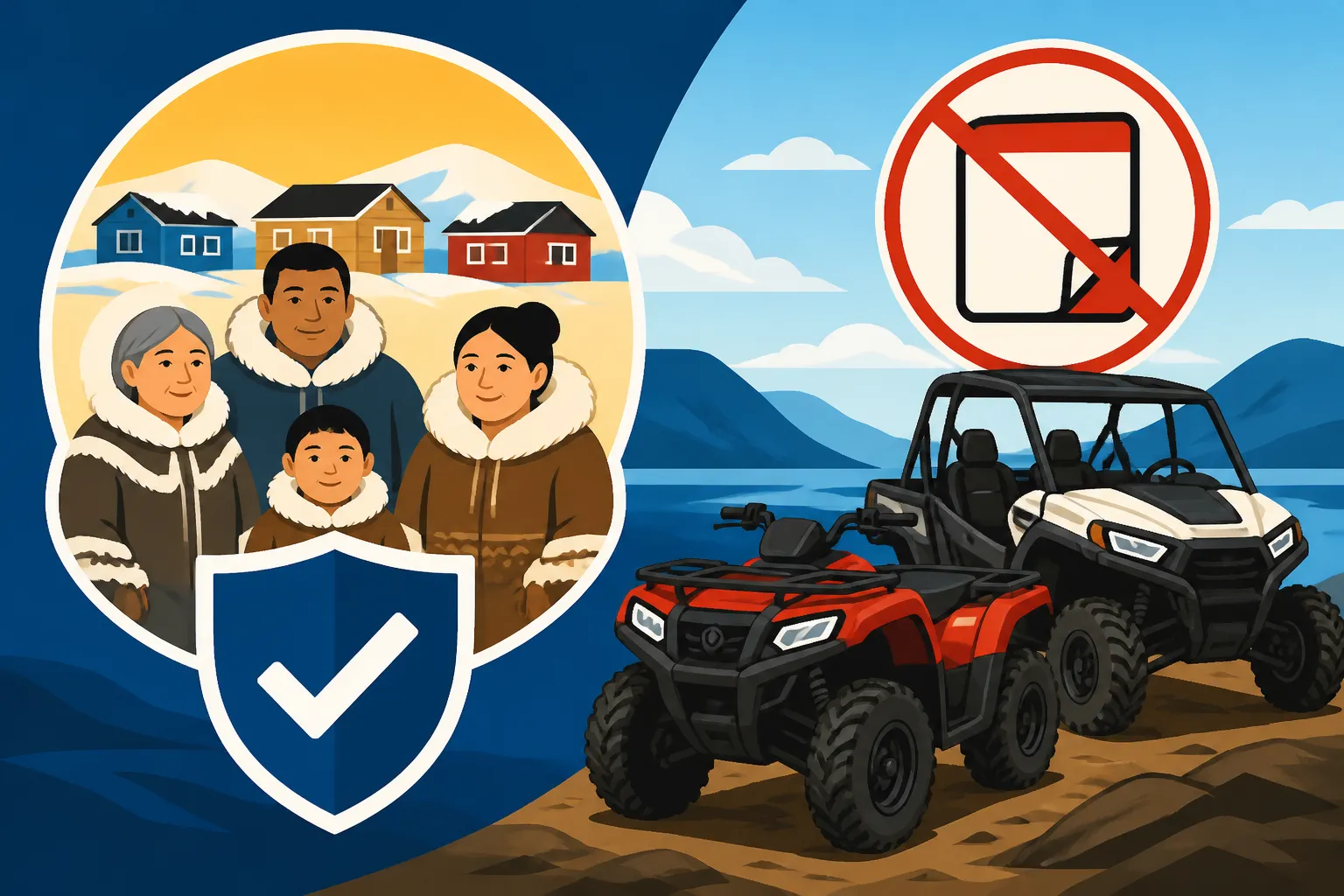
An exemption for Inuit community governments can remove a managed-trail sticker requirement, but it does not mean every Inuit rider or machine is exempt. The key questions are who is using the machine, whether the government qualifies, and what other rules still apply. Understanding those limits helps prevent a sticker exemption from being mistaken for permission to ride anywhere.
What the sticker exemption means
Newfoundland and Labrador requires a trail sticker for machines using managed trails, subject to specific exemptions. A qualifying Inuit community government is among the exempt groups. The exemption concerns the sticker requirement; it should not be read as a general exemption from off-road vehicle rules.
A managed-trail sticker is separate from a machine’s registration plate and registration document. It is also separate from a rider’s safety training proof. The sticker requirement applies to use of managed trails, while registration, training, insurance and access rules have their own requirements. For a broader overview of how those requirements fit together, see Newfoundland Managed Trail Rules and Managed Trails Require a Sticker on Your Machine.
The exemption matters most when a machine operated by a qualifying community government needs to travel on a managed trail without obtaining the usual sticker. But the name of the exemption alone does not answer every practical question. The status of the organization, the machine’s connection to it, the purpose of the trip and the location can all matter. If any part of the situation is unclear, confirm the exemption before setting out.
| Question | Practical takeaway |
|---|---|
| Who is covered? | A qualifying Inuit community government, not automatically every Inuit resident or rider |
| What requirement is addressed? | The managed-trail sticker requirement |
| Does it replace vehicle registration? | No; registration is a separate obligation |
| Does it replace safety training? | No; check the rules that apply to the rider |
| Does it grant access everywhere? | No; land access and trail restrictions still apply |
| Who can clarify a managed-trail question? | The trail operator or the relevant provincial authority |
A sticker exemption is best understood as a narrow exception to one requirement. It does not, by itself, establish that a particular machine is registered, that its operator is qualified, or that a route is open to that machine. Riders should check each of those matters independently rather than treating one exemption as a complete authorization to ride.
Who can rely on the exemption
The exemption is for Inuit community governments as qualifying entities. That is different from an exemption granted to every person who lives in an Inuit community, every Inuit rider, or every machine used in Labrador. A rider’s identity or residence, on its own, should not be treated as proof that the community-government exemption applies.
The distinction is important for shared machines and mixed-purpose trips. A vehicle owned by, assigned to or used by a community government may raise different questions from a privately owned machine used by an employee or resident. Likewise, a machine used for personal recreation should not automatically be assumed to qualify simply because its operator works for a community government.
Before relying on the exemption, establish what entity is responsible for the machine and whether the trip falls within the conditions that apply to that entity. If the machine is borrowed, privately owned, rented or being used by someone other than the government, ask the trail operator or relevant authority how the exception is applied. Do not rely only on a verbal assumption that “the community is exempt.”
The specific rules may distinguish between a community government and other people or organizations connected with the Labrador Inuit Settlement Area. Those are not interchangeable categories. The separate topic Labrador Inuit Trail Exemptions can help clarify that the settlement-area exemption and the community-government exemption should not be casually treated as the same rule.
In practice, gather basic information before the ride:
- Identify the legal entity that owns or operates the machine.
- Confirm that the entity is a qualifying Inuit community government.
- Establish who will operate the machine and why it is being used.
- Identify the managed trail or trail operator involved.
- Ask whether the particular use qualifies for the sticker exemption.
- Keep any relevant confirmation available while travelling.
This does not mean a rider needs to carry a special document in every case. It does mean that being able to explain the machine’s status and the reason for relying on the exemption can prevent confusion at a trail entrance or during an inspection. When the exemption is being used for government work, a clear record of the machine’s ownership or assignment and the trip’s purpose may be useful.
Requirements that remain separate
An exemption from the sticker requirement does not cancel other responsibilities. Start by checking that the machine is properly registered if registration is required. A trail sticker is not a substitute for a registration plate, permit or proof of ownership. See Newfoundland Proof of Ownership on the Trail for the separate question of documents that may help establish ownership.
Rider training is another separate matter. The sticker exemption does not automatically exempt an operator from training requirements that apply to them. In particular, check the rules for young riders and any required supervision. Newfoundland Training Required Under 16 and Carrying Your Safety Certificate on Every Ride cover those issues.
Insurance, equipment and operating rules also need their own checks. The exemption does not make a machine road-legal, remove applicable helmet or equipment requirements, or permit unsafe operation. If a route includes a highway crossing, public road or other restricted area, the rules for that location still matter. A sticker exemption is not a road-use permit.
Land access is separate as well. A managed-trail sticker, or an exemption from needing one, does not automatically authorize travel across private land, restricted Crown land, a closed route or an area with seasonal restrictions. Check the route and access conditions before riding. Newfoundland Crown Land Access Rules offers more information about access beyond the sticker question.
Be especially careful not to confuse the community-government exemption with the exemption for land owned by a rider or their family. Those are different situations, with different limits. Someone riding on family land should not assume that the community-government rule applies; likewise, government status alone should not be treated as permission to use any property. See Land You or Your Family Own for that separate exemption.
A practical pre-ride review should therefore cover four distinct questions:
- Sticker: Does the machine need a managed-trail sticker, or does a specific exemption apply?
- Registration and ownership: Is the machine registered when required, and can its status be explained?
- Operator: Does the rider meet applicable training, supervision, licence and safety rules?
- Route: Is this machine allowed on the selected trail and on any land or road along the way?
Keeping these questions separate makes it easier to spot what the exemption does and does not cover. For example, a qualifying government machine might not need the managed-trail sticker, while its operator still has to meet applicable safety requirements and the route must still be open to that machine.
How to confirm before riding
If you are unsure whether a particular machine or trip qualifies, ask the trail operator before arriving. The operator can explain how the sticker requirement is handled on that managed trail and what evidence, if any, is useful. For questions about the legal scope of an exemption, confirm with the relevant provincial authority rather than relying on an informal interpretation.
Make the question specific. Instead of asking only, “Are Inuit community governments exempt?”, explain which community government is responsible for the machine, who will operate it, whether the use is official or personal, and which trail is involved. A precise question is more likely to produce an answer you can apply to the planned trip.
You can also ask:
- Does the exemption apply to this type of government-owned or government-operated machine?
- Does the intended use affect eligibility?
- Is any proof of the machine’s government status expected at the trail?
- Does the exemption apply on this particular managed trail?
- Are there closures, access limits or other conditions for the route?
- Which registration, training, insurance or equipment rules still apply?
Keep the answer and any relevant supporting information together with the machine’s other documents. If a different operator or trail is involved on another trip, confirm again rather than assuming that one operator’s interpretation applies everywhere. Questions Worth Asking a Trail Operator can help with the practical conversation.
The safest rule is straightforward: treat the exemption as narrow, verify that the government and machine qualify, and check the remaining requirements separately. That approach respects the purpose of the exemption without stretching it to cover private riders, unrelated machines or routes that may have their own restrictions.
Disclaimer
This article is for general informational purposes only and does not constitute professional advice. Laws, prices and regulations vary by location and change over time. Consult a qualified professional for guidance on your specific situation.