Newfoundland National Park Machine Rules
A Newfoundland ATV trip can look close to a national park on the map and still be off-limits once you reach the park boundary. The key distinction is between travelling on a highway through a park and riding a trail or open ground. Here’s how to think about machine access, permits and trip planning before you unload.
The basic rule: a national park is not an ATV trail system
Do not assume that an ATV or side-by-side can use a national park trail just because off-road riding is allowed nearby. In Newfoundland national parks, off-road machines generally have no recreational trail network to ride. The practical rule for visitors is that machine travel inside a park is limited to highways open to ordinary highway traffic—not park trails, beaches, bogs or other off-road areas.
That distinction matters because a road on a map is not necessarily a public highway open to your machine. A park road, service road or access track may have its own restrictions. Check the road’s status and the park’s current rules before riding or driving onto it. If the route is not clearly an open highway, do not treat it as permission to ride.
For a closer look at the broad restriction, see National Parks Have No Trails Open to Machines and Inside a National Park, Only Highways Are Legal. These are useful starting points, but they do not replace checking the rules for the specific park and route you plan to visit.
The same caution applies to permits. A permit is not a general way to turn a closed trail into a recreational riding route. A park superintendent may have authority to issue permits for particular activities or circumstances, but that does not mean visitors can expect permission for an ordinary ATV outing. If you think your trip involves an exception, contact park staff before travelling and describe the exact machine, route and purpose.
| What you are considering | Safe planning assumption |
|---|---|
| Riding an ATV on a park trail | Do not assume it is allowed; recreational machine trails are not generally open in national parks |
| Driving on a highway through a park | Check that the specific highway is open to your machine and follow applicable road rules |
| Using a park service road or access track | Treat it as restricted unless park staff confirm otherwise |
| Riding outside the park boundary | Check the land designation, access rules and any trail or area restrictions separately |
| Applying for a permit | Ask park staff whether a permit applies to your specific purpose; do not assume recreational access will be granted |
A boundary can be easy to miss when you are following an established route or riding in a large group. Before setting out, identify where the park begins and ends, and make sure every part of your planned route is permitted. If the route crosses several types of land, the rules may change along the way.
What this means in Gros Morne
Gros Morne National Park is not an ATV trail destination. The useful takeaway is straightforward: do not plan to ride an ATV or UTV on a recreational trail inside the park. Highway travel is a separate question and should not be confused with permission to explore park trails or terrain.
The page Gros Morne Bans Machines in Newfoundland covers this park-specific issue. If your route would enter Gros Morne, check directly with the park before you leave. Ask whether the particular road is open to your type of machine, whether there are seasonal or temporary restrictions, and where the park boundary falls along your intended route.
A park highway may take you through the landscape, but that does not make the surrounding ground available for riding. Staying on an open highway is different from pulling onto a trail, parking area or informal track to continue off-road. Follow posted signs and barriers, and do not use an unmarked track as a shortcut.
If you are travelling to an area near Gros Morne for a ride, plan your route so that legal riding begins outside the park where the relevant land and trail rules allow it. Nearby access does not mean park access. A route that works on one side of a boundary may become prohibited when it crosses into the park.
The same principle applies to unloading. A trailhead or parking area near a park is not automatically an authorized staging point for riding into the park. Confirm where the riding area starts, whether you can leave a trailer there, and whether the route from the parking area to the trail remains outside restricted land.
Permits, exceptions and who to ask
If you have a specific reason to believe a permit may apply, ask the park directly before you make plans around it. Explain what you want to do, where you want to go, what kind of machine you will use and whether the activity is recreational or connected to another authorized purpose. A general question such as “Can I ride in the park?” may not get you a useful answer if your proposed route or purpose is unusual.
The post Asking Gros Morne for a Trail Permit is relevant if you are looking for a park-specific answer. The important point is not to rely on an informal assumption that a permit will be available. Ask whether the activity is permitted at all, what process applies, and whether written authorization is required. If staff say the route is closed to recreational machines, a provincial registration or trail permit does not override that restriction.
A permit or approval from one organization also may not cover the whole trip. For example, permission to use a trail outside park land would not, by itself, authorize you to continue onto park property. Likewise, being registered to operate a machine does not grant access to every road or parcel. Treat each permission as limited to the authority, location and activity it actually covers.
Before relying on a route, get clear answers to these questions:
- Does the route enter a national park or another restricted area?
- Is the specific road open to the kind of machine you are bringing?
- Does the proposed use count as highway travel or off-road riding?
- Is there a current closure, sign or seasonal restriction?
- Is a permit required, and does it authorize this exact route and purpose?
- Where can you legally unload, park and begin riding?
If you receive permission, keep the relevant details with your trip information and follow any conditions. Permission for one route or purpose should not be treated as permission to explore other tracks in the park.
Plan the route around the boundary
The most reliable way to avoid a problem is to settle the park question before loading the machine. Mark the park boundary and any restricted areas on a map, then compare them with the route you intend to ride. Do not depend on a phone signal once you are on the trail, and do not assume that a digital map shows the latest access restrictions.
For route planning, it helps to separate your trip into three parts: the highway journey, the staging point and the off-road riding area. Confirm that the highway portion is open to your machine, that the staging location is suitable, and that the riding area is outside any prohibited park land. A legally registered machine can still be on a route where riding is not permitted.
Newfoundland has separate requirements that may apply to registration, insurance, training and managed trails. Those requirements answer different questions from park access. A trail sticker or proof of training does not make a national park trail open to machines. Review Newfoundland National Park Machine Rules alongside Newfoundland Crown Land Access Rules and Newfoundland Managed Trail Rules when your trip involves more than one land type.
Also check for route changes close to departure. A trail or road may be closed for conservation, safety, maintenance or another park-management reason. Posted notices take priority over an old route description or a previous visit. If a road is blocked or signed as restricted, do not ride around the barrier or look for an alternate track through the park.
If the planned ride depends on an exception, make a backup plan that stays outside the park. That may mean choosing a different approved trail, moving the staging point, or leaving the machine on the trailer while you visit the park by another means. It is much easier to adjust the itinerary at home than to discover the restriction after towing to the area.
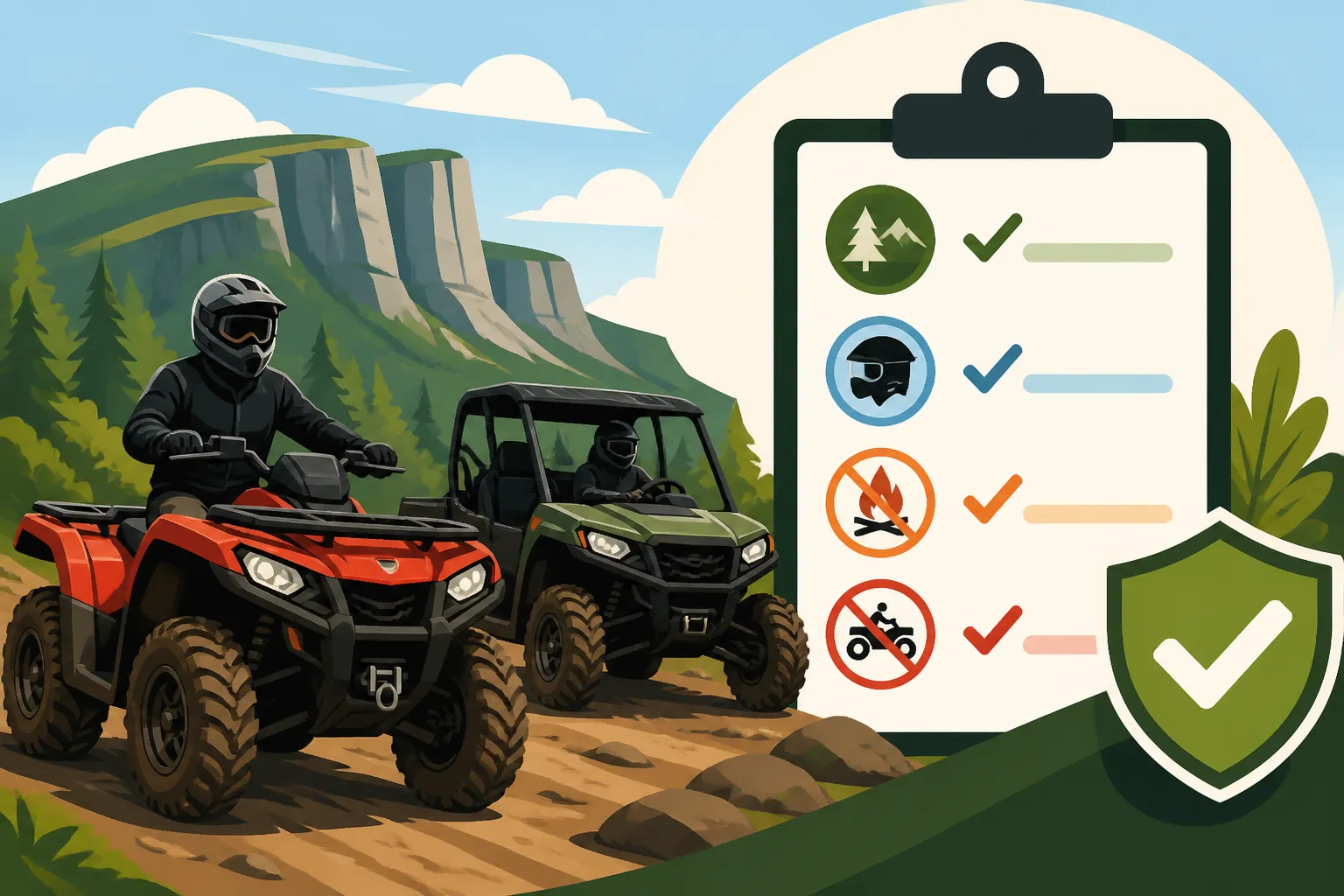
For quick trip preparation, use this checklist:
- Confirm the park boundary and the legal status of every road on your route.
- Contact park staff about any unclear road, permit question or unusual activity.
- Check for current signs, closures and access conditions before riding.
- Confirm that your off-road route is outside the park unless staff have clearly authorized the specific use.
- Keep registration, insurance and required trail documents ready for the areas where you will ride.
- Have an alternate riding plan that does not depend on entering park land.
The central rule is simple: national park scenery does not mean open ATV access. Treat park trails and off-road terrain as closed to recreational machines unless the park confirms otherwise, and distinguish any permitted highway travel from trail riding. When a boundary or route is unclear, pause and ask before proceeding.
Disclaimer
This article is for general informational purposes only and does not constitute professional advice. Laws, prices and regulations vary by location and change over time. Consult a qualified professional for guidance on your specific situation.