Newfoundland Visitors From Quebec
A Quebec registration does not automatically give you permission to ride every trail in Newfoundland and Labrador. If you are bringing an ATV or UTV for a visit, the key is to keep its home-jurisdiction documents current, understand the 30-day visitor exemption, and check separate insurance, training and trail-access requirements before riding.
What Quebec visitors can use their home registration for
A machine registered in Quebec may generally be used in Newfoundland and Labrador as a visiting vehicle for a limited period. The visitor exemption is up to 30 days; it is not an ongoing substitute for Newfoundland registration if the machine remains in the province longer. See Newfoundland’s 30-Day Visitor Exemption and Newfoundland Visitors Registered Elsewhere for the broader rules.
Carry proof that the ATV or UTV is currently registered in Quebec. Bring the registration document, and make sure any plate or identification displayed on the machine is visible and legible. If the machine is registered to someone else, carry paperwork showing that you have permission to use it. A bill of sale or ownership record can also help clarify who owns it, particularly if you have just bought the machine and are travelling before completing all paperwork.
| Your situation | What to plan for |
|---|---|
| Visiting for up to 30 days with a machine registered in Quebec | Carry current Quebec registration and other required documents; confirm insurance and trail-access requirements |
| Staying longer than the visitor exemption | Ask the Newfoundland Motor Registration Division what is needed to register the machine locally |
| Moving to Newfoundland | Treat the machine as part of your move and check the new-resident registration timeline |
| Riding on a managed trail | Check with the trail operator about its sticker and access requirements |
| Riding on a road or highway | Follow Newfoundland road-use rules; Quebec registration alone does not make every road legal for ATV or UTV use |
The visitor exemption is about registration. It does not mean that your Quebec machine is exempt from Newfoundland operating rules, equipment requirements, insurance obligations or local access restrictions. A machine that is legally registered at home can still be ticketed if it is operated somewhere it is not allowed, or if required documents cannot be produced.
Keep your visit and machine’s status clear. A holiday visit is different from moving to the province, establishing a home there or leaving a machine behind after your own departure. If your plans change, do not assume that the visitor allowance continues to apply simply because the ATV still has a Quebec registration. Ask the registry how the rule applies to your dates and circumstances. For a move, see Newfoundland Registration for a New Resident.
Insurance, training and documents to check before riding
Registration and insurance are separate. Before loading the machine, contact your insurer and confirm that the policy covers the ATV or UTV while it is being operated in Newfoundland and Labrador. Ask specifically about off-road use, any permitted road crossings and the type of riding you plan to do. Do not assume that a policy covering the machine in Quebec automatically covers every use elsewhere.
Newfoundland requires liability insurance for an off-road vehicle. The provincial minimum liability limit is $200,000, but a policy may have exclusions or conditions that matter more than the headline limit. Confirm that the coverage on your Quebec policy satisfies the local requirement and applies to the actual machine and operator. For details about what to carry and when proof may be requested, see Newfoundland Visitors Still Need Insurance and Newfoundland Insurance Proof on the Trail.
Bring proof of insurance in a form you can access while riding. A digital copy can be useful, but a paper copy is a sensible backup where phone service is poor or a device runs out of power. Make sure the document identifies the insured machine or clearly connects the policy to it. If you are borrowing the ATV or UTV, check that the policy permits the person who will operate it to ride.
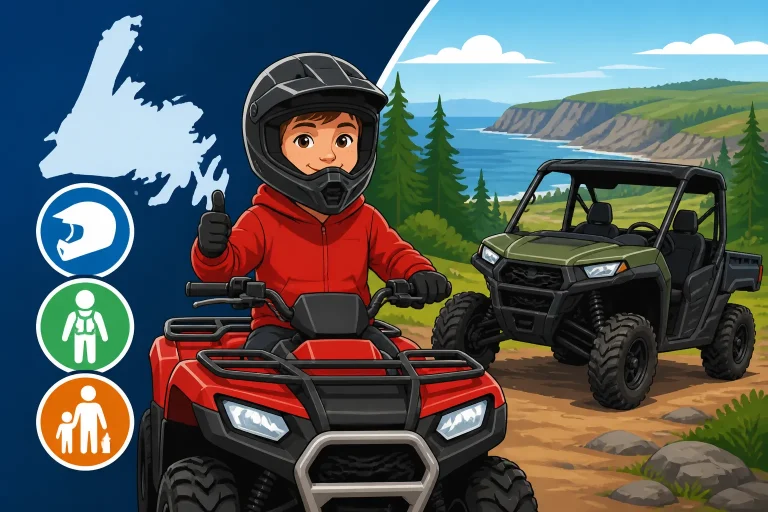
Training is another requirement to check rather than assume away. Newfoundland has safety-training rules for off-road vehicle operators, with specific obligations applying to young riders and their supervisors. A Quebec course certificate or card may not automatically be accepted as proof of the Newfoundland requirement. Before your trip, confirm with the province whether your existing certificate qualifies, and what documentation must be carried. The relevant background is covered in Newfoundland Safety Training Is Mandatory.
Keep a small document set with the machine:
- Current Quebec registration or other proof of registration.
- Proof of insurance that applies to the machine and intended use.
- Written permission from the owner if you are borrowing it.
- Safety-training proof, if required for the operator.
- A contact number for your insurer and any relevant policy details.
These documents do not replace one another. A registration permit does not prove insurance, and an insurance card does not prove that a machine has the right to use a particular trail. When more than one person will ride, check that each operator meets the applicable requirements. A passenger also needs to be carried in a seat designed for a passenger, where the machine has one.
Trail stickers and where you may ride
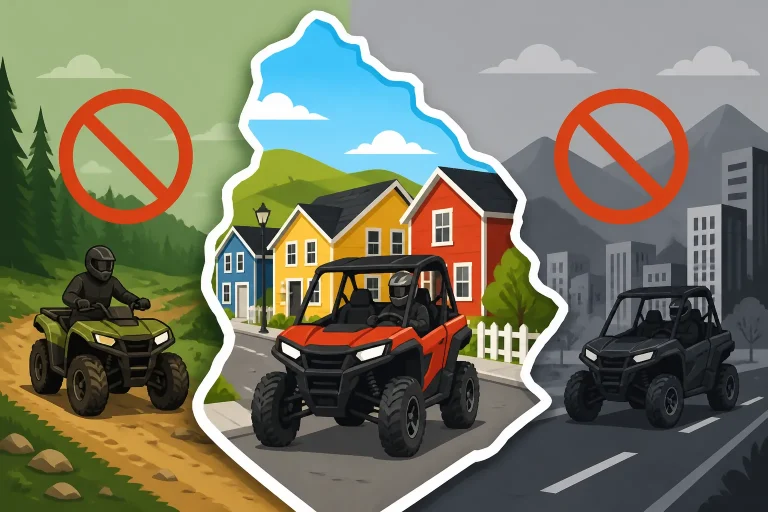
Visitors often confuse vehicle registration with trail access. They serve different purposes. Your Quebec registration establishes the machine’s registration status; it does not, by itself, grant permission to ride a Newfoundland managed trail, Crown land route, private woods road or municipal street.
Some managed trails require a trail sticker issued through the trail operator. Ask the operator before setting out whether a visitor needs a sticker, how to obtain it and whether it must be attached to the machine or carried. Requirements can depend on the trail and its management arrangements. Start with Newfoundland Managed Trail Rules and Managed Trails Require a Sticker on Your Machine.
A sticker is not a general province-wide riding permit. It does not override a closure, land restriction, local bylaw or posted sign. Similarly, permission to ride on private land does not automatically authorize travel across neighbouring property to reach it. Check the route from the trailhead to your destination as well as the destination itself. [Newfoundland Crown Land Access Rules] explains why a map or a familiar-looking track is not enough to establish that an area is open to riding.
National parks and other protected areas can have especially strict vehicle rules. Do not assume an ATV trail runs through a park because a route appears on a map or connects to a public trail elsewhere. Check the relevant park or land manager’s current rules before bringing a machine onto the property.
If you are planning to cross or travel along a road, check the specific Newfoundland rules for that type of road and machine. The provincial rules limit where off-road vehicles may operate on highways and shoulders, and municipalities may have additional bylaws. Quebec road permissions do not transfer to Newfoundland. For an overview, see Newfoundland Rules for an Out-of-Province Machine. When in doubt, use a trailer to move the ATV between riding areas rather than treating a public road as a connecting trail.
If your visit lasts longer or your plans change
Keep track of how long the machine will be in Newfoundland. The visitor exemption is limited to 30 days, so a longer holiday, seasonal stay or change of plans can affect what you need to do. Contact the Motor Registration Division before the exemption runs out and ask what documents are needed to register the machine locally. Processing requirements can depend on the machine’s history and ownership paperwork, so it is better to ask early than arrive at the counter with an incomplete file.
If you recently bought the ATV in Quebec, make sure the ownership chain is clear. Carry the purchase paperwork and any registration or transfer documents available. If the seller was not the person named on the current registration, or the machine has passed through several owners without a complete set of records, explain that when you contact the registry. A registration document in someone else’s name may not be enough to establish your right to register the machine.
If you are moving rather than visiting, do not rely on the visitor exemption as your main plan. New residents have a separate timeline and process, and the details can differ from those for a short-term visitor. Ask the registry which rule applies to your date of arrival and circumstances. Ninety Days After You Arrive covers the new-resident issue, while Newfoundland Registration Paperwork Explained can help you prepare for the documents that may be requested.
Before you leave Quebec, make a short checklist: confirm the visit dates, registration status and insurance coverage; check whether the operator’s training proof is accepted; contact the trail operator about stickers; and confirm that the areas on your route permit the type of machine you are bringing. Recheck trail closures and local access rules shortly before riding, since access can change with conditions or land-management decisions. That preparation will not guarantee access everywhere, but it helps prevent a valid Quebec registration from being mistaken for permission to ride wherever you choose.
Disclaimer
This article is for general informational purposes only and does not constitute professional advice. Laws, prices and regulations vary by location and change over time. Consult a qualified professional for guidance on your specific situation.