Managed Trail Stickers Come From the Trail Operator
A managed trail sticker is easy to confuse with vehicle registration, especially if you are visiting Newfoundland and Labrador with an ATV or side-by-side. They serve different purposes, and having one does not necessarily replace the other. Here is who issues the sticker, how to obtain it, and what to check before riding a managed trail.
What a managed trail sticker does
A managed trail sticker is connected to access on a managed trail. It is not the same thing as your vehicle’s registration permit or identification plate. Registration identifies the machine for road-use and ownership purposes; a trail sticker relates to the trail system and its operator’s requirements.
That distinction matters because a registered machine may still need a trail sticker before you ride on a managed trail. Likewise, a sticker does not make an unregistered machine legal, grant permission to cross private property, or let you ignore restrictions on a particular route.
| Item | What it relates to | Where to check |
|---|---|---|
| Vehicle registration permit and plate | The machine’s registration and identification | The provincial registration authority |
| Managed trail sticker | Access requirements on a managed trail | The trail operator |
| Safety training proof | The rider’s training requirement, where applicable | The provincial rules and accepted training providers |
| Land or route permission | Whether you may ride a particular area or trail | The land manager, owner or trail operator |
Newfoundland’s managed-trail requirement is separate from the machine’s registration status. Before you set out, check the [Newfoundland Managed Trail Rules] and the operator’s current instructions for the route you plan to use.
A sticker also does not mean every trail is open. A managed trail may have closures, route-specific rules or access limits. Other riding areas may have different requirements altogether. Confirm that your intended route is open to your type of machine and that you have permission to ride there.
Who is responsible for issuing it
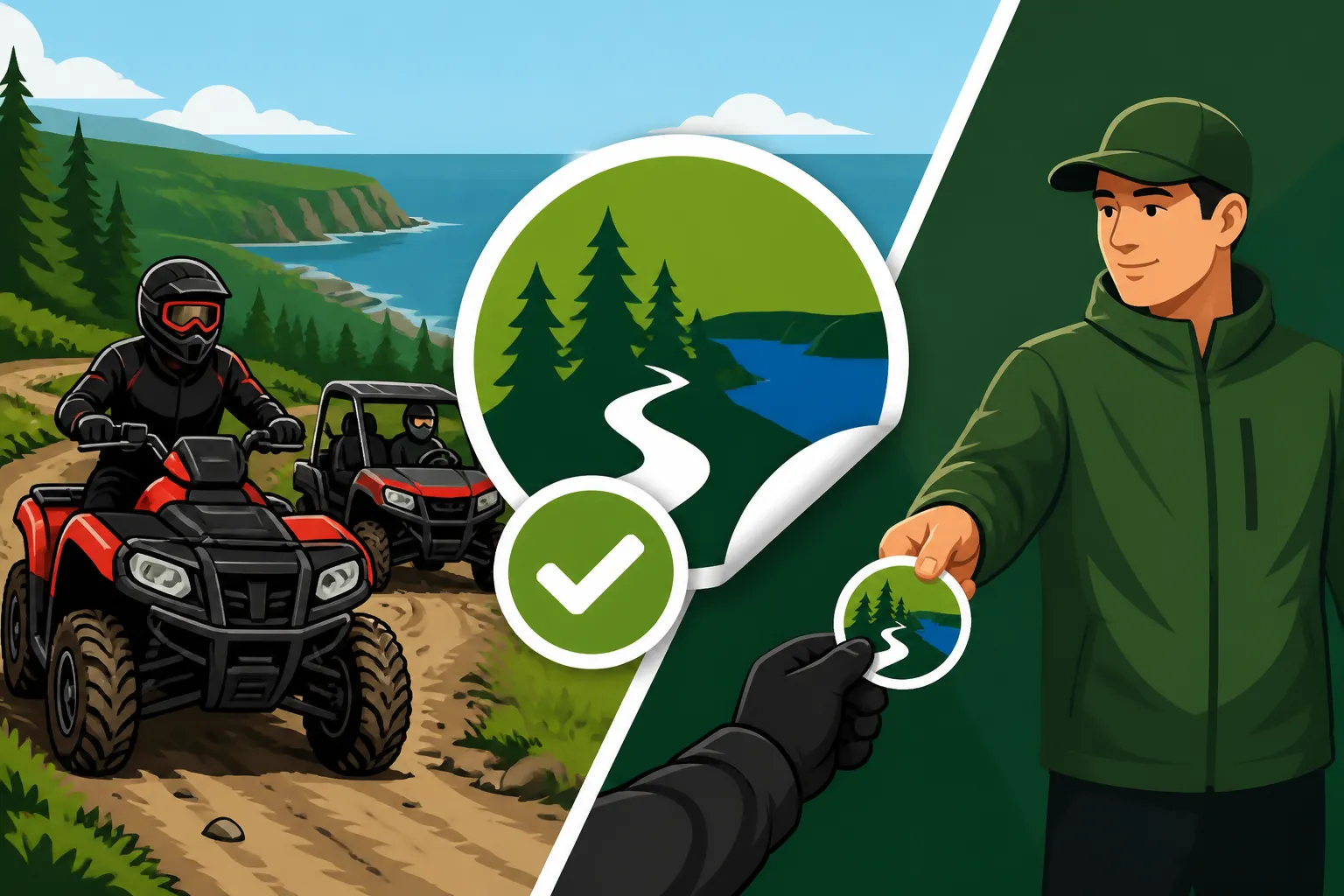
The trail operator is the starting point for obtaining a managed trail sticker. It is not a substitute plate issued through vehicle registration, and a general registration appointment is not necessarily where you get one. The provincial registration authority and a trail operator have different roles.
The operator can tell you whether a sticker is required for the trail, how to obtain it, what it costs, and whether there are instructions for attaching or carrying it. Rules and procedures can differ by operator, so don’t assume that advice from one trail system applies everywhere.
For more on how operator-issued stickers fit into the wider rules, see Managed Trails Require a Sticker on Your Machine and Which Operators Can Issue a Trail Sticker.
How to get a sticker from the trail operator
Start by identifying who manages the trail you want to ride. A trail map, operator website, posted notice, club or local riding organization may point you in the right direction. If you are not sure, contact the operator before travelling. The Newfoundland Trail Operator Contacts page is a useful starting point for finding the right organization to ask.
The operator’s process may involve getting the sticker from a designated contact or location. Ask whether you need to arrange it before your trip or whether it is available at the trailhead. Do not count on being able to buy or collect one on arrival unless the operator confirms that option.
A practical sequence is:
- Choose the trail or managed area. Identify the specific route, not just the general region. Different operators may manage different sections.
- Confirm that your machine is allowed. Ask whether the route is open to your ATV or side-by-side and whether any vehicle or access restrictions apply.
- Ask how to obtain the sticker. Confirm the pickup or purchase method, any required details, and whether you need to arrange it in advance.
- Check the cost and validity directly with the operator. Fees and sticker arrangements may vary. Ask what the sticker covers and whether it is limited to a particular period, machine or trail system.
- Clarify how to display or carry it. Follow the operator’s directions rather than guessing based on a sticker you used elsewhere.
- Bring your other required documents. Keep registration and any required training or insurance proof separate from the sticker.
- Check for closures before riding. A sticker does not override a closure, a posted restriction or a landowner’s access conditions.
The cost is set through the relevant trail-sticker process, so confirm the current amount with the operator before you go. Ask whether payment is accepted at the point of pickup, whether you need proof of purchase, and whether any other access conditions apply. A sticker fee should not be assumed to cover unrelated charges or permissions.
Confirm that the sticker matches your plans
When you contact the operator, give enough detail for a useful answer: the machine type, where it is registered, the route you plan to ride, and your expected riding dates. If you are travelling with a group, ask whether each machine needs its own sticker and whether there are group-specific arrangements.
If you plan to move between trail systems, check each operator’s requirements. A sticker from one operator should not be assumed to cover another operator’s managed trails. Ask specifically whether it is valid across the routes you intend to use.
You should also check whether a sticker is associated with a particular vehicle. If you borrow, rent, sell or switch machines, ask the operator what to do rather than transferring a sticker without permission. A sticker’s appearance may not tell you its coverage or transfer rules.
For vehicle registration details, see Newfoundland Permits, Plates and Decals. For the separate process of registering a machine, How to Register an ATV in Newfoundland explains what registration is for and how it differs from trail access.
Visitors and out-of-province machines
A visitor bringing a machine from another province should treat trail access and vehicle registration as two separate questions. A valid out-of-province registration may help establish that the machine is registered where it is normally kept, but it does not automatically answer whether a managed trail sticker is required.
Before travelling, contact the operator for the route you plan to ride. Tell them that your machine is registered outside Newfoundland and Labrador and ask whether you need a local sticker, how to obtain it and what documents to carry. For broader information about a machine registered elsewhere, see Newfoundland Visitors Registered Elsewhere.
There is also a separate time limit relevant to visitors who bring a machine into the province. The visitor exemption is not unlimited; if you expect to stay longer, check the rules that apply to your situation. Newfoundland Visitor Rules and the 30-Day Limit explains the registration issue. The time limit for an out-of-province registration should not be treated as a trail-sticker exemption: ask the operator about managed-trail access even if your machine is still within the visitor period.
What reciprocity does and does not mean
“Reciprocity” can sound like one province’s documents automatically work everywhere. In practice, different requirements may be handled by different organizations. A machine’s registration, the rider’s training, insurance, and a trail operator’s sticker are not necessarily interchangeable.
A visitor should check each requirement separately:
- Registration: Is the machine currently registered where it is normally kept, and does the visitor rule cover the planned stay?
- Trail sticker: Does the operator require one for the managed trail, and how can a visitor obtain it?
- Training: Does the rider need to meet Newfoundland and Labrador’s training requirement, or does an accepted course or certificate qualify?
- Insurance: What coverage is required, and what proof should the operator or an officer be able to see?
- Route access: Is the trail open to the machine, and are there any local or seasonal restrictions?
Do not assume that a sticker from another province, a club membership, a registration plate or a safety certificate takes the place of the operator’s sticker. Ask for a clear answer about the particular route and machine. If an operator gives you instructions by phone, consider following up in writing so you can refer back to the details when planning.
What to carry and how to avoid common mix-ups
Follow the operator’s instructions on whether the sticker must be attached to the machine or may be carried. Some operators may give specific placement directions, and the provincial rules may address how a sticker can be displayed. Read the instructions that come with it and ask the operator if anything is unclear. See Attach the Sticker or Carry It in Your Pocket for more on that distinction.
Keep the sticker, registration documents and safety proof conceptually separate, even if you store them together. Each item answers a different question. A trail sticker relates to access requirements; the registration permit identifies the machine; training proof relates to the rider. An officer or operator may ask for a different item than the one you were expecting.
A simple pre-ride check can prevent confusion:
- Confirm the route is managed and open.
- Check whether that operator requires a sticker.
- Make sure the sticker is for the correct trail system and machine, if applicable.
- Follow the operator’s directions for attaching or carrying it.
- Carry the machine’s registration documents and any other required proof.
- Check that the plate is visible and not covered by mud, cargo or equipment.
- Confirm that the rider meets applicable training and insurance requirements.
- Save the operator’s contact details in case access instructions change.
If the sticker is lost, damaged or difficult to read, contact the operator before riding. Do not assume that a receipt, a photograph or another machine’s sticker is an acceptable replacement. Ask what evidence the operator will accept and whether you need a replacement.
Common mistakes usually come from treating the sticker as a general riding permit. A sticker does not necessarily cover every trail in the province, authorize access to private land, replace vehicle registration or make a closed route open. It also should not be assumed to transfer with a sale or to another machine.
Another common mistake is waiting until the trailhead to find out how to get one. Trail operators may have specific pickup arrangements or limited access points. A quick call before departure can clarify where to obtain the sticker, what to bring and whether the route is suitable for your machine.
For related riding requirements, review Newfoundland Safety Training Is Mandatory and Newfoundland Proof of Ownership on the Trail. Those requirements are distinct from the sticker, but checking them together makes it less likely you will arrive without an important document.
Frequently Asked Questions
Who issues a managed trail sticker in Newfoundland and Labrador?
The relevant trail operator is the right place to ask. Contact the operator for the trail you plan to ride and confirm how to obtain its sticker.
Is a managed trail sticker the same as ATV registration?
No. Registration identifies the machine and is handled separately from managed-trail access. A sticker does not replace the vehicle’s registration permit or plate.
Does an out-of-province registration mean I do not need a trail sticker?
Not automatically. Ask the trail operator whether a sticker is required for the managed route, even if your machine is registered elsewhere.
Can I use one sticker on different trail systems?
Do not assume so. Ask whether the sticker covers the specific routes you intend to ride and whether it is tied to a particular machine or operator.
Should the sticker be attached to the machine?
Follow the instructions from the operator and any applicable rules. If the directions do not say clearly whether to attach or carry it, ask before riding.
Disclaimer
This article is for general informational purposes only and does not constitute professional advice. Laws, prices and regulations vary by location and change over time. Consult a qualified professional for guidance on your specific situation.