Newfoundland Rules for a Rented Machine
Renting an ATV or UTV can make a Newfoundland ride easier, but it can be unclear which requirements belong to you and which belong to the rental provider. Before setting out, confirm the machine is registered, check what insurance and trail access it has, and understand the rules you must follow as its operator.
Before you take the rented machine
In Newfoundland and Labrador, renting a machine does not mean you can assume its paperwork is in order. The vehicle owner must ensure that an off-road vehicle is registered, and the rules also apply to ATVs, UTVs and snowmobiles. Ask the rental provider to confirm the machine is registered and that its plate is attached and clearly visible. For more on that distinction, see Newfoundland Rental Machines and Registration.
Registration is required for off-road vehicles, and Government Services says the registration does not expire while the owner keeps the vehicle. The one-time fee applies for the duration of ownership, according to Government Services. That is ordinarily a matter for the machine’s owner, not a step for a renter to complete before each ride. Still, don’t treat a rental agreement as proof of registration: ask the provider how you can verify the machine’s status.
Insurance deserves a direct question before you book or ride. The Government of Newfoundland and Labrador says insurance is required when an off-road vehicle crosses or travels along a highway, or accesses trails. Digital Government and Service NL also notes that insurance may be required for off-road vehicles. Ask the provider what coverage applies to the particular rental and route, and what proof is available. If the planned ride includes a highway crossing or shoulder travel, do not proceed until you have clear confirmation that the required insurance is in place. See Newfoundland Rentals and the Insurance Floor for the insurance question specific to rentals.
Trail permission is separate from vehicle registration. Digital Government and Service NL says off-road vehicles are not permitted on managed trails without trail permits. Ask whether the rental includes a valid permit or whether you need to arrange one through the trail operator. Do not assume a plate, rental contract or verbal description of the route gives you permission to use a managed trail. The related details are covered in Newfoundland Rentals and the Trail Sticker.
Before accepting the keys, check that the plate is present and readable, and ask where the registration and insurance information can be found. If the provider cannot confirm one of these basics, pause and get an answer before leaving. These questions are easier to resolve at pickup than at a trail entrance or during a roadside stop.
Training, age and safety rules still matter
A rental does not make operator training rules disappear. The Government of Newfoundland and Labrador requires safety training for anyone under the age of 16 and anyone registering an off-road vehicle for the first time. It also applies when the Registrar of Motor Vehicles requires training after an offence and a registration suspension or cancellation. If you are renting rather than registering a machine, ask the provider whether any training requirement applies to your situation; renting by itself is not stated as a separate training exemption. Does the Training Rule Apply to a Renter? explains the distinction.
For a required operator, Digital Government and Service NL says the free safety training program is available on MyGovNL. Other courses approved by the Registrar of Motor Vehicles are accepted too. After completing the training, a user can print a certificate to carry while riding. Government Services says an operator who is required to complete training must provide proof within 2 business days if a peace officer requests it. If a young operator is in your group, confirm before departure who has completed the training and how proof will be carried. More detail is available in Newfoundland Rental Machines and Training Rules.
A person under 16 must be supervised by a licensed driver who is at least 18 years old, according to Government Services. The Government of Newfoundland and Labrador adds that the supervisor must be able to see the young operator, provide direction, and make sure the operator can see them. The machine must also match the manufacturer’s engine-size recommendations for the young person’s age and weight. A child’s presence on a ride is not enough to meet these conditions; make sure the rental provider allows the planned operator and machine combination.
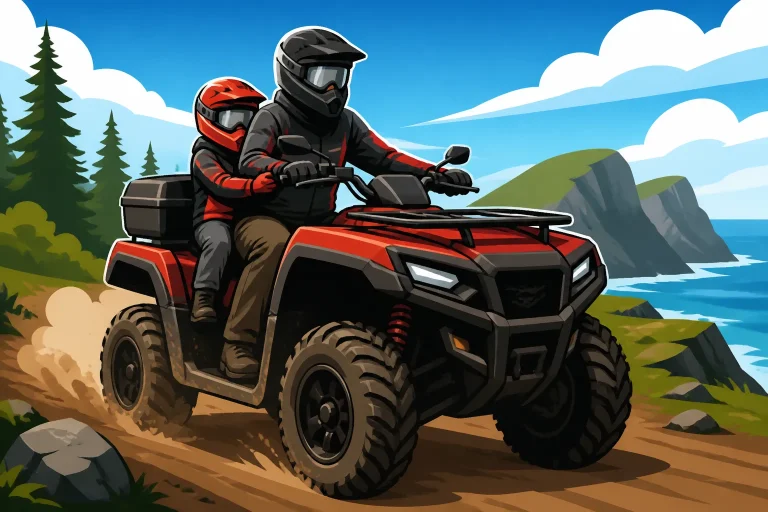
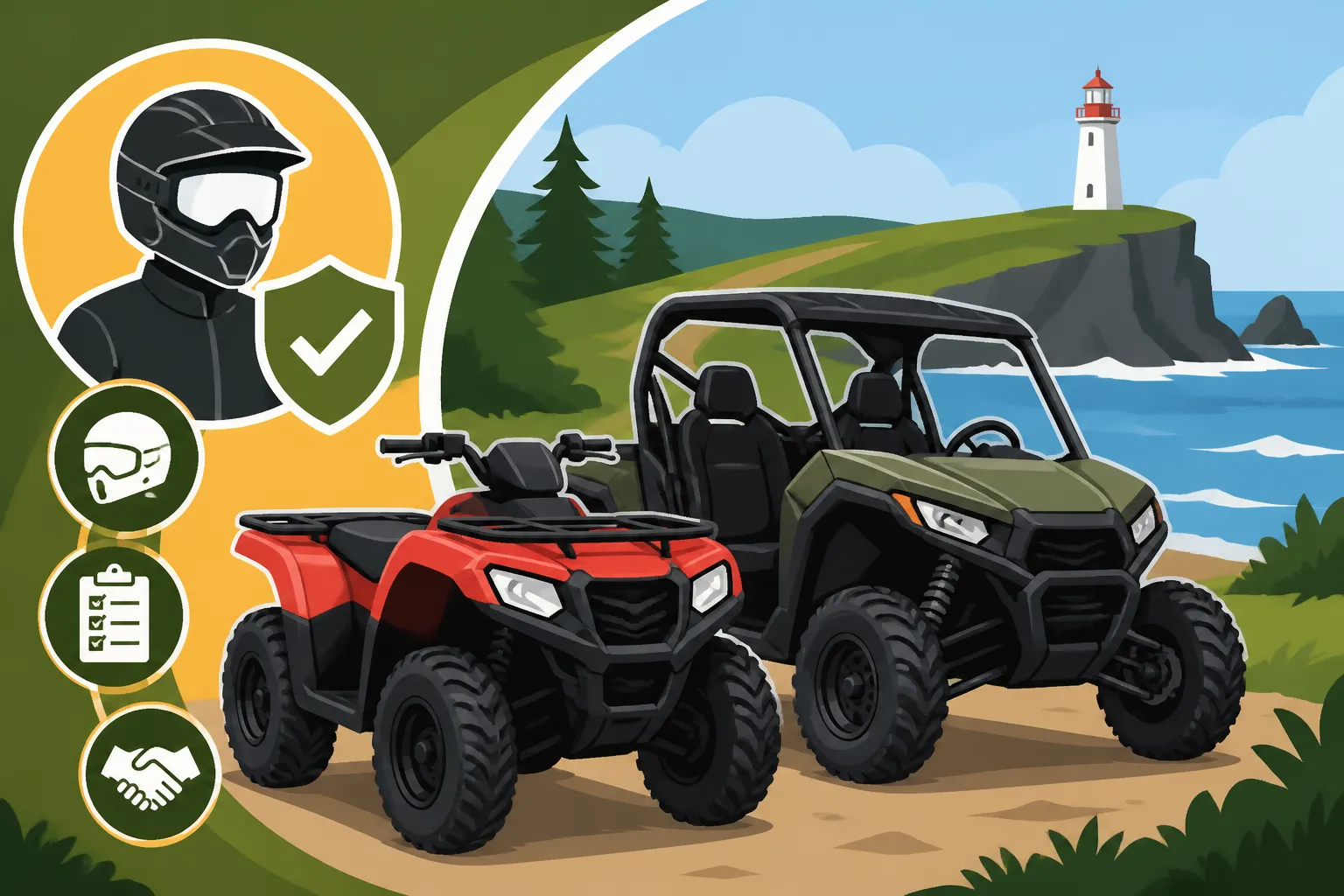
Protective equipment is also part of the ride, not an optional extra just because the machine is rented. The Government of Newfoundland and Labrador requires helmets for operators, passengers and anyone being towed in a trailer. Riders must also wear safety glasses, goggles or a face shield if the vehicle does not have a windshield of sufficient height. If the rental does not include suitable eye protection, ask what you need to supply. If buying goggles through a retailer such as Amazon, check that the fit and coverage suit the vehicle and conditions rather than relying on a product description alone.
Seatbelts must be worn when the manufacturer installed them, according to Digital Government and Service NL. For a side-by-side, check that every planned passenger has an appropriate seat and belt before departure. Children who are required to use a car or booster seat under the Highway Traffic Act must be properly secured in one when riding in a belted off-road vehicle, according to the Government of Newfoundland and Labrador. Passenger limits set by the vehicle manufacturer apply too; Digital Government and Service NL says operators may not carry more passengers than the manufacturer recommends. See Newfoundland Rental Passenger Rules before bringing a child or passenger along.
| Before riding | What to confirm |
|---|---|
| Registration | Ask the provider to confirm the machine is registered and check that its plate is attached and visible. |
| Insurance | Confirm what coverage applies, especially if your route involves a highway crossing, shoulder or trail access. |
| Trail access | Ask whether the managed-trail permit is included or needs to be obtained separately. |
| Training | Check whether anyone in your group is required to complete training and carry proof. |
| Protective gear | Confirm that helmets and any needed eye protection are available and fit the riders. |
| Passengers | Check manufacturer limits, working seatbelts and any child-seat requirements. |
Highway access and riding conduct
Off-road vehicles are not a general substitute for road vehicles. The highway rules described by the Government of Newfoundland and Labrador allow an off-road vehicle to cross where visibility is at least 150 metres in both directions. The operator must also have a driver’s licence and insurance. If visibility is obstructed, do not cross there; find a safer permitted location instead.
Shoulder travel is limited to reaching a trail. According to the Government of Newfoundland and Labrador, an off-road vehicle may travel along a highway shoulder for up to one kilometre to access a trail, at no more than 20 km/h. This is not permission to use the shoulder as a convenient route between destinations. Check the planned route with the rental provider, and make sure the machine and your insurance are suitable for the highway access involved. For additional context, see Newfoundland Rules for Crossing a Highway and Newfoundland Rules for Riding a Shoulder.
Do not carry a passenger in a trailer while operating on or across a highway. The Government of Newfoundland and Labrador prohibits passengers in a trailer in those circumstances. A trailer must also use a hitch type that meets the requirements in the Off-Road Vehicles Act. If the rental involves towing, ask the provider to explain the setup and any route restrictions before you attach or load anything.
The operator remains responsible for careful conduct. Digital Government and Service NL says it is an offence to operate without due care and attention or without reasonable consideration for other people or property. Operating while distracted or under the influence of alcohol or drugs is prohibited. The same department says operators must not chase, harass, agitate, injure or kill wildlife. A machine supplied by a business does not make unsafe or prohibited conduct acceptable.
The Government of Newfoundland and Labrador says helmet exemptions can apply during hunting and trapping activities involving frequent stops when speeds do not exceed 20 km/h. Do not treat this narrow exception as a general rule for a recreational rental ride. The practical default is to wear the required helmet and confirm any claimed exception with an official source before relying on it.
Consequences can be significant. Government Services lists fines for off-road vehicle infractions ranging from $100 to $2,500. Forestry, Agriculture and Lands also describes penalties under the ATV Regulations ranging from $100.00 to $500.00 or up to six days in jail, and says a seized vehicle may be automatically confiscated following a conviction. These are different descriptions of penalties under the relevant rules, not a reason to guess which one applies to a particular situation. Ask the rental provider about the terms of the rental agreement, but remember that a contract cannot make an unlawful ride lawful.
A renter’s practical checklist
Use this sequence before you leave the pickup area:
- Confirm the machine and route. Make sure you understand which vehicle you are taking, where the provider says you may ride, and whether the route includes a managed trail or highway access.
- Ask about registration and insurance. Have the provider confirm registration and explain what insurance applies to your ride. Get clear guidance for any highway crossing, shoulder travel or trail access.
- Check the trail permit. Confirm that the needed permit is supplied or ask how to obtain it before entering a managed trail.
- Match riders to the vehicle. Check the manufacturer’s passenger limit, the availability of appropriate seats and belts, and any child-seat needs. For a rider under 16, confirm training, supervision and the manufacturer’s age-and-weight guidance.
- Inspect and fit safety equipment. Make sure helmets are available for all riders and anyone being towed in a trailer. Check whether goggles, safety glasses or a face shield are needed because the vehicle lacks a sufficiently high windshield.
- Get an operating briefing. Ask how to operate the machine, use its safety equipment and contact the provider if a problem occurs. If the controls, limits or route instructions are unclear, resolve that before riding.
- Recheck highway plans. Do not cross unless the required visibility conditions are met, and use a shoulder only within the permitted distance and speed. Avoid carrying a passenger in a trailer on or across a highway.
A rental provider may supply the machine, equipment or paperwork, but you should not infer what is included. Ask specific questions and keep any required proof with you. For a fuller list of useful questions to raise before pickup, see Newfoundland Rental Questions Worth Asking. If the provider cannot explain whether registration, insurance or trail permission is in place, choose a route that does not depend on an unconfirmed condition or delay the ride until you have a reliable answer.
Sources
- Government Services — Off-Road Vehicles Safety – Government Services (checked November 3, 2026)
- Forestry, Agriculture and Lands — All Terrain Vehicles (ATV) Use – Forestry, Agriculture and Lands (checked November 3, 2026)
- Government of Newfoundland and Labrador — Off-Road-Vehicle-Training-Manual-24173.pdf (checked November 3, 2026)
- Digital Government and Service NL — Public Advisory: Off-Road Vehicle Training Now Available on MyGovNL – News Releases (checked November 3, 2026)
- Digital Government and Service NL — Public Advisory: Helmets and Seatbelts Mandatory for Off-Road Vehicles as of May 19 – News Releases (checked November 3, 2026)
- Digital Government and Service NL — Public Advisory: Residents Reminded to Practice Off-road Vehicle Safety – News Releases (checked November 3, 2026)
- Digital Government and Service NL — New Legislation Increases Safety for Off-Road Vehicle Users – News Releases (checked November 3, 2026)
- Government of Newfoundland and Labrador — Offroadsafety-summer.pdf (checked November 3, 2026)
- Government of Newfoundland and Labrador — Offroadsafety-winter.pdf (checked November 3, 2026)
Disclaimer
This article is for general informational purposes only and does not constitute professional advice. Laws, prices and regulations vary by location and change over time. Consult a qualified professional for guidance on your specific situation.