Newfoundland Game Transport Trip Limits
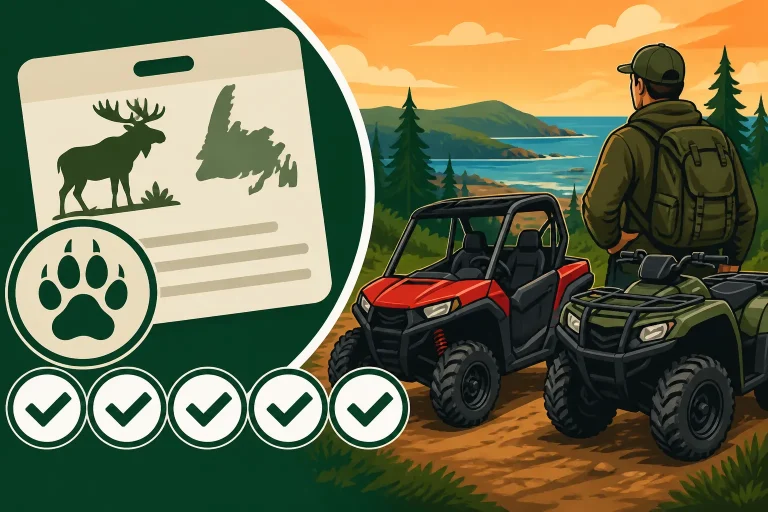
A big-game recovery can involve a long walk, a loaded machine and rules that are easy to mistake for general riding permission. In Newfoundland, the trip limit commonly associated with moving a big-game animal is five trips. The key is understanding what that limit covers—and what it does not—before you leave the trail.
What the five-trip limit means
Newfoundland’s game-transport rule is commonly described as allowing no more than five trips to move a big-game animal from where it was killed. It is a narrow allowance for recovering and transporting game, not a general permit to ride wherever hunting takes you.
The number alone does not answer every practical question. For example, do not assume without checking that “five trips” means five round trips, five one-way journeys, five trips per hunter, or five trips per machine. Nor should you assume that separate parts of an animal automatically count as separate loads with a fresh allowance for each. The current wording and official interpretation matter.
A safe approach is to plan around the five-trip limit as a firm maximum, keep a clear count, and confirm how the rule applies to your hunt before riding. If you are already at the kill site and uncertain about counting, do not treat ambiguity as permission for another journey. Contact the appropriate provincial office or check current hunting and off-road vehicle requirements.
| Question | Practical takeaway |
|---|---|
| How many trips are allowed? | The commonly cited limit for moving a big-game animal is five trips. |
| Does that grant access to any area? | No. The transport allowance is not a general land-access or trail-use permit. |
| Does it settle whether a trip is one-way or round-trip? | Not by itself. Confirm the current rule’s wording and interpretation. |
| Can you assume the limit applies separately to each hunter or machine? | No. Check how the limit is counted rather than guessing. |
| What should you do before hunting? | Confirm access, transport rules, machine requirements and the route to a lawful destination. |
The limit is relevant to the recovery task, but the route and location matter too. A legal hunting licence does not necessarily authorize a machine on every trail, barren, wetland or parcel of land. Review Newfoundland Big Game Licence and Machine Use alongside Newfoundland Crown Land Access Rules so that the hunt and the ride are both lawful.
The trip limit is not a trail or land-access permit
A common mistake is to treat a game-recovery allowance as permission to reach the animal by any route. Those are separate questions. A hunter may have authority to hunt in an area but still need to use an approved trail or obtain permission before crossing private land. A transport allowance does not automatically open a restricted area or make an otherwise prohibited route legal.
Before setting out, establish where the machine may travel and where the animal may be moved. Check whether the route uses an approved trail, a permitted road, land where you have permission, or another area with its own restrictions. If the kill site is off the route you are entitled to use, do not assume the five trips authorize riding directly to it.
This distinction is especially important on barrens and other open-looking terrain. An area that appears easy to cross may still have access rules or environmental restrictions. Riding off an established route can also damage soft ground, create ruts and affect other users. For location-specific considerations, see Newfoundland Rules for Riding a Barren and Retrieving an Animal From a Barren.
Check each permission separately
Think of compliance as a series of separate checks rather than a single hunting permit:
- Hunting authority: Confirm that your licence and the hunt cover the species, location and circumstances.
- Machine access: Confirm that ORV travel is allowed on the trail or land you intend to use.
- Private land permission: Get permission where your route crosses private property; do not rely on a hunting licence as a substitute.
- Game transport: Confirm how the five-trip limit applies to your planned recovery.
- Machine requirements: Make sure the vehicle, registration, plate, insurance and any applicable trail requirements are in order.
- Destination: Identify a lawful place to take the animal and a route you are permitted to travel.
These checks can overlap in the field, but one does not replace another. For instance, having a registered ATV does not by itself authorize entry to a restricted area, and being allowed to hunt does not necessarily authorize riding on every access road.
Visiting hunters need to check reciprocity too
If you are bringing a machine from another province, do not assume its home registration settles every Newfoundland requirement. Visitor rules can depend on how long the machine will be in the province, and access requirements may apply independently of registration. Start with Bringing a Machine Registered in Another Province and confirm the visitor time limit in Newfoundland Visitor Rules and the 30-Day Limit.
That check matters even for a short hunting trip. A visitor may be within the permitted period for using an out-of-province registration and still need to meet other requirements for insurance, trail access, training or proof of ownership. Keep relevant documents available while riding; Newfoundland Proof of Ownership on the Trail explains why paperwork can matter during a ride.
Plan the recovery before the hunt
The simplest way to stay within the trip limit is to decide in advance how you will recover the animal. A plan helps avoid extra journeys caused by missing straps, an unsuitable machine, an unclear route or a destination you cannot legally reach.
Before the hunt, write down the proposed route and the recovery steps. Identify the kill area, the permitted trail or road, any private parcels along the way, and the place where the animal can be unloaded. Then check the current rules about the number and counting of trips. If an official source uses a specific definition, use that definition rather than an informal interpretation.
Consider these practical points:
- Choose the machine for the load. Check the manufacturer’s capacity guidance and use a safe, stable method to secure the animal. Do not overload a rack or carry a load that blocks your view or control.
- Pack recovery equipment. Bring suitable straps and basic tools, and make sure the load can be secured without interfering with steering, braking, lights or the plate.
- Keep the route legal. Mark the route before the ride, including any point where you must stay on a designated trail or get permission.
- Leave room for changing conditions. Weather, soft ground and poor visibility can make a planned route unsafe or impassable. A trip limit is not a reason to push through conditions that put people or the machine at risk.
- Record your journeys. Note the time, route and purpose of each trip. A simple written tally helps you avoid losing count when several people are helping.
- Avoid unnecessary runs. Carry the tools and supplies you expect to need before beginning recovery. Do not make extra journeys merely because the first plan was incomplete.
- Know what to do if the plan fails. If the animal cannot be moved safely or lawfully within the permitted trips, stop and seek direction rather than improvising an unapproved route.
A written tally is useful, but it does not change the legal definition of a trip. Treat it as a way to stay organized, not as proof that a particular journey is allowed. If hunters, machines or loads are being moved separately, confirm whether the rule counts each journey in the same way.
The trip limit also does not replace ordinary riding responsibilities. Use a machine that is appropriate for the terrain and load, wear required protective equipment, and follow applicable rules for the trail or road. During hunting season, shared routes may have other users and changing conditions; Newfoundland Hunting Season Trail Rules offers related considerations.
Before you ride: a quick compliance check
Use this checklist before heading out and again if the recovery plan changes:
- Verify the current five-trip game-transport rule and how “trip” is counted.
- Confirm that the limit applies to the particular animal and situation.
- Check that the kill site and the proposed route are open to machine travel.
- Obtain permission for any private land you need to cross.
- Confirm registration and visitor requirements for your machine.
- Check insurance, plate visibility and other applicable vehicle rules.
- Carry hunting and machine documents that may be required.
- Plan a safe load and a lawful destination.
- Keep a running trip count and stop before exceeding the confirmed limit.
If you cannot confirm whether an extra journey is allowed, pause and ask the appropriate provincial authority before making it. This is especially important where the route crosses a restricted area, where the animal is far from an approved trail, or where several people are making separate journeys. Do not rely solely on advice from another hunter when the regulation’s wording is unclear.
For broader rules about where machines may travel, consult Newfoundland Crown Land Access Rules. For the hunting-specific limit, see Why a Big Game Licence Allows Only Five Trips and check current official guidance before your hunt. Together, those checks help prevent a common error: meeting the transport limit while using a route the machine was not permitted to take.
Disclaimer
This article is for general informational purposes only and does not constitute professional advice. Laws, prices and regulations vary by location and change over time. Consult a qualified professional for guidance on your specific situation.