Questions Worth Asking a Trail Operator
Before unloading an ATV or UTV in Newfoundland, it helps to know more than where the trail starts. Access, managed-trail stickers, current conditions and visitor requirements can vary by route. Asking a trail operator focused questions helps you avoid a wasted trip and spot issues that need confirmation with the province, your insurer or another authority.
Confirm who operates the trail and what access requires
Start by finding out whether the person you contacted manages the route you plan to ride. A club, trail association, land manager and provincial office may have different responsibilities. One operator may look after a particular section but have no authority over nearby roads, Crown land or municipal routes.
Ask for the name of the trail or section they manage, where it begins and ends, and whether access continues across land managed by someone else. If your planned route connects to another trail or road, ask who can confirm access for that portion. A trail shown on a map is not automatically open to every machine or rider.
Then ask whether your route is a managed trail and what proof or permission is required there. Newfoundland’s managed-trail rules can involve a trail sticker, but riders should confirm which operator issues it and whether the requirement applies to the route they intend to use. The provincial overview at Newfoundland Managed Trail Rules can help you understand the broader framework, while Managed Trails Require a Sticker on Your Machine explains the sticker question more directly.
Useful questions include:
- Is this route managed by your organization?
- Which sections are open to ATVs, and which are open to UTVs or side-by-sides?
- Is a trail sticker required on this section?
- Can your organization issue the sticker, or do I need to contact another operator?
- Where can I obtain it, and what proof should I have with me?
- Does the sticker apply to this route only, or to other managed sections as well?
- Are any sections closed or restricted even if the main trail is open?
Do not assume that every club or trail group can issue a sticker. Ask directly, and use Which Operators Can Issue a Trail Sticker if you need to understand how operator authority works. If the person you reach cannot confirm the rule, ask which office or organization can. An operator’s practical guidance is valuable, but it does not replace a legal requirement or an official decision.
It is also worth asking how the sticker must be displayed or carried. A rule may distinguish between attaching it to the machine and carrying it as proof, and the operator should be able to explain what applies on the route. If the answer is uncertain, verify it before leaving home rather than relying on what another rider did on a different trail.
For a group ride, check whether each machine needs its own sticker and whether the operator has any additional check-in procedure. Ask if a leader can collect the stickers for a group or whether each rider must make arrangements individually. Clarifying the process can prevent a line at the trailhead or a group member being turned away.
Check current access, closures and trail conditions
A trail can be legal to ride in general and still be temporarily closed, unsafe or unsuitable for your machine on a particular day. Weather, water levels, erosion, maintenance work and local restrictions can change what is passable. Ask about conditions close to your departure date, and check again if there has been heavy rain, a storm or a rapid change in temperature.
Instead of asking only, “Is the trail open?”, get specific:
- Is the entire route open, or only certain sections?
- Are there temporary closures, detours or gates?
- Are any bridges, culverts, bog crossings or steep sections difficult right now?
- Has recent rain affected water crossings or soft ground?
- Are there active trail work crews or logging operations?
- Are there sections that are currently unsuitable for a long or wide UTV?
- Is there a recommended turnaround point if conditions worsen?
The question about machine fit matters. A narrow ATV may pass a spot that is difficult for a wide side-by-side, and a route suitable for an experienced rider may not be a good first trip for a beginner. Ask about width restrictions, tight turns, low branches and places where a larger machine cannot easily turn around. Do not treat a general statement that “ATVs are allowed” as a guarantee that every model or configuration will fit.
For a longer ride, ask how operators share updates and whether there is a reliable way to check for closures before setting out. Some areas have limited cell service, so a social media post or online map may not be available once you are on the trail. Ask whether there is a current map, posted notice or phone contact you can use before departure. Newfoundland Trail Conditions Before You Ride offers more context on checking conditions, and Newfoundland Trail Operator Contacts can help when you need to find the right organization.
Ask what kinds of other users to expect. A route may be shared with hikers, cyclists, snowmobile users or other trail traffic. If the operator knows of busy periods, narrow passing areas or seasonal changes, that information can help you choose a safer time and plan appropriate speeds. Newfoundland Trail Etiquette Locals Expect is useful background for sharing space respectfully.
Do not rely on the operator to predict every hazard. Conditions can change between the time you call and the time you arrive. Carry a map that works offline, tell someone your route and expected return time, and be prepared to turn back. If the answer suggests that the route is beyond your machine’s capability or your group’s experience, choosing a shorter option is usually the better plan.
| What to ask | Why it matters | What to confirm before leaving |
|---|---|---|
| Is the route open today? | A general trail map may not show a temporary closure. | Which sections are open and any detours. |
| What are conditions like after recent rain? | Water, mud and soft ground can change quickly. | Difficult crossings, washouts and safe turnaround points. |
| Can a side-by-side use the full route? | Width and turning space may limit access. | Any machine-size restrictions or tight sections. |
| Is the trail shared? | Other users affect speed, visibility and passing. | Busy periods, narrow spots and local etiquette. |
| Is there cell service? | You may need to plan for communication gaps. | Where coverage ends and whether offline maps are advisable. |
Ask what rules apply to your machine and your group
Trail access and vehicle registration are related, but they are not the same question. Ask the operator what they check at the trailhead and what riders are expected to carry. Then confirm province-wide obligations separately. Do not assume that buying a sticker covers registration, safety training, insurance or road-use requirements.
If you are bringing a machine from outside Newfoundland, ask whether the operator has any trail-specific procedure for visitors and whether your route is subject to the same managed-trail rules. Then check the provincial visitor requirements. Newfoundland Visitor Rules and the 30-Day Limit explains the visitor time limit, but a visitor exemption from one requirement should not be treated as a blanket exemption from other rules. For example, visitors still need to check applicable insurance requirements; see Newfoundland Visitors Still Need Insurance.
Ask the operator:
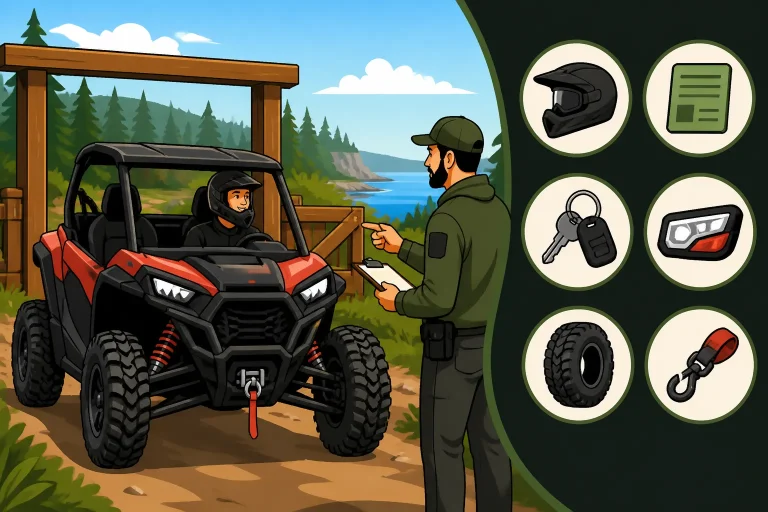
- What documents or proof are riders commonly asked to show here?
- Does every rider need to carry proof of safety training?
- Are there different access rules for an ATV and a side-by-side?
- Are passengers permitted on this section?
- Are there age or supervision conditions riders should check before arriving?
- Does your organization require additional paperwork for a group or organized event?
The operator can explain the trail’s process, but province-wide requirements should be confirmed with the relevant official source. For training questions, Carrying Your Safety Certificate on Every Ride explains why proof matters. If a minor is riding, do not rely on an informal answer from a trail contact about age or supervision; check the applicable provincial rules before the ride.
For an organized ride, charity event or large group, ask whether you need advance approval, an event permit or proof of insurance. A casual outing and an organized event may not be treated alike. Find out whether the operator limits group size, requires a route plan or needs notice to avoid conflicts with maintenance or other trail users. Newfoundland Event Permits for a Ride can help you identify the event-permit issue, but confirm the process for the specific location.
It is also reasonable to ask what the operator does not manage. They may be able to tell you about a managed trail but not whether a municipal street is open to ORVs, whether a private land crossing is permitted or what applies on a nearby restricted area. Those questions may belong to a town, landowner or government office. If an answer sounds like it covers “the whole area,” ask which exact section it refers to.
Plan the practical details before you tow
A few logistical questions can make the difference between a smooth arrival and an inconvenient one. Confirm where to unload, whether trailers can be left there, and whether parking is suitable for the size of your vehicle and group. Ask whether there are washrooms, fuel or supplies nearby, but do not assume those services are available at the trailhead.
Useful details to check include:
- Is there a designated parking or unloading area?
- Can a truck and trailer fit and turn around safely?
- Is overnight parking allowed?
- Are there washrooms or other facilities, and are they open?
- Is fuel available nearby, or should we arrive with full tanks?
- Is there a place to wait if the group arrives at different times?
- Are dogs, camping or campfires allowed in the area?
- Who should we contact if a gate is locked or the route is blocked?
For longer routes, ask how far the nearest fuel and services are, and whether those options keep the same hours throughout the week. Plan conservatively: a service being nearby on a map does not mean it will be open when your group needs it. For remote rides, carry enough food, water and basic repair supplies for delays, and make sure the group has a way to navigate if mobile data is unavailable.
If the trail operator sells or distributes stickers, clarify whether you need to arrange that before you arrive. Ask what payment methods are accepted and whether the process is available in person, online or through another location. Provider procedures can change, so confirm current details directly rather than relying on an old post or a friend’s recollection.
Keep a record of the information that affects your ride: route name, contact details, closure notices, parking instructions and any conditions the operator gave you. If several people are travelling separately, share the same information with everyone. It is easy for a group to split based on different assumptions about which entrance is open or where the sticker is available.
If you cannot get a clear answer, treat that as a reason to verify rather than a reason to guess. Contact the trail operator again with the exact route and machine type, or ask which authority can confirm the issue. A short call before loading can save a long tow, prevent riding where access is unclear and help your group arrive prepared.
Disclaimer
This article is for general informational purposes only and does not constitute professional advice. Laws, prices and regulations vary by location and change over time. Consult a qualified professional for guidance on your specific situation.