Proof Carried Under the Regulation
When you ride an ATV or UTV in Newfoundland and Labrador, it is not always obvious which papers belong in your pocket, which must stay with the machine, and which are only needed if an officer asks. The practical answer depends on your training, route and vehicle. Here’s how to separate required proof from useful backup, and how to carry it without risking damage or loss.
What proof are you expected to carry?
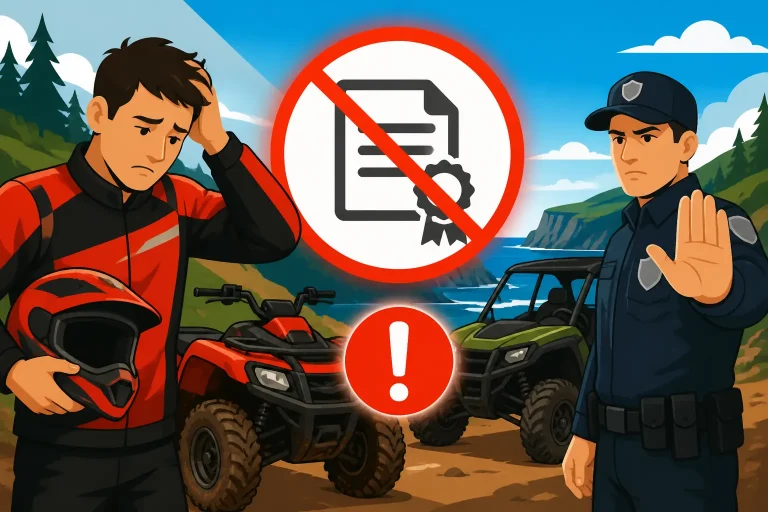
The clearest carry requirement concerns safety training. Digital Government and Service NL says that people who complete the off-road vehicle training program can print a certificate to carry while using an off-road vehicle. If training applies to you, keep that certificate with you on a ride rather than assuming that completing the course online means an officer can verify it on the spot. For details about who needs training and how to keep proof handy, see Carrying Your Safety Certificate on Every Ride.
Training is required for people under 16, people registering an off-road vehicle for the first time, and people directed to complete it after certain registration suspensions or cancellations, according to the Government of Newfoundland and Labrador. The Government of Newfoundland and Labrador also says a person under 16 must be supervised by a licensed driver who is at least 18 years old. A supervisor must ensure the young operator has completed training.
There is also a response deadline if a peace officer requests proof. According to Government Services, operators required to complete mandatory training must provide proof of completion within 2 business days if requested. Carrying the printed certificate avoids having to rely on finding it later, and helps keep the proof immediately available.
Other paperwork is useful to have, but it should not be confused with the explicit training-certificate instruction. Off-road vehicles must be registered with the Motor Registration Division, according to Digital Government and Service NL. The same source says the licence plate must be attached to the vehicle and clearly visible. Those are requirements for the vehicle; they are not the same thing as a stated requirement to carry the registration paper in your pocket.
It is still sensible to carry the registration permit or a copy when riding, especially if you are borrowing a machine, travelling away from home or riding with someone else. Treat it as practical backup, not as a substitute for the plate. For registration documents and what they show, see Newfoundland Registration Paperwork Explained and What the Registrar’s Permit Says About Your Machine.
| Proof or item | What the rules say | Practical approach |
|---|---|---|
| Safety training certificate | Digital Government and Service NL says a certificate can be printed to carry while using an off-road vehicle. | Carry the printed certificate if training applies to you. |
| Registration plate | Digital Government and Service NL says the plate must be affixed and clearly visible. | Check the plate before leaving; do not rely on paperwork to make up for an obscured plate. |
| Registration permit | The supplied rules require registration, but do not state a general requirement to carry the paper permit while riding. | Carry it or a copy as useful backup, and confirm current requirements if your situation is unusual. |
| Insurance proof | Digital Government and Service NL says insurance may be required; the Government of Newfoundland and Labrador specifies insurance for highway crossings. | Carry proof if your route or circumstances require insurance. |
| Managed trail permit or pass | Digital Government and Service NL says off-road vehicles cannot use managed trails without trail permits. | Confirm the trail operator’s requirements and keep the required pass or permit available. |
Registration, insurance and trail access are different kinds of proof
Registration is a vehicle requirement, not a training certificate. Government Services says off-road vehicles, including ATVs, UTVs and snowmobiles, must be registered. Government of Newfoundland and Labrador says registration is required on initial purchase and does not expire while you own the vehicle. A registered machine should have its plate attached and visible, as Digital Government and Service NL requires.
If you have recently bought a used machine, do not assume the seller’s paperwork alone settles the registration question. Government Services requires an appointment to register a new or used off-road vehicle and requires an application at the appointment. A used-vehicle registration also requires a bill of sale bearing the previous owner’s signature. See What to Bring to Your Registration Appointment or Newfoundland Proof of Ownership on the Trail if you need to sort out ownership documents. These are registration and ownership records to arrange, not documents that replace your training certificate.
Insurance is a separate question. Digital Government and Service NL says insurance may be required for off-road vehicles. The Government of Newfoundland and Labrador says an off-road vehicle may cross a highway only when the operator has a driver’s licence and insurance, as well as the required visibility. For the crossing rule, visibility must be at least 150 metres in both directions, according to the Government of Newfoundland and Labrador. If your ride includes a highway crossing, have the relevant insurance coverage in place and carry proof rather than treating registration as evidence of insurance. See Newfoundland Insurance Proof on the Trail for more on that distinction.
Trail access is another separate layer. Digital Government and Service NL says off-road vehicles are not permitted on managed trails without trail permits. The same source says managed trail users pay trail pass fees to their snowmobile club for grooming and maintenance. A registration plate or safety certificate does not stand in for a trail permit or pass. Check what the operator requires before setting out, and see Managed Trails Require a Sticker on Your Machine and Newfoundland Trail Operator Contacts for related trail-access details.
Visitors should also keep registration status distinct from trail permissions and training. If you are riding a vehicle registered elsewhere, confirm whether the visitor rules still cover your trip and whether the trail operator requires a permit. Newfoundland’s 30-Day Visitor Exemption is relevant if you are visiting with an out-of-province machine. An exemption from local registration does not, by itself, establish an exemption from every other requirement.
The simplest way to think about it is to ask what each document proves:
- A training certificate shows you completed a required safety course.
- Registration paperwork supports the vehicle’s registration and ownership record.
- Insurance proof relates to insurance coverage where it is required.
- A managed-trail permit or pass relates to access to that trail.
One item does not automatically prove the others. Before riding, check the details that apply to your machine, the person operating it and the route you plan to use.
A simple system for keeping proof accessible
Paper documents can be hard to protect on a wet, dusty or muddy ride. A small waterproof document pouch or sleeve can help keep a printed training certificate and other useful papers together. If you buy one through Amazon or another retailer, choose a pouch that closes securely and fits somewhere you can reach without rummaging around while operating the machine. A sealed pouch is a storage aid, not a legal substitute for the original document or any other proof that may be required.
Keep sensitive or irreplaceable papers at home where possible. A photocopy or printed duplicate can be a practical trail backup, but do not assume a copy will be accepted in every situation. If you are unsure whether a digital file, photocopy or original is acceptable, confirm the requirement with the relevant authority or trail operator before the ride.
Before heading out, use a quick check:
- Confirm the operator’s training status. If the operator is required to complete training, bring the printed certificate. Digital Government and Service NL says the certificate can be carried during use.
- Check registration and the plate. Confirm the vehicle is registered and that its plate is attached and clearly visible, as required by Digital Government and Service NL.
- Check insurance for the planned route. Digital Government and Service NL says insurance may be required. The Government of Newfoundland and Labrador requires insurance for the highway crossing described in its rules.
- Check managed-trail access. Confirm whether your route uses a managed trail and obtain the required permit or pass from the relevant operator.
- Keep useful ownership and registration information protected. Carry it as backup if it could help answer questions about the machine, but do not confuse it with the required plate or training proof.
If you are riding with a young operator, remember that the supervisor has responsibilities too. The Government of Newfoundland and Labrador says supervisors of operators under 16 must be able to see them at all times, provide direction and ensure the operator can see them. Carrying the young rider’s training certificate is a practical way to keep the proof available, but it does not replace supervision.
A ride that crosses a highway needs extra planning. The Government of Newfoundland and Labrador says off-road vehicles may travel along the shoulder to access a trail for up to one kilometre, at no more than 20 kilometres per hour. It also sets the visibility condition for crossing a highway. These are route and operation rules, not paperwork requirements, but they explain why a rider may need to have insurance proof and a valid driver’s licence ready for the part of the trip on or across a highway. Avoid assuming that permission to use a shoulder means the vehicle can be ridden along a highway for any purpose.
For a visitor or new owner, paperwork can take more thought. A registration transfer, a new registration appointment and trail access are separate tasks. Government Services says a sale or change in ownership must be reported to Motor Registration within 10 days, according to the Government of Newfoundland and Labrador. If you sell your machine, check the steps in Newfoundland Transfer of Ownership Explained. If you are moving to the province with a machine already registered elsewhere, see Newfoundland Registration for a New Resident.
The useful rule of thumb is straightforward: carry the training certificate when training applies; keep the machine’s plate visible; carry insurance proof when insurance is required for your ride; and obtain the permit or pass required for managed trails. Keep registration and ownership documents protected as backup, but do not treat them as replacements for those separate requirements.
Frequently Asked Questions
Do I have to carry my registration permit while riding?
The supplied rules require the vehicle to be registered and its plate to be attached and clearly visible. They do not state a general requirement to carry the paper registration permit while riding. Carrying it or a copy can still be useful backup.
Do I need to carry my safety certificate?
Digital Government and Service NL says people who complete the training can print a certificate to carry while using an off-road vehicle. If you are required to complete training, carrying the printed certificate is the safest practical approach.
Is registration proof enough to use a managed trail?
No. Digital Government and Service NL says off-road vehicles cannot be operated on managed trails without trail permits. Registration and trail access are separate requirements.
Should I carry insurance proof?
Digital Government and Service NL says insurance may be required for off-road vehicles. The Government of Newfoundland and Labrador specifies insurance for the highway crossing described in its rules. Carry proof when your route or circumstances require coverage, and confirm what applies to your ride.
Sources
- Government Services — Off-Road Vehicles Safety – Government Services (checked November 3, 2026)
- Government of Newfoundland and Labrador — Off-Road-Vehicle-Training-Manual-24173.pdf (checked November 3, 2026)
- Digital Government and Service NL — Public Advisory: Off-Road Vehicle Training Now Available on MyGovNL – News Releases (checked November 3, 2026)
- Digital Government and Service NL — Public Advisory: Helmets and Seatbelts Mandatory for Off-Road Vehicles as of May 19 – News Releases (checked November 3, 2026)
- Digital Government and Service NL — Public Advisory: Residents Reminded to Practice Off-road Vehicle Safety – News Releases (checked November 3, 2026)
- Digital Government and Service NL — New Legislation Increases Safety for Off-Road Vehicle Users – News Releases (checked November 3, 2026)
- Government of Newfoundland and Labrador — Offroadsafety-summer.pdf (checked November 3, 2026)
- Government of Newfoundland and Labrador — Offroadsafety-winter.pdf (checked November 3, 2026)
Disclaimer
This article is for general informational purposes only and does not constitute professional advice. Laws, prices and regulations vary by location and change over time. Consult a qualified professional for guidance on your specific situation.