Newfoundland Penalties for No Training Proof
A missing ATV safety certificate can turn a routine ride in Newfoundland into a roadside compliance problem. The key is to distinguish not having completed required training from having completed it but being unable to show proof. This article explains what riders should carry, what enforcement may involve, and how to prepare before heading out.
What “no training proof” can mean
Training and proof of training are related, but they are not the same issue. A rider may have completed the required course or test and still be unable to demonstrate it when asked. Another rider may not have completed training that applies to them at all. Those situations can be treated differently, so it helps to know which one applies before riding.
Newfoundland’s off-road vehicle requirements include safety training rules. Who must complete training can depend on the rider and the circumstances. For example, the rules described for young riders and for people registering a machine for the first time are not necessarily identical. Check the requirements that apply to the operator rather than assuming a family member’s certificate covers everyone. The overview Newfoundland Safety Training Is Mandatory explains the broader requirement, while Newfoundland Training Required Under 16 focuses on young riders.
Proof matters on the trail as well as completing the training. If you have a certificate, make sure the rider can produce acceptable proof during a ride. A certificate stored at home may establish that training was completed, but it does not help much during a roadside check if the requirement is to carry proof. See Newfoundland Proof Carried While Riding and Carrying Your Safety Certificate on Every Ride for more on this distinction.
| Situation | What it means | Practical next step |
|---|---|---|
| Training was required but never completed | The issue is compliance with the training requirement itself | Stop riding until the operator meets the applicable requirement |
| Training was completed, but proof is not available | The rider may have completed training but cannot readily demonstrate it | Ask what forms of proof are accepted and carry one before the next ride |
| A certificate belongs to another operator | One rider’s training does not automatically establish another rider’s compliance | Confirm that each operator has their own required training and proof |
| The operator is visiting Newfoundland | Out-of-province registration does not necessarily remove local riding obligations | Check the visitor rules and carry any required documents |
A safety test certificate and a machine’s registration are separate documents serving different purposes. Registration identifies the machine and its permitted status; training proof concerns the operator’s safety requirement. Having a plate or registration permit does not, by itself, prove that the person at the controls has completed required training. If you need to review the vehicle paperwork separately, Newfoundland Registration Paperwork Explained covers that topic.
Likewise, a managed-trail sticker is not a substitute for training proof. Sticker requirements relate to access on managed trails, while training concerns the operator. A rider may need to meet both sets of requirements on the same trip. Newfoundland Penalties for No Sticker discusses the separate sticker issue, and Newfoundland Managed Trail Rules explains why trail access rules should be checked in addition to the general riding rules.
What penalties may follow
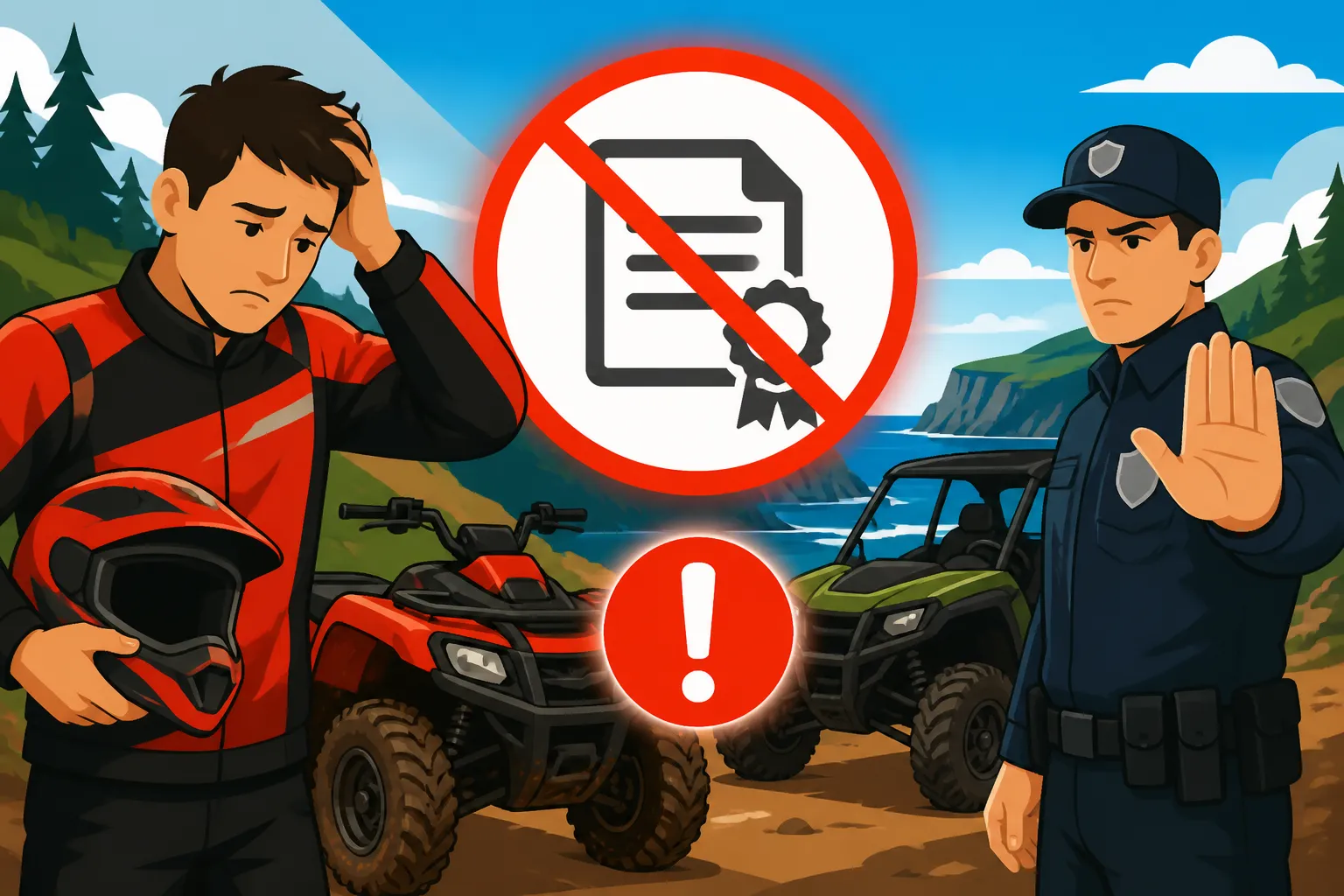
A rider who cannot show training proof should take the situation seriously, but should not assume that every case has the same outcome. The consequences depend on the applicable rule, what the officer observes, whether the rider completed the required training, and how the matter is handled afterward. Penalties can also change, so confirm current requirements with the official provincial source before relying on a particular fine amount or procedure.
The central distinction is between a documentation problem and a failure to meet the underlying training requirement. If training was completed but the proof is missing, explain that accurately and ask what document or record is needed to address the issue. If the rider has not completed training that applies to them, do not present the matter as merely a lost certificate. Giving a clear, truthful answer is more useful than guessing or claiming to have proof that is not available.
An enforcement interaction can lead to a warning, a ticket or another formal step, depending on the circumstances and the applicable law. Do not assume an officer must accept a promise to show the certificate later, or that producing it afterward automatically cancels a ticket. If you receive a ticket or notice, read it carefully, note any response deadline, and follow the instructions on the document. If the notice is unclear, contact the appropriate office or seek legal advice rather than ignoring it.
The consequences may also affect the ride itself. An officer may require the rider to address a safety or compliance issue before continuing, but the exact roadside response depends on the circumstances and applicable authority. Avoid treating a citation as permission to keep riding without the required training or proof. If you are unsure what is permitted after an interaction, ask the officer what action is required and make a note of the instructions.
A few common misunderstandings can make a small problem worse:
- “I passed the test, so I do not need to carry anything.” Completing training and carrying acceptable proof are separate practical steps. Check the current carry requirement and keep proof accessible.
- “The owner has a certificate, so the whole group is covered.” Training applies to individual operators where required. Confirm each person’s status.
- “The machine is registered, so the operator must be qualified.” Registration and training records establish different things.
- “I can use a screenshot, so no other proof matters.” Do not assume a screenshot, email or photograph is accepted. Verify what forms of proof are recognized.
- “If I cannot show it, I can just explain later.” A verbal explanation may not satisfy a requirement to carry proof. Prepare before the ride instead.
The broad penalty information on off-road vehicle offences does not necessarily tell you the exact result for every training-proof situation. The applicable offence and the facts matter. Avoid relying on a fine figure from an old post, an informal discussion or a different type of violation. For related enforcement context, Newfoundland Equipment Checks by Officers discusses checks of a machine and its required equipment, which are distinct from the operator’s training status.
How to avoid a training-proof problem
The simplest approach is to confirm the requirement before riding, complete any training that applies, and carry proof in a form accepted under current rules. Do not wait until a trailhead or roadside stop to find out whether the certificate is missing, difficult to access or issued under a different person’s name.
Use this process before your next ride:
- Identify the operator. Check the age and status of the person who will actually drive. A parent, owner or passenger cannot stand in for the operator’s own requirement.
- Confirm which training rule applies. Requirements may depend on age, registration circumstances or other details. Newfoundland Training for First-Time Registrants is useful if the machine is newly registered, and the broader training rules should be checked if the rider’s circumstances differ.
- Complete the accepted training route. If the online test is the appropriate option, Taking the Free Safety Test on MyGovNL explains that route. If you are considering another course, confirm it is accepted before paying or booking. See Newfoundland Approved Course Providers.
- Save the certificate when it is issued. Keep a copy where it can be retrieved without depending on a weak cell signal. A printed copy can be a practical backup for remote riding, provided it meets the current proof requirement.
- Check the document before leaving. Confirm that the name and identifying details are readable and that the proof belongs to the person who will operate the machine.
- Carry the proof for the full ride. A certificate left in a truck, cabin or home may not be available when requested on the trail.
- Recheck after a change in circumstances. If a certificate is lost, a training record is corrected, or the rider’s eligibility changes, verify what to do before riding again.
For riders completing the provincial test, Fifteen Questions Stand Between You and a Certificate describes the test format, and A Newfoundland Certificate You Print at Home covers the printable certificate. The certificate process is only useful if the rider finishes it and can then produce the resulting proof when needed.
If you discover that proof is missing just before a ride, the safest choice is to pause and resolve the issue rather than assume it will be accepted later. Contact the relevant office or training provider to confirm whether the record exists and what proof can be used. If training itself has not been completed, do not let another person operate on the assumption that the machine’s registration or another rider’s certificate solves the problem.
Good preparation is especially important for group rides. Check each operator’s training status individually, not just the lead rider’s. A quick document check at home can prevent a confusing conversation on a remote trail, where there may be limited phone service and few practical ways to retrieve missing paperwork. Keep training proof separate from registration and insurance documents so that each is easy to find if requested.
Disclaimer
This article is for general informational purposes only and does not constitute professional advice. Laws, prices and regulations vary by location and change over time. Consult a qualified professional for guidance on your specific situation.