Newfoundland Filming Permits on Crown Land
Planning to film an ATV or UTV ride on Newfoundland Crown land? The camera is only one part of the permission question. The location, commercial purpose, crew footprint, machine access and any drone use can all affect what approvals you need. Here’s how to sort out the requirements before you book a shoot or bring a production onto a trail.
When filming may require permission
There is no safe assumption that every camera needs a permit—or that Crown land is available for any filming activity. A rider recording a short personal clip is different from a production that brings a crew, stages scenes, sets up equipment or uses the land for a commercial project. The details matter, and the office responsible for the land should confirm what applies to your plan.
A permit or written authorization may be relevant when filming involves more than simply passing through with a camera. For example, ask about permission if your production will:
- Film for a commercial, promotional or broadcast project.
- Bring a crew, support vehicles, generators, lighting or substantial camera equipment.
- Set up temporarily, occupy a site, or return to the same location over multiple days.
- Block, direct or manage traffic on a trail or access road.
- Change, move or attach anything to the land or trail.
- Film in an area with restrictions, sensitive habitat or other special conditions.
- Use a drone or other equipment subject to separate rules.
These are reasons to contact the relevant land manager, not a definitive list of situations that always require a permit. The applicable requirements can depend on the exact location, scale and nature of the filming. Ask the provincial office responsible for Crown lands to assess your proposal before you treat a site as available.
Also separate filming permission from permission to ride. Authorization to film does not automatically register your ATV or UTV, make a restricted trail open, or satisfy rider requirements. Likewise, a machine’s registration does not grant permission to occupy Crown land for a production. Review Newfoundland Crown Land Access Rules and Newfoundland Restricted Area Permissions if your route may cross approved or restricted areas.
For filming along the T’Railway or another managed route, check with the relevant trail operator as well as the land authority. A trail may be managed for public recreation, but that does not necessarily mean a production can reserve a section, place equipment on it or control access. The operator can clarify local conditions and whether a separate request is needed. The general rules in Newfoundland Managed Trail Rules are a useful starting point, not a substitute for getting approval for a particular shoot.
A location that appears to be Crown land on a map may also be subject to other rules or overlapping responsibilities. A route could pass near private property, a protected area, a community or a managed trail. Confirm the status of the actual filming site and access route, rather than relying on a broad map label or a previous visit.
Identify the land, route and production activity
Before contacting an authority, make the proposal specific enough for someone to assess. “We want to film an ATV ride on Crown land” leaves important questions unanswered: where, when, how many machines, what equipment, how long, and whether the crew will affect other users.
Start by identifying the locations you want to use. Give the nearest community, trail or road name, and include map coordinates or a marked map if you have them. List the full route, including staging and parking areas. If you are considering alternate sites, identify those separately instead of assuming approval for one location covers the others.
Then describe what will actually happen. A useful summary covers:
- The purpose of the filming and whether it is personal, promotional or commercial.
- The dates, hours and number of filming days.
- The size of the crew and number of machines or support vehicles.
- The camera, lighting, sound, drone or other equipment you plan to bring.
- Whether equipment or vehicles will remain at the site.
- Whether the crew expects to stop or direct other trail users.
- Any temporary structures, signs, props, cleared areas or other changes.
- How the crew will manage waste, fuel, noise and site restoration.
The table below shows why the details can change the questions you need answered. It is a planning aid, not a decision about whether a permit is required.
| Filming activity | What to clarify before the shoot |
|---|---|
| Personal footage while riding an open route | Whether the route is open and whether normal rider rules apply |
| A commercial shoot with a small crew | Whether filming authorization is required and what conditions apply |
| A production with equipment, support vehicles or repeated site use | Whether the proposal involves temporary occupation or additional land-use approval |
| Filming on a managed trail | Whether the trail operator needs notice or approval, and how to avoid disrupting other users |
| A drone shot over a trail or Crown land | Whether aviation rules and land-manager conditions allow the planned flight |
| Filming in or near a restricted area | Whether access is permitted and whether a separate authorization is needed |
An authority may ask for additional details once it understands the proposal. If the shoot is still being designed, say so. Ask whether you can receive an initial assessment based on a draft plan, and what information will be needed for a formal application.
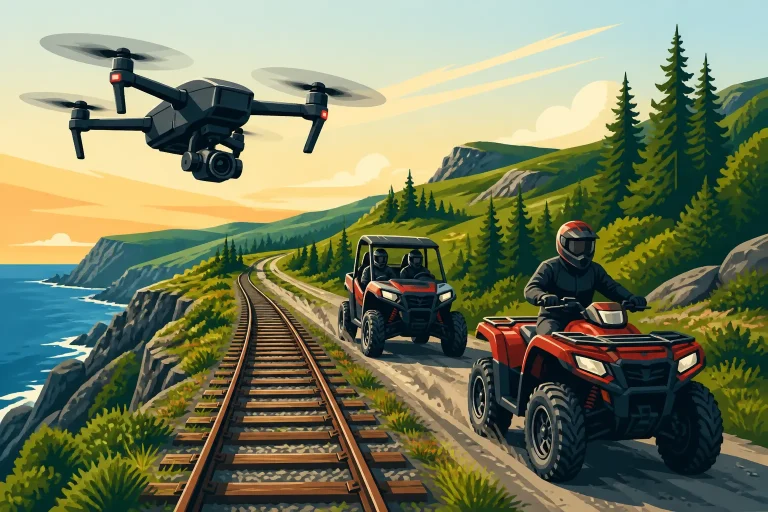
It is worth checking each activity separately. For instance, driving to a site, riding on a trail, setting up cameras and flying a drone are not one single permission. Each can involve different rules or decision-makers. For a drone over the railbed, see Filming With a Drone Over the Railbed, then confirm current aviation requirements and any location-specific restrictions before flying. Do not assume a land-use approval replaces aviation approval, or the other way around.
If your route includes a town road, private land, a provincial park or a national park, contact the relevant authority or landowner for that portion. Crown land permission cannot grant access across land controlled by someone else. Keep route plans flexible until you have confirmed every segment.
Prepare a clear request and check the conditions
Once you know who manages the proposed location, contact that office with a concise description and ask what authorization is needed. If there is an application process, use the current form and instructions provided by the authority. Requirements, forms, processing times and charges can change, so confirm those details directly rather than relying on an old application or a fee quoted for another project.
A complete request usually makes the review easier. Be ready to provide a map, proposed dates, a description of the production, crew and equipment details, and an explanation of how the site will be left afterward. The authority may ask for information about insurance, safety, environmental effects or other approvals. Ask which documents are required for your specific proposal rather than assuming that one standard package applies to every shoot.
Plan for enough time to receive an answer before committing to non-refundable travel, accommodation, rentals or crew arrangements. A request is not approval. Keep a written record of the response and any conditions, and ask whether approval applies to every named location, date and activity. If the plan changes—such as adding a drone, another filming day or a larger crew—check whether the authorization needs to be amended.
Conditions may address matters such as where equipment can be placed, what areas must remain clear, how the crew should interact with the public, and what environmental precautions are expected. Make sure everyone on the production has access to the conditions. A permit held by the producer is not useful if the camera operator or machine rider does not know the approved route or boundaries.
Build environmental care into the plan, especially in wet, soft or sensitive terrain. Keep machines on permitted routes, avoid widening or creating detours, and do not stage vehicles on vegetation or wet ground without approval. Bring out fuel containers, packaging, food waste and production materials. If the land manager sets restoration or cleanup requirements, assign someone to check the site before leaving.
A production also needs a practical safety plan. Consider changing weather, limited cell service, recovery needs, first aid, machine breakdowns and the possibility of meeting hikers or other riders. Avoid positioning cameras or crew where they create a blind corner or force trail users into unsafe manoeuvres. If the filming requires a temporary hold on a trail, do not manage access informally; ask the land manager or operator what arrangement is permitted.
Insurance deserves early attention. If an authority, trail operator, landowner or contractor requires proof of coverage, confirm the type and limits directly with them. Make sure the policy covers the actual activities planned, including machines, crew operations and any special equipment. Do not assume that a rider’s personal policy or a production company’s general coverage automatically satisfies every site’s requirements.
Keep riding and filming rules separate
After the location and production permissions are clear, check the rules that apply to each rider and machine. Newfoundland requirements can vary with the machine, rider and route. Registration, training, insurance, plates and managed-trail requirements are separate from filming authorization. Use Newfoundland ORV Road Rules Explained for an overview, and verify any detail that applies to your particular ride.
If riders are visiting from outside the province, confirm how long their out-of-province machine may be used before registration rules change. The visitor exemption is not the same as a filming permit; see Newfoundland’s 30-Day Visitor Exemption and confirm the current conditions before travel.
Check whether your route uses a managed trail and whether a sticker or other proof is required for the riders and machines involved. Do not assume a production’s commercial status exempts a crew from ordinary trail requirements. How to Get a Newfoundland Trail Sticker explains the sticker question, but check with the trail operator for the route you intend to film.
For every machine, confirm that its registration and identification plate are in order and that the rider understands where riding is allowed. A crew member filming from a stationary position may still need to be located somewhere they are allowed to stand, and a support vehicle may be subject to different access rules from an ATV. Do not leave equipment, vehicles or people in a location just because a machine can legally pass through it.
Before the shoot, assign one person to check the approval documents against the day’s plan. That person should know:
- Which locations and dates have been approved.
- Where the crew may park, unload and set up.
- Which routes are open to the machines being used.
- Whether filming may continue if other trail users arrive.
- What to do if weather or ground conditions make the approved route unsuitable.
- Who to contact if the production needs to change its plan.
If permission is unclear, pause the activity and get clarification. A short written confirmation before the shoot is easier to manage than a disagreement on location. If access is denied or the proposed site is restricted, ask whether a different location or a smaller production footprint would be acceptable. Do not treat silence, a map boundary or another group’s past use as approval.
The practical takeaway is simple: confirm the land status, describe the full production and route, and get the necessary permissions in writing before filming. Then check each machine, rider, trail and drone separately. That keeps a camera project from becoming an access or safety problem for the crew and everyone else using the land.
Disclaimer
This article is for general informational purposes only and does not constitute professional advice. Laws, prices and regulations vary by location and change over time. Consult a qualified professional for guidance on your specific situation.