Bringing a Machine Registered in Another Province
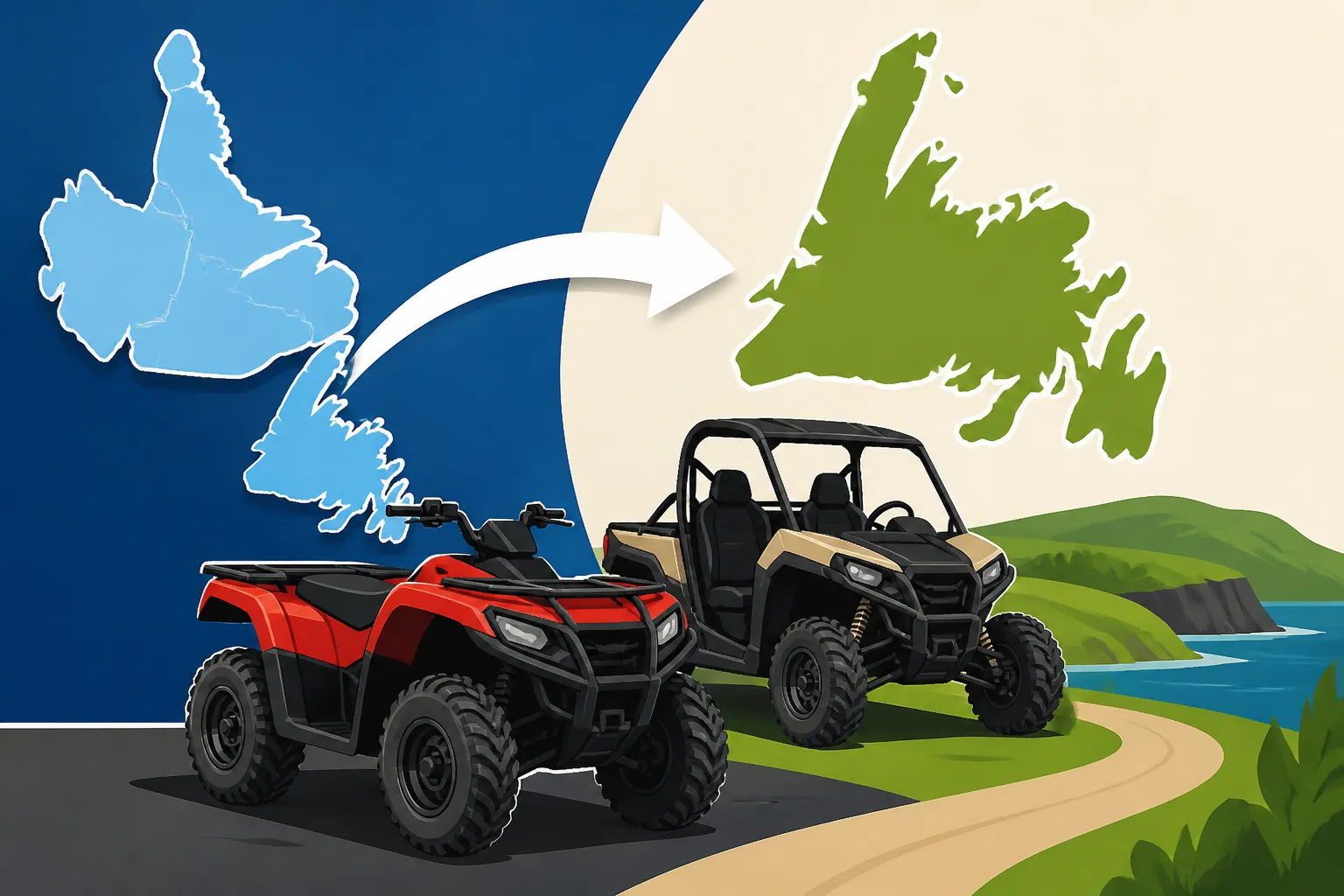
Bringing your ATV or UTV from another province can save you from registering it again for a short visit, but the home-province registration is not a pass for every Newfoundland trail or road. The key is understanding the visitor time limit, keeping proof of registration and insurance with you, and checking local riding rules before unloading.
How the 30-day visitor allowance works
Newfoundland and Labrador allows a qualifying visitor to use an off-road vehicle registered in another province for a limited period. The visitor exemption is generally described as a 30-day window. It is intended for temporary visits, not as a way to keep using an out-of-province registration indefinitely after moving here.
The exemption concerns registration. It does not automatically exempt a rider from insurance, equipment, safety, land-access, or trail requirements. Nor does it mean that every machine or every type of use qualifies. Review Newfoundland’s 30-Day Visitor Exemption and Newfoundland Rules for an Out-of-Province Machine before you travel, especially if the machine has unusual registration documents or is being brought in for work, rental, or commercial use.
A few practical points matter:
- Keep the machine registered in the other province while relying on the visitor allowance.
- Carry current proof of that registration and make sure the identification plate is displayed as required.
- Do not assume the 30 days begin or end on a particular date without checking how the rule applies to your circumstances. If you plan a lengthy stay, ask the registry how it calculates the period.
- If you move to Newfoundland and Labrador, plan to register the machine locally within the applicable period rather than treating the visitor allowance as permanent reciprocity. Newfoundland Registration for a New Resident explains the move-in situation.
- If the machine is not registered in your home province, do not assume a visitor exemption covers it. Ask the registry what documentation and process apply.
The length of your visit is only one part of the question. Your status, the machine’s registration, and how it will be used can all affect which rules apply. If your plans change—such as a vacation turning into a move—check the requirement again instead of relying on the original travel plan.
| Before you ride | What to confirm |
|---|---|
| Home-province registration | It is current, belongs to the machine, and can be shown if requested |
| Visitor period | Your stay and use fit the visitor exemption; confirm how the time limit is calculated |
| Insurance | Coverage applies in Newfoundland and Labrador and meets applicable requirements |
| Safety and equipment | The machine and each rider meet the rules that apply to the trip |
| Trail access | The route is open to your machine and any required trail authorization is in place |
| Longer stay or move | You know when local registration becomes necessary |
What to bring and check before leaving home
Prepare as if you may need to explain both who owns the machine and why it is being operated in Newfoundland and Labrador. Keep documents somewhere protected from rain and mud, but easy to reach. A phone photo can be a useful backup, but do not count on a digital copy being accepted in every situation; carry the original documents or the form of proof the issuing authority provides.
Registration and ownership
Bring the registration document issued for the machine in your home province. Check that the name, vehicle identification number, and other identifying details match the machine. If the machine has changed hands recently, bring supporting ownership paperwork too. A registration document in a previous owner’s name can create questions even when the purchase was legitimate. See Newfoundland Proof of Ownership on the Trail for why it is useful to have ownership evidence available.
Before you load the machine, compare its identification number with the number on its documents. If anything is difficult to read or does not match, resolve it before travelling. For a used purchase, gather a clear chain of ownership and sale documents; Newfoundland Registration Paperwork Explained covers the kinds of records that can matter when registering locally.
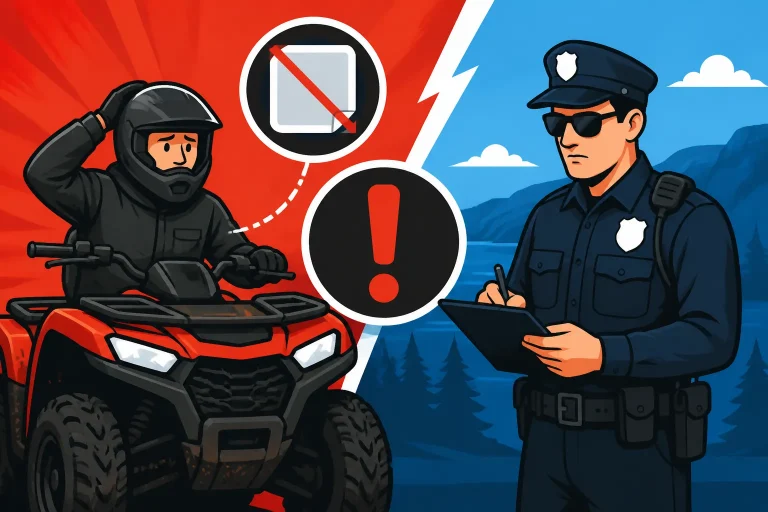
Make sure the plate is attached securely and is visible. Mud, cargo, a spare tire, or a poorly chosen mounting spot can hide it. The plate rules that apply in Newfoundland may differ from what you are used to, so check local requirements rather than assuming a plate arrangement accepted at home is enough.
Insurance
Do not treat registration as proof of insurance. Contact your insurer before travelling and confirm that the policy covers the machine while it is operated in Newfoundland and Labrador, including the type of riding you intend to do. Ask whether the policy covers trail use, transport between locations, passengers where relevant, and any other planned activity.
Carry proof of insurance in the form your insurer provides. If an officer or trail operator asks for it, you should be able to produce it without relying on a call to someone at home. More detail on the visitor side is available in Newfoundland Insurance Rules for Visitors.
Insurance can have restrictions that are easy to miss. A policy may distinguish between riding on private property, a managed trail, or a public road. Confirm the permitted uses directly with the insurer, and do not assume that a policy valid in your home province automatically covers every activity in Newfoundland and Labrador.
Training, equipment, and machine class
A home-province registration does not necessarily prove that the operator meets every local training requirement. Check the current visitor-specific rules before the trip and bring any training certificate or proof you may need. The general requirements are discussed in Newfoundland Safety Training Is Mandatory, but visitors should confirm how the rules apply to their situation.
Also check the machine itself. An ATV, side-by-side, snowmobile, and other off-road vehicle may be treated differently under particular rules. A registration category from another province does not settle every question about local classification, passengers, or equipment. Confirm that the machine is permitted on your intended route and that its lights, tires, muffler, seating, and other required equipment are in suitable condition.
If you are travelling with children or passengers, check the rules for their age, seating position, protective equipment, and supervision. Do not rely only on the machine’s passenger capacity or on what is allowed in your home province.
Registration is not permission to ride everywhere
A valid registration answers an important paperwork question. It does not establish that a route is open, that the landowner permits access, or that the machine is allowed on a particular trail. Those are separate checks.
Managed trails can have their own access conditions, including a trail sticker or other authorization. Confirm the requirements with the trail operator before setting out; Newfoundland Managed Trail Rules is a useful starting point. If a sticker is required, ask whether a visitor’s machine must display it, where to obtain it, and whether the operator has any additional conditions. Do not assume an out-of-province plate substitutes for trail authorization.
Land status matters too. A route that looks like a trail on a map may cross private land, restricted land, or an area where machine use is limited. Check the route and any posted signs, and get permission where required. A visitor’s short-term registration status does not create access rights.
Road use is another separate issue. A registration document does not make an ATV or UTV a road-legal vehicle, and it does not authorize riding on any road you choose. Where a route involves a highway crossing or shoulder, follow the specific restrictions and use only a permitted crossing or connection. Review Newfoundland’s 150-Metre Crossing Visibility Rule and Newfoundland Rules for Riding a Shoulder before planning a route that connects trails by road.
A sensible pre-ride routine is:
- Confirm that the route is open to your machine type and that you have permission to use the land.
- Check whether the trail operator requires a sticker or other authorization.
- Review local road, crossing, and shoulder rules for any connection on your route.
- Carry registration, insurance, ownership, and any required training or trail documents.
- Tell your group where the route goes and check for current closures or conditions before unloading.
This is especially important for visitors who are unfamiliar with local access patterns. A route that appears continuous on a map can change from a managed trail to a public road or private access road. Verify the whole route, not only the trailhead.
If your visit lasts longer or you move here
If you expect to stay beyond the visitor period, contact the appropriate registry office early and ask what local registration process applies. Do not wait until the last day to find out whether you need an appointment or additional documents. The requirements can differ depending on whether the machine is newly purchased, used, inherited, financed, or brought in as part of a move.
For a permanent move, collect your out-of-province registration, proof of ownership, identification, and any other records the registry requests. Ask about the local requirements before travelling if you can. A machine with missing paperwork or a mismatch in the identification number can take longer to resolve than a straightforward transfer. Newfoundland Visitors Beyond Thirty Days addresses the longer-stay question, while Newfoundland Registration Paperwork Explained can help you prepare documents.
If the machine was bought shortly before the trip, keep the bill of sale and any prior ownership records with the registration. If a lender has an interest in the vehicle, check what financing documents are needed. If the registered owner is not travelling with the machine, ask the registry or relevant authority what authorization is required; do not assume that a friend or family member can resolve every ownership question at the roadside.
For a temporary visit, a little preparation usually prevents the most common problems: an expired or mismatched registration, uncertain insurance, a plate that cannot be seen, or a route that does not allow the machine. Confirm the visitor time limit and requirements with the official registry, then check trail access with the relevant operator. That keeps the paperwork question separate from the equally important question of where you may ride.
Disclaimer
This article is for general informational purposes only and does not constitute professional advice. Laws, prices and regulations vary by location and change over time. Consult a qualified professional for guidance on your specific situation.