Newfoundland Training for First-Time Registrants
Registering your first ATV or side-by-side in Newfoundland can raise a basic but important question: do you need safety training before you can ride, and what counts as proof? This guide explains how first-time registration and training fit together, how to prepare for the test, and what to confirm before an appointment or first trip.
What first-time registrants need to know
In Newfoundland and Labrador, safety training is part of the rules riders need to understand, not just an optional introduction for beginners. If you are registering your first off-road vehicle, check whether you must complete an approved course or test and provide proof before you ride. The requirement can depend on your circumstances, including your age, whether you have completed approved training before, and the type of machine you will operate.
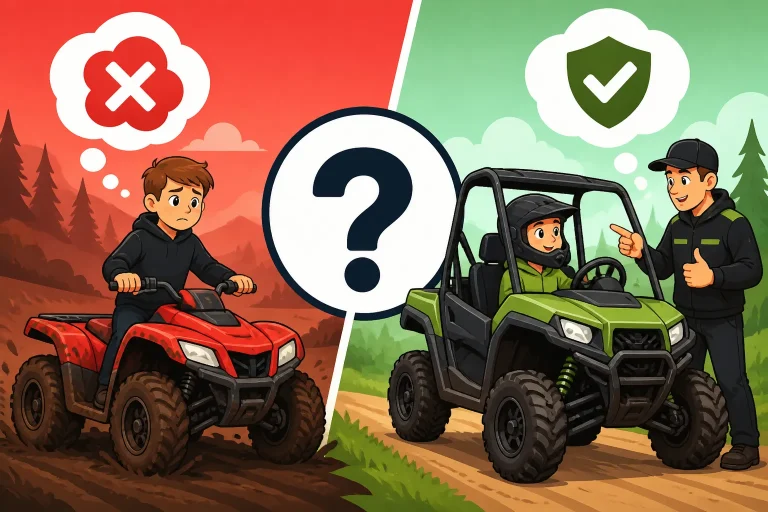
A key distinction: registering a machine and qualifying to operate it are not the same thing. Registration identifies the vehicle and its registered owner. Training addresses the person who will ride or operate it. A machine’s registration does not, by itself, show that every person using it has met the applicable training requirement.
This matters whether you are buying a new ATV, bringing a used quad home, or registering a side-by-side for the first time. A dealer may help with registration paperwork, but that does not necessarily complete your personal training requirement. Before arranging an appointment, review Newfoundland Registration Paperwork Explained and What to Bring to Your Registration Appointment so you can separate the documents for the machine from the proof required of you as a rider.
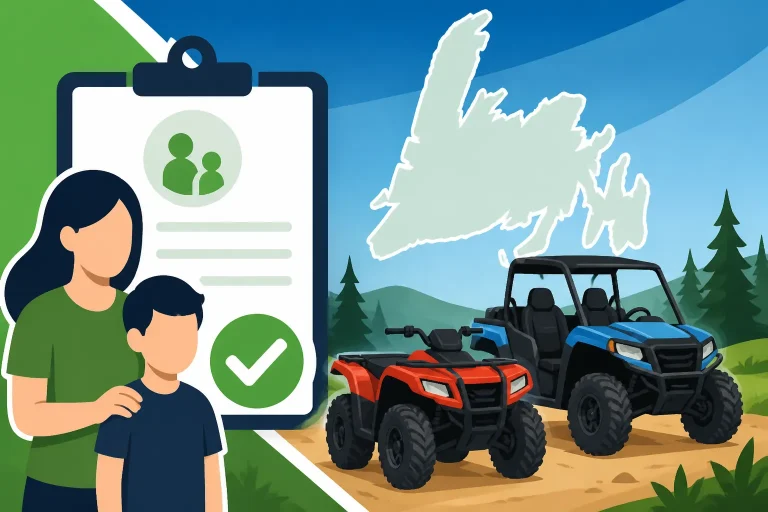
The rules can also apply differently to different riders in the same household. An adult who has already completed an accepted course may have proof to show, while a young person who plans to operate the family machine may have separate training and supervision requirements. Do not assume that one person’s certificate covers a spouse, child, passenger, or friend.
A useful starting point is to ask two questions:
- Who will operate the machine? Make a list of the intended riders, including occasional operators and young riders.
- What proof does each rider need? Check whether each person needs the provincial test, an accepted alternative course, or other documentation.
If you are registering your first machine but will not ride it yourself, do not assume the training question disappears. Ask the registry or the appropriate provincial office what applies to the registered owner and what applies to the person who will operate the vehicle. The requirements may not be identical.
The first registration can also be a good point to sort out the rest of your riding obligations. Training does not replace registration, a required trail sticker, insurance, a helmet, or rules about where you may ride. For a broader view of the paperwork, see How to Register an ATV in Newfoundland. For the rules that apply after registration, review Newfoundland ATV Age Requirements and Newfoundland ATV Insurance Requirements.
Registration is not a training certificate
A registration permit and a training certificate serve different purposes. The permit relates to the machine. Training proof relates to the rider. Keep them separate in your mind and in your paperwork.
A seller’s old documents are not proof that you have personally completed a course. Likewise, a bill of sale or a registration permit from another owner does not establish your training status. If you are buying a used machine, handle both sides of the transaction: confirm the ownership documents and confirm your own eligibility to ride.
Training is not permission to ride anywhere
Passing a test does not grant access to every woods road, trail, beach, barrens area, or piece of Crown land. Nor does it automatically authorize riding on a public road. You still need to follow the rules for the specific area, including land access limits, local bylaws, trail operator requirements, and road restrictions.
That distinction is easy to miss when you are eager to try a newly registered machine. Treat training as one part of a pre-ride checklist rather than a general permit. Before going out, check [Newfoundland Crown Land Access Rules] and [Newfoundland Managed Trail Rules] for the type of route you plan to use.
Who may need training and what counts
The safest practical approach is to verify training requirements for every intended operator instead of relying on the owner’s age, the machine’s age, or its registration history. Newfoundland has specific rules for younger riders, and there are also requirements associated with first registration and accepted training. The details matter, particularly if more than one person will use the machine.
The training obligation is personal. A parent’s course does not train a child, and an adult passenger’s experience does not substitute for the operator’s requirement. If you share a machine with family or friends, check the status of each rider rather than treating the ATV as if it has one universal certificate.
The provincial online safety test is one route riders may use to meet the training requirement. Accepted alternatives may also be available, but do not assume that a course from another province, a private instructor, or a workplace safety session automatically qualifies. Ask whether the specific course and its certificate are recognized before you spend time or money on it. The list of Newfoundland Approved Course Providers can help you identify what to check.
| Situation | What to check | Practical next step |
|---|---|---|
| You are registering your first machine | Whether training proof is required for your circumstances | Confirm the current registration checklist before booking |
| You have completed an ATV course elsewhere | Whether Newfoundland accepts that provider and certificate | Ask the province or registry before relying on it |
| A young person will operate the machine | Training, age, supervision, and machine suitability rules | Review the youth rules as well as training requirements |
| You are registering a side-by-side | Whether the operator needs a course specific to that vehicle class | Confirm the accepted course before operating it |
| You already passed the provincial test | How to retrieve, print, and carry the certificate | Keep a usable copy with your riding documents |
| You are a visitor with an out-of-province machine | Whether visitor rules or reciprocity provisions apply | Check the visitor rule and carry your home documents |
First registration does not mean every rider has the same status
If you are a first-time registrant and an experienced ATV rider, you may feel the test is just a formality. It is still worth checking the requirement rather than assuming experience replaces proof. Practical skill and recognized training are different things: you can be comfortable on a machine and still need to complete the required process.
The reverse is also true. Passing a basic test does not prove that you have the judgment or experience to handle every trail condition. A new rider should start with manageable routes, learn the machine’s controls, and avoid going alone into remote terrain. Training is a baseline, not a guarantee of competence in mud, steep ground, water crossings, poor visibility, or changing weather.
If you have completed a course but cannot locate the certificate, do not automatically take the test again. First find out whether the record can be looked up or a replacement certificate can be obtained. See Looking Up a Newfoundland Safety Certificate for the record-checking question, and ask what identification details you should provide.
Young riders have more than a training question
For a child or teenager, training is only one part of the decision. You also need to check minimum age and machine suitability, whether an adult supervisor is required, and whether the young person can operate that particular vehicle safely. Requirements can differ by age and machine characteristics. A certificate does not override those limits.
Do not treat a small quad as automatically suitable for every child, either. Consider the rider’s size, strength, attention, ability to reach and use the controls, and ability to understand instructions. The machine’s engine size and other characteristics can matter under the rules. For details, see Newfoundland Engine Size for Age and Weight and Newfoundland Supervision Rules for Young Riders.
If you are the adult responsible for a young rider, make sure you understand your own role before setting off. Supervision may involve more than being somewhere nearby. Keep the young operator in sight, choose terrain within their ability, and stop the ride if they become tired or conditions change.
How to complete the provincial online test
If the online test is the route you need, set aside time to read the material and take it when you can concentrate. A quick guess-through may get you to a score screen, but it is a poor way to prepare for real riding. The questions are most useful when they help you remember the decisions you may need to make on a trail or near a road.
The online safety test is described as having 15 questions, with 12 correct answers needed to pass. The format or access process can change, so check the current provincial instructions before starting. The test is associated with Newfoundland and Labrador’s online services; use the official route indicated by the province rather than relying on a third-party quiz as proof of completion. For details on the platform, see Taking the Free Safety Test on MyGovNL.
A practical way to prepare is:
- Read the official study material first. Focus on rules, responsibilities, and situations that affect safety, not just memorizing terms.
- Review the topics you find least familiar. Road crossings, passengers, helmets, insurance, and young-rider supervision are common areas to revisit.
- Make sure you can access the required online service. Check that your account and contact details work before you begin.
- Take the test when you can focus. Avoid doing it while distracted or rushing to finish before an appointment.
- Save or print the result after passing. Do not assume a result screen will be easy to retrieve later.
- If you do not pass, review the material and follow the instructions for another attempt. A failed attempt is a cue to study, not to rely on random answers.
The test’s pass mark is not a recommendation to study only until you can scrape through. The rules you miss on a screen may matter later when you are sharing a trail, carrying a passenger, or deciding whether a road crossing is safe. Think of the test as a compact rules review and keep learning after you pass.
Study the decisions you will actually face
For a first-time registrant, the most useful study approach is to picture a normal ride. You load the machine, reach a trailhead, meet other users, encounter a road, and return before conditions worsen. At each stage, ask what the rules expect of you.
For example:
- Before leaving: Is the machine properly registered and equipped? Do you have required insurance and documents?
- At the trailhead: Is the route open to your machine, and does the operator require a sticker or proof?
- On a shared route: How will you pass hikers, cyclists, snowmobilers, or other vehicles safely?
- Near a road: Is riding or crossing permitted at that location, and can you see enough to do it safely?
- With a passenger: Is there a proper passenger seat and are the rider and passenger protected?
- With a young operator: Are age, supervision, training, and machine suitability all addressed?
- After dark or in poor weather: Are the lights and visibility adequate, and is the ride still sensible?
You can use the related rule guides as a study map: Newfoundland Helmet Law for Every Rider, Newfoundland’s 150-Metre Crossing Visibility Rule, and Newfoundland’s Minimum Insurance Requirement. The details of each topic still need to be checked against the current rules.
If you do not pass on the first try
Do not treat a failed score as proof that you are incapable of riding. It means you need to revisit the material and follow the official process for another attempt. The retake instructions may explain whether you can try again right away or need to wait. Check those instructions rather than relying on a friend’s memory.
When reviewing, write down the subject areas that caused trouble. If the test does not identify individual answers, go back through the full study material and concentrate on the sections you found unfamiliar. Retaking the Safety Test After Scoring Under 12 covers the retake issue; follow the current instructions provided with the test.
Avoid paying an unverified service that claims it can secure a certificate for you or take the test on your behalf. Your certificate should reflect your own completion of an accepted training route. If you have a disability, access problem, or difficulty using the online system, ask the province about legitimate assistance or an approved alternative.
Getting and keeping proof of completion
Once you pass an accepted test or course, make sure you know how to show that you completed it. A result screen, a certificate, and a record in an online account are not always equally convenient at a registration counter or roadside stop. Follow the official instructions for retrieving the certificate and keep a copy you can access without relying on a weak mobile signal.
If the process lets you print a certificate, save both a digital copy and a printed one. Store the file somewhere you can find it, not only in a temporary downloads folder. If you use a phone, consider keeping a copy available offline. A printed copy can be useful when a device battery is flat or there is no service.
A simple document routine helps:
- Save the certificate with your registration and insurance records.
- Keep a readable copy in your home files.
- Carry the required proof while riding, following the provincial rules.
- Replace a damaged or illegible copy before a trip.
- Make sure each rider has their own certificate or proof where required.
- Do not assume the registry will retrieve a document instantly if you arrive without it.
A small waterproof document sleeve can protect paper copies from rain, mud, and a wet cargo box. If you are assembling a basic riding folder, a sleeve from an outdoor supplier or Amazon may be convenient. Keep it separate from items likely to get soaked or crushed, and do not put your only copy somewhere you cannot reach without unloading the machine.
For a certificate you need to print again, start with the official account or provincial instructions. If you cannot access the record, contact the appropriate office and ask what information is needed to verify your identity. The guidance in Newfoundland Printable Certificates and Newfoundland Proof Carried While Riding can help you think through the difference between getting a copy and carrying proof.
Keep the record tied to the right person
In a household with multiple riders, label each digital file clearly. A folder called “ATV paperwork” is less useful than separate, identifiable documents for each operator. Avoid sending someone else’s certificate with your registration paperwork just because the names are similar.
If a child’s certificate is stored by a parent, make sure the adult who supervises or transports the machine can find it. If a group is riding together, each person should know what proof they are expected to carry. The organizer should not assume one person can produce training records for everyone.
For an older course certificate, check whether it remains accepted and whether the information on it is legible. If the provider has closed or you have moved, ask the province what it needs to confirm completion. Do not edit a certificate or rely on a phone photograph if the official instructions require a different form of proof.
Documents to prepare for your appointment
Training proof is only one possible part of the registration process. Depending on the machine and how you acquired it, you may need identification, proof of ownership, tax-related information, and vehicle details. A new machine may have a manufacturer’s document; a private sale may call for a bill of sale and a clear chain of ownership. These are separate from your course record.
Before booking, make a checklist and confirm the current requirements for your case. Useful guides include Newfoundland Requires an NVIS for a New Machine, Newfoundland Bills of Sale From Each Owner, and Newfoundland Registration Without a Bill of Sale. The right documents depend on the transaction, so a checklist for a new dealer purchase may not fit a used machine bought privately.
Amazon may be useful for a basic folder or waterproof sleeve, but it cannot resolve missing ownership papers or confirm that a training course is accepted. Keep purchases practical: the critical step is verifying the requirements with the registry or provincial source before the appointment.
Reciprocity, out-of-province courses, and visitors
A common question from new residents is whether an ATV safety course completed elsewhere will count in Newfoundland and Labrador. The honest answer is: confirm the exact provider and certificate before relying on it. Course names can sound similar while their content, approval status, and documentation differ. A provincial test result or certificate from another jurisdiction should not be assumed to transfer automatically.
If you have moved to the province, gather the certificate, course provider’s name, date of completion, and any course identification number. Ask the provincial office whether that specific credential is accepted and whether you need to complete anything else. If the certificate is not accepted, ask what approved route is available before booking an appointment or planning a ride.
This is separate from vehicle registration reciprocity. A visiting rider may be allowed to use a machine registered elsewhere for a limited period under visitor rules, but that does not necessarily erase local safety, insurance, trail access, or operator requirements. Check Newfoundland’s 30-Day Visitor Exemption and Newfoundland Visitors Registered Elsewhere if you are coming for a trip rather than moving permanently.
Similarly, completing an out-of-province course does not determine whether your machine needs to be registered after you become a resident. The visitor period and the new-resident registration rule are distinct issues. If you have recently moved, review Newfoundland’s 90-Day New Resident Rule and ask how your training documentation fits into the registration process.
What to ask about an outside certificate
When you contact the registry or provincial office, make the question specific. “Does my ATV training count?” may not give staff enough information to answer. Ask:
- Is this exact course provider accepted for Newfoundland and Labrador?
- Does the certificate meet the requirement for a first-time registrant?
- Does the answer differ for the type of machine I plan to operate?
- Is the certificate accepted for young riders, adults, or both?
- Do you need an original, a printed copy, or a record sent directly by the provider?
- If the course is not accepted, which approved test or course should I complete?
Keep notes about the answer, including the date and the office or contact method, so you can follow up if the registration counter asks for something different. Do not rely on a general statement that a course is “recognized nationally” unless the provincial office confirms that it meets the local requirement.
New residents and local familiarity
Even experienced riders can benefit from reviewing Newfoundland-specific rules after moving. Trail access, road use, local bylaws, land status, and weather conditions may differ from what you are used to. A course certificate from another province may show prior learning, but it does not teach every local restriction or route condition.
Before the first ride, check the machine’s registration status, confirm insurance, and identify where the route is legally open. If you are bringing a vehicle from another province, Moving to Newfoundland With a Machine You Already Own is a useful companion guide. If the machine has been shipped or purchased from outside the province, see Newfoundland Registration for an Imported Machine.
Training is only one part of being ready to ride
Passing the test is a milestone, not the finish line. A first-time registrant should still prepare the machine, choose an appropriate route, and make sure everyone riding understands the plan. The most preventable problems often come from treating the certificate as a substitute for basic preparation.
Start with the machine. Check the controls, tires, brakes, throttle return, lights, and visible leaks. Read the manufacturer’s manual, especially if the vehicle is new to you or has a different transmission, drive system, or passenger layout than the machine you used before. Do not assume that riding a quad makes you immediately comfortable operating a side-by-side. The weight, turning behavior, visibility, and passenger risks can be different.
Then make a route plan. Pick a ride that matches the least experienced operator, not the most skilled person in the group. Let someone know where you are going and when you expect to return. In remote areas, do not assume a phone will have service. Carry what you need to deal with a delay, weather change, or minor breakdown.
Before a first ride, check the following:
- The machine is registered as required and displays its plate correctly.
- Insurance and other required documents are in place.
- You have the required training proof and any trail sticker or permit.
- Every operator meets the relevant training, age, and supervision rules.
- Helmets and other required protective equipment fit and are in good condition.
- Passengers have an approved seat and understand how to ride safely.
- The route is open to your machine and permitted for the activity.
- You have fuel, water, basic tools, first aid supplies, and a way to communicate.
- Someone who is not on the ride knows your route and expected return time.
Newfoundland’s terrain can turn a routine outing into a demanding one. Wet ground, bog, loose rock, water, fog, and rapidly changing weather are not good places to discover that you do not know the machine’s controls. Start on familiar, manageable terrain and build experience gradually. If the route includes a difficult section, turn around rather than letting group pressure make the decision for you.
For more on getting the required riding credentials and permissions in order, review The Trail Sticker and Training Proof Newfoundland Requires. For route selection, the guides to Newfoundland ATV Trails: The T’Railway and Beyond and Newfoundland Trail Conditions Before You Ride can help you plan beyond the registration counter.
Make the first ride a practice ride
A first outing does not need to be an ambitious trip. Use a short route to practise starting, stopping, turning, braking, reversing if applicable, and communicating with any passenger. Learn how the machine behaves on a gentle slope or loose surface before choosing a harder trail. If you are a novice, ride with someone experienced who understands local rules and will not pressure you into unsafe terrain.
If you are riding a side-by-side, practise steering and braking with the vehicle’s weight in mind. Keep passengers seated and belted as required, and do not carry more people than the manufacturer’s seating arrangement allows. A side-by-side is not a passenger vehicle simply because it has a cab or multiple seats.
Set group expectations before departure. Agree on spacing, stopping points, hand signals or radio use, and what to do if someone falls behind. The least experienced rider should not be pushed to keep up with a faster group. A slow, orderly first ride gives everyone room to learn.
Keep learning after the test
The test is designed to check core knowledge. It cannot cover every trail, road crossing, land-access question, mechanical problem, or emergency you might encounter. Make a habit of checking local information before each ride, especially if you are heading to a new area or riding during a season with closures or special restrictions.
When you are unsure, pause and ask before riding. Confirm trail access with the relevant operator, check municipal bylaws where roads or community areas are involved, and verify current requirements with the official source. A short call or message before leaving is far easier than dealing with a blocked route, an avoidable ticket, or a machine that is not properly prepared.
Common first-time registrant mistakes
A few avoidable assumptions account for many last-minute problems. The simplest way to prevent them is to check the training requirement early, save proof properly, and confirm that the person and machine both meet the rules.
Assuming the dealer handles everything
A dealer may handle some registration steps, but do not assume that buying a machine automatically completes your personal training requirement. Ask exactly what the dealer will submit, what you must do yourself, and which documents you will receive. If the dealer says training is not needed, verify that statement against the rules for your situation.
Confusing a registration permit with proof of training
The permit is about the vehicle; training proof is about the operator. Carry what is required for both. A previous owner’s permit, a bill of sale, or a photo of the machine’s plate does not show that you completed training.
Assuming any course will be accepted
A course completed in another province or through a private provider may be useful experience, but usefulness and official acceptance are not the same. Confirm the exact provider and certificate before relying on them. If you cannot confirm acceptance, complete an approved route rather than discovering the problem at the counter.
Waiting until the day of the appointment
If you need an account, test, course, certificate, or supporting documents, leave time to sort them out. Waiting until the day of registration can mean discovering a missing record when the office is ready to process the machine. Check Booking an Appointment at Motor Registration Before You Go and confirm the paperwork in advance.
Treating a pass as proof of safe riding ability
Passing shows that you met a training step; it does not show you can handle every machine or terrain. Get familiar with the controls, start with easy routes, and ride within your ability. Do not carry a passenger or take on challenging ground until you understand the machine and the relevant rules.
Forgetting that local access rules still apply
Training is not a trail pass. A route can be closed, restricted, subject to a sticker requirement, or governed by local rules. Check before you unload. A registered machine with a trained operator can still be on the wrong trail.
Carrying only a copy you cannot access
A certificate saved in an account that needs a data connection may be unavailable in a dead zone. Keep a copy in a form you can retrieve offline, and follow the rules about what proof must be carried. Store it where it stays legible and protected from water.
A straightforward routine avoids most of these mistakes: confirm your personal training requirement, complete an accepted course or test, save the certificate, gather the machine’s ownership documents, confirm the registration appointment requirements, and check the route before riding.
Disclaimer
This article is for general informational purposes only and does not constitute professional advice. Laws, prices and regulations vary by location and change over time. Consult a qualified professional for guidance on your specific situation.