Newfoundland Family Riding Trips
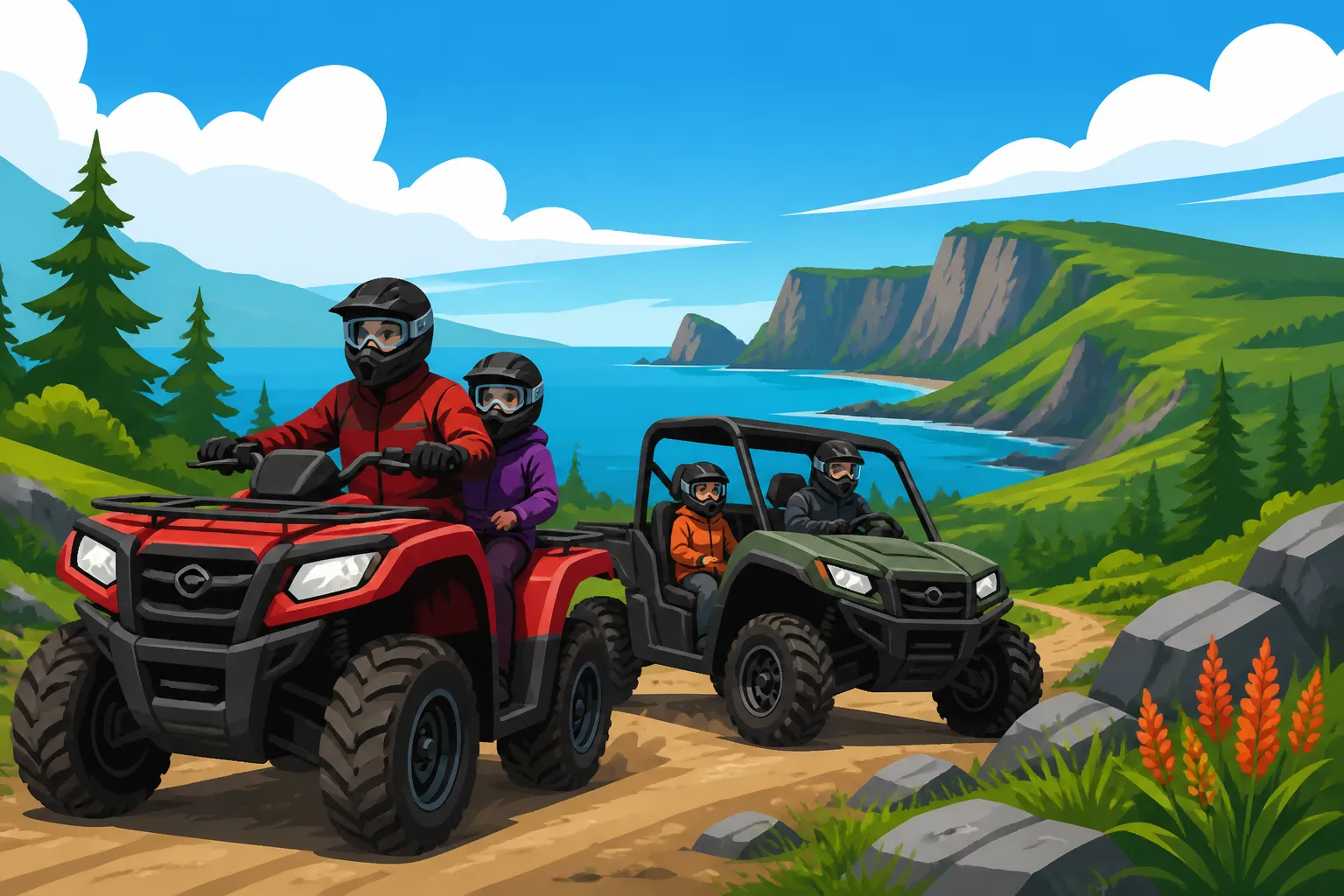
Planning a family ATV or UTV outing in Newfoundland means more than finding a machine that seats everyone. Age and licence rules, trail access, weather, equipment, and what a rental includes can all shape the day. This guide explains how to choose between a rental and a guided tour, prepare riders of different ages, and build a realistic family trip without assuming every trail or vehicle suits every group.
Choose the Kind of Family Ride That Fits Your Group
Family riding trips can mean very different things: a short rental near a town, a guide-led outing, or a multi-day holiday built around a machine you bring yourself. The right choice depends on who is riding, how comfortable they are off-road, and how much responsibility your family wants to manage.
A self-guided rental
A self-guided rental gives your family control over your pace and schedule. It can work well if the operator provides a clear route, the adults are confident driving, and the trip stays within the rental area and the operator’s rules. Before booking, confirm exactly where the machine may go. A rental is not automatically permission to ride anywhere nearby.
Ask how the operator handles route planning and what happens if you encounter a closed trail, a mechanical issue, or weather that makes continuing unwise. Families who are new to off-road riding may prefer a short, familiar route rather than a long outing with uncertain conditions.
A guided ride
A guided trip adds route knowledge and someone to help set the pace. That can be useful for first-time riders, families unfamiliar with local trails, or groups who would rather focus on the outing than navigation. The guide may also be able to adjust the route to the group’s ability, but ask what that means in practice. A tour described as family-friendly may still involve uneven ground, mud, exposure to weather, or a minimum age.
Compare the format, not just the length. Find out whether the guide rides ahead, whether the group stays together, how breaks work, and whether the trip has a route alternative if conditions change. If you are considering listings through Viator, confirm the details directly with the tour operator as well; the operator can clarify age limits, equipment, route, and cancellation arrangements.
A trip with your own machine
Bringing your own ATV or UTV may make sense if you already own a suitable machine and are planning several days of riding. It also means handling transport, registration, insurance, trail access, maintenance, and equipment yourself. A machine that is legal to use where you live is not automatically ready for every Newfoundland trail or road.
Before travelling, check the rules that apply to your machine and route, including Newfoundland Rules for an Out-of-Province Machine and Newfoundland’s 30-Day Visitor Exemption. If you are travelling by ferry, confirm current vehicle booking and loading requirements directly with the ferry operator. A trip with your own machine can offer flexibility, but it requires more planning than a rental outing.
| Trip style | Usually suits | Main advantage | Main trade-off |
|---|---|---|---|
| Self-guided rental | Families comfortable following an operator’s route and instructions | Greater control over pace and breaks | Your group handles navigation and decisions within the permitted area |
| Guided tour | First-time riders or families who want local guidance | A guide leads the outing and can explain the route | The schedule, route, and group pace may be less flexible |
| Own machine | Families planning several rides and comfortable managing logistics | Familiar equipment and more control over the trip | You arrange transport, documents, access, and preparation |
For a broader overview of what may be available, see Newfoundland ATV Rentals and Tours. Rental availability, tour formats, and included services vary, so treat an online listing as a starting point rather than a substitute for confirming details.
Check Ages, Drivers, Passengers, and Training Before Booking
A family booking can fail at the point of pickup if the operator’s rules do not match the ages, licences, or roles in your group. Clarify who will drive, who may ride as a passenger, and what documents or training proof are needed before paying a deposit.
Ask which adults can drive
Do not assume a standard car licence automatically meets a rental operator’s requirements. Requirements can depend on the machine, the location, the operator, and applicable rules. Ask which licence the driver must hold, whether the operator accepts a licence from your home jurisdiction, and whether an international licence or translation is needed in your circumstances.
A rental company may also impose stricter conditions than the legal minimum, such as requiring a particular driving history or limiting who can operate the machine. Get the answer for every adult who might take a turn driving, not only the person who made the booking. See [Newfoundland Rental Driver’s Licence Rules] for more detail.
Confirm the minimum age for every role
The minimum age to rent, drive, ride as a passenger, or join a guided tour may not be the same. A child might be too young to drive but allowed as a passenger on one type of machine, while another operator may set a higher minimum for everyone in the group. Never infer the rules from a machine’s seat count or from a photograph of families on a trail.
Give the operator each child’s age and ask for a direct answer about whether that child can participate, which machine they can use, and whether an adult must ride with them. Check Newfoundland Rental Minimum Age and Newfoundland Tours That Allow Kids, then verify the actual booking’s conditions.
Match the machine to the passenger arrangement
A UTV may look like the obvious choice for a family, but seating capacity alone does not establish that every passenger can ride safely or legally. Ask whether the machine has a proper seat and restraint for each person, how children are secured, and whether the operator permits a child of your child’s size and age in that position.
For a passenger, use only a seat and restraint designed for that machine. Do not carry a child on an adult’s lap, on a cargo area, or in any improvised position. Passenger rules can depend on the vehicle and its manufacturer-installed equipment. Review Newfoundland Passenger Seat Requirements and ask the operator how its specific machines are configured.
Ask about young riders and supervision
If a teenager or older child hopes to drive, confirm the applicable age, training, supervision, and machine-size requirements before building the trip around that possibility. Newfoundland has rules for young riders, and the age of the driver is only one consideration. The machine’s design and engine size, the child’s age and weight, supervision, and the riding location can matter.
Do not rely on a rental operator’s general statement that “kids can ride.” Ask whether the child may operate the machine or only ride as a passenger, what training proof is required, and who must supervise. For details on the broader rules, see Newfoundland Supervision Rules for Young Riders and Newfoundland Safety Training Is Mandatory. Confirm how those rules apply to your exact situation with the operator or the appropriate official source.
Choose a Route and Tour That Match Family Ability
The best family route is not necessarily the longest or most scenic one. It is the route your least experienced rider can manage with enough time for breaks, a safe turnaround, and a sensible response if conditions worsen.
Prioritize route information over dramatic descriptions
Words such as “adventure,” “remote,” and “scenic” tell you little about the ground your family will actually cover. Ask what the surface is like, how narrow or exposed the route gets, whether there are steep sections, and how much of the ride is muddy, rocky, or open to wind. A route can be physically tiring even if the machine does most of the work.
For children, first-time riders, or anyone who is nervous, a short outing with a clear return plan is often a better introduction than a full-day loop. Ask whether the operator offers a shorter option, whether the group can turn back early, and how that affects the booking. If you are arranging a tour, ask whether all riders must complete the same route or whether the guide can adapt it.
Consider the type of place, not just the destination name
Newfoundland has varied riding environments, and a route near a community is not necessarily simple or suitable for every family. Railbeds, woods roads, open barrens, and boggy areas each bring different challenges. A broad, familiar surface may be easier to follow than a narrow or rough trail, but weather, traffic, and surface conditions still matter.
The T’Railway is a shared corridor, not a private family riding track. Riders may encounter walkers, cyclists, other machines, and changing conditions. A particular section may be a reasonable option for a group, while another may be slow, rough, or inappropriate for your plan. Read Newfoundland’s Old Railbed Turned Trail and check Newfoundland Trail Conditions Before You Ride before deciding that a named trail suits your family.
National parks are not a general alternative for off-road recreation. Check the rules for the specific park and area rather than assuming an ATV or UTV may use a trail there. For example, see Newfoundland National Park Machine Rules before planning around a park visit.
Ask about distance, duration, and pace
A tour’s advertised duration may include orientation, fitting equipment, stops, or travel to the riding area. Ask how much time the family will actually spend moving on the machine and how long the full outing takes from arrival to return. If you are booking multiple machines, find out whether the group will travel at the pace of the least experienced driver.
Use practical questions:
- How long is the riding portion, rather than the total booking?
- Is the route a loop, an out-and-back, or a guided route with a fixed turnaround?
- How often does the group stop?
- Can a family leave early if a child is tired or uncomfortable?
- Is there a place to use a washroom before departure?
- What happens if the group is delayed or a machine needs attention?
A confident adult can still find a long ride tiring, and a child who is enthusiastic at the start may need more breaks than expected. Build time into the day rather than scheduling the ride between tight appointments.
Understand What the Rental or Tour Includes
Rental descriptions often focus on the machine, but the remaining details can determine the real cost and whether the outing works for your family. Confirm the full arrangement before paying, particularly if you are bringing children or have limited transport.
Ask for a clear list of included equipment
Find out whether helmets, eye protection, gloves, rain gear, and other safety items are supplied, and whether sizes are available for every family member. If helmets are included, ask how to check their fit and approval markings. A helmet that is too loose, uncomfortable, or incompatible with a child’s head shape is not a useful substitute for proper fit.
Ask whether the operator supplies child-sized equipment or expects you to bring it. Also check whether passengers need their own protective gear and whether a tour has any equipment that differs from a self-guided rental. For general requirements, see Newfoundland Helmet Law for Every Rider and Newfoundland Eye Protection Requirements.
Some items that make a ride more comfortable may not be included, even when required safety equipment is. Confirm what the operator supplies, what is mandatory, and what it recommends for the route and weather. Do not count on being able to buy missing gear at the trailhead.
Clarify the price and possible extra charges
Rental and tour costs can be structured in different ways. A quote may cover a machine, a time period, a guided route, or a certain number of riders, while other items are charged separately. Ask for the total expected amount for your family and what could change it. Do not compare two listings based on a headline rate alone.
Check whether the booking includes fuel, protective gear, a guide, trail access, taxes, or transport to the starting point. Confirm how a late return, extra time, passenger change, or route change is handled. Read Newfoundland Rental Fuel Charges and Newfoundland Rental Deposits Explained when comparing rental terms. The provider sets its current charges and conditions, so request the latest details before booking.
Understand deposits, damage rules, and waivers
A deposit or card hold is not necessarily the same as a rental fee. Ask when it is taken, when it is released, what happens if the trip is cancelled, and whether any deductions may apply. If a machine is damaged, stuck, or returned late, the contract may assign costs differently depending on the circumstances.
Read the waiver and damage terms before signing. Ask what the operator considers normal wear, what happens after a bog recovery, and whether damage to a tire, bodywork, or accessory is treated separately. Do not assume that a guide, insurance policy, or credit card benefit covers every incident. See Newfoundland Rental Damage Charges and Newfoundland Rental Waivers You Sign for issues to clarify.
Check the pickup and return plan
A rental may require you to reach a shop, trailhead, or other meeting point, and those locations are not interchangeable. Confirm the exact address, arrival time, parking arrangement, and whether a vehicle or trailer can be left there. If the operator delivers a machine, ask where delivery is available and whether the machine can be used from that location.
For a family travelling without a truck, clarify whether the machine is available at the riding area or whether you must arrange transport. If you are staying outside the immediate area, ask how much time to allow for travel and whether late arrival affects the booking. See Newfoundland Rentals Without a Truck and Newfoundland Rental Pickup Times when those details affect your plan.
Prepare Children and Adults for a Comfortable Day
Good preparation makes a family ride more enjoyable, but it should not be used to make an unsuitable route seem manageable. Be honest about comfort, attention, motion, and weather. If a family member is anxious or tired before departure, changing the plan is usually wiser than pressing on.
Set expectations before arriving
Explain that the ride may be noisy, bumpy, dusty, wet, or slower than a child expects. Make sure everyone understands that the guide or driver can stop for a safety concern and that passengers must follow instructions. Children should know how to communicate discomfort and should not wait until they are overwhelmed to speak up.
An orientation is a chance to learn how the machine, restraints, and group signals work. Listen closely, including if an adult has ridden elsewhere. Controls and operating instructions can differ between machines. Ask questions before leaving the staging area, not after the group is already separated on the trail.
Dress for changing conditions
Coastal weather can shift, and a family should plan for wind and rain even when the start of the day is pleasant. Wear layers that are comfortable beneath protective equipment. Choose sturdy footwear and clothing that can get dirty. Avoid loose items that can catch on a machine or interfere with controls and restraints.
Bring a dry layer for after the ride and consider a change of clothes for children. If the route is exposed, cold, or wet, ask the operator what it recommends for that day. Avoid assuming the rental includes weather protection. A machine with a cab may offer some shelter, but it does not make every condition comfortable or remove the need for suitable clothing.
Pack a small, useful family kit
Keep personal items simple and secured so nothing falls from the machine. Depending on the trip, useful items may include water, snacks, basic first aid supplies, tissues, and a charged phone. Ask the operator what can be carried safely and where it should go. Do not overload a machine or obscure its plate, lights, or controls with cargo.
Plan snacks and water around the length of the outing, especially for children who may get hungry or thirsty between stops. If a child uses medication or has a health need, think through access and storage before departure, and tell the responsible adult or guide what they need to know. For longer rides, consider how you will manage a delay or a change of route.
Plan breaks and a quiet alternative
Not every family member has to ride for the entire outing. A child who becomes uncomfortable, a passenger who feels unwell, or an adult who is not confident may need a way to pause or opt out. Ask whether there is a safe place to wait, whether the group can return early, and whether an accompanying non-rider can stay nearby.
If the whole family is joining a guided tour, ask whether the operator can accommodate a rider who needs a slower pace or additional stops. Do not assume the guide can split the group or provide one-on-one support. The answer may depend on group size, staffing, terrain, and the tour’s safety plan.
Follow the Rules and Respect Other Trail Users
A family outing still needs to comply with vehicle, rider, insurance, and access rules. A rental operator may handle some requirements for its own machine, but that does not mean every responsibility transfers to the operator or guide.
Confirm insurance and documentation
Ask who is responsible for insurance on a rental machine, what the policy covers, and whether there are exclusions or a deductible. A rental contract may describe damage responsibility without providing the same protection as liability coverage. Ask direct questions rather than treating the word “insured” as a complete explanation.
If you are riding your own machine, confirm the required registration and insurance before departure. Keep the required proof available while riding, and make sure the adults understand what documents may be requested. For background, read Newfoundland Insurance Proof on the Trail and Newfoundland Proof of Ownership on the Trail.
Check trail access and local restrictions
A machine that is registered or rented is not automatically allowed on every road, trail, or parcel of land. Access depends on the route, land status, signs, local rules, and any restrictions that apply. Ask the operator which sections are authorized for the machine and whether the route changes during closures or seasonal restrictions.
If you are riding your own machine, check the applicable map and signs, and get landowner permission where needed. Do not treat a track on a phone map as proof of permission. A closed gate, posted notice, or restricted area is a reason to stop and check, not to find another way through. Start with Newfoundland Crown Land Access Rules and Finding Approved Areas on the Provincial Map.
Ride considerately on shared routes
On a shared trail, leave room for walkers, cyclists, and other riders. Slow down well before passing, follow the guide’s instructions, and avoid creating dust or noise that makes the route unpleasant for others. Keep the group together without blocking the trail, and stop only where the group can pull safely clear.
Children may be excited by speed or by seeing other machines. Set expectations before the ride: stay in the assigned position, do not race, and do not pass the guide unless told to do so. Read Newfoundland Trail Etiquette Locals Expect and Riding Etiquette on a Shared Railbed for practical reminders.
Keep the day within safe limits
Fatigue, poor visibility, and changing weather can make a route harder than it looked at the start. Follow the operator’s limits and do not continue just to complete a planned loop. If the guide changes the route or turns back, treat that as part of responsible trip management.
After the ride, check that every person is accounted for, collect belongings, and report a problem with a machine or route to the operator. A family’s decision to stop early is not a failure. It is often the right call when a rider’s comfort or conditions change.
Plan the Booking and the Rest of the Trip
A family ride is easier when the booking, travel day, and backup plan are all treated as one itinerary. The machine time may be only part of the day, and a rushed arrival can make the start harder for children and adults alike.
Book only after getting the details in writing
Before confirming, make sure you have the date, meeting point, total time, machine arrangement, and all age and licence conditions. Keep a copy of the booking details and the operator’s contact information. If a tour page and a direct message give different information, ask the operator to resolve the discrepancy in writing.
For a booking platform such as Viator, check the listing’s stated conditions and then confirm any family-specific questions with the local provider. Pay particular attention to child participation, pickup logistics, and what happens if weather interrupts the tour. A platform’s general description may not explain every operational detail.
Build in travel and arrival time
Allow time for the drive to the meeting point, parking, washroom stops, and check-in. Families arriving with young children may need more time than the booking instructions suggest. Ask how early to arrive and what happens if you are delayed by traffic, a ferry schedule, or weather.
If the ride is the main activity of the day, avoid scheduling another fixed commitment immediately afterward. A tour may run longer than the riding portion, and returning a rental can take time. Leave room for food, changing clothes, and a slower-than-expected trip back to your accommodation.
Have a weather and cancellation plan
Ask what conditions lead to a delay, route change, cancellation, or refund. Do not assume that rain automatically cancels a ride or that a tour will proceed in all conditions. The operator’s policy and safety judgment determine what happens, and the terms can vary.
Check the forecast close to departure and ask the operator whether conditions affect the planned route. For more context on planning around local conditions, see Newfoundland Riding Season and Weather. If the outing is cancelled, have a second activity in mind that does not depend on riding.
Consider whether a guided tour is worth the trade-off
A guide can help with route decisions and make an unfamiliar outing easier to follow, but a guided ride still requires every participant to meet the operator’s conditions. It may not be a private family experience, and the guide may need to keep the group moving at a set pace. Ask whether your booking is private or shared and how many machines may be in the group.
A self-guided rental can feel more flexible, but it places more responsibility on the adults. Compare the full cost, included equipment, route, support, and cancellation terms rather than choosing solely by price or duration. Newfoundland Rental Questions Worth Asking can help you turn a general inquiry into a useful comparison.
Frequently Asked Questions
Is a Newfoundland ATV or UTV trip suitable for young children?
It depends on the child, the machine, the operator’s age limits, passenger seating, and applicable rules. Ask whether the child may ride, where they will sit, what restraint they will use, and whether the route and tour format suit their age. Do not assume that a UTV’s seat count means a child can use every seat.
Is a guided tour better than renting a machine?
A guided tour can be helpful for first-time riders or families unfamiliar with the area because a guide leads the route. A rental may offer more control over pace and timing, but your group must follow the operator’s route and handle more decisions. Choose based on experience, route support, group needs, and the exact terms.
Can a family ride the T’Railway?
Some sections may fit a particular family outing, but conditions, access, and the experience can vary along the corridor. It is shared with other users and is not a guaranteed easy route. Check current trail conditions, access information, and the operator’s route before planning to ride there.
What should I confirm before paying for a rental or tour?
Confirm ages, driver qualifications, passenger arrangements, required training, equipment, insurance, fuel, total charges, deposit and damage terms, meeting point, route, and cancellation policy. Ask for any family-specific answer in writing.
Disclaimer
This article is for general informational purposes only and does not constitute professional advice. Laws, prices and regulations vary by location and change over time. Consult a qualified professional for guidance on your specific situation.