Newfoundland Ferry Fares for an ATV
A Newfoundland ATV ferry quote can be harder to predict than a simple vehicle fare: the machine, towing vehicle, trailer, passengers, route and sailing date may all affect the total. The practical way to budget is to price the whole crossing setup, not just the quad, then confirm how the ferry operator wants each item entered before booking.
What an ATV ferry fare usually covers
The first thing to understand is that a ferry quote is based on the way you travel, not simply on owning an ATV. A rider bringing a machine may need to account for the machine itself, the vehicle carrying or towing it, any trailer, and the passengers travelling with that vehicle. Optional services can affect the final bill too.
For Newfoundland, Marine Atlantic operates ferry service between North Sydney, Nova Scotia, and Port aux Basques, Newfoundland. A seasonal service also connects North Sydney with Argentia. Those routes have different sailing times and schedules, so check the available crossing and its booking details before comparing quotes.
A useful starting point is to think in fare components:
| Part of the trip | What to check |
|---|---|
| ATV or UTV | Which vehicle category to select, and whether the machine travels alone or on a trailer |
| Towing vehicle | Whether its length and height include installed racks or other equipment |
| Trailer | Whether it is charged as a separate item and how its dimensions are measured |
| Passengers | How many are included with the vehicle booking and whether additional passengers need separate tickets |
| Route and sailing | Whether the sailing you want is available and how its schedule affects your plans |
| Optional services | Whether a cabin or other onboard option is available and worth adding |
| Fare conditions | Change, cancellation and payment rules shown for the selected booking |
The exact total is the amount shown for your actual vehicle combination, passenger count, route, sailing and chosen options. A number quoted for a quad on its own may not apply to a pickup towing a loaded trailer. Likewise, a quote for a vehicle and trailer does not necessarily include every passenger or optional service.
If you are comparing costs, keep the complete booking details together. Write down the route, sailing, machine arrangement, vehicle dimensions, trailer dimensions, passenger count and any options. Comparing two totals without matching those details can make a fare look lower when it is simply based on a different setup.
The fare is only one part of the trip budget. Fuel to the terminal, food, accommodation, trail access costs, insurance and travel at the Newfoundland end are separate planning items. Ferry fares can also change, so use the operator’s current booking information for a quote rather than relying on an old receipt, a forum post or a number someone remembers.
How the ferry may classify your ATV or UTV
A quad or side-by-side can be treated differently depending on how it is transported. The machine might be booked as a vehicle in its own right, or it could be carried on a trailer behind a truck or another vehicle. Do not assume the booking screen will use the same everyday description you use for your machine.
Ferry booking systems group vehicles into categories. ATVs may appear under a motorcycle-related or other vehicle category, but the right selection depends on the current booking instructions and how the machine will be carried. A UTV is wider and often heavier than a quad, so it is especially important not to select a category based only on a familiar label. If the booking choices do not clearly match your machine, ask the operator before paying.
The machine’s dimensions can matter even when it is not being driven onto the ferry under its own power. Measure the actual arrangement you are bringing, including accessories that extend its footprint. A wide set of tires, a cargo box, a windshield, a roof, a plow mount or a rack can change the vehicle’s overall dimensions. If the machine is on a trailer, the trailer dimensions and the towing vehicle’s dimensions are also important.
Before you choose a category, make a short inventory:
- Is the ATV or UTV travelling by itself, or on a trailer?
- Is the towing vehicle part of the same booking?
- How many passengers are travelling?
- What are the full outside dimensions of the vehicle and trailer?
- Are racks, boxes or other accessories installed?
- Does anything project beyond the normal body or trailer?
- Does the booking screen offer an exact category for the machine?
When you are unsure whether a machine belongs in a particular category, do not use a guess to get through the booking. A mistaken category or dimension can lead to a correction at the terminal, a revised quote, or a problem loading the vehicle. Confirm what to enter with the ferry operator and keep the answer with your booking details.
If you are bringing a side-by-side, mention that it is a UTV rather than describing it only as an ATV. Its size and configuration may affect how the operator needs to record it. The same applies to a machine with unusual attachments or a non-standard trailer. If you are arranging a trip around a particular model, you may also want to review Newfoundland Ferry Fare for a Machine and Newfoundland Ferry Fare With a Trailer while building your estimate.
Choose the route before comparing the total
For a trip from Nova Scotia to Newfoundland, the route is part of the fare decision. The North Sydney–Port aux Basques service and the seasonal North Sydney–Argentia service do not provide the same arrival point or journey plan. Choosing a route based only on a fare total can create extra driving, timing or overnight costs after you land.
Port aux Basques is on Newfoundland’s west coast, while Argentia is on the Avalon Peninsula. Consider where you intend to ride, where you will stay and how much road travel you are prepared to do after the crossing. A sailing that looks convenient on the water may not be the easiest choice for your full itinerary.
The route can also affect how you plan the crossing itself. Sailing availability, departure times and crossing duration are not interchangeable. A longer crossing may change whether you want to book an onboard cabin or plan a rest before continuing your drive. Schedules can change, and seasonal service has its own operating window, so check the route calendar and sailing information directly when planning.
Compare routes using the full trip rather than the ferry fare alone:
- Identify the trail area or community you are heading to.
- Estimate the road distance from each ferry arrival point.
- Check whether the route you want is operating on your travel dates.
- Compare the complete fare for your vehicle, trailer and passengers.
- Include fuel, meals, lodging and any extra driving in the overall estimate.
- Consider whether your arrival time leaves enough daylight and rest for the next leg.
A lower ferry total may not mean a lower trip cost if it leaves you with a much longer drive or an inconvenient arrival time. On the other hand, a route that is farther from your destination may still make sense if its sailing and schedule fit your plans better. The right comparison is the cost and practicality of the whole journey.
For a trip involving a machine, route selection also affects where you can unload, fuel up and continue toward your destination. Plan the first travel day with room for delays. Avoid setting an ambitious trail ride immediately after a long drive and ferry crossing, particularly if the driver is tired or the machine needs to be unloaded and checked. The route overview at Newfoundland Ferry Routes for Riders can help you think through the crossing as part of a riding trip.
Build a complete quote for your setup
A reliable estimate starts with the exact combination you intend to bring. Before using the booking system, gather the information about the machine, vehicle, trailer and passengers. This saves time and reduces the chance of having to revise the reservation.
If you are driving the ATV onto the ferry
Some riders travel with the ATV as the vehicle being carried, rather than hauling it behind a pickup. In that case, check which category the booking flow uses for that machine and whether the vehicle’s dimensions are required. Do not add a towing vehicle or trailer if neither is part of the crossing.
The booking may ask for the number of passengers travelling with the machine. Make sure the passenger count matches the people who will actually be on the reservation. A driver and a passenger are not necessarily handled as one combined fare item, so read the passenger section carefully rather than assuming that every person is automatically covered by a vehicle entry.
If the ATV has an unusual size or configuration, contact the operator before confirming the booking. This is particularly sensible for a larger UTV, a machine carrying bulky equipment, or an arrangement that does not fit the categories on the screen.
If the ATV is on a trailer
When the machine is travelling on a trailer, the booking may need information about the towing vehicle and the trailer as well as the load. Confirm whether the trailer is entered as a separate item and whether the dimensions requested are for the trailer alone or for the full combination. The booking instructions determine how to enter it; do not infer the method from another traveller’s reservation.
Measure the trailer with the ATV loaded if the operator’s instructions call for the overall transport dimensions. Include any part that extends beyond the deck. If the ATV’s tires or accessories project past the trailer, the maximum outside width may be greater than the trailer’s advertised width. An extension, spare tire, tool box or rear carrier can also affect the length.
A trailer’s rating or deck size is not necessarily the dimension the booking form asks for. The form may request overall length, width or height, so measure the actual setup and follow the wording on screen. For additional detail, see How a Trailer Is Measured for the Fare.
If you are towing with a pickup or another vehicle
The towing vehicle can be a separate and significant part of the booking. Give its actual dimensions as requested, including equipment that changes its outside measurements. A pickup with a canopy, roof rack, cargo box or other fitted accessory may not have the same height or length as the standard model.
Do not count the machine twice. If it is on a trailer, enter it as part of the trailer load where the booking instructions call for that, rather than also booking it as a separate vehicle. If the booking instructions are unclear, ask the operator how the combination should be represented.
For a vehicle-and-trailer setup, keep the details consistent throughout the booking. The vehicle, trailer and passenger information should all describe the same trip. Reviewing Newfoundland Ferry Fare for a Truck alongside Newfoundland Ferry Fare With a Trailer may help clarify which pieces of the combination need to be considered.
If the machine is shipped without you
A rider travelling as a passenger while a machine is transported separately has a different arrangement from someone towing an ATV behind a personal vehicle. Confirm whether the operator accepts the shipping arrangement you have in mind, how the machine must be presented, and what paperwork or handling instructions apply. Do not assume that a standard passenger reservation automatically covers an unattended machine.
If you are arranging freight or another separate transport service, ask who is responsible for loading, securing and collecting the machine. Make sure the pickup and arrival plans match the service’s process. These details can affect both the quote and the practical timing of your trip. Newfoundland Shipping a Machine by Ferry is useful background for this kind of arrangement.
Trailers, towing vehicles and onboard loading
A trailer can make the trip easier at the destination, but it adds another dimension to the ferry booking. The fare may be affected by the complete vehicle combination, and the operator needs accurate information to plan the loading space. If the machine is secured on a trailer, the trailer must be suitable for road travel and safe for the ferry deck.
Check the trailer before leaving home. Inspect tires, lights, hitch, safety chains, straps and the loading ramps. Make sure the ATV is secured so it cannot roll or shift during transport. Remove or secure loose cargo that could move in transit. Carrying fuel or other hazardous materials may be subject to rules, so confirm the operator’s current requirements rather than relying on assumptions.
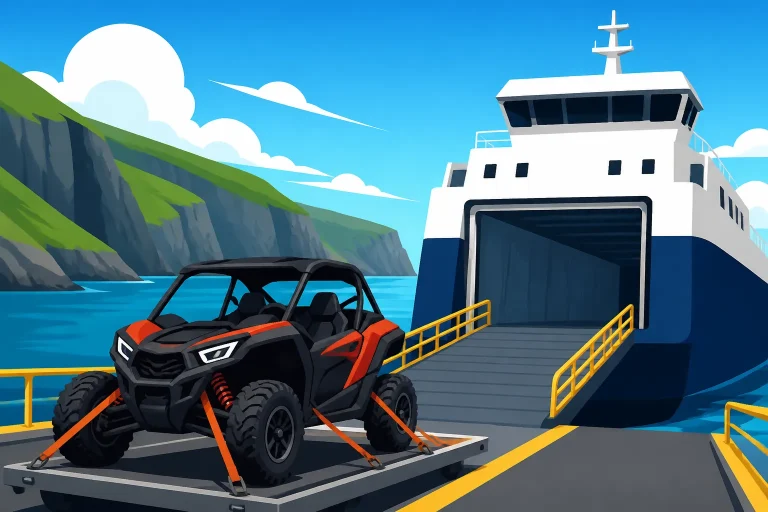
The machine should be positioned and secured according to the ferry crew’s instructions. Do not expect to choose the parking position or tie-down method yourself once aboard. Crew members manage loading and may direct drivers to leave keys, use particular tie-down points or follow other procedures. Follow the instructions given at the terminal and on the vehicle deck.
A few practical steps can prevent delays:
- Check the reservation against the vehicle and trailer you are actually bringing.
- Confirm the dimensions before departure, not while in the terminal queue.
- Keep tie-down straps in good condition and easy to reach.
- Secure accessories and cargo before arriving.
- Leave enough room to access the machine’s attachment points.
- Follow crew directions even if you have travelled by ferry with a similar setup before.
If you are driving a pickup and towing a trailer, make sure the booking includes the right combination and that no item has been omitted. The operator’s loading staff need to know what is arriving. If anything changes after booking, such as changing from a trailer to a truck bed, contact the operator before travelling to the terminal.
The fare quote should not be treated as confirmation that every loading arrangement is acceptable. A booking records the details supplied, but unusual dimensions or equipment may need a separate check. If a machine has a roof, windshield, oversized tires, a plow, or other attachments that make it taller or wider, provide those details when you ask for guidance.
For more on the trip itself, Booking the Newfoundland Ferry With a Quad Aboard and Strapping a Machine Down on the Vehicle Deck cover practical parts of bringing a machine across.
Booking, changing plans and preparing for departure
Once you have a complete quote, check the reservation details before you pay. Verify the route, date, sailing, vehicle category, dimensions, trailer, passenger count and any optional services. An error that seems minor in the booking screen can become a problem when the actual vehicle arrives at the terminal.
Read the booking conditions carefully. Rules for changes, cancellations, refunds and payment depend on the fare and the operator’s current terms. Do not assume that a reservation can be changed without consequence, or that a missed sailing will be handled in a particular way. If your travel dates are uncertain, understand the change rules before choosing a fare.
Book with enough lead time for your travel plans, especially if you need a particular sailing, are travelling during a busy period or have a large vehicle combination. Availability can be limited, and it is easier to adjust a plan before the trip than to discover that a preferred crossing is unavailable. Check the operator’s current booking calendar directly; a past sailing pattern is not a guarantee of future availability.
Before leaving, compare the confirmation with your actual setup one more time. If your vehicle, trailer or passenger count has changed, ask the operator whether the reservation needs to be amended. Keep the booking confirmation accessible and allow time to reach the terminal, check in and follow loading instructions. The confirmation will help resolve questions about what was booked, but it does not replace the crew’s instructions.
It is also sensible to plan for the trip after disembarking. The ferry fare does not cover lodging, fuel, food or trail access. If you are towing, consider where you can safely stop and inspect the trailer after the crossing. If you are continuing toward a trail, plan enough time to unload, check the machine and reach the starting point without rushing.
A machine that has travelled on a trailer may need a quick inspection before it is ridden. Check that straps have not loosened, cargo is still secured, and tires and lights appear sound. If the machine was loaded onto the deck as a vehicle, wait for the crew to direct you off the vessel and avoid trying to handle equipment while the vehicle deck is active.
Build a realistic Newfoundland trip budget
A ferry fare is easiest to manage when it is one line in a trip budget rather than the entire plan. Add the crossing, road fuel, accommodation, meals, possible trailer expenses and riding-related costs. If you plan to use a rental or guided tour after arrival instead of bringing your own machine, compare that alternative separately rather than treating it as part of the ferry fare.
For a machine you bring, include the cost of travelling to the terminal and from the arrival port to your destination. A route choice can change those road costs substantially. If your itinerary includes a long drive after the ferry, budget for a rest stop or an overnight stay rather than assuming you will be ready to ride immediately.
Do not use an old online fare as a fixed budget number. Fare tables and booking conditions can change, and a price may refer to one route, one vehicle category, one sailing, a particular passenger count or a different booking date. Use current information from Marine Atlantic to get a quote for the exact arrangement you plan to take.
When checking a quote, look for the total and the details behind it. If the total seems unexpectedly low, make sure the trailer, towing vehicle and every passenger are included as intended. If it seems unexpectedly high, review the vehicle category and dimensions before assuming there is an error. A wrong category can distort the quote in either direction.
A simple comparison sheet helps:
| Quote item | Your planned detail |
|---|---|
| Route | North Sydney–Port aux Basques or seasonal North Sydney–Argentia |
| Sailing date and time | The crossing that fits the itinerary |
| ATV or UTV | Exact machine and booking category confirmed |
| Towing vehicle | Vehicle type and measured dimensions |
| Trailer | Trailer included and dimensions recorded |
| Passengers | All travellers counted correctly |
| Options | Any onboard service selected |
| Fare conditions | Change and cancellation terms reviewed |
| Separate trip costs | Fuel, lodging, meals and onward travel budgeted |
Keep a copy of the confirmed booking and the dimensions you used. If the operator asks you to clarify the setup, having those details ready makes the conversation straightforward. If you change machines or vehicles, recheck the quote rather than assuming the previous total still applies.
For riders planning a broader trip, ferry costs are only one logistical piece. The machine must also be properly registered and the rider should understand the rules that apply on trails and roads. Relevant planning includes Newfoundland Ferry Rates for a Trailer, Newfoundland Ferry Fare for a Truck, and Newfoundland Registration Before Your First Ride. These are separate from the ferry fare but can help prevent last-minute surprises.
Frequently Asked Questions
Is an ATV booked as a motorcycle on the Newfoundland ferry?
It may be grouped with a motorcycle or another vehicle category in the booking process, but the correct option depends on the current booking instructions and how the machine is being transported. Confirm the category with the operator if it is not clear.
Does a trailer change the ferry fare?
It can. The trailer and towing vehicle may need to be included in the booking, and their dimensions can affect how the combination is recorded. Enter the information requested for the complete setup and confirm any uncertainty before paying.
Are passengers included in the vehicle fare?
Do not assume every passenger is included automatically. Enter the full passenger count in the booking and review the total and confirmation to see what is covered.
Which ferry route should I take with an ATV?
Compare the North Sydney–Port aux Basques route with the seasonal North Sydney–Argentia service based on your destination, sailing availability, onward driving and full trip costs. The lowest crossing total may not be the most convenient overall route.
Can I rely on a fare I found online?
Use an old fare only as general context, not as a current quote. The total depends on the route, sailing, vehicle setup, passengers and options. Check the operator’s current booking information for the exact trip.
Disclaimer
This article is for general informational purposes only and does not constitute professional advice. Laws, prices and regulations vary by location and change over time. Consult a qualified professional for guidance on your specific situation.