Newfoundland Shipping a Machine by Ferry
Taking an ATV or side-by-side to Newfoundland by ferry involves more than adding a vehicle to a ticket. You need to choose a route, describe your machine and any trailer accurately, prepare it for transport, and plan where it can be ridden after arrival. Here’s how to organize the trip and decide whether bringing your own machine makes sense.
Decide whether to ship your own machine or rent
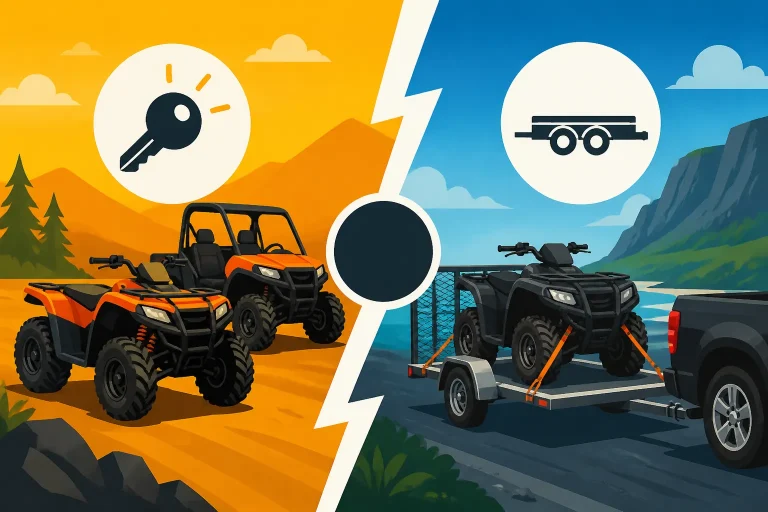
Bringing your ATV or UTV can make sense if you already own a machine that suits your riding plans, expect to ride for several days, and are comfortable handling transport and preparation. Renting can be simpler for a short visit, especially if you do not have a tow vehicle or trailer, or if you would rather not manage the ferry arrangements for a machine.
The right choice depends on the whole trip, not just the ferry fare. Compare the cost and effort of transporting the machine with the cost and availability of a rental, plus any towing, lodging, fuel, and trail-access arrangements. Rental availability can be limited, and a rental may not be close to where you want to ride, so check the details before booking travel. For a wider comparison, see Newfoundland Rentals Compared to Bringing Your Own.
| Consideration | Bring your own machine | Rent in Newfoundland |
|---|---|---|
| Ferry arrangements | You must report the machine and any trailer as required by the ferry operator | The rental operator usually handles transport and registration for its fleet |
| Familiarity | You ride a machine you already know and can prepare yourself | You may need an orientation and time to learn a different machine |
| Equipment | You can bring your own helmet, riding gear, tools, and accessories | Ask what equipment is supplied and what you must bring |
| Flexibility | You control when and where the machine is available, subject to access rules | Your trip depends on the operator’s location, schedule, and rental terms |
| Main planning concern | Accurate vehicle details, transport, paperwork, and trail access | Availability, pickup and return, insurance, and permitted riding area |
| Best fit | Longer trips or plans where having your own setup is important | Short visits, first-time rides, or trips without a tow vehicle |
A ferry booking does not give you permission to ride wherever you land. You still need to follow registration, insurance, training, trail sticker, road-use, and land-access rules that apply to your machine and route. Before deciding to bring it, think through how you will get from the ferry terminal to a legal riding area and where the machine will be stored when you are not riding.
If a guided ride is a better fit than organizing your own trip, compare what the operator includes and where the tour goes. Some visitors use booking sites such as Viator to look for activities, but confirm the schedule, equipment, meeting point, age rules, and cancellation terms directly with the operator before making travel plans.
Choose the ferry route and plan the journey
Marine Atlantic operates ferry service between Nova Scotia and Newfoundland, with a crossing to Port aux Basques and a seasonal Argentia route. Which sailing works best depends on your departure point, destination, trip dates, and how much driving you want to do on each side of the crossing. Review Newfoundland Ferry Routes for Riders and Newfoundland Ferry Crossings and Timing as you compare options.
Port aux Basques is a common arrival point for riders travelling to western Newfoundland and the T’Railway. Argentia may suit some itineraries, but its seasonal schedule and location can make it a poor fit for other plans. Do not choose a sailing only because it appears to shorten the ferry portion of the trip. Consider the full route, including the drive from your home to the departure port, the time spent on the crossing, and the road distance from the arrival terminal to your intended destination.
When estimating time, allow for more than the scheduled crossing. You need time to reach the terminal, follow check-in instructions, load, disembark, and continue to your overnight stop or trailhead. Weather, sailing changes, and road conditions can also affect the day. Avoid building an itinerary that depends on reaching a distant trailhead immediately after arrival, particularly if you are travelling with a trailer or are unfamiliar with the roads.
Compare the whole route, not just the crossing
Make a simple trip plan that includes:
- Your home-to-terminal drive.
- The sailing and the check-in time stated in your booking instructions.
- The drive from the Newfoundland terminal to your first overnight stop.
- Any fuel, food, lodging, and rest breaks.
- The return drive and sailing.
A machine and trailer can change the pace of the trip. A route that looks manageable in a car may take longer when you are towing, especially if you need to stop to check straps or adjust a load. Leave room for delays rather than planning every hour tightly.
Ferry times, route availability, booking conditions, and fares can change. Check the operator’s official information for the dates you plan to travel, and make sure the sailing you choose accepts the vehicle configuration you intend to bring. For details on how a trailer affects a booking, see Newfoundland Ferry Fare With a Trailer. For a broader look at how the fare is calculated, review Newfoundland Ferry Fare for a Machine.
Book using accurate vehicle details
When booking, describe the vehicle and trailer according to the ferry operator’s instructions. Be ready to provide the details it requests, which may include the type of vehicle, overall dimensions, and the trailer configuration. A quad on a trailer is not necessarily treated the same as a machine carried in a truck bed. A side-by-side may also take up a different amount of space than an ATV.
Do not guess at measurements or rely on the length of the machine alone if the booking asks for the full vehicle or trailer dimensions. Include any added accessories that affect the overall size, such as a cargo box, canopy, or other equipment, when the operator’s instructions require it. If you are unsure how to enter the setup, contact the ferry operator before purchasing the ticket.
The fare depends on the booked configuration and the operator’s current rules. Check the current fare information directly rather than relying on an old quote, a third-party estimate, or a past trip’s receipt. If you change vehicles or trailers after booking, ask the operator whether the reservation needs to be updated. A mismatch between the booked space and the actual load can create problems at check-in.
For a summer trip or a long weekend, planning ahead is sensible. The best sailing, vehicle space, or cabin option may not be available at the last minute. See Booking a Ferry Crossing Months in Advance for booking considerations, then check the current availability and conditions with Marine Atlantic.
Prepare the ATV or UTV for transport
A machine that is ready to ride is not automatically ready to travel by ferry. Before leaving home, make sure it is safe to load, can be secured as directed, and will not create an avoidable issue for the vessel or other vehicles. The operator’s rules and crew instructions take priority over general preparation advice.
Start with a mechanical check. Look for fuel or oil leaks, loose bodywork, damaged tires, weak battery connections, and anything else that could worsen during loading or transport. Remove loose items that could fall off or shift. Secure accessories and cargo so they cannot come free, and avoid leaving valuables or essential travel items on the machine.
If the machine will travel on a trailer, inspect the trailer as carefully as the ATV or UTV. Check the tires, lights, hitch connection, safety equipment, and loading ramps before the trip. Confirm that the machine fits on the trailer and can be secured at appropriate points without straps rubbing against sharp edges or delicate controls. A poorly balanced or inadequately secured load can cause trouble well before the ferry terminal.
Plan how the machine will be secured
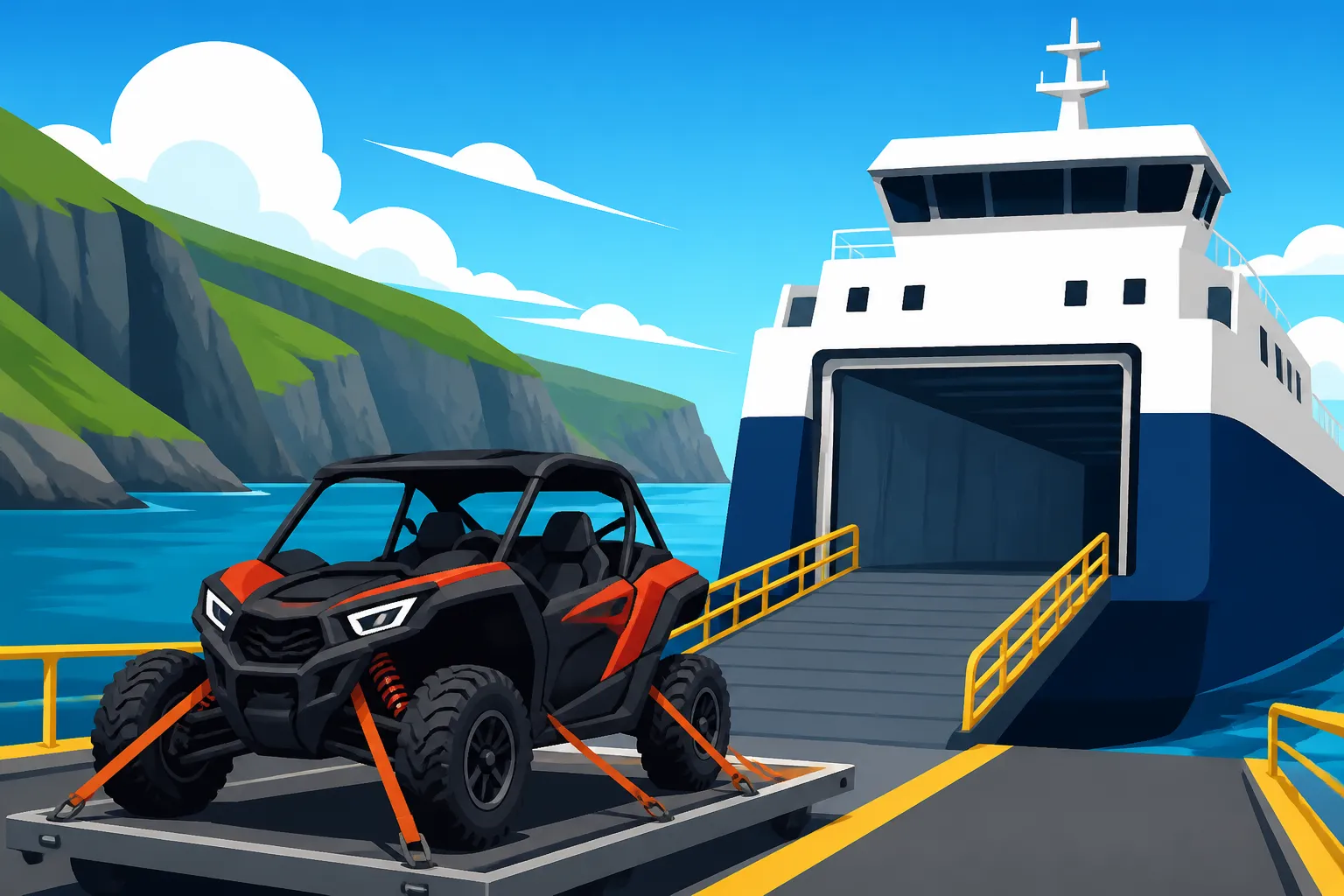
Follow the ferry operator’s directions for loading and securing your vehicle. Ask ahead if you are uncertain whether you are expected to bring tie-downs or other equipment, or whether crew members will direct the process. Do not assume the same procedure applies to every vehicle, trailer, or sailing.
If you use your own tie-downs, check them before departure. They should be in good condition and suitable for the machine and the points where they attach. Keep straps away from hot or moving parts, and do not attach them to components not designed to take the load. If the machine is carried on a trailer, make sure the trailer itself is secured and that the ATV or UTV cannot shift within it.
Allow enough time to prepare the load at the terminal. Keep necessary straps and tools accessible rather than buried under luggage. Once a vehicle is positioned, follow directions from the crew and do not move or adjust anything unless it is safe and permitted to do so.
Pack for a trip where you may not have access to the deck
Follow the operator’s instructions about what you can take with you and whether passengers can return to a vehicle during the crossing. Plan as though you may need to take the items you want for the crossing with you when you leave the vehicle deck.
Keep important items—such as identification, medication, booking details, phone, charger, and essential clothing—out of the trailer and somewhere accessible. Pack separately from riding gear that will remain with the machine. If you need a helmet, boots, or waterproof clothing for your first ride after arrival, decide in advance whether it should travel with you or remain securely stored.
Do not leave perishable food, loose equipment, or anything that could leak or create a hazard in the vehicle. Check the ferry operator’s rules for prohibited items and requirements related to fuel, batteries, or other equipment. If a particular item is essential to your trip, confirm that it can be carried before you arrive at the terminal.
Bring the right documents and meet Newfoundland requirements
Getting the machine onto a ferry and getting it legally ready to use in Newfoundland are separate parts of the trip. A ferry ticket does not replace registration or prove that you may ride on a trail. Before departure, organize your ownership and registration documents and check the rules that apply to your situation.
If the machine is registered in another province, find out how long a visitor may use it in Newfoundland before registration is required. The rules can depend on where the machine is registered and how long it remains in the province. Start with Newfoundland Rules for an Out-of-Province Machine and confirm the current requirements with the appropriate provincial authority if the trip is long or your circumstances are unusual.
If you have recently bought the machine, do not assume that a bill of sale alone will answer every question about its registration status. Keep ownership and registration records together, and make sure the information on the documents matches the machine. If you are transporting a machine you intend to register in Newfoundland, see Newfoundland Registration for a Machine Shipped In and Newfoundland Paperwork for a Shipped Machine before you travel.
Check registration, insurance, and proof of ownership
Before the trip, confirm:
- The machine’s registration is valid for the planned use and location.
- You have the registration document or other proof required while riding.
- The machine’s identification number matches the paperwork.
- Your insurance applies to the machine and the way you intend to use it.
- You know how to show proof of insurance if asked.
- You have documents that support your right to possess and transport the machine.
Insurance is worth checking directly with your insurer. Ask whether coverage applies while the machine is being transported, while it is used in Newfoundland, and on the kinds of trails or roads included in your plans. Do not assume that a vehicle policy, homeowner policy, or credit card benefit covers every part of the trip.
If your machine is borrowed, rented, financed, jointly owned, or registered to someone else, make sure you have any additional authorization or documents that may be needed. Carry copies separately from the originals where practical, but follow official requirements about what must be produced. For questions about registration documents and what they establish, see Newfoundland Proof of Ownership on the Trail.
Check training and trail access before you arrive
Newfoundland’s rider requirements are not just paperwork at the ferry terminal. Training rules may apply depending on the rider’s age and circumstances. Trail access requirements can also apply independently of registration. If you plan to ride on managed trails, check whether a sticker is required and learn how to obtain one from the relevant trail operator. Begin with The Trail Sticker and Training Proof Newfoundland Requires.
Do not plan on riding simply because the machine has a plate or because a trail appears on a map. Access rules vary by location and land status. Some areas may be restricted, and a route that works for one type of vehicle may not be open to another. Review Finding Approved Areas on the Provincial Map and confirm local conditions before setting out.
If the machine is headed to a cabin, a private property, or a family-owned parcel, check the rules that apply to that land and the route you will use to reach it. The destination alone does not settle whether you can ride across intervening land or use a public road. A few calls or map checks before travelling can prevent a wasted trip.
Work out the arrival, unloading, and first ride
The ferry terminal is one stop in a larger transport plan. Once you arrive, you still need to unload or leave the terminal with the machine, reach your accommodation or storage location, and prepare for your first ride. Make sure the person driving the truck or towing the trailer knows the route and has any required documents close at hand.
Do not treat the arrival terminal as a trailhead unless the site’s rules and your intended route make that appropriate. Plan where the machine will go next, and check whether you need to drive on public roads to reach a trail or staging area. Riding on a road or shoulder is subject to specific restrictions; do not assume that a short connector is automatically allowed. For the basics, review Newfoundland ORV Road Rules Explained.
Make a staging plan
Before you sail, identify:
- Where you will unload or park after leaving the terminal.
- Whether the trailer can be stored safely at your accommodation.
- How you will move the machine between the trailer and the riding area.
- Whether your route includes any road or shoulder use.
- Where you can get fuel, food, or supplies.
- What you will do if weather delays your first ride.
A hotel or cabin may not have enough room for a trailer, and parking rules can differ by property. Ask before arrival. If the machine will remain on a trailer overnight, consider how you will secure it and where the vehicle can be parked without blocking access.
If you are heading to a trailhead, confirm that it allows the vehicle and trailer combination you are bringing. A narrow access road, limited parking, or a full staging area can make an otherwise straightforward plan difficult. Trail conditions also change, so check local updates near the time you leave. Newfoundland Trail Conditions Before You Ride can help frame the checks to make.
Prepare for changing conditions
Newfoundland riding conditions can vary by region and weather. A route that is comfortable in dry conditions may become difficult after heavy rain, and fog or poor visibility can affect exposed areas. Keep your first ride conservative while you learn the terrain. Do not commit to a long, remote route before you have checked the machine, the forecast, the trail, and your group’s experience.
Bring the equipment appropriate to your itinerary. A short ride near services calls for different planning than a long day on a remote route. At a minimum, think about suitable protective gear, water, food, communication, first aid, basic tools, and a way to manage a breakdown. Cell coverage can be unreliable in some areas, so do not rely on a phone as your only safety plan.
If the trip is mainly about seeing trails rather than riding a specific personal machine, a guided tour can remove some of the logistics. Ask the operator where the tour starts, what it includes, which machine you will use, and what happens if weather changes. Confirm whether transportation from your accommodation is available rather than assuming it is.
Estimate the total cost and compare options
The ferry charge is only one part of taking a machine to Newfoundland. Your overall budget may include transportation to and from the terminals, ferry fares for the machine and any trailer, passenger travel, fuel, accommodation, food, insurance, trail access, and supplies. If you are renting, add the rental’s charges and any costs for reaching the pickup point.
Ferry pricing can depend on the booked vehicle setup and current fare rules. A trailer can change the dimensions and the booking category, while a truck carrying a machine may be treated differently from a machine travelling on its own trailer. Use the current official fare information for your exact configuration, and check whether the booking requires a separate vehicle entry. For more on the trailer side of the calculation, see Newfoundland Ferry Fare With a Trailer.
| Cost area | Questions to answer |
|---|---|
| Ferry | How is the machine or vehicle configuration booked, and does a trailer need to be included? |
| Road travel | What will fuel, meals, and possible overnight stops cost on both sides of the crossing? |
| Machine transport | Do you need a truck, trailer, ramps, tie-downs, or help loading? |
| Accommodation | Can your lodging safely accommodate the machine and trailer? |
| Riding access | Are there trail stickers, permits, or other requirements for the areas you plan to use? |
| Insurance | Does your coverage apply to transport and riding in Newfoundland? |
| Rental alternative | What is included, where is pickup, and what additional charges or conditions apply? |
| Contingency | Can you absorb a delay, weather change, repair, or missed connection? |
Compare costs for the full length of the trip. For one or two riding days, a rental or guided tour may be less complicated even if the daily rental cost looks high at first. For a longer trip, the fixed effort of bringing your own machine may be worthwhile—particularly if you already own the truck and trailer and have a clear plan for where you will ride.
A rental quote also needs careful reading. Ask whether the machine, helmet, fuel, trail sticker, insurance, and orientation are included, and whether the price changes with the rental period or machine type. Ask about deposits, damage responsibility, and cancellation terms. The overall cost of a rental is not always the number shown on a booking page. For context, see Newfoundland Rental Cost Per Day and Questions to Ask Before Booking a Rental.
Avoid common ferry and trip-planning mistakes
Many problems arise because travellers book one part of the trip before checking the others. The machine may fit the ferry booking but not the chosen trailer. The sailing may work, but the planned drive after arrival may be too long. Or the rider may arrive with a registered machine and discover that the planned route has access rules they did not check.
Avoid these common oversights:
- Booking with guessed dimensions. Measure the relevant vehicle or trailer setup and follow the operator’s booking instructions.
- Leaving the trailer out of the reservation. If your setup includes a trailer, make sure the booking reflects it as required.
- Assuming an old fare still applies. Check current fares and booking rules for your travel dates.
- Leaving preparation until the terminal. Inspect the machine and trailer at home, and keep loading equipment accessible.
- Packing essential documents in a locked trailer. Keep travel and riding documents accessible.
- Assuming registration means trail access. Verify trail, sticker, training, and land-access rules separately.
- Planning to ride immediately after disembarking. Leave time for unloading, driving, weather, and fatigue.
- Assuming lodging accepts a trailer. Ask about parking space and overnight storage in advance.
- Ignoring the return trip. Confirm the return sailing, vehicle details, and any change to your configuration.
- Relying on a single source for trail conditions. Check close to the ride date and respect local closures.
Keep a folder, physical or digital, with your ferry confirmation, vehicle details, ownership and registration documents, insurance information, lodging details, and emergency contacts. Save the ferry operator’s instructions where you can find them without needing a signal. A little organization makes check-in and arrival easier, particularly when multiple people are travelling with different vehicles.
If plans change, contact the relevant provider promptly. A new trailer, a different vehicle, a change in passenger count, or a revised route may affect reservations or requirements. Do not assume a change has been accepted until you have confirmation from the operator or agency responsible.
Frequently Asked Questions
Can I take an ATV or side-by-side on the ferry to Newfoundland?
Ferry travel arrangements depend on the vehicle and trailer configuration, route, sailing, and current operator rules. Check the official booking information and report the setup accurately before travelling.
Is it better to bring my own machine or rent one?
Bringing your own can suit a longer trip or a rider who wants a familiar machine. Renting can reduce transport work for a short visit. Compare the full costs, availability, location, equipment, insurance, and access requirements before deciding.
Do I need Newfoundland registration if my machine is registered elsewhere?
A visitor may be able to use an out-of-province registered machine for a limited period, but the applicable rules depend on the circumstances. Check Newfoundland Rules for an Out-of-Province Machine before travelling, especially if you will stay for an extended period.
Can I ride as soon as I arrive at Port aux Basques or Argentia?
Arrival does not automatically provide trail access. You must meet the rules that apply to your machine and route, including registration, insurance, training, trail sticker, and land-use requirements. Plan how you will get from the terminal to a legal riding area.
Should I book the ferry early?
Booking ahead can give you more choice of sailings and space for your vehicle configuration, particularly when travel dates are busy. Check current availability and booking conditions with the operator, and make sure your reservation matches your actual vehicle and trailer.
Disclaimer
This article is for general informational purposes only and does not constitute professional advice. Laws, prices and regulations vary by location and change over time. Consult a qualified professional for guidance on your specific situation.