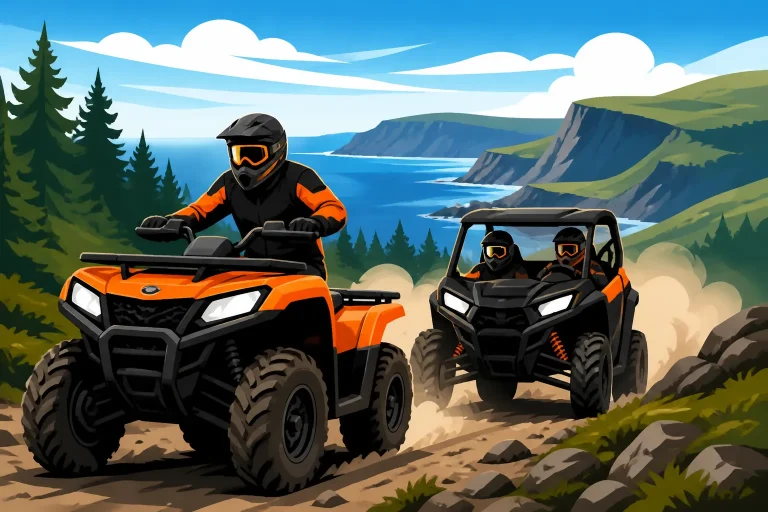
Newfoundland ATV Rentals and Tours
Planning an ATV ride in Newfoundland can be harder than choosing a machine. Rentals and guided tours are limited in some areas, trail access depends on where you ride, and weather can change the day’s plan. This guide explains how to compare options, what to confirm before booking, and how to prepare for a ride that fits your experience and schedule.
Choose between renting on your own and booking a guided tour
A self-guided rental gives you more control over your pace and route, but it also puts more planning on you. You need to understand where the machine is allowed, how to follow the route, what to do if conditions change, and which local rules apply. A guided tour trades some independence for support from someone familiar with the area and the riding conditions.
| Option | Best for | Main advantages | Trade-offs |
|---|---|---|---|
| Self-guided rental | Riders who are comfortable operating an ATV and navigating | More control over timing and stops | You may need to arrange transport, route information and trail access yourself |
| Guided tour | First-time riders, visitors unfamiliar with local trails, or anyone who wants help with logistics | A guide can explain the route, operating procedures and local conditions | The route and pace are usually set by the tour |
| Rental with a guide option | Riders who want a machine but also some local support | May combine a dedicated machine with route assistance | Availability, group size and included services vary |
The words “rental” and “tour” do not always mean the same thing from one provider to another. A rental may include a short orientation but no guide. A tour may include the machine, basic gear, a planned route and supervision, but not transportation to the starting point. Ask what the service actually includes instead of relying on its label.
When a self-guided rental makes sense
A self-guided outing can work well if you already know how to operate the machine, have a suitable route in mind and can manage basic navigation. It may also suit a visitor staying near an established riding area who wants a short outing rather than a full-day excursion.
The main challenge is that a rental machine does not automatically give you permission to ride everywhere. Trails, private land, Crown land, managed routes and community roads can have different access rules. The provider should explain where the machine can go, but it is still sensible to confirm the route and restrictions before leaving. For an overview of where riding is allowed, see Newfoundland Crown Land Access Rules.
Ask whether the rental includes a route map, GPS information or a guide who can be contacted during the ride. Find out what to do if you reach a closed trail, lose the route or encounter a machine problem. If the answer is simply “stay on the trail,” ask which trail and how you are expected to identify it.
When a guided tour is a better fit
A tour is often the practical choice for a first-time rider, a visitor who has never ridden in Newfoundland, or a group that would rather focus on the outing than plan logistics. A guide can set a suitable pace, explain how the group should travel and adjust the route if weather or trail conditions make the original plan unsuitable.
Guides are especially useful when the route is unfamiliar or conditions are difficult to judge from a map. That does not mean every tour is effortless or suitable for every rider. You still need to be comfortable following instructions, wearing the required safety equipment and controlling the machine. Tell the operator about your experience before booking, including whether you have ridden an ATV or side-by-side before.
A guided outing may also help with practical questions such as where to meet, whether a passenger can ride along and what happens if the weather turns. Confirm those details rather than assuming all tours provide the same support.
Decide where you want to ride before you book
Newfoundland is large, and a ride that sounds close on a map may not be convenient from your accommodation. Before choosing a rental, decide which part of the province you will be visiting, how much time you have and whether you can travel to a trailhead. A rental shop may be far from a scenic route, and a tour may meet at a location that requires a vehicle or taxi ride.
The T’Railway is a prominent route for riders, but it is only one part of the island’s riding picture. The corridor runs for a long distance, and its surface and conditions are not identical from one section to another. A ride advertised as being “on the T’Railway” could mean a short outing near one community, not a long-distance trip. For route context, see Newfoundland ATV Trails: The T’Railway and Beyond and The T’Railway’s 883 Kilometres in Newfoundland.
Match the outing to your available time
A half-day tour, a full-day rental and a multi-day ride require different planning. For a short outing, prioritize a convenient meeting point, clear instructions and a route that matches the group’s ability. For a longer trip, ask about fuel, food, breaks, weather exposure, communications and what support is available if a machine breaks down.
Do not judge a route only by its advertised distance. A route with rough surfaces, water crossings or frequent stops can take much longer than a smoother route of the same length. The operator should give you a realistic estimate and explain whether that estimate includes the safety briefing, equipment fitting and travel to the trail.
If the plan depends on reaching a particular community or trailhead, check the drive time from your accommodation as well as the riding time. Build in room for delays, especially when the trip involves a ferry, a long drive or a fixed tour departure.
Confirm that the route is open and appropriate
Trail access can change because of weather, maintenance, land-use restrictions, seasonal conditions or local decisions. A line on an online map is not proof that the route is open to ATVs. Ask the rental provider which route you will use and whether there are current restrictions or closures.
The same caution applies to riding near parks, wetlands, wildlife areas and private property. A tour operator should know the permitted route for its trip, but do not assume that a trail continues legally just because it looks rideable. If you are arranging your own ride, ask who manages the trail and check current access information before you set out.
Some areas also have municipal rules. A trail that is available outside a community may not mean ATVs are permitted on every local street. If a route includes a public road or community road, ask the provider exactly where and under what conditions the machine can travel. Newfoundland Municipal Road Bylaws explains why local rules are worth checking rather than assuming one province-wide rule covers every road.
Find a provider and compare the actual offer
Rental availability varies by location and season. Do not assume there will be a shop near every trail or that a rental will be available on short notice. Start by searching for providers near the area where you plan to ride, then contact them directly to verify current availability and the details of the trip.
A marketplace such as Viator may help you see whether guided experiences are listed for your destination and compare the general format of available activities. Treat a listing as a starting point, not a substitute for confirming the details with the operator. Routes, departure times, included equipment, minimum requirements and cancellation terms can change, and not every local rental provider will appear on a booking platform.
Compare the experience, not just the headline
A tour description may emphasize scenery or duration without explaining the practical details that matter on the day. Before you commit, compare:
- Where the ride starts and whether you need to arrange your own transport
- How long you will actually be riding, separate from check-in and instruction time
- Whether the machine is an ATV or a side-by-side
- Whether a passenger can ride and whether the machine has an appropriate passenger seat
- The expected group size and guide-to-rider arrangement
- What experience level the route is designed for
- What safety equipment is provided and what you must bring
- Whether fuel, trail access or other required costs are included
- What happens if poor weather, a closure or a mechanical issue affects the trip
If you are comparing two similar options, ask each provider the same questions. A lower advertised cost may not represent the better value if essential gear, transportation or trail access is extra. Likewise, a more expensive package is not automatically better if it includes services you do not need.
Reviews can be helpful for assessing communication, organization and equipment condition, but they may not describe the exact route or season you are booking. Look for recent, specific comments about check-in, instruction, guide communication and how the provider handled changes. Then confirm the details directly.
Book early when your schedule depends on one provider
A small rental fleet can fill up quickly during popular travel periods, weekends and local events. If your trip depends on a particular date or machine type, contact providers early and ask whether the reservation is confirmed or only a request. Check the cancellation and rescheduling terms before paying or providing a card.
Ask how the operator handles a weather cancellation. Newfoundland’s coastal conditions can change quickly, and fog, wind or heavy rain may affect a ride even when it is not raining at your hotel. Find out whether the provider decides when conditions are unsafe, whether you can reschedule and how you will be contacted.
For a group, avoid assuming every member can ride the same machine type. Give the provider the number of drivers and passengers, approximate ages if relevant, and everyone’s experience level. Ask whether the group can ride together and what happens if one person is not able to continue.
Understand what the price includes and what may cost extra
Rental and tour costs depend on the machine, duration, location, season and services included. Providers set their own terms, so check the current details with the operator before booking. The useful question is not just “How much?” but “What will I need to pay for the whole outing?”
| Cost area | What to ask |
|---|---|
| Machine rental or tour | Is the booking charged by machine, by rider, by hour or by trip? |
| Passenger use | Is a passenger included, and does the machine have a suitable passenger seat? |
| Safety gear | Which items are supplied, and which must you bring? |
| Fuel | Is fuel included, or will you pay for what you use? |
| Trail access | Is a required sticker or access charge included, or handled separately? |
| Transport | Do you need to reach the shop or trailhead on your own? |
| Deposit or card hold | Is a temporary hold required, and when is it released? |
| Damage and recovery | What responsibility do you have if the machine is damaged or needs recovery? |
| Cancellation | What happens if you cancel or the operator calls off the ride? |
Ask whether the quoted amount is for one machine or one person. That distinction matters for side-by-sides, where the machine may carry a driver and passenger, and for guided tours where pricing could be structured per seat. Confirm the passenger arrangement before booking rather than expecting a second seat to be available.
Clarify deposits, damage and recovery terms
A rental agreement may include a deposit or card hold to cover potential damage, late return or other charges. Ask whether the hold is separate from the rental payment, what can lead to a charge and how long it may take to release the hold. Do not assume the amount or release time will be the same between operators.
Understand what happens if you tip the machine, damage a part, get stuck or need a recovery. A rental agreement may treat ordinary use, damage and recovery differently. Ask whether assistance is included, whether recovery costs are your responsibility and what number to call if the machine cannot be moved safely.
Read any waiver before signing. Ask the provider to explain language you do not understand, particularly the sections about damage, injury, insurance, exclusions and responsibility for a passenger. A waiver is not a reason to skip safety instructions or to ride beyond your ability.
Ask about insurance without making assumptions
Insurance arrangements differ between providers and types of booking. Ask what insurance the operator carries, what it covers and whether the rental agreement leaves you responsible for particular costs. Do not assume that your personal auto policy, credit card benefits or travel insurance covers an ATV or side-by-side rental.
If you are bringing your own machine rather than renting, the rules and proof requirements are different. For broader background, see Newfoundland ATV Insurance Requirements. For a rental, the operator is the right place to ask about the coverage attached to that machine and any requirements for the person operating it.
Check eligibility, equipment and riding rules before paying
A booking is only useful if everyone in your group is eligible to operate or ride the machine. Minimum age, licence requirements, training expectations and passenger rules may depend on the vehicle, the rider and the type of outing. Ask the rental provider to confirm the requirements for each person, and check official rules if anything is unclear.
Do not assume that renting a machine removes normal safety or legal obligations. Ask whether you need a valid driver’s licence, safety training proof or other documentation. This is especially important for younger riders and for trips that involve a side-by-side or travel on a road. The rules are not necessarily identical for a driver, passenger and supervised young rider. See Newfoundland Rental Driver’s Licence Rules and Newfoundland Safety Training Is Mandatory for related details.
Confirm the machine fits the rider and the route
Ask what type of machine will be supplied and whether the operator can guarantee a particular model or only a general class. An ATV and a side-by-side handle differently. A side-by-side may be more comfortable for a passenger, but it still requires the driver to understand its controls, restraint system and dimensions.
Share relevant experience honestly. If you have never operated an ATV, say so. A good provider can explain whether its route is suitable and what instruction it provides before departure. Do not choose a machine based only on engine size or appearance. The correct choice depends on rider ability, passenger needs, the route and the operator’s rules.
For a passenger, confirm that the machine has a manufacturer-installed seat intended for that use and that the passenger can sit safely with the required restraint. A cargo area or improvised seat is not a substitute. Ask about child passengers well before booking; age and size alone do not tell you whether a particular machine and tour are suitable.
Find out what protective equipment is supplied
Ask whether the operator supplies a helmet and whether you should bring your own. If helmets are provided, check that the fit is secure and that the helmet has an accepted approval marking. A helmet that is loose, damaged or poorly fitted is not an adequate substitute for one that fits properly.
Ask whether goggles or other eye protection are included. Coastal weather can bring wind, dust, rain and insects, so eye protection can make a ride more comfortable as well as safer. If the machine has an enclosed cab or windshield, confirm what protection is still expected.
Wear clothing that can handle mud, damp conditions and changing temperatures. Closed-toe footwear with secure soles is a sensible baseline. Gloves can help with grip and cold, and layers are more practical than relying on one heavy garment. A provider may have its own clothing requirements, so ask before arriving.
Know what riding rules apply to your trip
A guided tour does not mean you can ignore road or trail rules. Listen carefully to the briefing about spacing, passing, stopping, signals, speed and where the group can ride. Stay with the guide, follow the route and do not leave the group to explore on your own.
If a tour uses a public road or shoulder, ask the operator what rules govern that portion of the trip. Road use is not the same as trail riding, and limits can apply to where and how an off-road vehicle may travel. For an overview of the distinction, read Can You Ride an ATV on the Road in Newfoundland?.
Ask how the guide handles a rider who is uncomfortable, falls behind or wants to stop. A responsible trip plan should make room for safety decisions without pressuring someone to continue. If the route includes a crossing, a narrow section or a difficult surface, the guide should explain what to do before the group reaches it.
Prepare for Newfoundland weather, terrain and communications
The same outing can feel very different depending on weather and trail conditions. Rain can make surfaces slick, fog can reduce visibility, and wind can make an exposed route unpleasant. A forecast for the nearest town may not describe conditions on a barren or along a coastal route. Check the forecast close to departure and ask the operator whether conditions have changed.
Dress for the possibility that the ride will be colder or wetter than expected. Waterproof outer layers, warm mid-layers and spare gloves can make a significant difference on a long ride. Avoid clothing that can snag on controls or moving parts. If the operator provides gear, ask what it covers and what you should still bring.
Expect surfaces to vary
Trail surfaces can include packed gravel, rough ballast, mud, loose rock, wet sections and uneven ground. The route’s condition may change after rain or maintenance. A machine that feels easy on a smooth road can require more attention on a rough or slippery trail.
Ask whether the planned route includes water crossings, steep sections or deep mud. If you are inexperienced, tell the provider and ask whether those sections can be avoided. Do not ride into water, mud or an unfamiliar obstacle just because another rider has crossed it. Follow the guide’s instructions and wait for help if you are unsure.
Avoid treating a machine’s four-wheel drive or tires as a guarantee that it can get through anything. Getting stuck can damage the machine, the trail or the surrounding environment. If conditions look worse than expected, slow down, stop in a safe place and contact the operator.
Plan for limited mobile coverage
Some routes have weak or unreliable mobile service. Ask the provider what communication plan is in place if the group separates, a machine stops or someone is injured. A guided tour should explain how to stay with the group and what to do if you lose sight of the guide.
For a self-guided rental, ask whether the operator supplies a route map or navigation device and whether it works without cellular data. Download or carry route information before leaving. A paper map can be useful where a phone has no signal or loses power. Do not rely on a single phone for navigation, emergency contact and photographs without a backup plan.
Tell someone who is not riding where you plan to go and when you expect to return, especially if you are riding without a guide. Keep the provider’s contact information accessible, and make sure everyone in the group knows how to stop safely and call for help.
Respect shared trails and the environment
Trails may be shared with hikers, cyclists, other riders or local traffic. Slow down when approaching other users, give them space and follow the guide’s directions. Keep noise and speed under control near homes and communities. Do not assume a route is private just because it is remote.
Stay on the authorized trail. Riding around a muddy spot can widen the trail and damage vegetation, while cutting across a wet area may cause lasting harm. Do not cross land or gates that are closed to riders, and do not leave litter behind. If you encounter a closure or a sign that conflicts with your route, stop and ask the operator rather than continuing.
Wildlife encounters also call for patience. Give animals room, avoid chasing or crowding them, and follow any seasonal restrictions or instructions. Your guide may change the route to protect wildlife or respond to current conditions; that is a normal part of responsible trip planning, not a failure to deliver the advertised ride.
Use a booking checklist and know what to do on the day
A few direct questions can prevent surprises at check-in. Before you confirm, make sure you know the meeting location, arrival time, length of the ride and what happens if you are late. Ask whether the operator expects you to arrive already dressed for riding and how much time is set aside for the safety briefing.
Use this checklist when contacting a rental provider or tour operator:
- Confirm the date, start time, meeting point and total time required.
- Ask whether the ride is guided, self-guided or a rental with an orientation only.
- Confirm the vehicle type, passenger arrangements and any model limitations.
- Check the driver and passenger eligibility requirements for every person in your group.
- Ask what safety gear is supplied and what you must bring.
- Confirm the route area, expected difficulty and any seasonal or access restrictions.
- Ask whether fuel, trail access, transportation and other required items are included.
- Read the deposit, damage, recovery, cancellation and weather policies.
- Save the provider’s contact details and find out how to reach them during the ride.
- Tell the operator about medical, mobility or experience concerns that could affect the trip.
On the day, arrive early enough to complete paperwork and listen to the briefing without rushing. Check that your helmet fits, the machine’s controls make sense and the passenger is seated correctly. Ask the guide to demonstrate anything unfamiliar. Before leaving, confirm where the group will stop and what signal or procedure to use if you need assistance.
During the ride, keep a safe distance from the machine ahead and do not try to catch up by riding faster than you can control. Stay where the guide can see you. If you feel uncomfortable, stop in a safe place and tell the guide. It is better to pause than to continue while distracted or unsure.
If you are self-guided, follow the provider’s route and return instructions closely. Do not extend the rental into an unfamiliar area without permission. Contact the provider if the route is blocked, the machine develops a problem or conditions become unsafe. At return, report damage or a mechanical issue honestly and ask for a copy of any incident record or additional charge explanation.
Frequently Asked Questions
Are ATV rentals and tours easy to find across Newfoundland?
Availability varies by location and season. Some areas may have limited providers or a small fleet, so contact operators early and confirm that a machine is available for your dates. A booking platform may show some experiences, but checking directly can reveal options that are not listed there.
Do I need experience to book a Newfoundland ATV tour?
Not necessarily, but every operator sets its own experience expectations and route difficulty. Be honest about your riding background and ask whether the tour includes instruction. If you have never operated an ATV, confirm that the operator accepts beginners before booking.
Does renting an ATV mean I can ride any trail?
No. A rental does not create access rights. You must follow the route and access rules that apply to the land or trail, including any closures or local restrictions. Ask the provider where the machine may be ridden and whether any required trail access arrangements are included.
What should I bring on a rental ride?
Ask the operator for its exact list. In general, plan for weather-appropriate layers, gloves, secure footwear and any personal items you need. Confirm whether a helmet and eye protection are provided, and carry the route or contact information the provider recommends.
What happens if weather makes the ride unsafe?
Each operator sets its own cancellation and rescheduling terms. Ask before booking how the decision is made, how you will be notified and whether you can reschedule. Conditions can differ between your accommodation and the riding area, so check with the provider before travelling to the meeting point.
Disclaimer
This article is for general informational purposes only and does not constitute professional advice. Laws, prices and regulations vary by location and change over time. Consult a qualified professional for guidance on your specific situation.