Managed Trails Require a Sticker on Your Machine
A registered ATV or UTV can still be turned away from a managed trail if you do not have the trail permit the operator requires. The key is to understand that vehicle registration and trail access are separate things. Here’s how to sort out the sticker or pass before you unload, what to carry, and which questions to ask the trail operator.
What the managed-trail sticker is for
Newfoundland and Labrador has two separate requirements to think about: registering the off-road vehicle and getting permission to use a managed trail. Registration identifies the vehicle for provincial purposes. It does not, by itself, grant access to every trail.
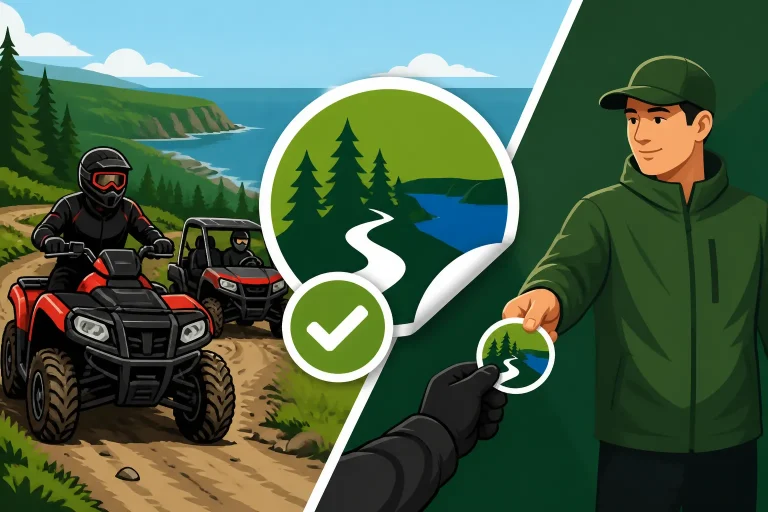
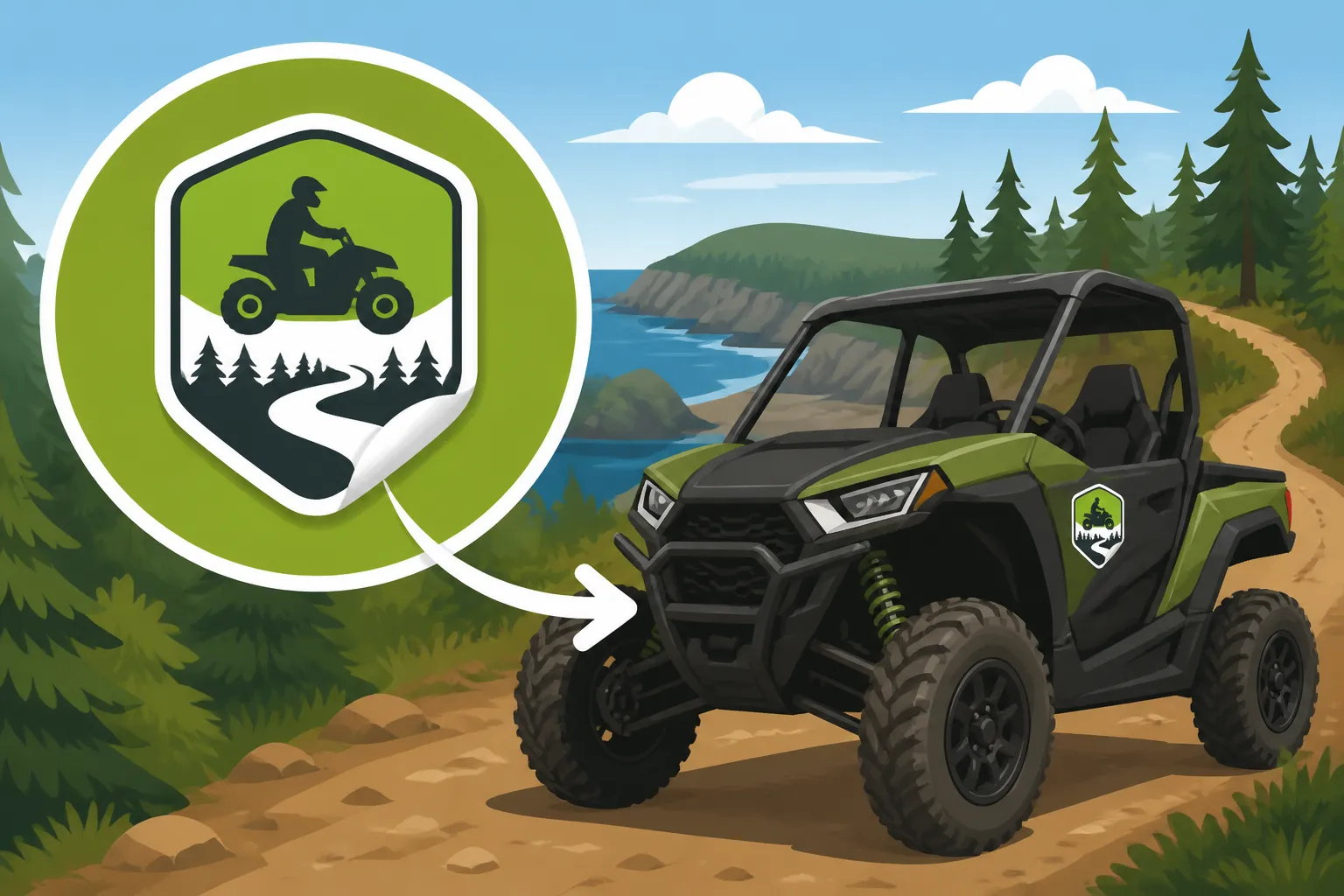
Digital Government and Service NL states that off-road vehicles are not permitted on managed trails without trail permits. The permit or trail pass is the part that relates to using the managed trail. Depending on the operator’s system, proof may be provided as a sticker, permit, or other marker. Check what the trail operator issues and how it must be displayed or carried before setting out. For more on where the marker comes from, see Managed Trail Stickers Come From the Trail Operator and Attach the Sticker or Carry It in Your Pocket.
The money and administration for trail access are separate from vehicle registration as well. According to Digital Government and Service NL, users pay trail pass fees to their snowmobile club for grooming and maintenance. Check with the relevant trail operator or club for current costs, availability, and the process for getting a pass. Those details can vary, so do not assume that a pass from one operator covers another managed trail.
| Requirement | What it does | Where to check |
|---|---|---|
| Vehicle registration | Registers the off-road vehicle with Motor Registration Division | Government Services |
| Licence plate | Identifies the registered vehicle and must be affixed and clearly visible | Digital Government and Service NL |
| Managed-trail permit or pass | Provides permission to use a managed trail | Trail operator or snowmobile club |
| Trail sticker or marker | May be used to show that the required trail permission has been obtained | The operator that issues the pass |
The distinction matters in both directions. A trail sticker is not a replacement for vehicle registration, and registration is not a substitute for a managed-trail permit. If your machine has a plate but you have not arranged trail access, you may still be missing a required permit. If you have a trail pass but the machine is not registered, you have not met the separate registration requirement. The basics of registration are covered in Newfoundland Permits, Plates and Decals and Do You Need to Register an ATV in Newfoundland?.
It is also worth separating managed trails from other places where people ride. A pass for a managed trail does not automatically establish that you can ride on a road, private property, or in a restricted area. Access rules depend on the location and the authority managing it. For help distinguishing those questions, see Newfoundland Crown Land Access Rules and Newfoundland Restricted Area Permissions.
What to arrange before you ride
Start by identifying the operator responsible for the trail you plan to use. Ask whether that route is managed, whether a trail permit is required, how to obtain it, and what proof you must show. If the operator uses a sticker, ask whether it must be attached to the machine or whether it can be carried. Do not rely on a photo of a pass or a sticker from a previous season unless the operator confirms that it is accepted.
Then make sure the vehicle itself is registered. Digital Government and Service NL says off-road vehicles must be registered with the Motor Registration Division, and licence plates must be affixed to the vehicle and clearly visible. Registration and trail access are separate checks, so sort out both before leaving home. If you are buying a machine, How to Register an ATV in Newfoundland and What to Bring to Your Registration Appointment explain the registration side.
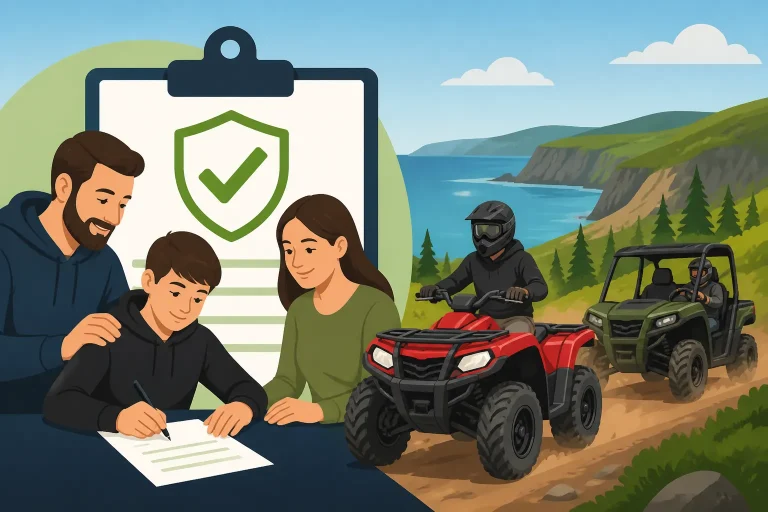
For a first registration, training may also be part of your preparation. Government of Newfoundland and Labrador says safety training is required for anyone registering an off-road vehicle for the first time, as well as for anyone under 16 and anyone required to complete it after an offence. Digital Government and Service NL says a free safety training program is available on MyGovNL. Confirm what applies to the operator, and carry proof if required. More details are in Newfoundland Training for First-Time Registrants and Carrying Your Safety Certificate on Every Ride.
Check that the machine is ready for the route and that the operator has the required safety equipment. Digital Government and Service NL says helmets are required for all riders, passengers, and anyone being towed in a trailer. It also says seatbelts must be worn when the manufacturer has installed them, and safety glasses, goggles, or a face shield are required if the machine does not have a windshield of sufficient height. These are operating requirements, not substitutes for a trail permit.
If a child or youth will be operating, confirm the supervision and training arrangements before departure. Government of Newfoundland and Labrador says an operator under 16 must be supervised by a licensed driver who is at least 18 years old. The supervisor must be able to see the young operator, provide direction, and ensure the operator can see them. The vehicle must also meet the manufacturer’s engine-size recommendation for the operator’s age and weight. The trail sticker does not change those safety rules.
A practical pre-ride checklist helps prevent a wasted trip:
- Confirm the route is open and identify its trail operator.
- Ask whether the route requires a managed-trail pass and how the operator issues proof.
- Obtain the pass before riding, and follow the operator’s instructions for displaying or carrying it.
- Confirm the vehicle is registered and its plate is attached and visible.
- Check that the operator and passengers have the required safety equipment.
- Carry any training proof that applies to the operator.
- Ask whether any local restrictions or closures affect the route.
For more questions to raise directly with the operator, see Questions Worth Asking a Trail Operator. If you are unsure what may be checked when you arrive, What Gets Checked at a Managed Trail Gate can help you prepare.
At the trailhead: keep registration and trail access distinct
Arriving at the trailhead is not the time to discover that a pass must be bought from a particular club or that the sticker needs to be visible on the machine. Follow the operator’s instructions at the point of access. If there is a gate, sign-in process, or staff member, be ready to show the permit in the form the operator accepts. Ask before riding if the instructions are unclear.
Keep your registration plate unobstructed. A plate hidden by mud, cargo, or a poorly placed accessory may be difficult to see, even though it is attached to the machine. Digital Government and Service NL says plates must be affixed and clearly visible. That requirement is distinct from the trail operator’s pass check. For plate-specific reminders, see Keeping Your Plate Free of Mud and Dust and Cargo That Hides a Plate.
Do not treat a sticker from another machine as permission for yours. Ask the operator whether the pass is connected to a particular machine, rider, or other condition. The facts of that system are set by the operator, so confirm before relying on a pass that someone else has bought or used. Likewise, do not assume a pass for one trail network works across all managed trails.
If the operator tells you that the trail is closed or that your pass is not valid, do not ride onto the managed trail while you try to resolve it later. Contact the operator and find out what is needed. A vehicle’s registration status does not override a closure or replace the required trail permission. This is especially important when arranging a group ride: make sure each machine and rider meets the applicable requirements rather than assuming one person’s pass covers everyone.
The same care applies when approaching a trail by highway. Trail permission does not make highway travel unrestricted. According to Government of Newfoundland and Labrador, an off-road vehicle may travel along a highway shoulder to access a trail for no more than one kilometre, at no more than 20 kilometres per hour. The province also says a vehicle may cross a highway when visibility is at least 150 metres in both directions, subject to the stated requirements, including the operator having a driver’s licence and insurance. Plan the approach to the trailhead as carefully as the trail ride itself.
Managed trails are not permitted to be plowed, according to Digital Government and Service NL. Conditions can therefore differ from a maintained public road, and a pass does not guarantee that a route is suitable for your machine or conditions on the day. Check current information with the operator and ride within your ability. For shared-route etiquette and planning, see Newfoundland Trail Etiquette Locals Expect.
Common misunderstandings that cause trouble
“My ATV is registered, so I can use the managed trail.”
Not necessarily. Registration and a managed-trail permit serve different purposes. Digital Government and Service NL says off-road vehicles cannot be operated on managed trails without trail permits. Check the operator’s requirements before riding.
“The sticker and the licence plate are the same thing.”
They are not. The plate relates to vehicle registration; a trail sticker or pass relates to permission for the managed trail. Keep both requirements in mind and follow the rules for each.
“I can buy the pass from any office.”
Do not assume that. Digital Government and Service NL says trail pass fees go to the snowmobile club for grooming and maintenance. Ask the operator or club responsible for your planned route how to obtain the pass and what proof it provides.
“A pass means every part of the route is open to me.”
A pass does not remove other access limits, closures, or operating rules. Confirm the route and any restrictions with the operator. Separate rules may apply to private land, Crown land, restricted areas, and highways.
“I can sort out the permit once I reach the trail.”
That may leave you unable to ride, especially if the operator’s office or staff are not available at the trailhead. Arrange the pass beforehand and confirm how the operator expects you to show it.
The simplest approach is to treat the trail pass as its own item on your pre-ride checklist. Confirm the route and its operator, obtain the required permit, follow the instructions for the sticker or other proof, and check that the machine is separately registered and properly equipped. For a broader overview of access and trail rules, see Newfoundland Managed Trail Rules.
Sources
- Government Services — Off-Road Vehicles Safety – Government Services (checked November 3, 2026)
- Government of Newfoundland and Labrador — Off-Road-Vehicle-Training-Manual-24173.pdf (checked November 3, 2026)
- Digital Government and Service NL — Public Advisory: Off-Road Vehicle Training Now Available on MyGovNL – News Releases (checked November 3, 2026)
- Digital Government and Service NL — Public Advisory: Helmets and Seatbelts Mandatory for Off-Road Vehicles as of May 19 – News Releases (checked November 3, 2026)
- Digital Government and Service NL — Public Advisory: Residents Reminded to Practice Off-road Vehicle Safety – News Releases (checked November 3, 2026)
- Digital Government and Service NL — New Legislation Increases Safety for Off-Road Vehicle Users – News Releases (checked November 3, 2026)
- Government of Newfoundland and Labrador — Offroadsafety-summer.pdf (checked November 3, 2026)
- Government of Newfoundland and Labrador — Offroadsafety-winter.pdf (checked November 3, 2026)
Disclaimer
This article is for general informational purposes only and does not constitute professional advice. Laws, prices and regulations vary by location and change over time. Consult a qualified professional for guidance on your specific situation.