Newfoundland Visitors Staying Over 30 Days
A visit to Newfoundland and Labrador that lasts longer than a month can change what paperwork your ATV or UTV needs. A machine registered in another province may qualify for a limited visitor exemption, but that does not necessarily cover a longer stay—or replace trail, insurance, and riding requirements. Here’s how to plan for the 30-day point and avoid confusing a visit with a move.
What the 30-day visitor exemption means
A visitor arriving with an ATV or UTV registered in another jurisdiction may be able to ride in Newfoundland and Labrador without registering the machine locally for a limited period. The exemption is associated with a 30-day limit. It is not a permanent reciprocity arrangement, and it should not be treated as permission to keep riding indefinitely on out-of-province registration.
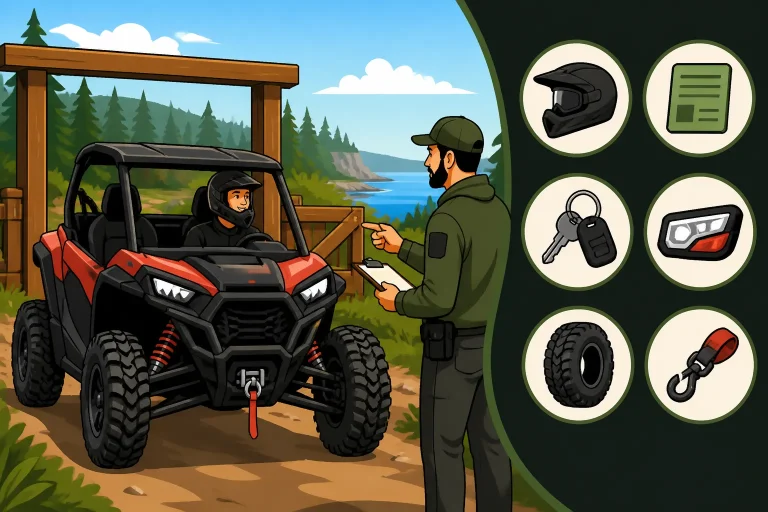
The first practical step is to check that your machine is properly registered where it is normally based and that the registration remains valid during your trip. Bring the registration document, proof of insurance, and identification. If another person owns the machine, have the owner’s permission and any relevant ownership paperwork available as well.
Do not assume that your home registration automatically answers every question about riding here. Registration, insurance, training, trail access, and road use are separate matters. A visitor may satisfy one requirement and still need to meet the others.
The 30-day rule is also easy to misunderstand if your plans change. A trip that begins as a short holiday might extend because of weather, repairs, work, or a longer stay with family. If you expect to be here beyond the exemption period, contact the appropriate Motor Registration office before you ride past it. Ask what date the exemption ends for your situation and what steps are required to register the machine locally. The details can depend on your circumstances and the machine’s paperwork.
| Situation | What to check |
|---|---|
| Short visit with an out-of-province machine | Confirm the machine’s home registration is valid and ask how the visitor exemption applies |
| Planned stay longer than 30 days | Ask the registry what local registration steps and documents are required |
| You have moved to Newfoundland and Labrador | Check the rules for a new resident rather than assuming the visitor exemption applies |
| Riding on a managed trail | Check whether a trail sticker, safety-training proof, or other trail requirements apply |
| Riding on or crossing a road | Check the separate rules for insurance, licence, equipment, and where riding is allowed |
For the basics of when a visiting machine has to be registered, see When a Visiting Machine Has to Register in Newfoundland. The visitor exemption itself is covered in Newfoundland’s 30-Day Visitor Exemption, while Newfoundland Visitors Beyond Thirty Days addresses the situation when a stay extends past the limit.
A longer visit is not always the same as moving
The length of your stay matters, but so does your actual situation. Someone visiting for an extended holiday may be treated differently from someone who has moved to the province and brought a machine along. If you have changed your home, work, or usual place of residence, do not rely only on the visitor rules. Review Newfoundland Registration for a New Resident and explain your circumstances to the registry.
A planned stay of more than 30 days is a good reason to ask before arriving, especially if you will be far from a registry office or intend to ride soon after landing. Avoid waiting until the last day of the exemption to find out that a document is missing or an appointment is needed.
Keep the dates and documents clear
Write down your arrival date, the date you first bring the machine into the province, and the answer you receive from the registry about the exemption. These dates can help you explain your situation if plans change. Keep copies of your documents in a place where they can be reached while riding, and store originals safely when appropriate.
If the machine is registered in more than one person’s name, make sure the paperwork reflects the owners correctly. If you borrowed it, ask the owner for the documents and written permission you may need. A registration document that is valid at home does not resolve a missing ownership trail or an unclear right to use the machine.
What to arrange before the exemption ends
If you will remain in Newfoundland and Labrador beyond the visitor period, contact Motor Registration early. Ask whether you must register the machine locally, what forms and proof are needed, whether you need an appointment, and whether you can continue riding while an application is being processed. Do not assume that submitting paperwork automatically authorizes riding after the exemption expires.
The exact requirements can depend on whether you own the machine, how you acquired it, and what documents you have. A machine brought from another province may need more than its current registration document. For example, the registry may ask for proof of ownership or information that identifies the machine. Review Newfoundland Registration Paperwork Explained and Newfoundland Registration by Appointment before making the trip to the counter.
Use this checklist to organize the conversation:
- Explain your status. Say whether you are visiting, staying temporarily, or have moved to the province.
- Give the machine details. Have its make, model, vehicle identification number, current registration jurisdiction, and registration information ready.
- Describe the ownership history. Explain whether you bought it, brought it from another province, or are using someone else’s machine.
- Ask about the deadline. Confirm when the visitor exemption ends in your case and whether any transition period applies.
- Confirm the local registration process. Ask which documents to bring, whether an appointment is required, and what happens while the application is being considered.
- Ask about continued use. Get a clear answer about whether the machine may be ridden while you wait for local registration.
- Check the other riding requirements. Ask separately about insurance, training proof, managed-trail stickers, and any rules for the places you plan to ride.
This is also the time to deal with gaps in the ownership paperwork. A bill of sale, previous registration, or written permission from the owner may help establish the machine’s history, but do not guess which documents will be accepted. Explain what you have and ask what else is needed. If the machine has passed through multiple owners, mention that early rather than arriving with only the most recent document.
A visitor who has actually moved should say so plainly. The rules for a new resident may use a different timeline from the visitor exemption. The article Ninety Days After You Arrive may help explain the new-resident timing, but confirm the rule that applies to your own circumstances with the official registry.
Registration is not the same as trail permission
Local registration does not automatically grant access to every trail or area. Managed trails may have their own sticker and safety-training requirements, and access can also depend on the trail operator, land status, closures, and local rules. Check the requirements for the route before setting out, rather than assuming that the plate or registration document is enough.
Visitors should ask whether their out-of-province training certificate or other proof is accepted, and whether the answer differs for an adult, a young rider, or a particular type of machine. If a trail sticker is needed, confirm where to get it and whether it must be attached to the machine or carried. The rules are separate from the 30-day registration exemption.
Registration also does not make road riding generally permissible. Road use, highway crossings, shoulders, and local roads have their own restrictions. Before planning a route that includes any road section, check Newfoundland ORV Road Rules Explained and confirm whether municipal bylaws apply where you will be riding.
Insurance and riding obligations still apply
Do not treat the visitor exemption as an exemption from insurance. A machine registered elsewhere may still need appropriate insurance while being operated in Newfoundland and Labrador. Check with your insurer before the trip and ask whether the policy covers the machine, the operator, the province, and the types of riding you plan to do. Confirm what proof you should carry.
If you are borrowing a machine, do not rely only on the owner’s assurance that it is insured. Ask the insurer or owner to confirm that the policy covers your use. Keep the required proof accessible while riding, and make sure the details match the machine. For more on this issue, see Newfoundland Visitors Still Need Insurance.
Other rules can apply regardless of where the machine is registered. Operators may need to meet requirements for helmets, equipment, licences on highways, and rider training. Young riders can have additional limits and supervision requirements. A passenger also needs to be carried in a way the machine is designed to allow. Check the rules for your machine and the riders in your group before choosing a route.
The practical distinction is:
| Requirement | What it covers | Why a visitor should check it |
|---|---|---|
| Vehicle registration | The machine’s registration and identification | The visitor exemption is time-limited, and a longer stay may require local registration |
| Insurance | Financial responsibility and coverage for operating the machine | An out-of-province policy may have conditions or limits |
| Safety training | Operator knowledge and any required proof | A certificate or exemption may need to meet Newfoundland and Labrador requirements |
| Trail sticker or access permission | Use of certain managed trails or land | Registration alone does not provide access |
| Road and equipment rules | Where and how the machine may be operated | These obligations can apply even during a short visit |
Before departure, make a simple document check: registration, insurance proof, identification, any required training certificate, and permission to use the machine if you are not the owner. Confirm that the plate is visible and the machine meets the equipment rules for the planned ride. Keep a phone number or written note from the registry if you have received advice about a longer stay, but do not treat an informal conversation as a substitute for required documents or approval.
If a storm, breakdown, or change of plans pushes your stay past 30 days, pause and get an answer before continuing to ride. Ask the registry what applies now, not only what applied when you arrived. If you have moved rather than extended a visit, explain that distinction and ask about the new-resident process. Sorting this out early is easier than discovering the issue at a trailhead or roadside stop.
Frequently Asked Questions
Can I ride after 30 days if my machine is still registered at home?
Do not assume so. The visitor exemption is limited, and a longer stay may require local registration. Confirm your deadline and next steps with Motor Registration before riding beyond the exemption.
Does local registration give me permission to use every trail?
No. Registration and trail access are separate. Check whether a trail sticker, training proof, land permission, or other access condition applies to the route.
Do I still need insurance as a visitor?
Yes, you should confirm that suitable insurance covers the machine and your use in Newfoundland and Labrador. Carry the required proof and check your policy before travelling.
What if I have moved to the province rather than visiting?
Tell the registry that you are a new resident. Do not assume the visitor exemption applies to a move; check the separate registration timeline and requirements.
Disclaimer
This article is for general informational purposes only and does not constitute professional advice. Laws, prices and regulations vary by location and change over time. Consult a qualified professional for guidance on your specific situation.