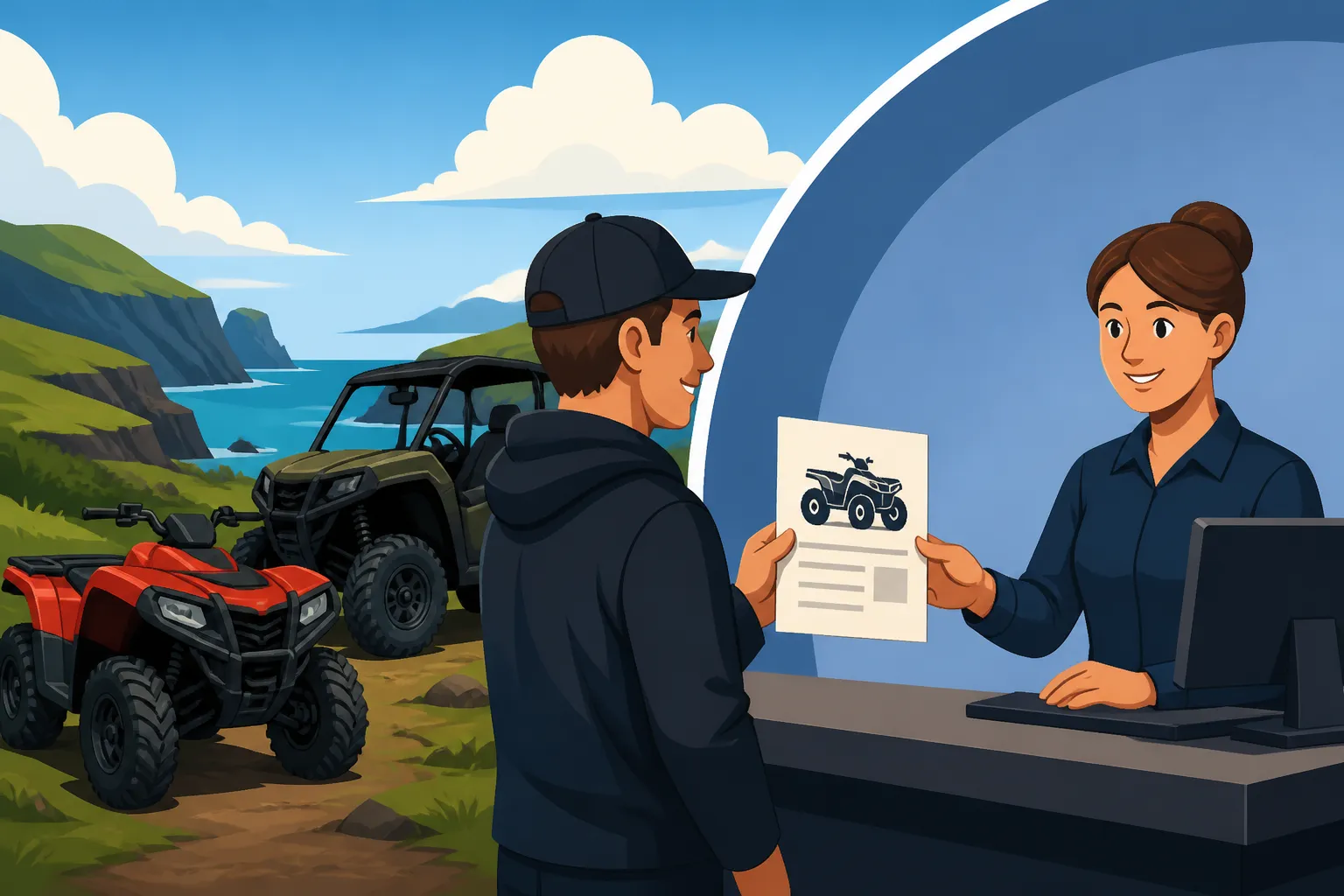
When a Visiting Machine Has to Register in Newfoundland
There's nothing quite like the freedom of exploring Newfoundland and Labrador's vast wilderness on your ATV or UTV, but if you're visiting from away, you might be scratching your head about local registration rules. It's a common concern: you've got your machine registered back home, but does that cover you here? This guide will clear up the confusion surrounding when your visiting machine needs to be registered in Newfoundland, helping you avoid fines and ensuring your adventures are smooth sailing.
Understanding the 30-Day Exemption for Visitors
Newfoundland and Labrador offers a fantastic grace period for folks bringing their off-road vehicles (ORVs) in from other provinces, states, or even countries. You don't immediately need to rush to Motor Registration the moment your tires hit our shores. The province's Off-Road Vehicles Act provides a specific exemption for visitors, allowing them to ride their machines without Newfoundland registration for a limited time. This is a huge relief for anyone planning a shorter trip, perhaps a week-long fishing expedition, a hunting trip, or just a scenic tour of the island.
This exemption is incredibly useful for tourists who want to experience our rugged trails and breathtaking barrens. You can focus on packing your gear and planning your route, rather than dealing with immediate paperwork. Just make sure you understand the conditions of this grace period. It's not a free pass forever, and there are still important rules you must follow, especially regarding safety and operation.
What Counts as a "Visitor"?
So, who exactly qualifies as a "visitor" under this rule? Essentially, it's anyone who does not ordinarily reside in Newfoundland and Labrador. If your primary residence is in Nova Scotia, Ontario, Maine, or anywhere else outside our provincial borders, you're considered a visitor. This is crucial because it distinguishes between someone on a temporary stay and someone who is moving here permanently. The key here is intent and residency. You're here for a temporary purpose, enjoying what our beautiful province has to offer, and you fully intend to return to your home province or country.
This definition ensures that someone simply passing through or vacationing doesn't get bogged down in bureaucratic processes. The provincial government recognizes the value of tourism and aims to make it as easy as possible for visitors to enjoy our trails responsibly. Think of it as Newfoundland's way of saying, "Welcome, enjoy your stay, and bring your toys!" You'll find this kind of hospitality extends across many aspects of visiting our province. For more details on this specific window, check out [Newfoundland's 30-Day Visitor Exemption].
Proof of Registration from Your Home Province/State/Country
While you might be exempt from Newfoundland registration for the first 30 days, you are absolutely not exempt from needing proper registration from somewhere. Your visiting machine must be validly registered in your home jurisdiction. This means you need to carry proof that your ATV or UTV is legally recognized and titled wherever you usually live. Think of it as reciprocal recognition: Newfoundland respects your home province's paperwork, provided it's current and legitimate.
Imagine getting pulled over on a woods road near Grand Falls-Windsor. An officer will likely ask for your identification and proof of your machine's registration. If you can produce a valid registration document from, say, New Brunswick or New York, that's what they're looking for. Without it, even within the 30-day window, you could face trouble. It's about demonstrating legal ownership and compliance with some jurisdiction's laws. Make sure these documents are easily accessible, perhaps in a waterproof pouch, just like your driver's licence.
Insurance: Still a Must for Everyone
Here’s a non-negotiable point: even if your machine is only visiting and you're within your 30-day exemption, you must have valid insurance coverage. This isn't a suggestion; it's a legal requirement for anyone operating an ORV in Newfoundland and Labrador. The province mandates a minimum third-party liability insurance coverage for all off-road vehicles. This protects you and others in case of an accident.
Many riders, especially those from outside the province, assume their existing vehicle insurance policies might cover their ATV or UTV, but this isn't always the case, or the coverage might be insufficient for ORV use. It's absolutely critical to confirm with your insurance provider that your policy covers off-road vehicle operation in Newfoundland and Labrador, and that it meets our minimum liability requirements. The last thing you want is an unfortunate incident on the trails turning into a financial nightmare. You should be able to produce proof of this insurance if requested by law enforcement, just as you would for a car. For more on this, consider reading [Newfoundland Insurance Requirements for Riders].
When the 30-Day Window Closes: What Happens Next?
Life happens, and sometimes a "short trip" turns into a much longer stay. Perhaps you fall in love with the rugged beauty of the west coast and decide to linger, or your family plans get extended. Whatever the reason, if your ATV or UTV is going to be in Newfoundland and Labrador for more than 30 consecutive days, the rules change. That initial exemption that felt so liberating now expires, and you're expected to bring your machine into compliance with local regulations. Ignoring this can lead to significant penalties, including fines and possibly even your machine being impounded.
This transition from visitor to temporary resident, in the eyes of the ORV Act, is where many riders get caught off guard. It's a clear line in the sand: 30 days means 30 days. Don't assume that just because you're not officially moving here, you're still considered a "visitor" indefinitely. The clock starts ticking the moment your machine enters the province.
The Obligation to Register in Newfoundland
Once that 30-day period passes, your visiting machine is officially required to be registered in Newfoundland and Labrador. There's no getting around it. This is not about declaring permanent residency for yourself; it's about the machine's prolonged presence within the province. The province wants to ensure all ORVs used on its land for extended periods are trackable, accountable, and contribute to the provincial system.
This means you'll need to go through the same registration process as any other resident ORV owner. It's a straightforward process, but it does require gathering specific documents and heading to a Motor Registration office. It’s a good idea to start this process before your 30 days are up, to ensure there’s no lapse in your legal ability to ride. Being proactive saves a lot of hassle and potential fines down the road. You can usually book an appointment to make the process smoother, avoiding long wait times.
The Registration Process for Out-of-Province Machines
Registering an out-of-province machine is quite similar to registering one purchased new or used within Newfoundland, with a few key differences. The main goal is to prove ownership, ensure the machine meets provincial standards (though there's no inspection for registration), and pay the necessary fees.
Here's a general rundown of what you'll typically need:
- Proof of Ownership: This is paramount. You'll need the original registration or title document from your home jurisdiction. If your machine is older and titles weren't common in your home area, you might need a sworn affidavit of ownership. Websites like LawDepot offer templates for these kinds of legal documents, which can be helpful if you need to create a formal declaration of ownership history.
- Bill of Sale (if recently purchased): If you bought the machine just before or during your extended stay, a bill of sale showing the transaction will be required. Again, clear, concise documents are best.
- Your Identification: A valid government-issued ID (like a driver's licence) will be needed.
- Completed Application Form: Motor Registration will provide the necessary forms.
- Payment for Fees: Be prepared to pay the applicable registration fee and any taxes.
- New Vehicle Information Statement (NVIS): If your machine is very new and was never registered anywhere else, you'll need this. But for most visiting machines, the existing registration from your home jurisdiction suffices.
You'll essentially be "importing" your machine into the provincial registration system. It might sound complex, but the staff at Motor Registration are usually very helpful in guiding you through the specifics. For a more detailed look at what documents you might need, explore [Newfoundland Registration Paperwork Explained].
The Costs Involved
Registering an off-road vehicle in Newfoundland and Labrador involves a one-time fee. This is a crucial distinction from many other jurisdictions that require annual renewals. Here, you pay once, and the registration remains valid for as long as you own the machine.
The cost varies depending on the type of machine you're registering. For example:
- ATVs (All-Terrain Vehicles) generally cost a specific amount. [Newfoundland Charges $95 for an ATV] will give you the exact figure for quads.
- Side-by-Sides (UTVs) are usually in a similar price range, having been specifically added as their own class in recent years.
- Trail Bikes (dirt bikes) often have a much lower registration fee, reflecting their typically lighter use and nature. [Newfoundland Charges $5 for a Trail Bike] outlines this.
In addition to the registration fee, you may also be subject to HST (Harmonized Sales Tax) if the machine was recently purchased and tax hasn't been properly remitted. It's always a good idea to check current fee schedules directly with Motor Registration as these figures can change. Remember, this is a one-time cost, so while it might feel like a lump sum upfront, it saves you from recurring annual fees.
| Machine Type | Typical Registration Fee (Newfoundland) | Renewal Requirement |
|---|---|---|
| ATV | Check current rates | None (One-time fee) |
| Side-by-Side (UTV) | Check current rates | None (One-time fee) |
| Trail Bike | Check current rates | None (One-time fee) |
| Snowmobile | Check current rates | None (One-time fee) |
Note: Specific fees are not provided here due to potential changes. Always confirm current rates with Newfoundland Motor Registration before proceeding.
Special Considerations for New Residents and Other Scenarios
Sometimes, a prolonged visit transitions into something more permanent. People fall in love with Newfoundland and Labrador and decide to make it their new home. This changes the registration game entirely, as you're no longer just a visitor. There are also unique situations where the 30-day rule might apply differently, or where law enforcement might have specific questions about your machine's status.
Understanding these nuances is key to staying on the right side of the law, whether you're here for a short stint, a longer work contract, or a permanent move. The province aims for clarity, but it's up to us as riders to be informed.
The 90-Day Rule for New Residents
If you've officially made the move and become a resident of Newfoundland and Labrador, the rules shift from the 30-day visitor exemption to the 90-day new resident rule. This means that once you establish residency here (e.g., getting a Newfoundland driver's licence, registering to vote, working here), you have 90 days to register your ORV with Motor Registration. This is a more generous window than the visitor exemption, acknowledging the often-complex process of moving and settling into a new province.
During this 90-day period, your out-of-province registration is still considered valid, similar to the visitor rule. However, after these 90 days, you must have your machine registered in Newfoundland. It's an essential step in fully integrating into the provincial system. Don't wait until the last minute; give yourself ample time to gather your documents and make an appointment. For more on this, you can refer to [Newfoundland's 90-Day New Resident Rule]. This is also where you might consider creating any necessary ownership documents, such as a bill of sale if you acquired the machine recently, and LawDepot can be a good resource for such templates.
Long-Term Stays Without Becoming a Permanent Resident
What if you're not officially becoming a permanent resident, but your stay extends beyond 30 days, perhaps for a long-term contract job, extended family care, or a full seasonal experience? In these cases, the 30-day visitor exemption still applies. Once you've exceeded that 30-day mark, even if your primary residence is technically still elsewhere, your machine is expected to be registered in Newfoundland and Labrador.
The province doesn't distinguish between a long-term visitor and a short-term visitor once that 30-day window has passed; the machine's continuous presence triggers the registration requirement. This is to prevent machines from being used indefinitely without contributing to the provincial registry and oversight. It’s better to be proactive and register the machine than to risk a fine or having your fun interrupted. Many seasonal workers, for example, will go through the full registration process even if they know they'll be leaving the province again in a few months.
What an Officer May Ask for on the Trail
Regardless of whether you're a visitor, a new resident, or a long-time local, peace officers have the authority to stop you on the trails and ask for certain documents. This is a routine part of ensuring compliance and safety on our off-road networks. Knowing what they can ask for will save you stress and potential delays.
Typically, an officer will want to see:
- Proof of Registration: This means your valid Newfoundland registration permit, or if you're a visitor within 30 days, your valid out-of-province registration.
- Identification: Your driver's licence or other government-issued ID.
- Proof of Insurance: Your current insurance card or document showing the required liability coverage.
- Safety Training Certificate: If you are a young rider or a first-time registrant, proof of safety training may be requested.
- Trail Permit/Sticker: If you are riding on a designated "managed trail," you'll need the appropriate sticker or proof of permit.
If you're stopped and can't produce the required documents, especially if you're past the 30-day visitor exemption without having registered, you could face fines. Officers have discretion, but the law is clear. Carrying these documents, ideally in a waterproof bag on your machine, is just good practice for any rider. Being prepared shows responsibility and helps ensure your ride continues smoothly. For more on what to expect, consider [What an Officer Can Ask You to Produce].
Disclaimer
This article is for general informational purposes only and does not constitute professional advice. Laws, prices and regulations vary by location and change over time. Consult a qualified professional for guidance on your specific situation.