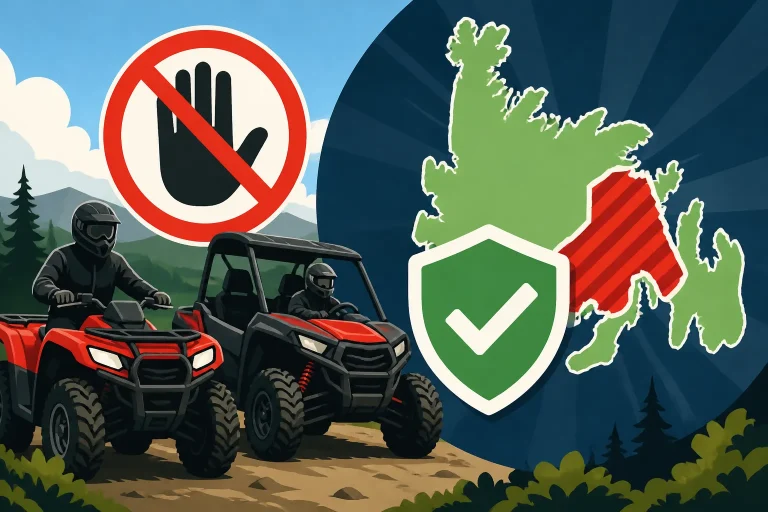
Newfoundland Community Government Exemptions
Newfoundland’s community government exemption is easy to misunderstand: it does not automatically exempt every resident, machine or ride from trail requirements. The key is what the exemption applies to, who qualifies, and which separate rules still apply. Here’s how to think through the exemption before a community government takes an ATV or UTV onto a managed trail.
What the community government exemption covers
The exemption associated with community governments is a narrow exception to the managed-trail sticker requirement. It is not a general waiver from Newfoundland and Labrador’s off-road vehicle rules.
A managed-trail sticker is the trail-access credential issued through a trail operator. It is separate from a vehicle registration plate and registration document. A machine can be registered and still need the appropriate sticker to use a managed trail. Conversely, an exemption from the sticker requirement does not make an unregistered machine legal to operate where registration is required.
The exemption is generally relevant to a qualifying Inuit community government and its eligible government use of a machine. It should not be read as a blanket exemption for everyone living in a community, every local organization, or every machine that happens to be in community territory. The qualifying entity and the circumstances of the ride matter.
That distinction is important because “community government” sounds broader than the actual category. A town council, volunteer association, private business, resident, or community member is not automatically covered just because they serve or live in a community. The exemption should be verified for the specific government, machine, use and trail before relying on it.
For the wider context, see Newfoundland Labrador Inuit Trail Exemptions and Labrador Inuit Settlement Area and the Sticker Exemption. The exemption is tied to a specific legal and geographic framework, not simply to a rider’s address or community connection.
The sticker is not registration
A trail sticker and a registration plate answer different questions:
| Requirement | What it relates to | What the community government exemption means |
|---|---|---|
| Managed-trail sticker | Permission or authorization to use a managed trail under the applicable trail system | A qualifying government may fall within a limited sticker exemption |
| Vehicle registration | The machine’s registration and identification under provincial rules | The sticker exemption does not by itself remove registration requirements |
| Safety training | The operator’s training obligations, where applicable | The sticker exemption does not automatically waive training |
| Insurance | Financial protection and proof required under applicable rules | The sticker exemption does not automatically remove insurance requirements |
| Access permission | Whether a particular trail, road or land parcel is open to that machine | The exemption does not open a closed or restricted area |
The word “exempt” only has meaning within the rule that creates the exemption. It does not mean “free to ride anywhere without other requirements.”
It is about eligibility, not a general local privilege
An exemption can be based on the identity of the entity involved and the purpose or ownership of the machine. It is not safe to assume that a personal ATV qualifies because its owner is an elected official, community employee, contractor, or resident.
For example, a community government may operate a machine for government work, while an employee may also own a separate personal quad. Those are different situations. The government-use machine may be eligible for a specific exemption; the employee’s personal machine does not inherit that status merely because of the employment relationship.
Likewise, a government-owned machine used privately, lent to a resident, or taken on a recreational ride may raise different questions from one being used for an official purpose. Do not rely on the government’s status alone to settle every use case. Confirm how the exemption applies to that trip.
Who can rely on the exemption
The first practical question is whether the entity is within the category named by the applicable rule. A local organization may be important to its community without being a community government for this purpose. A private business may provide services to a community government without becoming part of it.
The second question is whose machine is involved and who is using it. Ownership and control can help establish whether a machine is being used by the qualifying government, but they do not necessarily settle the issue on their own. If the machine is leased, borrowed, privately owned by an employee, or operated by a contractor, ask the trail operator or responsible authority how the exemption is treated in that arrangement.
The third question is what kind of ride is planned. A government work trip, a public-service task, a staff recreation ride and a personal trip are not interchangeable just because they use the same machine. If the purpose is unclear, get a decision before setting out rather than relying on an informal interpretation at the trailhead.
A useful eligibility check
Before treating a machine as exempt, check each of these points:
- The entity: Is it the specific type of community government covered by the exemption, rather than a different local body or organization?
- The machine: Is the ATV or UTV owned, controlled or operated in a way that the exemption covers?
- The operator: Is the person riding on behalf of the qualifying entity, or is this a personal or private use?
- The purpose: Is the ride consistent with the use covered by the exemption?
- The trail: Is the route a managed trail, and does its operator recognize the exemption in this situation?
- Other rules: Does the machine still need registration, insurance, training documentation or other permits?
- Proof: Can the operator show why the machine is eligible if asked?
If any answer is uncertain, pause and confirm. A quick call or written response from the trail operator can prevent a dispute about sticker requirements later.
Residence does not automatically establish eligibility
A rider’s home community may be relevant to some exemptions, but residence alone is not the same as a community government exemption. A private rider should not assume that living within or near an Inuit community means they can use a government exemption.
This is also different from rules applying to land owned by a rider or the rider’s family. The personal-land exception and the community-government exception are separate concepts. The details of family-land rules are covered in Newfoundland Exemptions on Your Own Land and Land You or Your Family Own.
Similarly, an exemption connected to Inuit community governments should not be confused with an exemption for an Inuit business. They are separate categories and may have different conditions. A business should check Inuit Businesses and the Trail Sticker Exemption rather than assuming that a government exemption extends to it.
How to confirm and document an exempt ride
A community government should have a consistent way to confirm an exemption before sending a machine onto a managed trail. The goal is not to create unnecessary paperwork. It is to make sure the operator, trail staff and rider share the same understanding of why the machine does not need the usual sticker.
Start with the trail operator. Managed trails may be administered by different operators, and the operator is the practical contact for trail access and sticker questions. Ask whether the exemption is recognized on the particular trail and what evidence the operator expects the rider to carry. The operator can also explain whether a sticker is still needed for a different machine or a different type of trip.
If the operator cannot confirm the legal basis, check the current provincial rule or ask the appropriate government office. Do not treat a general answer about “community exemptions” as confirmation that a particular machine, rider or trip qualifies. Describe the details clearly: the government entity, machine ownership, operator, purpose and route.
A practical process
- Identify the machine and the planned trip. Record the machine’s registration details, who will operate it, where it will go and whether the trip is official or personal.
- Confirm the entity’s status. Make sure the community government falls within the specific category covered by the exemption. Do not assume another organization has the same status.
- Ask the trail operator about the route. Confirm that the trail is managed, that the exemption applies there, and what proof should be carried.
- Check separate requirements. Verify registration, insurance, operator training and any other permit or access conditions that may apply.
- Keep a simple record. Retain the operator’s response and carry appropriate evidence of the machine’s government connection and the trip’s purpose, if requested.
- Recheck for a different use. If the machine is lent, used privately, operated by a contractor or taken on another trail, confirm that the original answer still applies.
This process is especially useful where a fleet includes both government machines and personal machines. A short written policy can tell staff which machines may use the exemption, who can operate them, what uses are authorized and what documents to carry. It also helps prevent an employee from treating a government machine as exempt during a personal outing without checking.
What proof may be useful
The applicable rule and trail operator determine what proof is necessary, so do not assume there is one universal document or form. In practice, it is sensible to be able to establish the machine’s connection to the qualifying government and explain the nature of the trip.
Depending on the situation, that may mean having access to:
- Registration information identifying the machine and its registered owner
- An asset or fleet record showing the government’s connection to it
- A work assignment or authorization for the operator
- A written response from the trail operator confirming how the exemption is handled
- Any required safety, insurance or permit documents for the operator and machine
Avoid carrying sensitive personal or organizational records unnecessarily. Ask what the trail operator actually needs, and provide only what is relevant. A clear, concise confirmation is more useful than a folder of unrelated documents.
For general information about how the sticker works, see Managed Trails Require a Sticker on Your Machine and Which Operators Can Issue a Trail Sticker. If the question is whether to attach a sticker or carry it, Newfoundland Stickers Attached or Carried explains that separate issue.
What the exemption does not change
A sticker exemption is not a universal permission slip. Other requirements can still apply, and the rider remains responsible for complying with them. This is the most important point for anyone planning a community-government ride.
Registration and vehicle identification
The machine may still need provincial registration, a plate and its registration document. Do not confuse an operator-issued trail sticker with the plate or document issued through motor vehicle registration. Check the registration rules for the machine’s type and circumstances, including whether it is a quad, side-by-side or another covered vehicle.
A government’s ownership does not automatically settle registration status. If a machine is newly acquired, transferred, imported or missing paperwork, address that separately. Helpful background includes Newfoundland Permits, Plates and Decals and Newfoundland Registration Paperwork Explained.
Safety training and operator rules
The person riding must still meet the applicable operator requirements. The details can depend on the operator’s age, machine and other circumstances, so check the rules that apply to that rider rather than relying on the government’s sticker status.
The government should also make sure operators know the machine’s controls, passenger limits, equipment and route restrictions. A work assignment does not remove the need to ride safely or follow operator rules. See Newfoundland Safety Training Is Mandatory and Newfoundland Training Required Under 16 for related training requirements.
Insurance and liability
Do not assume the sticker exemption provides insurance or replaces any insurance requirement. The government should confirm that its policy covers the machine, the operator and the planned use. A policy that covers official work may not automatically cover recreational use, and a machine borrowed by a third party may require a separate check.
The operator should also know what proof must be available while riding. For the broader rules, see Newfoundland’s Minimum Insurance Requirement and Newfoundland Insurance Proof on the Trail.
Trail and land access
An exemption from buying or displaying a sticker does not mean every trail is open. A route may be closed, restricted, privately owned, under seasonal limits or subject to conditions set by its operator. The exemption does not override a closure or provide permission to cross private land.
Before departure, confirm that the trail is open to the machine and that the government’s intended use is permitted. Ask about temporary closures, construction, seasonal conditions and any local restrictions. More on the distinction between access and other requirements is available in [Newfoundland Crown Land Access Rules] and [Newfoundland Managed Trail Rules].
This matters on a multi-part route. A machine might travel on an exempt managed trail for one section and then enter a different area with separate access conditions. Treat each part of the planned route as its own check, especially if the ride crosses from a managed corridor onto Crown land, a local road or private property.
Equipment and conduct
The exemption does not waive equipment rules, safe riding practices or road restrictions. Machines still need to meet applicable requirements, and operators must follow rules for helmets, passengers, lighting and road crossings where relevant. A sticker exemption does not protect a rider from enforcement for an unrelated violation.
For route planning, consult Newfoundland ORV Road Rules Explained and check any municipal rules that apply to a road or community area. A managed trail’s sticker policy is not the same thing as permission to ride on every street or road nearby.
Common situations and mistakes to avoid
The same machine can raise different questions depending on who is operating it and why. These examples are not legal determinations; they show why the details should be confirmed before a ride.
| Situation | What to check |
|---|---|
| A community government uses its machine for an authorized work task on a managed trail | Confirm that the entity and use qualify, and ask the trail operator what proof is needed |
| A community employee rides a personally owned ATV on the same trail | Do not assume the employer’s exemption applies to a personal machine |
| A government machine is used for a staff recreation outing | Confirm whether the exemption covers recreational use rather than assuming all government use qualifies |
| A contractor operates a government machine | Check whether the operator and work arrangement fit the exemption and insurance coverage |
| A local business provides services to the government | Check the separate business rules; service to a government does not automatically make a business exempt |
| A government machine travels beyond the managed trail | Check access, registration, road and land rules for each part of the route |
| A rider lives in the community but uses a private machine | Residence alone does not establish a community-government exemption |
One frequent mistake is treating an exemption as something that “belongs” to a place. It is more useful to think of it as a specific exception tied to a qualifying entity and a defined situation. A community’s geographic location does not necessarily extend the exemption to every person or vehicle there.
Another mistake is assuming that a machine’s government ownership settles every question. Ownership may be relevant, but the operator, purpose and trail can matter too. If the machine is used outside its usual government role, check again.
A third mistake is conflating the sticker with the vehicle plate. If someone asks for the trail sticker, showing a registration document may not answer the question. If someone asks for registration, a trail sticker may not answer that one either. Carry the documents that apply to the trip, and understand what each one proves.
Finally, avoid relying on hearsay from a previous season or another trail. Rules and operator practices can change, and different managed trails may have different procedures for checking exemptions. Get confirmation for the route and ride that are actually planned.
Frequently Asked Questions
Does every community government in Newfoundland and Labrador qualify?
No. The exemption is associated with a specific qualifying category, not every local government or community organization. Confirm that the entity falls within the rule before relying on it.
Are residents automatically exempt because they live in an Inuit community?
No. Residence alone does not make a private rider or privately owned machine part of a community-government exemption. Check the separate rules that apply to personal riders and machines.
Does the exemption remove the need to register a government ATV or UTV?
Not by itself. The community-government exemption discussed here concerns the managed-trail sticker requirement. Registration and other obligations need to be checked separately.
Can a community employee use the exemption on a personal ride?
Do not assume so. A personal ride may be treated differently from an authorized government use. Confirm the circumstances with the trail operator before setting out.
What should a rider carry to show the exemption?
Ask the trail operator what proof it accepts for the particular machine and route. It is sensible to have relevant registration information and a clear record of the machine’s government connection and the authorized purpose, while also carrying any other required documents.
Disclaimer
This article is for general informational purposes only and does not constitute professional advice. Laws, prices and regulations vary by location and change over time. Consult a qualified professional for guidance on your specific situation.