Newfoundland Test Length and Pass Mark
Newfoundland’s ATV safety test is short, but a near miss on the pass mark can delay getting proof of training. Knowing how many questions to expect, how many you need right and what to review first makes the process easier. Here’s how to prepare, take the test and understand what your certificate does—and does not—allow you to do.
How long is the Newfoundland ATV safety test?
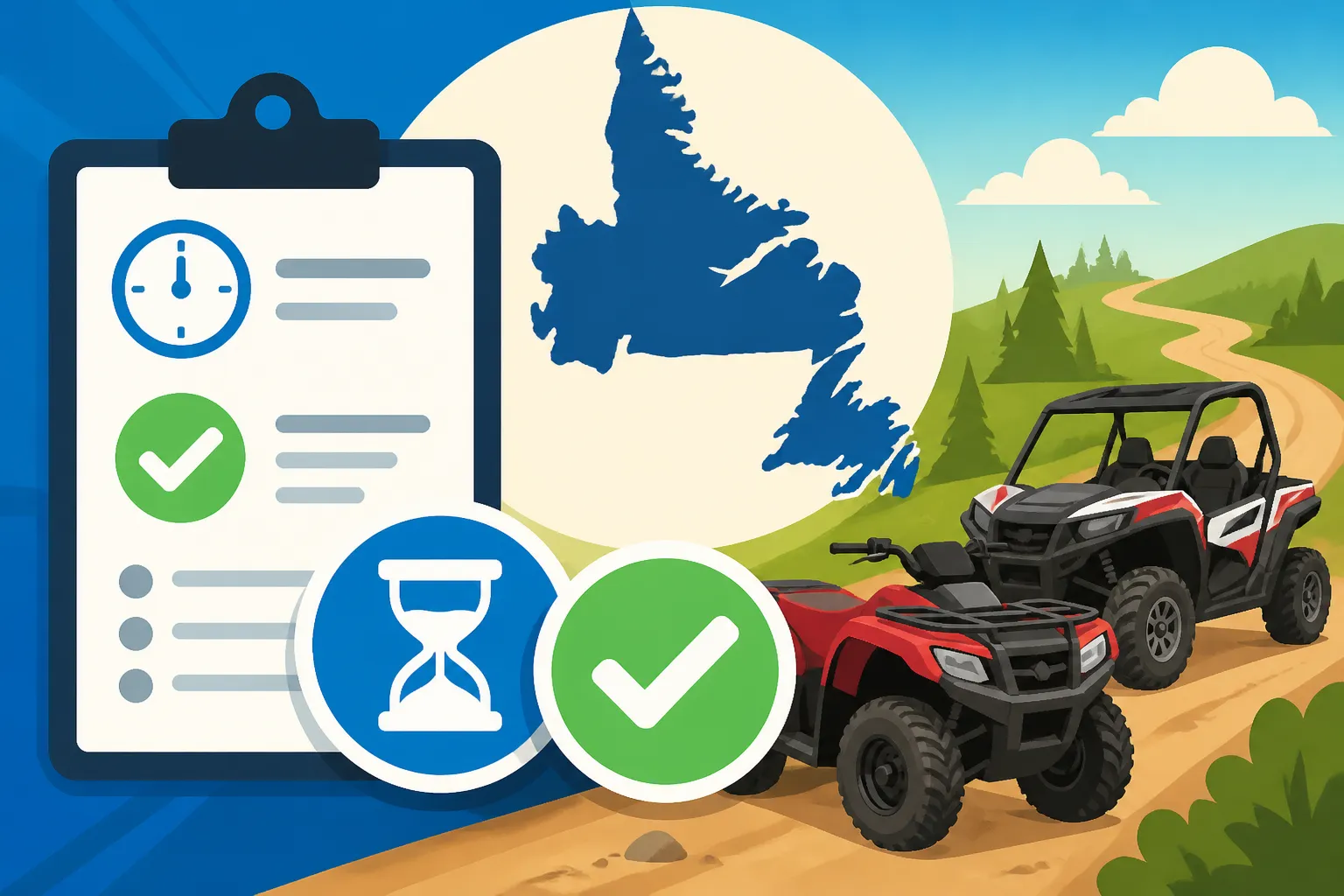
The online test has 15 questions. You need at least 12 correct answers to pass. In other words, you can miss three questions and still earn a passing result; missing four means you have not met the pass mark.
The number of questions is the clearest measure of the test’s length. It is a short knowledge check, not a substitute for learning the rules or practicing safe riding. If the online service displays a time limit or other test conditions, follow the instructions shown there. Don’t rely on an old screenshot or an informal description to determine how much time you have.
The test is available through MyGovNL. It is described as free, and passing allows you to print a certificate. Check the service itself for the current steps and any requirements before starting. For a closer look at how the assessment is set up, see What Is on the Newfoundland ATV Safety Test and Fifteen Questions on a Free Test.
| Test detail | What to expect |
|---|---|
| Question count | 15 |
| Pass mark | At least 12 correct |
| Maximum incorrect answers while passing | 3 |
| Where to take it | Online through MyGovNL |
| After passing | Print the safety certificate and keep proof available as required |
A short test can still be easy to underestimate. The questions may cover rules that are simple to overlook while riding, such as who must supervise a young rider, when a helmet is required, and what to do before taking a machine onto a road or trail. Studying the broader riding rules is more useful than trying to guess the exact questions.
This test is connected to ATV safety training requirements, but it is not the same thing as registering a machine, getting a trail sticker or earning permission to ride everywhere. Those are separate requirements. If you are trying to work out whether training applies to your situation, read Newfoundland Training for First-Time Registrants and Newfoundland Safety Training Is Mandatory.
What to review before you start
The best preparation is to understand the practical rules a rider is expected to follow. Don’t treat the test as a trivia exercise or assume that knowing how to operate a quad is enough. Legal responsibilities can apply even to experienced riders, and they are especially important when a child is riding or when a route approaches a public road.
Start with supervision and rider eligibility
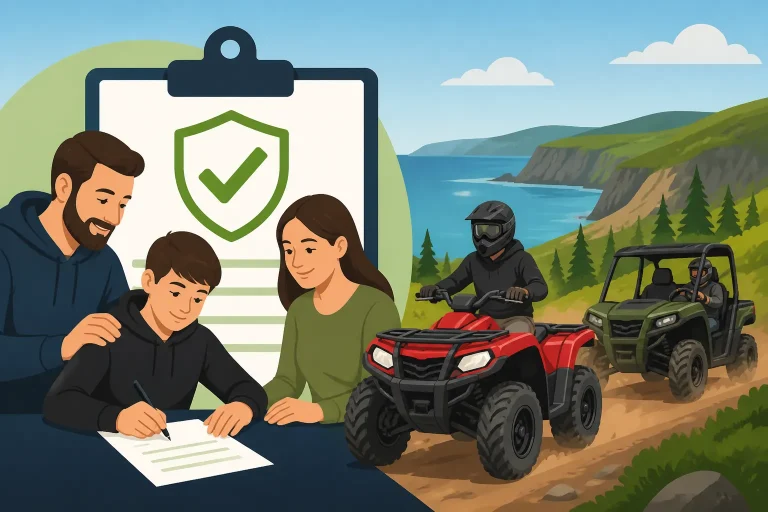
Rules for young riders are worth reviewing carefully. The appropriate supervision, machine size and riding conditions can depend on the rider’s age and other circumstances. A parent or supervisor should understand the requirements too; a young rider passing a test does not remove an adult’s responsibility to make sure the ride is appropriate.
If you are helping a child prepare, check the rules that apply to that child’s age rather than relying on a general answer about “kids on ATVs.” Newfoundland ATV Age Requirements covers the wider age question, while [Newfoundland Rules for a Ten-Year-Old Rider] addresses a specific age group. Requirements may differ by age, so do not assume that another child’s setup is a suitable model.
Review helmets, equipment and passengers
A rider should know the basic safety obligations before turning the key. That includes wearing the required helmet correctly and following rules for passengers and passenger seating. A machine having space to carry someone does not necessarily mean it is legal or safe to do so. The seat and the machine’s design matter.
Other equipment rules may also be relevant to riding safely and lawfully. Review the information on Newfoundland ATV Helmet Law and Newfoundland Equipment Requirements. The goal is not to memorize isolated details; it is to understand that requirements can vary with the machine, the location and the conditions of the ride.
Understand roads, crossings and where riding is allowed
A test can draw attention to the difference between riding on a trail and using a road or shoulder to reach one. Do not assume that an ATV can be driven on any public road just because it is registered. Road access is limited by rules, and local bylaws can add restrictions.
Before riding, know the requirements for a highway crossing and any permitted shoulder travel. Newfoundland Rules for Crossing a Highway and Newfoundland Rules for Riding a Shoulder explain those situations. For the bigger picture, Can You Ride an ATV on the Road in Newfoundland? is a useful companion.
Also distinguish between the right to ride a machine and the right to ride on a particular piece of land. Registration or a training certificate does not automatically authorize access to private property, a restricted area or a trail with its own conditions. Check the route and land-access rules before setting out.
Think through insurance and documents
Registration, insurance and safety-training proof serve different purposes. A rider should know which documents relate to the machine and which relate to the person operating it. Passing a safety test does not register an ATV or replace insurance.
For an overview of the documents a rider may need, see Newfoundland Proof of Ownership on the Trail and Newfoundland Insurance Proof on the Trail. Carry or produce the required proof in the manner the rules specify. If you are not sure what applies to your machine, confirm that before riding rather than assuming a certificate covers every obligation.
Taking the test and avoiding common mistakes
A straightforward approach can reduce errors. Use the official online service, read each question fully, and avoid rushing simply because the test is short. A question may ask about a particular rider, machine or setting; a familiar rule may not apply in exactly the same way to every situation.
- Review the rules before opening the test. Focus on safety, supervision, equipment, road use and the rider’s responsibilities. If a rule is unclear, check the related official information rather than relying on a guess.
- Use the MyGovNL service. Follow the instructions shown in the online test. Make sure you can complete the process without interruptions, especially if you plan to print your certificate right afterward.
- Read every question and answer choice carefully. Watch for details that change the answer, such as whether the rider is a child, whether the situation involves a highway, or whether the question is about a passenger.
- Check your choice before submitting it. With 15 questions and a pass mark of 12, a few avoidable mistakes can matter.
- Save or print your proof after passing. Confirm that the certificate is legible and that you know how to access it again if you need another copy.
What not to assume
The test’s short length does not mean preparation is unnecessary. It also does not mean the test is a full practical course. A multiple-choice knowledge check cannot show whether a rider can control a machine on a slope, judge changing trail conditions or respond safely around other users.
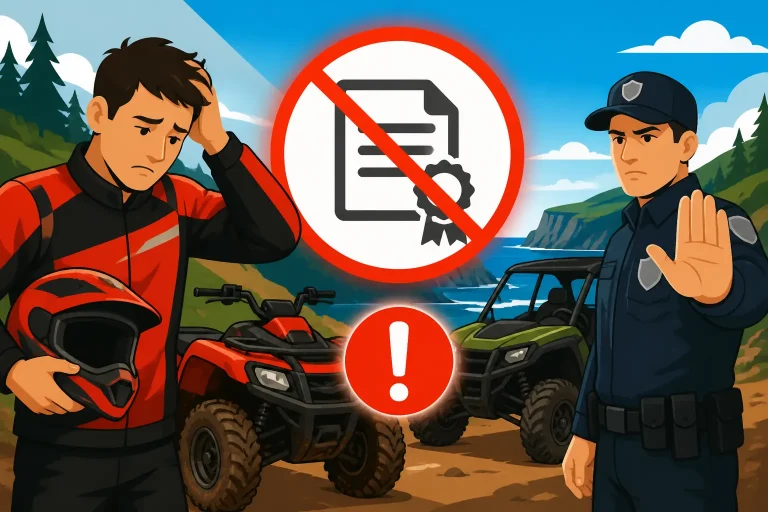
Do not assume that one passing certificate replaces every training requirement. Some riders may be required to complete safety training, and accepted alternatives may depend on the applicable rules. Check Newfoundland Approved Course Providers if you are considering a course instead of the online test. If you have a specific question about when training applies, review the current information before relying on a certificate or course record.
Do not assume that the certificate proves that your ATV is registered. Registration applies to the machine, while a training certificate relates to the rider’s safety knowledge. For registration questions, How to Register an ATV in Newfoundland explains the separate process.
Finally, do not rely on an unofficial copy of the test or an answer key as your only study material. A copied question set may be incomplete or out of date, and memorizing answers without understanding the rules offers little help on the trail. The safest preparation is to understand the rule behind the answer.
After passing: certificates, visitors and other requirements
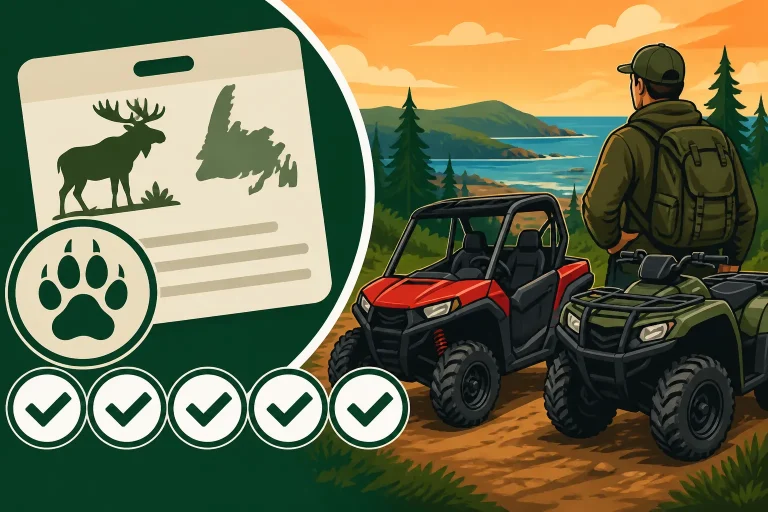
Once you pass, print the certificate and keep it somewhere you can retrieve it. The certificate is evidence of completing the test; it is not an ATV registration document, a driver’s licence, an insurance policy or a trail permit. Those requirements have separate purposes and may apply at the same time.
Keep a clear copy and know where the original or digital version is stored. Check the current rules about how proof must be carried or produced while riding; Newfoundland Proof Carried While Riding discusses that issue. If you are unsure whether a phone copy is acceptable, verify the requirement rather than assuming it will be.
If you do not pass
A score below 12 means you have not reached the pass mark. The practical response is to review the areas you found difficult and use the retake instructions presented by the online service. The reference guidance describes retaking the test after a score under 12; check the service for the current process and any waiting or account steps.
Avoid repeatedly retrying without reviewing the material. If a question exposed a gap in your understanding, look up the underlying rule first. That is especially worthwhile for questions about young riders, supervision, road use and required equipment, where getting the answer right matters beyond the test.
If you are visiting Newfoundland
Visitors should not assume that their home-province training proof automatically settles every Newfoundland requirement. Registration reciprocity and training obligations are related to different rules. A visitor’s machine may qualify for a temporary registration exemption, but that does not by itself mean every other riding requirement disappears.
Check Newfoundland’s 30-Day Visitor Exemption to understand the temporary registration rule, and Visitors Registered Elsewhere for the broader visitor situation. Visitors should also confirm insurance, licence and trail-access requirements. A test certificate does not grant permission to ride on a managed trail or exempt a visitor from rules that otherwise apply.
If you already completed another course
Some courses may be accepted as alternatives to the online test, but do not assume that any safety course qualifies. Check whether the provider or course is accepted and what proof is needed. Newfoundland Approved Course Providers is a useful starting point. Keep the course record and confirm how it must be presented if asked.
If you are registering a machine for the first time, keep the paperwork steps separate from rider training. A registration appointment or completed application does not automatically mean the safety-training requirement has been met. Likewise, passing the test does not finish the machine-registration process.
Frequently Asked Questions
How many questions are on the Newfoundland ATV safety test?
The online test has 15 questions.
What is the pass mark?
You need at least 12 correct answers. You can miss up to three questions and still pass.
Is the test timed?
The number of questions is known, but check the current MyGovNL test instructions for any time limit or other conditions. Do not rely on outdated information about timing.
Can I print my certificate after passing?
Yes. Passing allows you to print a safety certificate. Keep proof available as required, and check the current rules on how it must be carried or produced.
Does passing register my ATV or provide a trail sticker?
No. The certificate is proof related to safety training. Machine registration, trail access and other riding requirements are separate.
Disclaimer
This article is for general informational purposes only and does not constitute professional advice. Laws, prices and regulations vary by location and change over time. Consult a qualified professional for guidance on your specific situation.