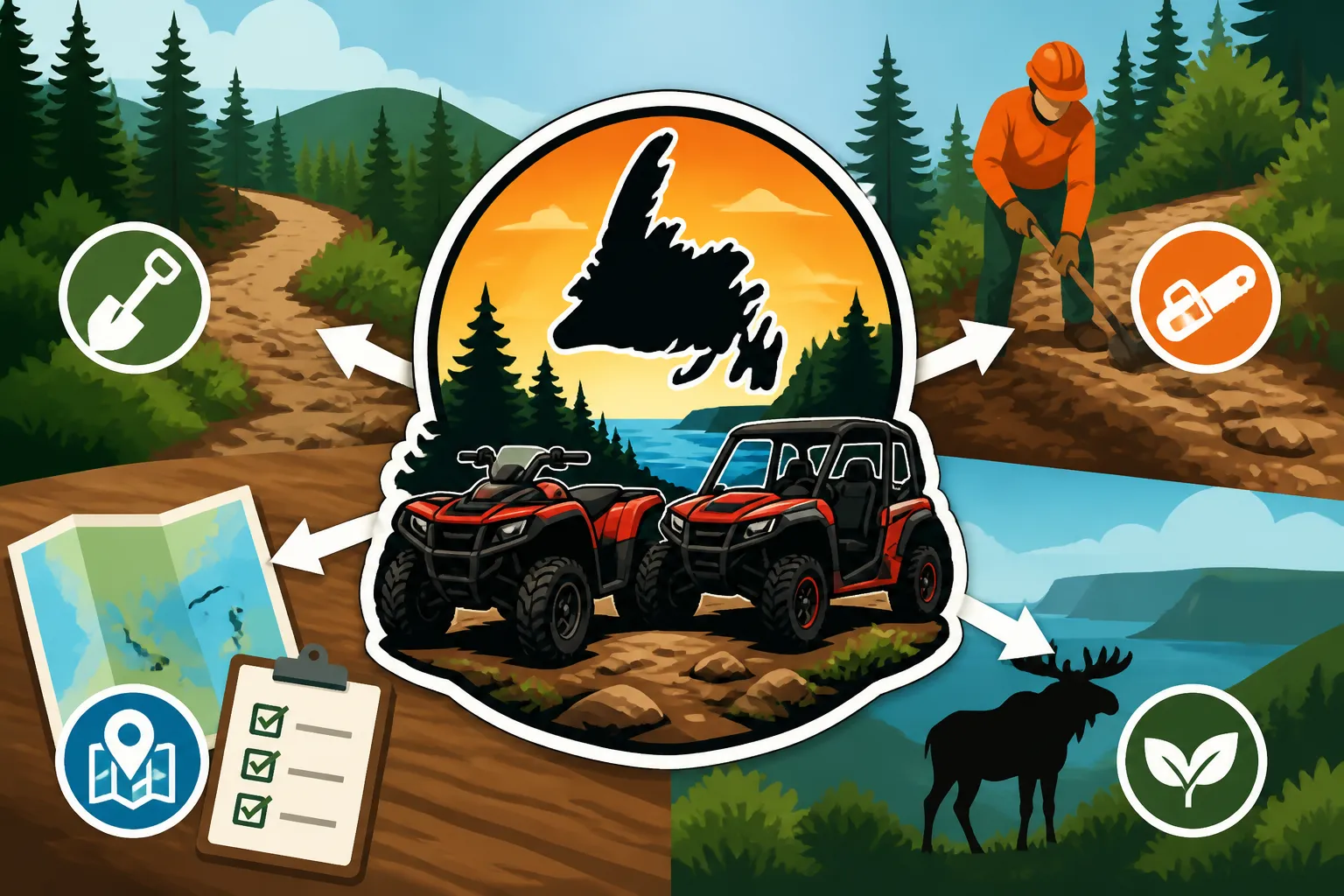
Where Your Newfoundland Trail Sticker Money Goes
A managed-trail sticker is easy to mistake for another registration charge, especially when you cannot see what it pays for. The practical answer is that sticker revenue is connected to operating the managed trail system, but you should not assume every dollar goes directly to the trail beneath your tires. Here’s what riders can reasonably expect—and what to ask before paying.
What your trail sticker money is meant to support
A trail sticker is tied to access on managed trails, not to ownership of your ATV or UTV. Its purpose is to help support the system that makes those designated trails available for riding. That can mean work such as maintaining trail surfaces, repairing damage, managing access points, and providing signs or other trail information.
The people and organizations doing that work may have costs beyond clearing or grading a trail. Depending on the operator and the arrangements in place, those costs can include administration, equipment, insurance, and coordinating trail use. It is reasonable to see a sticker as helping support trail operations overall, rather than as a direct payment for a particular stretch of trail.
That distinction matters. A sticker does not necessarily mean that the specific trail you ride will receive a matching amount of money, or that every section will be maintained to the same standard. Some routes may need more work than others; conditions can also change with weather, use, and available resources.
| What the sticker supports | What not to assume |
|---|---|
| The managed-trail system and its operation | That the full payment goes to one trail |
| Trail-related work and services arranged by operators | That every trail gets the same share |
| Costs that may include administration and equipment | That buying a sticker guarantees a particular trail condition |
| Access under the applicable managed-trail rules | That the sticker replaces registration, training, or insurance |
The sticker is also not the same as the government registration for your machine. Registration identifies the vehicle under Newfoundland and Labrador’s rules; the sticker relates to managed-trail access. If you are sorting out those separate requirements, see Newfoundland Registration Before Your First Ride and Newfoundland Managed Trail Rules.
Who receives the money and how to ask about it
Managed-trail stickers come through authorized trail operators. That means the operator is the best place to ask how sales are handled and what costs the sticker revenue helps cover. The arrangements may not be identical for every operator, so avoid assuming there is one universal allocation for every trail or region.
If you want a clear answer before buying, ask the operator a few direct questions:
- Who sells and administers the sticker for this trail?
- Does the sticker revenue support a local trail network, a broader managed-trail program, or both?
- What kinds of trail work or operating costs does it help fund?
- Is there a current summary of how revenue is used?
- Who should you contact about a damaged trail, missing sign, or access problem?
These questions are fair. They also help distinguish between the sticker’s purpose and the precise accounting behind it. An operator may be able to describe the work funded by trail revenue without providing a dollar-by-dollar breakdown for each trail. If you are looking for operator information, start with Newfoundland Trail Operator Contacts and confirm that the organization you contact is authorized to issue the sticker.
The sticker’s price and the way it is sold can change. Check with the operator for current details rather than relying on an old receipt, a social media post, or another rider’s recollection. For an overview of the purchase process, see How to Get a Newfoundland Trail Sticker and Newfoundland Trail Sticker Cost.
You can also ask whether the operator publishes updates about its work. A maintenance notice, trail report, annual summary, or member update may help show what the organization is doing. Those materials can explain priorities and projects, but they do not necessarily provide a complete accounting of sticker income.
What paying for a sticker does—and does not—give you
Buying a sticker gives you only the access described by the applicable managed-trail rules. It is not a general licence to ride anywhere in the province, and it does not remove other legal requirements. A sticker does not, by itself, make a restricted area open, authorize travel across private property, or replace a landowner’s permission where permission is required.
It also does not replace machine registration, required rider training, or insurance. Those requirements serve different purposes. Check the relevant rules before you head out, especially if you are riding somewhere unfamiliar or bringing a visitor’s machine. Managed Trails Require a Sticker on Your Machine explains the sticker requirement, while Newfoundland Safety Training Is Mandatory covers a separate obligation.
Do not assume that every exemption from one requirement also applies to another. Rules can depend on the land, the rider, the machine, and the type of trail. If you believe an exemption applies to your trip, confirm its scope with the relevant operator or official source before riding.
The sticker also cannot promise that every managed trail will be open or in good condition when you arrive. A route can be affected by weather, maintenance, temporary restrictions, or other local conditions. Check for current notices and ask the operator about access before making a long drive or planning a group ride.
At a trailhead, be ready to show that you have met the applicable requirements. The sticker is one part of that picture, not a substitute for the other documents or proof you may need. For what may be checked, see What Gets Checked at a Managed Trail Gate.
How to decide whether the sticker is worth buying
The value of a sticker is not only the amount printed on a receipt. It also depends on whether you plan to use managed trails, how often you ride, and what services or trail access the operator provides. If you will ride the managed network regularly, contributing to the system that supports it may be part of the cost of using that access. If your plans are limited, check whether the same sticker covers your intended rides and whether any other rules apply.
Before paying, use this short checklist:
- Confirm that your planned route is a managed trail and that the sticker is required there.
- Check which operator is authorized to issue it.
- Ask what period or access arrangement the sticker covers, and confirm current terms with the operator.
- Find out whether the sticker must be attached to the machine or can be carried, as the applicable rules allow.
- Check for closures, local restrictions, and trail conditions.
- Keep any purchase confirmation and carry the required proof while riding.
If your main concern is whether your money is being used responsibly, ask for a description of current priorities rather than expecting a guaranteed repair on a specific trail. Useful answers might identify the network or work supported, explain how maintenance needs are chosen, or point to public updates. If the response is vague, you can ask who manages the revenue and whether the operator shares reports with riders or members.
Some riders support trail organizations through other means, such as volunteering or membership. Those contributions are not automatically a replacement for a required sticker. If you are interested in local involvement, ask the operator what options exist; Newfoundland Club Membership Benefits may help you understand what club participation can involve.
A trail sticker is best understood as a contribution associated with access to managed trails, not a personal maintenance contract. Its value depends on the network you use and the work operators carry out. Check the current requirement, ask how the operator uses the revenue, and keep registration, training, insurance, and land-access rules in view as separate responsibilities. For broader land-use questions, see Newfoundland Crown Land Access Rules.
Disclaimer
This article is for general informational purposes only and does not constitute professional advice. Laws, prices and regulations vary by location and change over time. Consult a qualified professional for guidance on your specific situation.