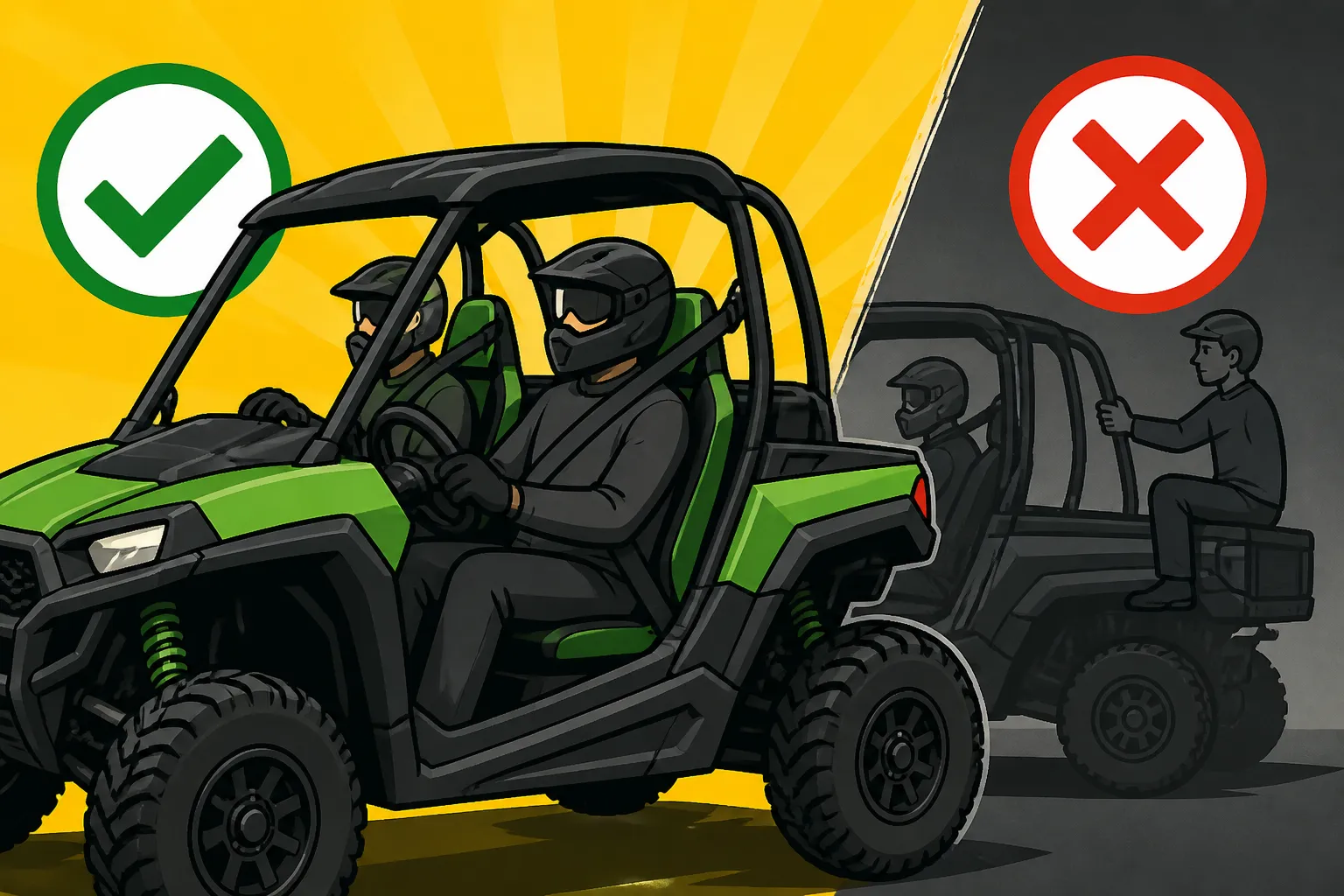
Passengers Must Sit on a Factory-Installed Seat
Riding the trails and barrens of Newfoundland is an incredible experience, but sometimes the rules around carrying passengers can feel a bit murky, leaving you wondering if you're putting yourself or others at risk, or even facing a fine. This guide will thoroughly explain Newfoundland's regulations regarding passengers on off-road vehicles (ORVs), ensuring you understand the critical requirement that all passengers must sit on a factory-installed seat, and what that means for your adventures.
Understanding the "Factory-Installed Seat" Rule in Newfoundland
Let's get straight to the heart of the matter: in Newfoundland and Labrador, if you're carrying a passenger on an off-road vehicle, that person absolutely must be seated on a seat that was installed by the manufacturer when the machine was built. This isn't just a suggestion; it's a fundamental part of the Off-Road Vehicles Act and its associated regulations. Many riders might see an open cargo rack or a handy spot on the fender and think it's perfectly fine for a short hop, especially on private land or a familiar cabin road. However, the law is quite clear and doesn't make exceptions for convenience or short distances.
The intention behind this rule is pure and simple: safety. Factory-installed seats are designed with specific ergonomics, weight distribution, and often, safety features like handholds or backrests in mind. They are integral to the ORV's overall stability and control, particularly when navigating uneven terrain or making sudden maneuvers. Without a properly designed and anchored seat, a passenger is at a significantly higher risk of being jostled off, falling, or suffering serious injury during a ride. It's about ensuring the machine operates as intended by its designers when carrying more than just the operator.
This regulation directly addresses the potential dangers of makeshift seating arrangements. We've all seen machines with cushions strapped to cargo racks or folks riding perched precariously on a fender. While these might seem harmless enough to the experienced rider, they introduce unpredictable variables that can quickly turn a fun outing into an emergency. The rule aims to eliminate these risks by standardizing where and how passengers can be carried, putting the onus on using only equipment designed and tested for human occupation. This means no improvising with milk crates, coolers, or simply having someone stand on the footpegs – it has to be a legitimate, purpose-built seat.
Why Designated Seating Matters for Safety
The emphasis on factory-installed seating isn't an arbitrary bureaucratic hurdle; it's rooted deeply in the physics and dynamics of off-road vehicle operation. ATVs and UTVs are incredibly powerful machines capable of traversing challenging terrain, and their design takes into account how a single operator or a specified number of passengers will affect balance, braking, and steering. When you add a passenger to a machine not designed for it, or improperly seat them, you fundamentally alter these critical dynamics.
Consider the center of gravity. An ATV, for instance, is designed for a single rider who actively shifts their weight to maintain balance and control, especially during turns or when climbing and descending hills. Adding a passenger, particularly one who isn't able to shift their weight in sync with the operator, can dangerously raise and alter the machine's center of gravity. This dramatically increases the risk of tipping over, especially on side slopes or during sharp turns. A factory-installed passenger seat, like those found on "two-up" ATVs or side-by-sides, positions the passenger in a way that minimizes this negative impact, often lower and closer to the machine's central axis, and with secure handholds. [Newfoundland Passenger Seat Requirements] highlight these safety considerations.
Beyond stability, there's the critical issue of impact protection. Factory seats often incorporate padding and sometimes even suspension elements that absorb shocks from rough terrain, protecting the rider's spine and body. A passenger perched on a hard, unpadded surface like a cargo rack has no such protection. Even a small bump can translate into a severe jolt, leading to bruising, sprains, or even spinal injuries. In the event of an accident, a properly secured passenger in a factory seat has a far greater chance of remaining within the protective envelope of the machine or being ejected in a less harmful manner than someone who was merely clinging on. [Newfoundland Helmet Law for Every Rider] is another crucial safety measure that works in conjunction with proper seating.
Navigating Different Machine Types: ATVs vs. Side-by-Sides
The "factory-installed seat" rule plays out differently depending on whether you're riding an ATV (all-terrain vehicle) or a UTV (utility task vehicle), often called a side-by-side. It’s crucial to understand these distinctions because what’s legal and safe for one machine might be prohibited and dangerous for another. The core principle remains, but its application varies with the machine's design and intended use.
Single-Rider ATVs and Passengers
Most traditional ATVs are designed and manufactured for a single operator. They have one seat, clearly intended for the person controlling the machine. While it might seem convenient to have a small child or even another adult sit behind you on the same seat, this is generally illegal and highly unsafe. These machines are not engineered to safely carry the weight and dynamics of two people. The extra weight behind the operator can make the front end light, affecting steering and making it easier to wheelie inadvertently. More critically, there are no proper handholds or footrests for a passenger, increasing their risk of falling off. Some riders might add aftermarket seating attachments to their single-rider ATVs, but these usually do not meet the "factory-installed" criteria for passenger safety and legal compliance under the Act.
"Two-Up" ATVs and Designated Passenger Seats
The market has responded to the demand for carrying passengers by developing specific models known as "two-up" or "tandem" ATVs. These machines are explicitly designed by the manufacturer to carry an operator and one passenger. They feature an elongated seat, often with a raised backrest for the passenger, dedicated handholds, and separate footrests. These are the only ATVs where carrying a passenger is legally permissible and safe, because the second seating position is a legitimate "factory-installed seat." When purchasing a two-up ATV, ensure it's clearly marketed and designed as such, not just a single-rider ATV with an added accessory seat. Brands like SuperATV offer many accessories for various ORVs, but remember the rule specifically points to factory-installed or manufacturer-approved passenger seating configurations. Always check your machine's documentation to confirm its passenger capacity.
Side-by-Sides and Multi-Passenger Seating
Side-by-sides (UTVs) are designed with multi-passenger capabilities in mind, often resembling mini-cars with bench seats or individual bucket seats and roll cages. For UTVs, the "factory-installed seat" rule means that passengers must sit in one of the designated seating positions provided by the manufacturer. These machines often come in two-seater, four-seater, or even six-seater configurations, complete with seatbelts (which are also mandatory) and doors or nets for occupant retention. You cannot add extra, non-factory seats to the cargo bed or cram more people onto a bench seat than it was designed for. Each passenger must have their own designated, factory-installed seating position and use the corresponding seatbelt. This is where UTVs really shine for family outings or group rides, as they inherently accommodate multiple people safely and legally. [Newfoundland Rules for a Side-by-Side Driver] cover these machines more extensively.
Here's a quick comparison of seating requirements for different ORV types:
| Machine Type | Passenger Capacity (Legal) | Seating Requirement | Key Safety Features |
|---|---|---|---|
| Single-Rider ATV | Operator Only | One factory-installed seat for the operator. | Designed for active rider weight shifts. |
| Two-Up ATV | Operator + One Passenger | Two factory-installed seats, one behind the other. | Elongated seat, backrest, handholds, separate footrests. |
| Side-by-Side (UTV) | Operator + Multiple Passengers | Factory-installed bench or bucket seats for each occupant. | Seatbelts, roll cage, doors/nets, individual seating. |
Consequences of Non-Compliance and Enforcement
Ignoring the "factory-installed seat" rule isn't just a matter of tempting fate with safety; it carries real legal consequences in Newfoundland and Labrador. Peace officers and Royal Newfoundland Constabulary (RNC) officers are authorized to enforce the Off-Road Vehicles Act, and they take these regulations seriously, especially when it comes to passenger safety. Getting caught with an improperly seated passenger can result in fines and, in some cases, other penalties that can really put a damper on your riding season.
The fines for violating ORV regulations can vary depending on the specific offense and whether it's a first or repeat infraction. Carrying an improperly seated passenger typically falls under safety violations, which can lead to significant financial penalties. Imagine planning a fun weekend ride to your cabin, only to be stopped by an officer on a main access trail and slapped with a hefty fine simply because your buddy was perched on the cargo rack. It’s a frustrating situation that’s entirely avoidable by understanding and adhering to the rules. [Newfoundland Penalties for Riding Illegally] covers the range of potential fines and repercussions you might face.
Beyond direct fines, there are other potential repercussions. In the event of an accident involving an improperly seated passenger, your insurance coverage could be jeopardized. Most insurance policies are contingent on adherence to local laws and safe operating practices. If a passenger is injured while riding illegally, your insurer might deny a claim, leaving you personally liable for significant medical bills and damages. This is a far more severe consequence than a fine and underscores the importance of proper seating. [Newfoundland Insurance Requirements for Riders] are important to review before hitting the trails.
Officers are also empowered to issue warnings, order you to cease operation, or even seize your machine in more egregious or dangerous situations. While a warning might be a lighter outcome, being ordered to stop riding mid-trip can ruin your day, and having your ORV impounded comes with additional towing and impound fees. They are trained to look for obvious safety infractions, and a visibly unsecured passenger or one not in a proper seat is usually a clear sign of non-compliance. Always be prepared to show [Newfoundland Proof of Ownership on the Trail] and adhere to all safety regulations to ensure a smooth and legal ride. Don't let a simple oversight turn your passion for riding into a costly headache.
Disclaimer
This article is for general informational purposes only and does not constitute professional advice. Laws, prices and regulations vary by location and change over time. Consult a qualified professional for guidance on your specific situation.