Newfoundland Trails With Camping
A Newfoundland ATV camping trip can go sideways when the trail, campsite, fuel stop and overnight rules don’t line up. The T’Railway offers a long route across the island, but it isn’t a continuous campground, and nearby parks don’t automatically allow riding inside their boundaries. This guide explains how to plan overnight stops, check access and pack for changing conditions.
Plan your route around campsites, not just trail mileage
Understand what the T’Railway does and does not offer
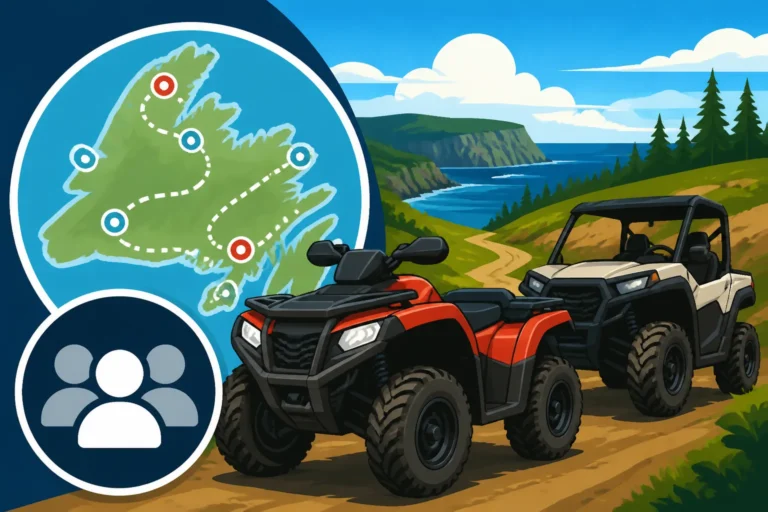
The T’Railway is an approximately 883-kilometre rail corridor running across Newfoundland between Port aux Basques and the St. John’s area. It gives riders a useful backbone for a multi-day trip, but distance on a map can be misleading: services and overnight facilities are not evenly spaced, and a trail corridor should not be treated as an invitation to pitch a tent wherever you find a flat patch.
Before choosing a campsite, establish the actual route between the trail and the place you intend to sleep. A campground may look close on a map but require a long road detour, a difficult connection, or permission to cross private land. Don’t assume you can ride through a provincial park, onto a private campground, or along a local road simply because it appears to connect two points. Confirm the access rules with the land manager, campground or relevant local authority.
Break a longer trip into realistic daily sections. Account for the pace of your group, trail surface, weather, stops for fuel and food, and the possibility that a boggy or rough stretch will take much longer than expected. For an introduction to the corridor and its different sections, read [Riding the T'Railway From St John's to Port aux Basques]. You can also use [Newfoundland ATV Trail Map Downloads] as one part of your planning, while checking access and closures with the appropriate local sources.
Treat campgrounds as a base, not an automatic trail connection
Several parts of Newfoundland have established campgrounds that may be worth investigating as overnight bases. Examples include J.T. Cheeseman Provincial Park near Port aux Basques, Barachois Pond Provincial Park near Stephenville, Sir Richard Squires Memorial Provincial Park near the Buchans area, Notre Dame Provincial Park near Lewisporte, Lockston Path Provincial Park on the Bonavista Peninsula, and Butter Pot Provincial Park in the St. John’s region.
These names are starting points for research, not a promise that a campground has direct ATV access or accepts every kind of machine. Ask whether the site permits ATV or UTV use on its property, whether you can keep a machine and trailer there, and whether the route from the campground to your intended riding area is legal. In a provincial park, don’t ride on hiking trails or through park grounds unless the park specifically permits it. You may need to trailer your machine to an approved riding area instead.
A practical option for some riders is to leave the machine secured at a campground and use it as a base for a day trip, rather than trying to ride directly from the campsite. That can be less exciting than rolling straight out of your tent onto the trail, but it avoids making a questionable connection part of your itinerary. For more planning ideas, see [Newfoundland Campgrounds Near a Trailhead] and [Newfoundland Cabins Near a Riding Area].
Choose the right overnight setup
Compare campgrounds, cabins and dispersed camping carefully
A serviced campground can make a multi-day ride easier, especially if you want access to washrooms, potable water, a place to cook and a clear check-in process. It can also give you a predictable place to park a truck and trailer. The trade-off is that your riding route may not start at the campground, and you’ll need to confirm the rules for machine storage, noise, late arrivals and trail access.
A cabin or other fixed accommodation may be more comfortable when coastal weather turns wet or cold. It can also give riders a proper place to dry gloves and layers overnight. The main planning question is still access: check whether riding to the cabin is allowed, or whether the machine must be trailered to a trailhead. A booking that welcomes people and trailers does not necessarily mean the property welcomes ATV use.
Dispersed camping requires even more care. Don’t assume an empty clearing beside a railbed, a woods road or a pond is public land where camping is permitted. Land ownership, protected areas, local restrictions, fire rules and permission requirements can differ. Confirm the land status and applicable rules before setting up, and leave the site as you found it. If you cannot establish that an overnight stop is allowed, choose a confirmed campground or accommodation instead.
| Overnight option | What it can offer | What to confirm before you go |
|---|---|---|
| Established campground | Facilities, a defined place to stay and potentially secure trailer parking | ATV rules, machine storage, access route, check-in requirements and seasonal opening |
| Cabin or lodge | Shelter from rain and a place to dry gear | Whether machines are allowed on the property, parking arrangements and legal trail access |
| Dispersed campsite | Flexibility and a quieter overnight setting | Land ownership, camping permission, fire restrictions, sensitive habitat and waste disposal |
| Trailside stop | A tempting option when daylight is fading | Whether stopping or camping there is allowed; never assume the rail corridor is a campsite |
Ask the questions that prevent a frustrating arrival
Call or message the campground or accommodation before you build the ride around it. Explain that you’re travelling by ATV or side-by-side, whether you’re bringing a trailer, how many machines are in your group and what time you expect to arrive. Ask about parking dimensions, security, machine washing, quiet hours and whether fuel or supplies are nearby. A quick conversation can uncover a restriction that a general lodging listing doesn’t mention.
If you’re booking for a group, make sure the site can handle the whole setup—not just the riders. A group of machines may need more space than expected, and trailers can be difficult to manoeuvre in a busy campground. If you plan to leave machines overnight, ask where they can be parked and whether the area is accessible without driving through a restricted part of the property.
Finally, make a backup plan. A site may be full, the access road may be unsuitable for your trailer, or severe weather may make it unwise to continue. Identify a second overnight option and a safe place to turn around before you set off. For broader trip-planning advice, [Newfoundland Weekend Riding Itineraries] can help you think in terms of manageable sections rather than ambitious mileage alone.
Check riding access, conditions and local rules
Confirm that every connection is legal
A camping itinerary often includes more than the main trail. You may need to travel from a trailhead to a campground, cross a road, pass through a community or use a spur route to reach supplies. Each connection matters. A route shown on a general map is not proof that ATVs are allowed there, and a route that was passable on a previous visit may now be closed or affected by construction, erosion or seasonal restrictions.
Check the relevant trail operator’s guidance and ask local authorities or land managers about uncertain sections. Pay close attention to posted signs and barriers. Don’t bypass a closure because the detour looks inconvenient, and don’t ride across private land without permission. If your route includes managed trails, make sure you understand the sticker and other requirements before leaving home; [Newfoundland Managed Trail Rules] is a useful starting point.
Mapping tools can help you compare possible routes, identify distance between stops and mark fuel or camping options. For example, onX Offroad may be useful as a planning layer for organizing a route and saved locations. Still, don’t treat any app as the final word on permission, current closures or land access. Cross-check important sections with official maps, trail operators and local sources. That extra check is particularly worthwhile when a short-looking connector is the only way to reach your overnight stop.
Check weather, trail conditions and seasonal limits
Newfoundland weather can shift quickly, especially on exposed stretches of trail. Rain can make a wet route harder to manage, fog can reduce visibility, and strong wind can make a long day on open barrens uncomfortable. Check the forecast for the areas you’ll actually ride—not only the nearest town—and leave room in the schedule for slower travel or a change of plan. [Newfoundland Trail Conditions Before You Ride] and [Newfoundland Riding Season and Weather] are relevant checks before setting out.
Fire restrictions deserve special attention when your trip includes camping. Rules and restrictions can vary by area and season, so check the applicable notices before lighting a campfire or using outdoor cooking equipment. A fire ban can change your meal plan and your choice of campsite. Don’t assume that a fire is allowed because a previous visitor had one, or because a campsite includes a fire ring. Review [Newfoundland Fire Season Dates] and follow the current instructions from the responsible authority.
Use a map with an offline option, carry a paper backup and share your route and expected check-in times with someone who is not riding with you. Mobile coverage may be unreliable in remote areas. onX Offroad can help you save a planned route or key locations for reference, but a phone battery can run down or a device can fail. Carrying a paper map and knowing how to use it gives you another way to orient yourself if that happens.
Pack for an overnight ATV trip
Prepare the machine and the campsite separately
A machine that is ready for a day ride may need extra attention before a multi-day trip. Inspect tires, brakes, lights, controls and fluid levels before departure. Check the winch and recovery points if your route may include soft ground, and bring repair items suited to your machine. Carrying a spare belt where appropriate, a basic tool kit and a reliable tire-repair setup can help with minor problems far from a shop.
Keep camping equipment secure and balanced. Heavy gear should not be piled high or allowed to shift, and cargo should not block your view or obscure the machine’s plate. Use dry bags or waterproof containers for sleep gear and spare clothing. Newfoundland rain can turn a comfortable camp into a miserable one if your sleeping layer, gloves and warm clothes are wet before you arrive.
Pack the campsite essentials as deliberately as the riding gear: water, food, a first-aid kit, headlamps, charging options, waste bags and a way to stay warm if conditions change. If you’ll be camping away from services, calculate supplies for the full trip plus a delay. A stalled schedule can mean another night out, so keep a modest reserve rather than planning every meal and battery charge to the last minute.
Make the day’s finish safe and predictable
Set a turnaround time each day. If the group is behind schedule, the weather is worsening or a machine is having trouble, stop adding detours and head toward a safe, confirmed place to stay. Riding into darkness to reach a campsite can create a bigger problem than spending an extra night at a closer, suitable option. Tell someone your intended route and let them know if your plan changes.
At the end of the ride, park machines in the location approved by the campground or landowner. Keep cooking and sleeping areas separate from exhaust and fuel, and store food and waste responsibly. Avoid leaving equipment on a trail or blocking access for other users. Shared routes may also be used by walkers, cyclists, maintenance crews and other riders, so slow down, give people space and keep noise under control. [Newfoundland Trail Etiquette Locals Expect] offers helpful reminders for sharing the corridor respectfully.
For navigation, onX Offroad can be one component of your trip plan, alongside your offline map, written itinerary and local access checks. Before departure, confirm the next day’s trail status and overnight arrangements rather than relying on a saved route alone. If the group can’t verify that a campsite and its access are permitted, choose a known alternative. A little flexibility is part of a good Newfoundland riding trip: it gives you room to enjoy the route without turning a camping plan into a last-minute scramble.
Disclaimer
This article is for general informational purposes only and does not constitute professional advice. Laws, prices and regulations vary by location and change over time. Consult a qualified professional for guidance on your specific situation.