Newfoundland Riding in Summer
Summer is a tempting time to explore Newfoundland by ATV or UTV, but long daylight hours do not make every trail easy or every route legal. A sunny start can turn into fog, rain, soft bog, or a washed-out section. This guide covers how to plan a summer ride, check access, prepare your machine, and make sensible choices on the trail.
Plan a Newfoundland summer ride before you unload
Choose a route that matches your group
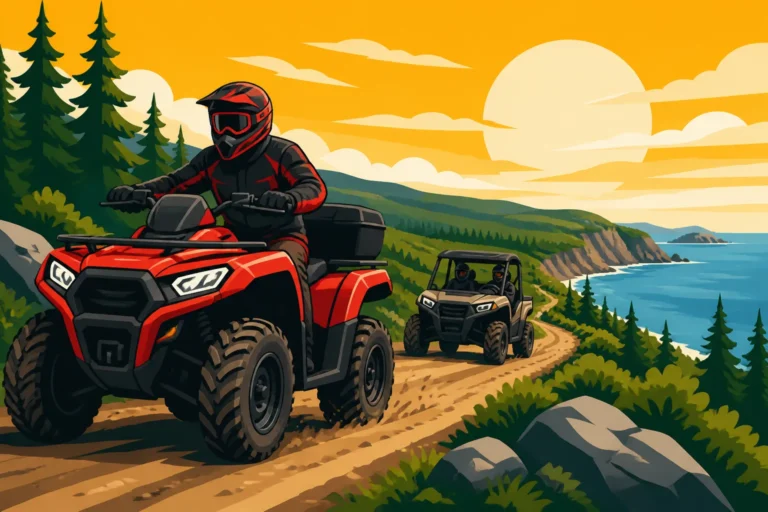
Newfoundland offers very different riding experiences, from stretches of the T’Railway to rougher routes across barrens, woods roads, and boggy ground. A route that sounds manageable on a map can feel very different when you meet loose ballast, standing water, a narrow trail, or a long distance between places to turn around. Choose your ride based on the least experienced person in your group, not the most confident rider.
The T’Railway is a shared corridor, not a private ATV track. Walkers, cyclists, and other trail users may be present, and trail conditions can vary along its length. Before planning a long day, look into the specific section you want to ride rather than assuming the entire route has the same surface or access. For more background, see [Newfoundland ATV Trails: The T'Railway and Beyond] and [Riding the T'Railway From St John's to Port aux Basques].
For a first outing, a shorter out-and-back ride is often less stressful than a one-way route that depends on a pickup at the far end. It gives your group a clear turnaround point and lets you assess the surface before committing to more distance. If one rider is tired, cold, or uncomfortable with the terrain, you can head back without leaving someone to wait for a complicated shuttle.
Before setting off, identify likely stopping points, fuel options, and places where your group could safely turn around. A route that looks close on a screen may still take much longer than expected when you stop for other users, navigate rough ground, or wait out weather. Build in more time than you think you need, especially if you are unfamiliar with the area.
Check trail access and conditions
A visible track is not automatically an authorized place to ride. Access can depend on whether the route is approved, whether it crosses private land, and whether temporary restrictions or closures apply. Check the rules for the specific area, and do not treat an old track, an open gate, or another rider’s tire marks as proof that a route is open to motorized use. [Newfoundland Crown Land Access Rules] explains why checking access matters before heading out.
If your plan includes a community or municipal road, confirm that local rules allow the riding you have in mind. Rules on a particular road can differ from what applies on a managed trail or approved area. When the answer is unclear, ask the relevant town office, trail operator, or land manager before you unload. A quick question at the start can prevent a frustrating turnaround—or a conflict with a landowner—later.
Trail reports and maps are useful planning tools, but they are not guarantees. Conditions may change after heavy rain, and a route that was passable last weekend may have new washouts, deep water, or fresh damage. If you use a mapping app such as onX Offroad, check the area and save the information you need before leaving service. Treat the app as a navigation aid, not as confirmation that every line shown is legal or currently open.
Prepare for changing weather and rough ground
Pack for a day that can change quickly
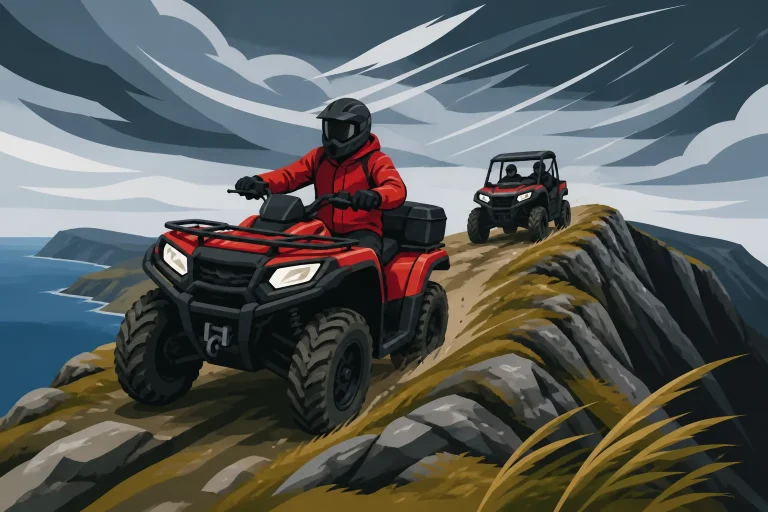
Summer weather on the island can be unsettled, particularly on open or exposed sections. A warm morning does not mean you will stay comfortable all day. Fog, rain, wind, and wet clothing can make a ride feel miserable much sooner than people expect, especially if they have planned a long route with few sheltered stops.
Pack layers that you can add or remove, and bring rain protection that covers you while riding—not just a light jacket that works for a walk from the truck. Keep a dry layer in a sealed bag. Gloves, eye protection, water, food, and basic first-aid supplies are easy to overlook when the forecast looks pleasant, but they matter when a short ride becomes a slow return in wet weather.
The table below is a practical starting point. Adjust it for your group, route length, machine, and forecast.
| Ride concern | Useful preparation | Why it matters |
|---|---|---|
| Rain and cold wind | Waterproof outer layer and a dry spare layer | Wet clothing can make a long ride uncomfortable and distracting |
| Navigation gaps | Downloaded map, saved route, and a paper backup | Cell service may not be available throughout a route |
| Minor delays | Water, food, and a basic first-aid kit | A stop or detour can stretch the day |
| Mechanical trouble | Machine-appropriate tools and a tow strap | A small problem can become a recovery issue far from the trailhead |
| Shared-trail riding | Eye protection, working lights, and a way to communicate within the group | Other users and changing visibility call for attention and coordination |
Navigation deserves a little extra attention if your route crosses areas with weak service. You can use onX Offroad or another mapping tool to review your plan and save map information ahead of time, but bring a backup way to understand where you are. A paper map or a clearly written route plan can help if a phone battery dies, a device gets wet, or the group takes an unexpected turn.
Inspect your ATV or UTV before leaving
A machine that ran well in the driveway still deserves a proper check before a longer ride. Look over the tires, brakes, steering, lights, and visible fluid levels. Check that cargo is secured and cannot shift into the controls or block the machine’s plate. If you have a side-by-side, make sure required belts are in place and usable. If you are riding with a passenger, confirm the machine has a passenger seat designed for that purpose.
Carry basic recovery gear suited to your machine and experience. A tow strap, gloves, and a small set of tools may be useful, but they do not replace judgment. If the group is unfamiliar with deep bog or water crossings, the safest choice may be to turn around rather than attempt a recovery that could damage the machine or put someone at risk. Newfoundland’s terrain can punish a rushed decision.
Before departure, agree on a simple group plan: who leads, who rides at the back, where you regroup, and what to do if someone stops. Keep enough distance to see the rider ahead without crowding them. If one person has to slow down or pull over, the rest of the group should know how to respond rather than continuing until they notice someone is missing.
Ride responsibly on shared and sensitive terrain
Give other trail users room
Summer brings more people outdoors, and not all of them are travelling by machine. On shared routes, slow down when approaching walkers and cyclists, give them plenty of space, and wait until the trail is clear before passing. Reduce speed around blind corners and dusty stretches, where another user may be difficult to see. A friendly wave is no substitute for slowing down, but courteous riding helps everyone feel safer.
Stay on the authorized route instead of widening it to get around mud, puddles, or a slow section. Riding around a wet patch can create a second track that damages vegetation and makes the area harder to manage. If the trail is too soft or damaged for your machine, turn back or choose another route. Avoid treating a bog as a challenge to conquer simply because the machine has enough power to push farther.
If you are riding the T’Railway, remember that the corridor serves different kinds of users. Keep noise and speed under control near people, buildings, and trail access points. Give cyclists and pedestrians time to react, and do not assume they can hear you coming around a bend. The guidance in [Riding Etiquette on a Shared Railbed] is useful for setting expectations before your group begins.
Respect restrictions, fire conditions, and private land
Summer riding plans should include a check for restrictions that can change with conditions. Fire-related rules, closures, and land-access requirements may affect where or when you can ride. Check the notices relevant to your route before leaving, and follow posted signs once you arrive. Do not assume a restriction applies only to campfires; riding access can also be affected by land management decisions or conditions on the ground. See [Newfoundland Fire Season Riding Restrictions] for a related overview.
Private land requires care even when a route looks like a familiar woods road. A road that has been used by riders may still cross land where permission is needed, and a gate or sign may communicate a boundary or restriction. If you are uncertain, ask the landowner or relevant authority rather than riding through and hoping the route is open. Do not move a barrier or use another person’s passage as permission for your own group.
Use current maps and local advice together. A mapping app such as onX Offroad can help you keep track of your route, but access decisions should be based on reliable information about the specific land and trail. Downloading a map before you lose service is sensible; checking signs and closures at the trailhead is just as important. Keep a backup plan in case the route you intended to ride is closed or too wet.
Make the day safer and easier for everyone
Plan fuel, timing, and a turnaround point
A common summer mistake is planning around distance alone. The route may appear short, but soft ground, stops, other trail users, and navigation can all add time. Estimate the day conservatively and set a time to turn back even if you have not reached the point you hoped to see. That gives your group a clear decision when the ride is taking longer than expected.
Fuel planning should account for the machine, terrain, load, and riding style. Rough or soft ground can use fuel differently than a relaxed ride on a firm surface. Start with enough fuel for the planned route and a reasonable margin for a detour or delay. If the route depends on a fuel stop, confirm that the stop is available and accessible rather than relying on a vague assumption that something will be open along the way.
Tell someone who is not riding where you plan to go and when you expect to be back. If the plan changes, update them when you can. This is especially helpful for routes where service is inconsistent or where the group may be far from a road. Keep your phone charged, but do not make your whole safety plan depend on being able to call from every point on the trail.
Keep the ride comfortable for the whole group
The best summer route is not necessarily the longest one. For a mixed-experience group, choose a plan with options: a shorter loop, a clear turnaround, or a nearby place to stop if conditions change. Check in with quieter riders instead of assuming they will speak up when they are uncomfortable. Someone who is tired or anxious may need a break before the group reaches a difficult section.
Be honest about skill and machine limits. A UTV may feel stable and powerful, but that does not make a steep, wet, or boggy section safe. An ATV can be nimble, but it can also become difficult to recover if it gets deeply stuck. Keep passengers comfortable, secure cargo, and avoid pressure to follow another rider onto terrain you have not assessed for yourself.
If your route or plans change because of weather, closures, or trail conditions, treat that as good decision-making—not a failed outing. A shorter ride that ends safely is better than pressing on simply because the group drove a long way to reach the trailhead. For planning by season, [Newfoundland Riding Season Month by Month] can help you compare summer with other riding periods, while [Packing for Weather That Changes Every Hour] offers practical preparation ideas for unsettled conditions.
Disclaimer
This article is for general informational purposes only and does not constitute professional advice. Laws, prices and regulations vary by location and change over time. Consult a qualified professional for guidance on your specific situation.