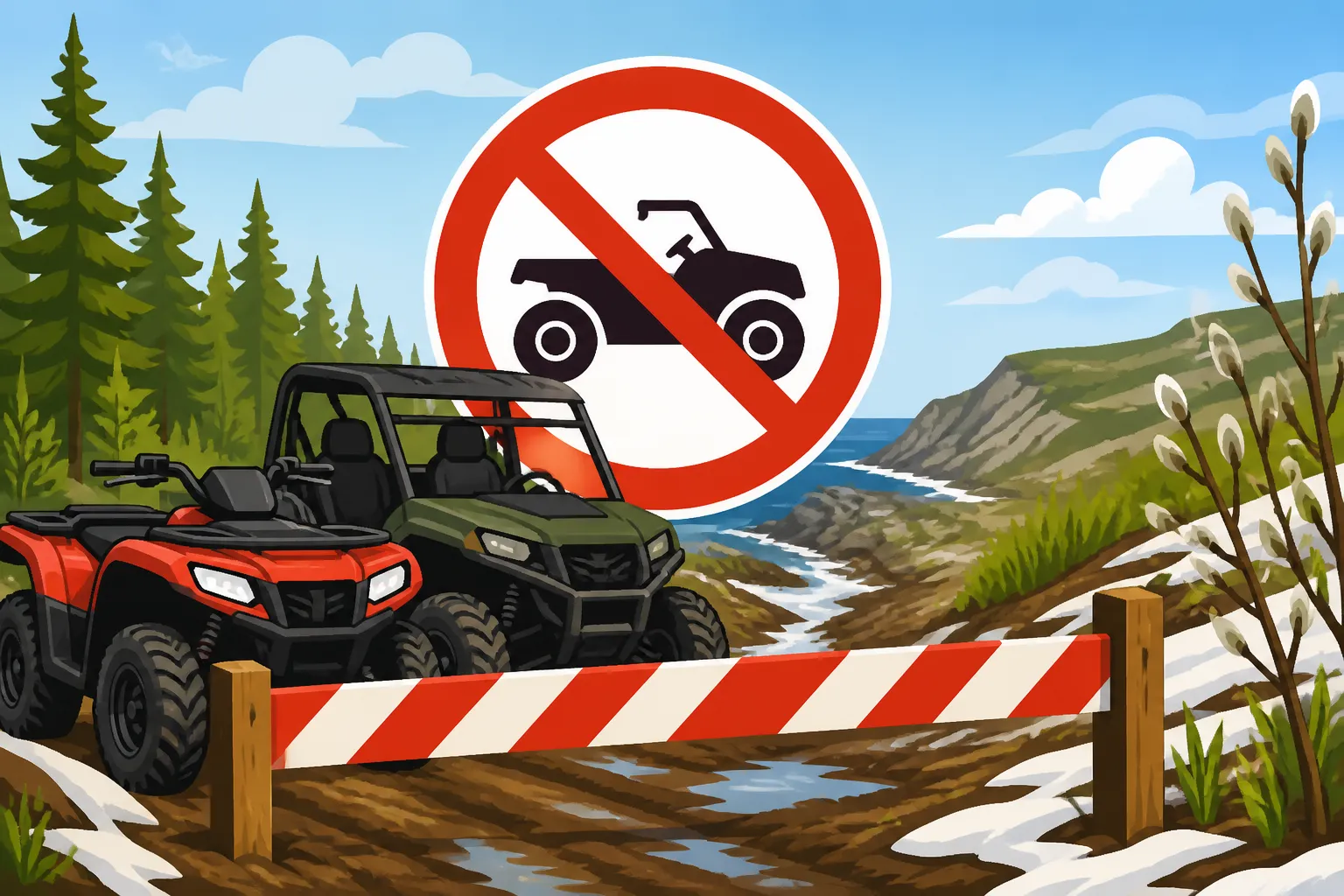
Newfoundland Trails Closed in Spring
A warm weekend can make a Newfoundland trail look ready to ride, while shaded sections are still soft, flooded, or posted closed. Spring closures protect vulnerable trails from deep ruts and damage that can linger long after the ground dries. This guide explains why closures happen, how to check access before hauling your ATV or UTV, and what to do when your usual route is off-limits.
Why Newfoundland trails close in spring
Thaw turns firm trails into fragile ground
Newfoundland spring conditions can change quickly from one stretch of trail to the next. A sunny, dry approach may lead into a shaded hollow with standing water, soft soil, or lingering snow. The surface can look solid but give way under a machine’s tires, especially where water has nowhere to drain.
When a trail is saturated, an ATV or side-by-side can leave deep ruts. Those ruts collect water, widen with repeated traffic, and can be difficult to repair. Boggy areas and wetlands are particularly vulnerable: driving around a puddle often creates a new track through vegetation rather than solving the problem.
The damage is not just cosmetic. A badly rutted trail can become harder and less safe to use, and repairs may require time, materials, and volunteer effort. That is why a spring closure may be in place even when the route seems passable at first glance.
Closures protect more than the trail surface
Trail operators and land managers may close a route or section to prevent damage while the ground is thawing. A closure can also reflect a local access restriction, maintenance work, a washout, or a concern about conditions that have changed since the last inspection.
There is no single spring opening date that applies to every Newfoundland route. Snowmelt, drainage, elevation, shade, recent rain, and the type of trail all affect how quickly conditions improve. A section near Corner Brook may be rideable while a wet area elsewhere remains too soft. Even two nearby sections of the same route can recover at different speeds.
A trail’s usual reputation does not override a current closure. Check the route’s current status and posted signs, and do not ride around a gate or barrier. For a wider look at access restrictions, see [Newfoundland Restricted Areas and Approved Trails] and [Newfoundland Crown Land Riding Rules].
Not all routes respond to spring in the same way
A gravel railbed, a forest road, a narrow trail, and a bog crossing do not handle thaw in the same way. A firm gravel surface may drain better than a low-lying, muddy trail, but that does not mean every railbed section is open or suitable. Bridges, approaches, culverts, and nearby side trails may have separate issues.
The T’Railway is a long corridor crossing many different landscapes. Its conditions can vary considerably from one community to another, so a report about one section should not be treated as a report about the whole route. If you are planning a longer trip, consult [Newfoundland ATV Trails: The T'Railway and Beyond] and [Newfoundland Trail Conditions Before You Ride] as starting points, then confirm the specific section with the appropriate trail contact.
How to check whether a Newfoundland trail is open
Check the route close to your planned ride
Start with the organization responsible for the trail or area. Depending on where you plan to ride, that may mean a trail operator, a local club, a community council, or the relevant provincial land-management office. Look for a current notice about spring access, trail work, water damage, or a closure. If the notice is unclear, ask about the exact entrance and section you intend to use.
A map can help you plan, but it may not show a closure that was posted recently. Apps such as onX Offroad can be useful for understanding route layouts and keeping your planned ride organized. Treat any mapping app as a navigation aid, not proof that a trail is open. Verify access with the responsible operator and obey signs on the ground.
A quick check before leaving home can prevent a long drive with a trailer only to find a barrier at the trailhead. If you are travelling from St. John’s toward an area near Clarenville, for example, check both the destination route and the access point you plan to use. Conditions and restrictions can differ between them.
Use several checks instead of relying on one clue
A social media post or a rider’s report can be helpful, but it may describe a different date, entrance, or section. Likewise, a track shown in an app may reflect where someone rode in the past rather than current permission to ride. If reports conflict, contact the responsible operator and follow the latest official notice or posted closure.
Use this checklist before setting out:
- Identify the exact trail section and access point you want to use.
- Check for current closures or seasonal restrictions from the responsible operator.
- Look for recent notices about maintenance, flooding, washouts, or soft conditions.
- Confirm that your planned route is permitted for your type of machine.
- Check signs and barriers when you arrive, even if you have already confirmed the route.
- If conditions are uncertain, choose a confirmed open route or postpone the ride.
For more help with locating permitted areas and understanding access, read [Finding Approved Areas on the Provincial Map] and [Emailing a Trail Operator Before You Ride]. onX Offroad can help you keep route options visible while planning, but it should sit alongside—not replace—local confirmation.
Read a closure as a boundary, not a suggestion
A gate, sign, berm, or barrier is a clear signal to stop and find out what is permitted. Do not assume that a closure applies only to trucks, only to one vehicle type, or only to the visible section. If the notice does not explain the limits, ask the trail operator rather than riding past it to investigate.
Do not make a new route around a closed section. Going around a barrier through brush or wet ground can damage vegetation, create unauthorized tracks, and expose riders to hazards that the marked route was meant to avoid. The same goes for following tracks left by another machine. Fresh tire marks do not prove that access is allowed.
What spring trail notices may mean for riders
A closure can apply to a section or an entire route
Some notices identify a particular crossing, entrance, or stretch as closed. Others may restrict use of a broader area. Read the wording carefully and note any landmarks or endpoints. If you are not sure whether your route crosses the restricted area, ask before loading your machine.
Closures can also change. A section may be closed for a period of repair, then reopen when the operator considers it safe. Conversely, heavy rain or new damage can lead to a fresh restriction. A notice you saw earlier in the week may not reflect what you find on the day of your ride.
Use a map to trace your intended route and identify alternative access points, but do not assume an alternate entrance avoids the closure. A restriction may apply to the whole trail or area, not just the nearest gate. onX Offroad may help you compare route options, while the trail operator can clarify which routes remain available.
Open does not always mean dry or easy
A route that is open may still be rough, wet, or difficult. Opening status means access is permitted under the applicable rules; it is not a promise of ideal riding conditions. Expect standing water, soft shoulders, debris, or uneven ground where the trail has been affected by thaw or storms.
If you find a wet patch on an open route, stay on the established trail and avoid widening it. Do not spin the tires in deep mud or push through a section that could be damaged by repeated passes. When a reasonable, safe passage is not available, turn back and report the problem to the operator.
Spring conditions also make it important to leave room for other trail users and to ride at a speed suited to visibility and footing. A shaded bend may hide a soft spot, a downed branch, or someone approaching from the other direction. See [Newfoundland Trail Etiquette Locals Expect] for more on sharing routes responsibly.
Use a simple decision guide at the trailhead
Before unloading, take a moment to check the signs, surface, and weather. If the entrance is posted closed, do not ride in. If the status is uncertain, pause and contact the operator. If the route is open but the first section is already badly saturated, consider choosing a firmer route or calling the ride early.
| What you find | Sensible response |
|---|---|
| A posted closure or barrier | Do not enter or ride around it. Confirm the restriction with the responsible operator. |
| Conflicting reports about access | Verify the exact route and date with the operator before unloading. |
| Standing water and soft ground on an open route | Stay on the established track, avoid creating bypasses, and turn back if passage would cause damage. |
| A washout, damaged crossing, or new hazard | Keep a safe distance and report the location to the trail contact. |
| A firm, open route with no restriction | Ride within the permitted area and continue checking conditions as they change. |
Planning a spring ride without damaging trails
Choose routes and timing with flexibility
Plan a spring outing around confirmed access rather than choosing a destination first and hoping the route is open. If you are bringing a group, agree on a backup route before anyone leaves. That is especially useful when riders are coming from different communities or towing machines to a shared meeting point.
A later date may offer firmer conditions, but the calendar alone cannot tell you whether a trail is ready. Recent rain, snowmelt, drainage, and shade matter. Check again on the day of travel, particularly if the weather has changed since your first inquiry.
Keep your route plan realistic. A short ride on a confirmed section is often better than pushing into a questionable area to preserve a longer itinerary. For trip preparation and changing conditions, [Packing for Weather That Changes Every Hour] and [Newfoundland Riding After Heavy Rain] offer useful planning reminders. onX Offroad can help you keep a backup route in view, but confirm that alternate route is open before using it.
Protect soft ground and report problems
When the surface is damp but the route is open, ride smoothly and avoid sudden acceleration that spins the tires. Do not repeatedly cross the same soft area to test it. If other riders are with you, avoid bunching up in a vulnerable spot, where several machines can churn up the same ground in quick succession.
If you encounter a section that looks damaged or unsafe, note the nearest trail marker, entrance, or recognizable landmark. A clear description helps the operator locate the issue. You can also record the direction you were travelling and whether the problem involved water, a washout, debris, or a blocked crossing. Do not move barriers or attempt repairs that could create additional hazards.
The care riders take during spring can affect access for everyone later in the season. Respecting closures, sticking to established routes, and sharing accurate condition reports helps protect trails for ATV and UTV users, hikers, cyclists, and other permitted visitors.
Keep the rules and paperwork in mind
Trail access is only one part of a legal ride. Make sure your machine and riders meet the requirements that apply to the area, and carry the required documents and proof while riding. Rules can differ depending on where you are travelling and what kind of route you are using.
If you are unsure about access, trail conditions, or what applies to your machine, ask the relevant operator or authority before the trip. It is far easier to change plans at home than to discover at a closed entrance that the route is unavailable. A spring ride is most enjoyable when the trail is ready for it—and when your plan leaves room to turn back.
Disclaimer
This article is for general informational purposes only and does not constitute professional advice. Laws, prices and regulations vary by location and change over time. Consult a qualified professional for guidance on your specific situation.