Newfoundland Moose Encounters While Riding
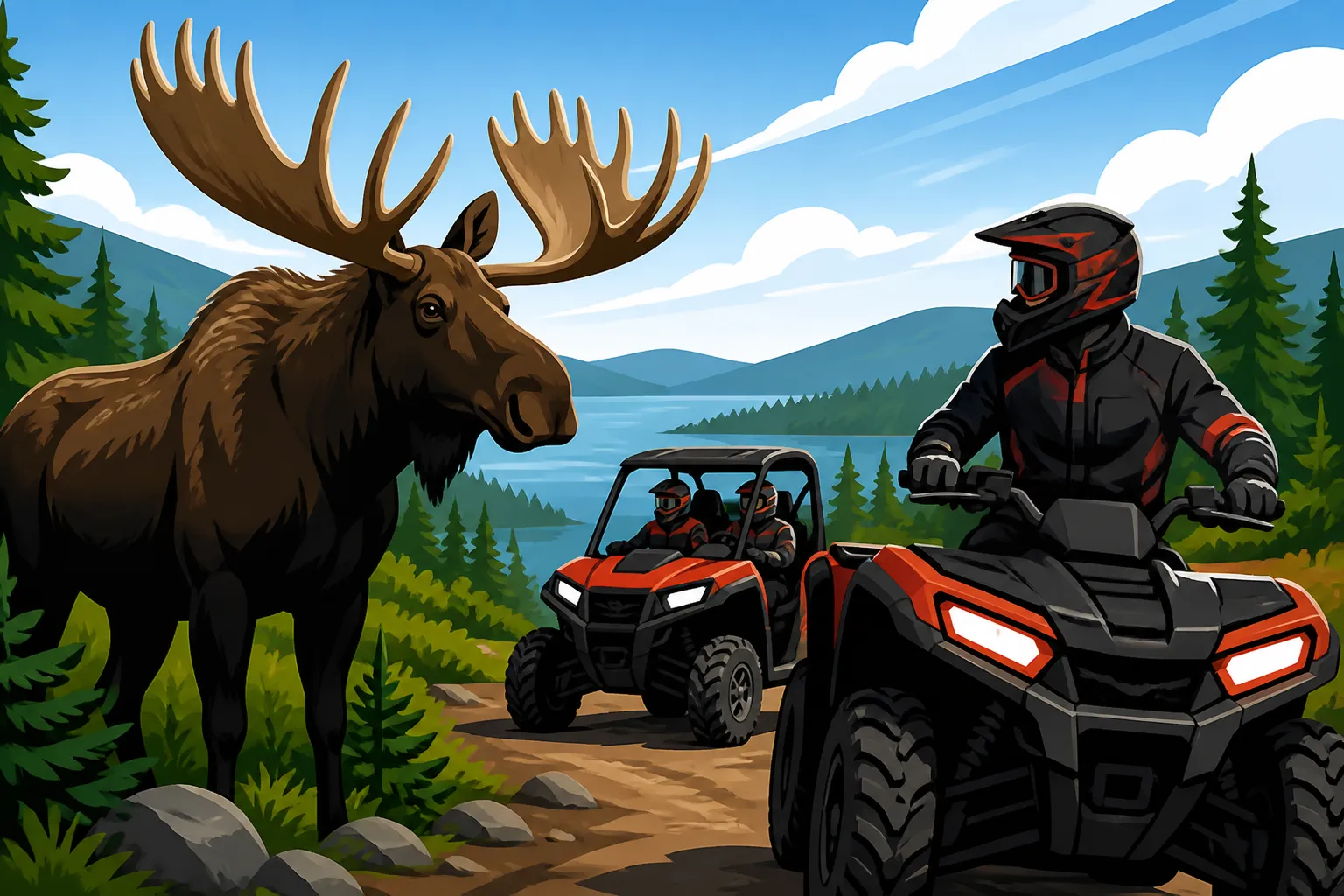
A moose can appear around a bend, step out of thick brush, or stand on a trail with little warning. On a Newfoundland ATV or UTV ride, the machine’s noise and size do not make you safe from a startled animal. This guide explains how to spot risk early, respond calmly to an encounter, and plan a ride that gives wildlife room to move.
Why moose encounters need extra care in Newfoundland
Where and when a moose may appear
Moose use a wide range of Newfoundland landscapes, including wooded trails, barrens, bog edges, and roadsides. You might see one crossing an open stretch of the T’Railway, browsing near a trail, or partly hidden among trees. A familiar route can still hold a surprise: vegetation, bends, dips, and changing light can limit how far ahead you can see.
Moose are often more active around dawn and dusk, when riders may also be travelling to or from a trailhead. They can be difficult to spot against brush or shadow, especially when the trail is narrow. Wet conditions and fog can make it harder to see movement ahead, while a noisy machine may mask other sounds. Slow down where sightlines are short rather than relying on the animal to hear you coming.
Season matters, too. During calving periods, a cow may be especially protective of a calf, and during the rut, a bull’s behaviour can be less predictable. That does not mean every moose you see will be aggressive. It does mean that an animal standing still, feeding, or appearing calm should still be given space. For broader wildlife awareness on a ride, see [Newfoundland Wildlife on the Trail].
What makes an ATV or UTV encounter risky
A moose may react to a machine as a threat, particularly if it feels cornered or has a calf nearby. The risk can increase if riders close the distance, surround the animal, block its route, or rev the engine to push it off the trail. A group can unintentionally make matters worse when several machines crowd together and leave the moose with no clear way out.
The size of a moose is another reason not to treat an encounter casually. It is a large, powerful animal, and an ATV or UTV is not a dependable shield. A collision can injure people and damage a machine, while an animal that charges can create danger even without direct contact. Riding faster does not guarantee you can get away safely, especially on uneven ground or a tight trail.
The safest approach is prevention: ride at a speed that lets you stop within the distance you can see, stay alert near brush and bends, and avoid startling wildlife. Trail knowledge helps, but it cannot eliminate the chance of an encounter. Before heading out, check [Newfoundland Trail Conditions Before You Ride] and keep local wildlife and access information in mind.
What to do when you see a moose
If the moose is ahead and has not noticed you
Ease off the throttle and stop at a distance that leaves the animal plenty of room. Do not ride closer to get a better look or a photo. Give the moose an open route away from you, and avoid positioning machines so it is boxed in between riders, trees, fences, or other obstacles.
Keep your movements quiet and predictable. Avoid sudden acceleration, repeated horn use, shouting, or revving. If the animal is calmly feeding or standing, wait rather than assuming it will move immediately. It may cross the trail, turn into the woods, or remain where it is for a while. Patience is safer than trying to hurry it along.
If you are with a group, let the lead rider communicate the stop clearly and ask everyone to stay back. Do not let one person pass the animal while others remain behind it; that can leave the moose surrounded. Once it has moved away and the route is clearly open, continue slowly and remain watchful in case it is nearby.
If the moose approaches, acts agitated, or blocks your way
Treat warning behaviour seriously. Signs such as raised hair, pinned-back ears, licking its nose, head tossing, or a direct approach can mean the animal is stressed or preparing to charge. These signs are not a guarantee of what it will do next, so do not wait for certainty before creating distance.
If you can safely move away without passing close to the animal or cutting off its escape route, do so slowly. Do not try to race past it, chase it, or use the machine to drive it away. If the moose comes toward you, put a substantial barrier between yourself and the animal if one is immediately available, such as a large tree or solid structure. An ATV or UTV should not be treated as a reliable protective barrier.
If a charge seems possible, prioritize getting yourself and other riders away from the animal’s path and behind cover. Do not stop to film. Once the immediate danger has passed, leave the area carefully and alert other riders if you can do so safely. If someone is injured or in immediate danger, contact emergency services.
| Situation | Safer response | Avoid |
|---|---|---|
| Moose is visible at a distance | Stop, give it room, and let it choose where to go | Riding closer for a photo |
| Moose is on the trail | Wait without surrounding it; leave an open escape route | Blocking both ends of the trail |
| Moose approaches or shows agitation | Move away if safe and seek substantial cover | Revving, chasing, or trying to pass close by |
| Calf is visible | Give the area extra space and do not approach the calf | Getting between the calf and an adult |
| You encounter a moose around a blind bend | Stop and assess before moving forward | Accelerating through the bend |
Plan your ride to reduce the chance of a close encounter
Adjust speed, spacing, and group habits
Choose a pace that matches the trail’s visibility. On a straight, open section, you may be able to see far ahead; in thick woods, near a bend, or on a narrow trail, your stopping distance should be much shorter. Slow down before a blind corner rather than braking hard after an animal appears. Keep enough space between machines for the rider behind you to respond if the lead rider stops suddenly.
Agree on a simple stop signal before the ride begins. Everyone should know that a wildlife stop means staying put, not riding forward to see what is happening. On a larger ride, have a designated lead and sweep rider so the group can stop in an orderly way without leaving someone around a bend or blocking the trail.
Good riding habits protect other trail users as well as wildlife. Stay on permitted routes, yield appropriately, and avoid making a stressful situation worse with crowding or noise. The guidance in [Newfoundland Trail Etiquette Locals Expect] and [Newfoundland Crown Land Access Rules] can help you prepare for the wider responsibilities of riding in shared outdoor areas.
Prepare for limited signal and changing conditions
A wildlife encounter can become more difficult if it happens in a remote place or in poor visibility. Before leaving, tell someone where you plan to ride and when you expect to return. Carry a charged phone, but do not assume you will have service along the whole route. A paper map can be useful when your phone has no signal, and a mapping tool such as onX Offroad may help you review your route before setting out. Check its current map and offline options before relying on it in a dead zone.
Build extra time into the ride so you are not tempted to hurry near dusk or in worsening weather. Pack basic first aid supplies and suitable layers, particularly for a longer trip across exposed terrain. [Cell Dead Zones Along the Railbed] and [What to Carry for First Aid on the Barrens] cover two practical planning concerns that can matter when help is not close by.
If the trail is muddy, rutted, or difficult to navigate, take that as another reason to slow down. Poor traction and restricted visibility leave less room to react to wildlife. Reviewing [Newfoundland Riding After Heavy Rain] can help you think through how trail conditions affect control and stopping distance. You can also use onX Offroad or another navigation option to plan the route in advance, while remembering that a map cannot tell you whether a moose is around the next bend.
After the encounter
Leave carefully and report a safety concern
Once the moose has moved off, do not assume it has gone far. It may be in nearby brush or travelling parallel to the trail. Continue slowly, keep a lookout, and avoid stopping close to the area where it disappeared. If you are unsure whether the animal has left a safe path, give it more time or choose another route.
If the moose appeared injured, behaved unusually, or created an immediate safety concern, report the situation to the appropriate local wildlife or emergency authority. Share a clear location and a factual description of what happened. Do not approach the animal to check for an injury, and do not return with other people to look for it.
If a machine was damaged or anyone was hurt, get to a safe place before dealing with equipment or making calls. Tell the rest of your group what happened and confirm that everyone is accounted for. A calm, organized response is especially important when the encounter occurs far from a road or trailhead.
Make the next ride safer
After the ride, think through what made the encounter difficult. Was speed too high for the sightline? Did the group have a clear stop signal? Were riders spaced far enough apart? These are useful questions, not reasons to blame yourself. Wildlife can appear suddenly, but small changes to riding habits can give everyone more time to react.
If you ride with family or less experienced operators, talk through the response before the next trip. Explain that nobody should approach a moose, separate a calf from an adult, or use a machine to push wildlife off a trail. Review the safety basics in [Newfoundland Safety Training Is Mandatory] and make sure riders understand how to stop and communicate as a group.
The best outcome is usually an encounter that ends with the animal moving away undisturbed and riders continuing only when it is safe. Keep your distance, leave the animal an escape route, and choose caution over a closer look. A map app such as onX Offroad can support route preparation, but attentive riding and respectful decisions are what matter most when wildlife is on the trail.
Disclaimer
This article is for general informational purposes only and does not constitute professional advice. Laws, prices and regulations vary by location and change over time. Consult a qualified professional for guidance on your specific situation.